

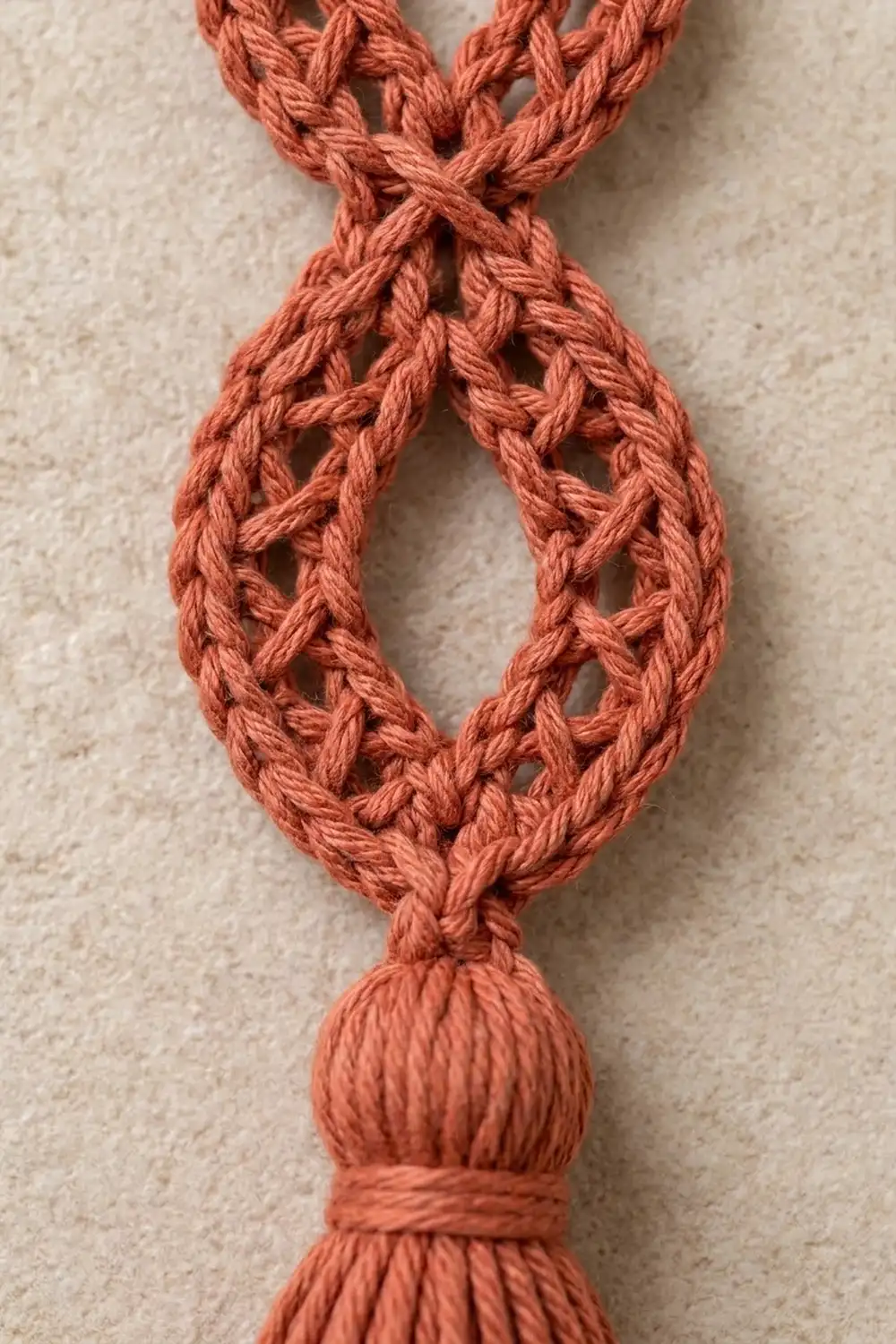
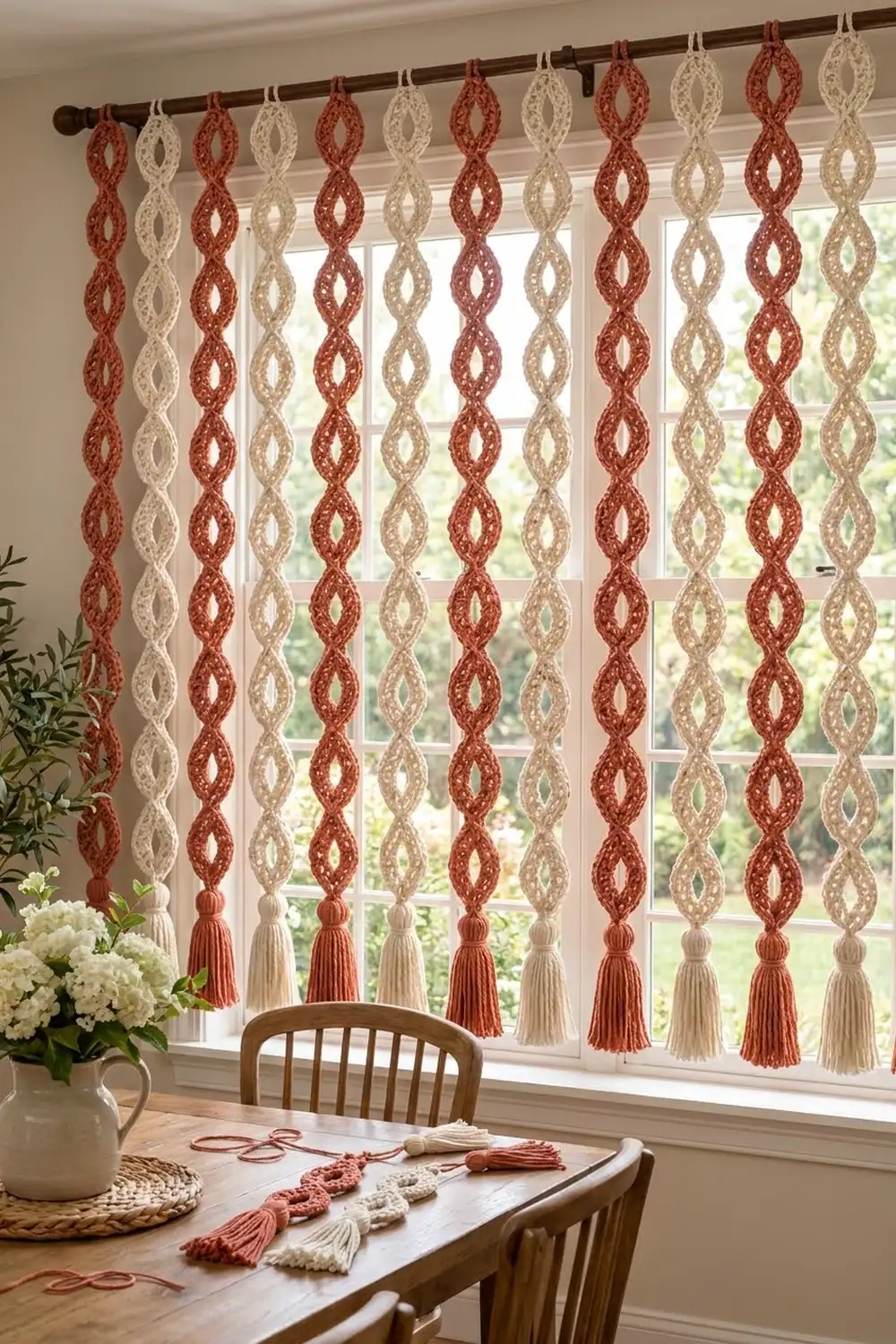
This strand curtain is made of long, airy columns of twisted links. On each strand, two narrow lattice bands cross over each other again and again. That leaves a stack of open almond-shaped eyes, and a full tassel finishes the bottom of every strand.
The palette alternates warm terracotta and soft cream, so it looks earthy and boho without feeling heavy. Light comes through every eye, so the panel softens a window or doorway but doesn’t block it. Each band has a small crossed-stitch lattice texture with a firm slip-stitch rim that looks like a braid.
This pattern uses US crochet terms. One finished panel has 10 strands. Each strand is 2.5 in (6.4 cm) wide at the widest eye and 60.5 in (153.7 cm) long from the top of the hanging loop to the tassel tips. With strands spaced 3 in (7.6 cm) apart, the panel covers 30 in (76.2 cm) of rod. Make two panels for a pair.
Construction is simple. You work each band lengthwise: a foundation row, a lattice row, a single crochet row, then a slip-stitch rim. Then you twist two bands together, tack each crossing, form a hanging loop at the top and tie a tassel to the bottom.
Finished Size and Construction
- Finished panel: 30 in (76.2 cm) wide on the rod × 60.5 in (153.7 cm) long
- Skill level: Intermediate
- Terminology: US
- Yarn weight: Worsted (#4) cotton or cotton blend
- Hook: US H-8 (5.0 mm)
- Number of pieces: 20 bands and 10 tassels, which make 10 strands
- Layout: 10 strands in one row, alternating terracotta and cream
- Piece size (one band): 64 in × 7/8 in (162.6 cm × 2.2 cm)
- Band size before border: 64 in × 3/4 in (162.6 cm × 1.9 cm)
- Border depth: 1/16 in (0.2 cm) on each long edge
Materials
Use a smooth worsted-weight cotton or cotton blend. Cotton keeps the lattice crisp, makes the strands hang heavy and straight, and gives full tassels. Avoid fuzzy or very stretchy acrylics, because the strands will lengthen over time.
- Terracotta: 300 g (570 m), for example 3 balls of 100 g / 190 m
- Cream: 300 g (570 m), for example 3 balls of 100 g / 190 m
Each color makes 10 bands and 5 tassels. These quantities include a margin of about 50 g per color for your gauge swatch and tension differences.
Tools:
– US H-8 (5.0 mm) crochet hook
– Tapestry needle
– 30 locking stitch markers
– Stiff cardboard, cut to 6.5 in × 4 in (16.5 cm × 10.2 cm), for tassels
– Sharp scissors
– Tape measure
– Rust-proof pins and a long blocking surface
Abbreviations (US Terms)
- ch – chain
- sl st – slip stitch
- sc – single crochet
- dc – double crochet
- fsc – foundation single crochet
- sk – skip
- st(s) – stitch(es)
- RS / WS – right side / wrong side
Special stitch – Crossed Stitch (Xst): Sk next st, dc in next st, then dc in the skipped st, working in front of the dc you just made. Each Xst uses 2 sts and makes 2 sts.
Gauge and Checkpoints
Gauge: 16 sts = 4 in (10.2 cm) in the Xst row. Three rows (fsc, Xst, sc) = 3/4 in (1.9 cm) in width.
Before you start the full panel, make one test piece: a short two-eye section like the sample shown laid flat.
- Make two test bands of 32 sts each, following the band rows below. Row 2 is: ch 3, 15 Xst, dc in last st, which gives 32 sts.
- Work the border on each test band: 32 + 32 + 4 + 4 = 72 sl st, plus 4 corner chains.
- Lay the bands side by side, tack the ends together at st 1 and st 32, and cross them at st 16.
Checkpoints:
– After Row 1, 32 fsc measure 8 in (20.3 cm).
– After Row 3, the band is 8 in × 3/4 in (20.3 cm × 1.9 cm).
– After the border, the band is 8 in × 7/8 in (20.3 cm × 2.2 cm).
– When the test piece hangs, each eye is about 3.5 in (8.9 cm) long and 3/4 in (1.9 cm) wide.
If your band is too long, go down half a hook size. If it’s too short, go up half a size. If the band is wider than 3/4 in (1.9 cm) before the border, your dc are too tall. Pull up less on the dc loops before you change hooks. Each 1/4 in (0.6 cm) of error per 8 in becomes 2 in (5.1 cm) across a full band, so fix gauge now.
Band Pattern (Make 20)
Work each band lengthwise. Leave an 18 in (45.7 cm) tail at the start for tacking.
Row 1 (RS): Fsc 256. (256 sts) The band should measure 64 in (162.6 cm). Place a locking marker in every 16th st (sts 16, 32, 48 and so on up to 240), for 15 markers. Turn.
Row 2: Ch 3 (counts as dc), Xst over next 2 sts; rep from * 126 more times, dc in last st. Turn. (1 + 254 + 1 = 256 sts: 127 Xst)*
This row makes the lattice. Each Xst leaves a small open diamond between pairs. Move the markers up into this row’s matching sts.
Row 3: Ch 1, sc in each st across. (256 sts) Turn. Don’t fasten off. Go straight into the border round (see Border section).
Band checkpoint: 64 in × 3/4 in (162.6 cm × 1.9 cm), with markers every 4 in (10.2 cm).
Stitch map for each band:
– Sts 1–16: hanging loop section, 4 in (10.2 cm)
– Sts 17–256: 15 eye segments of 16 sts, 4 in (10.2 cm) each
– Marker at st 16: base of the loop, where the strand starts
– Markers at sts 32–240: 14 crossing points
– St 256: tassel point
Make All Pieces
Bands:
– Terracotta: 10 bands (5 strands)
– Cream: 10 bands (5 strands)
Tassels:
– Terracotta: 5
– Cream: 5
Tassel: Wrap yarn 30 times around the 6.5 in (16.5 cm) side of the card. Slide a 12 in (30.5 cm) strand under the wraps at the top edge and tie it tight. Leave both tie ends long. Cut the wraps along the bottom edge. Cut a 24 in (61.0 cm) strand for the neck wrap and set it aside. You’ll wrap the neck after you attach the tassel. Trim the ends to 6 in (15.2 cm) after blocking.
Layout grid (strands left to right on the rod, 3 in / 7.6 cm center to center):
| T | C | T | C | T | C | T | C | T | C |
  1   2   3   4   5   6   7   8   9   10
T = terracotta strand   C = cream strand
Each strand uses two bands of the same color.
Joining
The joining here is the twisting and tacking that turns two bands into one strand. The strands are never joined to each other. Each band must have its border (next section) before you tack it.
Step 1 – Hanging loop. Fold sts 1–16 of each band to the WS so that st 1 meets st 16. Whipstitch the band end to the back of the band at the st-16 marker. That makes a 2 in (5.1 cm) loop. Lay the two looped bands side by side, RS up. Call the left band A and the right band B. Whipstitch their inner edges together along the full 2 in (5.1 cm), so the tab is one double-width loop. It fits a rod up to 1 in (2.5 cm) in diameter.
Step 2 – Crossings. At the st-32 markers, cross the left band over the right band so the two marked sts sit exactly on top of each other. Tack through both layers with 4–5 small stitches in a 1/2 in (1.3 cm) square, using the starting tail or a new length of yarn.
Repeat at sts 48, 64 and so on to 240. Always cross the left band over the right band. Because the bands swap sides at every crossing, A and B take turns being on top, which makes the twist. That gives 14 crossings and 15 eyes, and each eye uses 16 sts of each band.
Stitch-to-stitch logic: Always match marker to marker. Both bands have identical counts, so the same st number meets at every crossing and neither band pulls ahead.
Tension: Tack firmly enough to hold the crossing flat, but don’t cinch it. Puckered crossings make the eyes shorter and the strand gets shorter too.
Step 3 – Tassel. Overlap the two st-256 ends and whipstitch them together. Tie the tassel’s top strands tightly around this joined end. Then wrap the 24 in (61.0 cm) neck strand 8 times around the tassel 3/4 in (1.9 cm) below the top and bury the ends inside the tassel.
Size checkpoint: When it hangs, the strand measures 2 in (5.1 cm) for the loop plus 15 × 3.5 in (8.9 cm) for the eyes, which is 54.5 in (138.4 cm) to the tassel. Add the 6 in (15.2 cm) tassel and the total is 60.5 in (153.7 cm).
Border
The border is a slip-stitch rim worked on each band right after Row 3. It firms up the edges and gives the braided outline you can see on the strands.
Border gauge: 1 sl st per st, which matches the band’s 16 sts = 4 in (10.2 cm). Work loosely. If the rim gathers, go up one hook size for this round only.
Border round (RS): Working along the Row 3 edge, sl st in each st across. (256 sl st)
- Ch 1 at the corner.
- Work down the short end: 1 sl st in the sc row-end, 2 sl st around the dc row-end and 1 sl st in the fsc row-end. (4 sl st)
- Ch 1 at the corner.
- Sl st in the base of each fsc along the foundation edge. (256 sl st)
- Ch 1 at the corner.
- Work along the second short end. (4 sl st)
- Ch 1, then join with a sl st to the first sl st.
Fasten off, leaving an 18 in (45.7 cm) tail.
Round total: 256 + 4 + 256 + 4 = 520 sl st, plus 4 corner ch.
Why the math works: Each long side gets exactly one sl st per existing st, so the band stays at 256 sts and 64 in (162.6 cm). The 15 markers stay 16 sts apart. The 4-st short ends match the row heights (1 + 2 + 1), and the ch-1 corners stop the ends from cupping. The rim adds 1/16 in (0.2 cm) per long edge: 3/4 in + 1/8 in = 7/8 in (2.2 cm).
Final Blocking
- Lightly mist or soak each finished strand and roll it in a towel to remove excess water.
- Lay the strand flat at full length, loop at the top.
- Pin each crossing on a straight center line, 3.5 in (8.9 cm) apart.
- Ease each eye open to 3/4 in (1.9 cm) wide and pin the widest point of each band.
- Comb the tassel straight and let everything dry completely.
- Unpin, then trim the tassel evenly to 6 in (15.2 cm).
- Hang the strand for 24 hours before you make any final length adjustments.
Final Quality-Control Checklist
- Every band has 256 sts and measures 64 in (162.6 cm).
- Every band has a full 520-sl-st rim with 4 corner chains.
- Each strand has 14 crossings, all made with the left band over the right band.
- Each strand has 15 eyes, about 3.5 in (8.9 cm) long when hanging.
- The hanging loops are 2 in (5.1 cm) deep and stitched securely.
- Tassels are 6 in (15.2 cm), with neck wraps 3/4 in (1.9 cm) below the top.
- All 10 strands are 60.5 in (153.7 cm) long, within 1/2 in (1.3 cm) of each other.
- All ends are woven in and invisible from the RS.
Troubleshooting
- The band twists like a corkscrew. Your fsc tension is uneven. Block it flat. If it’s severe, rework Row 1 more loosely.
- The eyes collapse shut. The crossings are too tight, or they’re off the markers. Retack them flat, exactly marker to marker.
- One strand is shorter than the others. Check your crossings. A skipped or doubled segment changes the length by about 3.5 in (8.9 cm).
- The rim waves. Your sl sts are too tight or too loose. Rework the border with the hook size adjusted.
- The tassel looks thin. Add 5–10 wraps. Thirty wraps is the minimum.
- The twist reverses partway down. You crossed right over left at some point. Untack it and redo that crossing.
Care
Hand wash in cool water, then lay flat to dry and reshape the eyes while the strands are damp. Comb the tassels gently once they’re dry, and rehang right away so the strands stay straight.
Final Notes
The measurements chain together like this:
- 16 sts = 4 in (10.2 cm), so 256 sts = 64 in (162.6 cm).
- Each band is 3/4 in (1.9 cm) wide, or 7/8 in (2.2 cm) after the border.
- A 2 in (5.1 cm) loop plus 15 eyes of 3.5 in (8.9 cm) is 54.5 in (138.4 cm).
- Adding the 6 in (15.2 cm) tassel gives a 60.5 in (153.7 cm) strand.
- Ten strands spaced 3 in (7.6 cm) apart fill 30 in (76.2 cm) of rod.
Check your gauge with the test piece first and match every crossing marker to marker. The finished curtain will hang evenly.
Happy crocheting!