

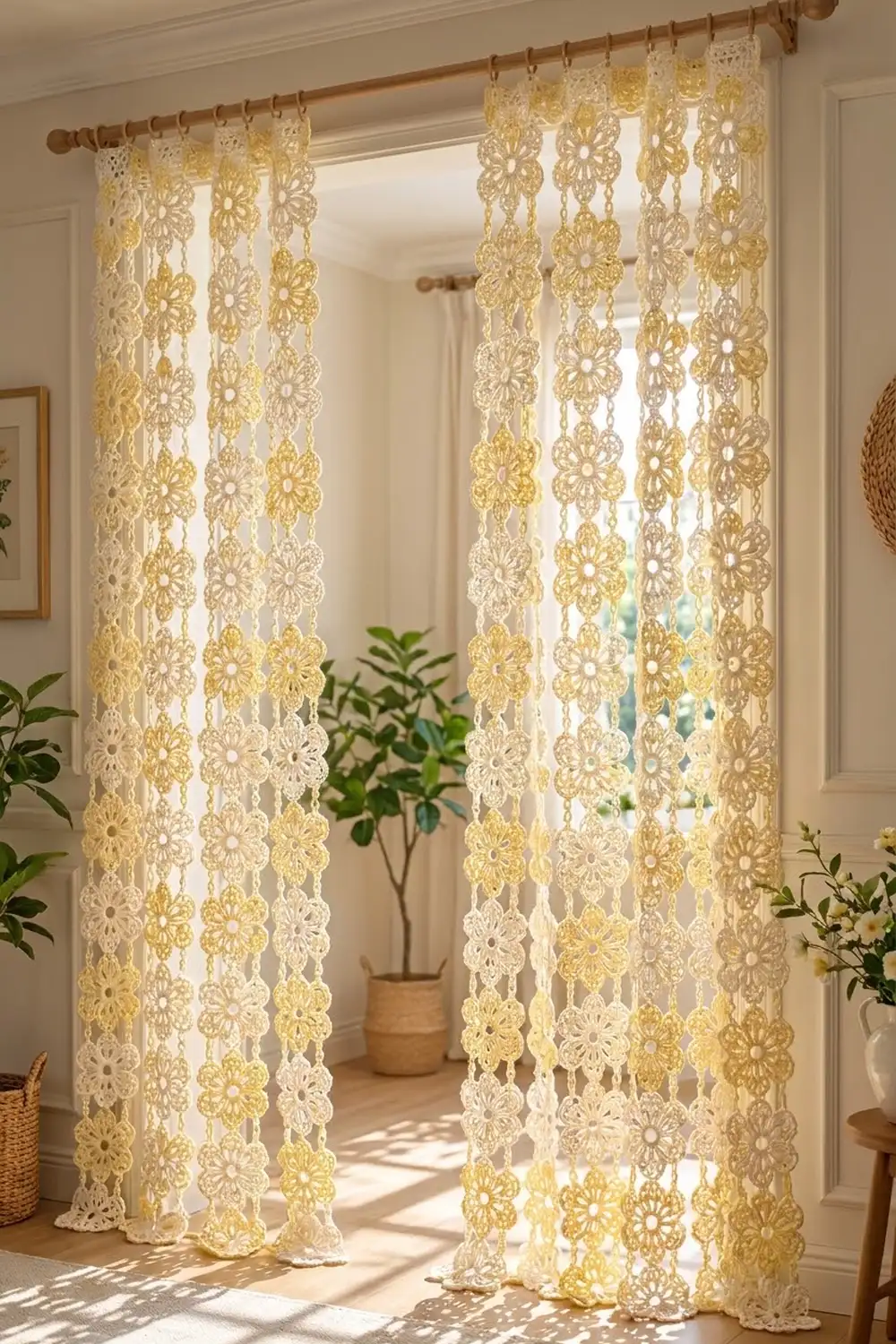
The Lemon Daisy Chain Curtain is a light, airy hanging panel made from six-petal lace flowers linked into long vertical strands. Each flower has a small open center ring, fan-shaped spokes inside every petal, and a smooth rounded petal edge. Sunlight passes straight through the open spaces, so the panel filters light without blocking the view.
The palette is soft and summery: cream and pale buttercup yellow. Two colorways alternate down every strand, one with yellow fans and a cream edge, the other with cream fans and a yellow edge. Neighboring strands start on opposite colorways, so the finished panel reads as a gentle checkerboard. The pattern uses US crochet terms throughout.
One finished panel measures about 29.3 in (74.4 cm) wide and 85.5 in (217.2 cm) long, including the rod-pocket header. The photo shows a pair of panels hanging at a window; make the panel twice for the same look.
Construction is simple and repetitive. You crochet 4-round flower motifs, linking each new motif to the one below with a doubled chain as you work its last round. Six strands of 14 motifs are then attached to a folded single-crochet header that forms the rod pocket.
Finished Size and Construction
- Finished size (one panel): 29.3 in (74.4 cm) wide x 85.5 in (217.2 cm) long
- Skill level: Intermediate
- Terminology: US crochet terms
- Yarn weight: Worsted (#4) cotton
- Hook: 4.0 mm (G-6)
- Number of pieces: 84 flower motifs plus 1 header per panel (168 motifs and 2 headers for the pair)
- Layout: 6 strands across x 14 motifs down
- Motif size: 4.5 in (11.4 cm) from petal tip to opposite petal tip
- Size before border (strands only): 84 in (213.4 cm) long
- Border (header) depth: 1.5 in (3.8 cm), folded
Materials
Choose a smooth mercerized or combed worsted-weight cotton of about 170 m per 100 g. Cotton holds the open petal shapes, hangs straight, and does not stretch much under its own weight. Avoid acrylic for this project; long strands of acrylic tend to grow.
Per panel:
- Color A (cream): 540 g / 918 m
- Color B (pale yellow): 400 g / 680 m
For the pair shown: Color A 1,080 g / 1,836 m; Color B 800 g / 1,360 m.
Quantities include a margin of roughly 13-18% for gauge differences, swatching, and weaving in ends.
Tools:
- 4.0 mm (G-6) crochet hook
- Tapestry needle
- Stitch markers
- Scissors
- Measuring tape
- Blocking mat and rust-proof pins
- Spray bottle with clean water
- Curtain rod up to 1 in (2.5 cm) in diameter
Abbreviations (US Terms)
- ch – chain
- sl st – slip stitch
- sc – single crochet
- dc – double crochet
- tr – treble crochet
- fsc – foundation single crochet
- sk – skip
- sp – space
- rep – repeat
- st(s) – stitch(es)
Tip sc: the single sc worked into the center (7th) dc of a petal in Round 4. It marks the point of the petal and is where links attach.
Doubled chain link: ch 8, sl st into the target st, then sl st back into each of the 8 ch. The link sts are never counted in the motif’s stitch total.
Gauge and Checkpoints
Motif gauge: one finished motif = 4.5 in (11.4 cm) tip to tip.
Header gauge: 18 sc and 20 rows = 4 in (10.2 cm) in sc rows.
Make one full motif before anything else and measure it flat, without stretching. Check each round as you go:
- After Round 1: 1.5 in (3.8 cm) across, with a 0.6 in (1.5 cm) open hole
- After Round 2: 3.25 in (8.3 cm) across the fan tips
- After Round 3: 4 in (10.2 cm) across the petals
- After Round 4: 4.5 in (11.4 cm) tip to tip
If your motif is too big, go down one hook size. If it is too small, go up one hook size. A difference of only 0.25 in (0.6 cm) per motif adds 3.5 in (8.9 cm) over a 14-motif strand, so match gauge closely. If the center ring cups, your Round 1 tension is too tight; relax it rather than adding stitches.
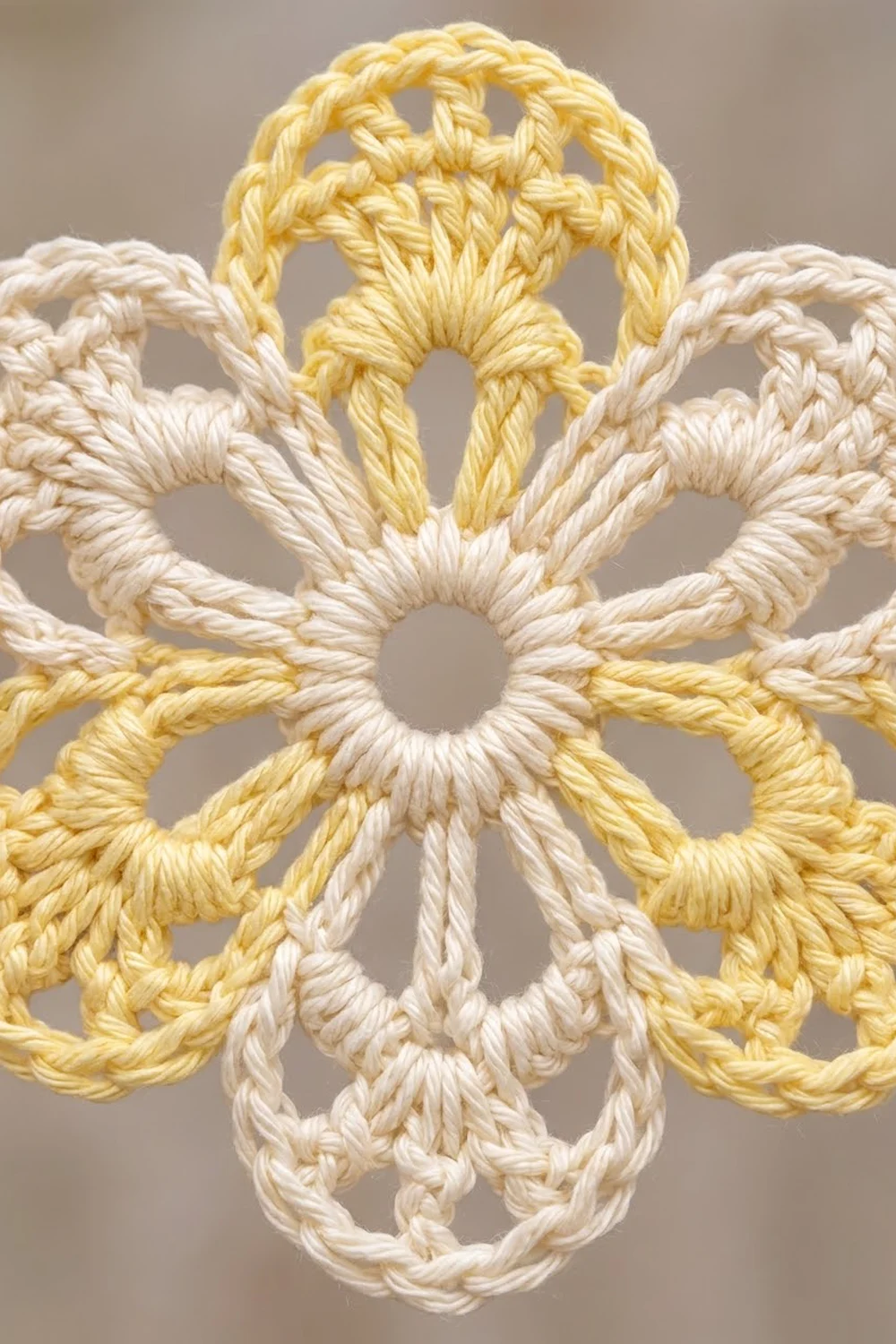
Flower Motif
Every motif uses Color A for Round 1. The colors of Rounds 2-4 depend on the colorway:
- Motif X (cream edge): Round 1 A, Rounds 2-3 B, Round 4 A
- Motif Y (yellow edge): Round 1 A, Rounds 2-3 A, Round 4 B
Round 1 (A): Ch 10, sl st in first ch to form a ring. Ch 1, work 24 sc into the ring, sl st to first sc. Fasten off. [24 sc]
Round 2 (fan color): Join with sl st in any sc. Ch 5 (counts as tr and ch-1 sp), (tr, ch 1) twice in same sc, tr in same sc; ch 2, sk 3 sc. (Tr, ch 1) 3 times in next sc, tr in same sc; ch 2, sk 3 sc. Rep from * 4 more times. Sl st to 4th ch of beginning ch-5. Fasten off. [6 fans: 24 tr, 18 ch-1 sps, 6 ch-2 sps]*
Each fan is worked into 1 sc and is followed by 3 skipped sc, so 6 fans x 4 sc = all 24 sc of Round 1. The four tr in each fan spread out from one point and form the spokes inside the petal.
Round 3 (fan color): Join with sl st in any ch-2 sp. Ch 1, sc in same sp. Ch 2, 4 dc in next ch-1 sp, 5 dc in next ch-1 sp, 4 dc in next ch-1 sp, ch 2, sc in next ch-2 sp. Rep from * around, omitting the final sc on the last rep. Sl st to first sc. Fasten off. [78 dc (13 per petal), 6 sc, 12 ch-2 sps]*
The ch-2 sps lift each dc arch away from its fan, which creates the open gap between spokes and petal edge.
Round 4 (edge color): Join with sl st in any sc between petals. Ch 1, sc in same sc. 2 sc in next ch-2 sp, sc in each of next 6 dc, tip sc in next dc, sc in each of next 6 dc, 2 sc in next ch-2 sp, sc in next sc. Rep from * around, omitting the final sc on the last rep. Sl st to first sc. [108 sc: 17 per petal + 6 between petals]*
The first petal you work in Round 4 is Petal 1. Petal 4 sits directly opposite it. On every motif, Petal 1 points down and Petal 4 points up.
Make All Pieces
Each strand holds 14 motifs alternating X and Y. Odd-numbered strands start with X at the bottom; even-numbered strands start with Y.
Per panel: 42 Motif X and 42 Motif Y (84 total).
For the pair: 84 Motif X and 84 Motif Y (168 total).
Make Rounds 1-3 of all motifs in batches. Work Round 4 only when you link the motif into its strand.
Layout grid (front view, top of panel at top):
Row 14:  Y  X  Y  X  Y  X
Row 13:  X  Y  X  Y  X  Y
Row 12:  Y  X  Y  X  Y  X
Row 11:  X  Y  X  Y  X  Y
Row 10:  Y  X  Y  X  Y  X
Row  9:  X  Y  X  Y  X  Y
Row  8:  Y  X  Y  X  Y  X
Row  7:  X  Y  X  Y  X  Y
Row  6:  Y  X  Y  X  Y  X
Row  5:  X  Y  X  Y  X  Y
Row  4:  Y  X  Y  X  Y  X
Row  3:  X  Y  X  Y  X  Y
Row  2:  Y  X  Y  X  Y  X
Row  1:  X  Y  X  Y  X  Y
        S1 S2 S3 S4 S5 S6
Joining
Method: join-as-you-go with a doubled chain link, worked during Round 4.
Motif 1: Work Round 4 as written. Fasten off and weave in ends.
Motifs 2-14: Work Round 4 until you reach the tip sc of Petal 1. Work the tip sc, then ch 8, sl st into the tip sc of Petal 4 on the motif below, and sl st in each of the 8 ch back toward your motif. Continue Round 4 with sc in the next dc. The link is in the edge color of the new motif, so links alternate cream and yellow.
Top tail: On Motif 14, at the tip sc of Petal 4, ch 9, sl st in 2nd ch from hook and in each of next 7 ch, then continue Round 4. This gives an 8-st doubled tail with a free top end.
Stitch logic: Each link goes from a single tip sc to a single tip sc. No motif stitches are skipped or added, so each Round 4 still has 108 sc.
Tension: Keep the 8 ch at the same tension as your sc. Tight links pull the petals into points; loose links let the strand twist.
Strand checkpoint: 14 motifs x 4.5 in (11.4 cm) = 63 in (160.0 cm), plus 13 links x 1.5 in (3.8 cm) = 19.5 in (49.5 cm), plus the 1.5 in (3.8 cm) tail = 84 in (213.4 cm). Measure each strand hanging, not lying on a table. All 6 strands should match within 0.5 in (1.3 cm).
Border: Header and Rod Pocket
The header is the only border on this panel. It runs along the top side only; the two long sides and the bottom are left as free-hanging strands.
Border gauge: 18 sc and 20 rows = 4 in (10.2 cm).
Starting count for the top side: each strand gets a 22-st block of the header, so 6 strands x 22 sts = 132 sts. No extra sts are added between strands.
Row 1 (A): Fsc 132. [132 sts]
Rows 2-14 (A): Ch 1, turn, sc in each st across. [132 sc per row] Piece measures 29.3 in (74.4 cm) wide x 2.8 in (7.1 cm) tall.
Row 15 (fold and attach row, A): Do not turn. Fold the header in half lengthwise, wrong sides together, so the Row 1 edge lies behind Row 14. Ch 1. Working through each Row 14 sc and the matching Row 1 fsc together, sl st in each of the first 10 sts. In the 11th st, insert the hook through both layers and through the top end of the Strand 1 tail, and sl st. Sl st in each of the next 11 sts to complete the block. Work each remaining 22-st block the same way: 10 sl st, attach the next strand in st 11, 11 sl st. Fasten off. [132 sl st, 6 strands attached]
Why the math works: 22 sc at 4.5 sc per in = 4.9 in (12.4 cm) per strand. A 4.5 in (11.4 cm) motif therefore leaves a 0.4 in (1.0 cm) gap between neighboring strands, enough room to hang freely without tangling. Each outer strand sits 11 sts in, so its petals stop about 0.2 in (0.5 cm) from the panel edge. The fold turns 2.8 in (7.1 cm) of fabric into a 1.4 in (3.6 cm) pocket; with the sl st row the header is 1.5 in (3.8 cm) deep.
Total length: 84 in (213.4 cm) strands + 1.5 in (3.8 cm) header = 85.5 in (217.2 cm).
Final Blocking
- Weave in every end along the back of the sc edge or inside a link before blocking.
- Lay each strand flat on a clean towel or mat and mist it until damp, not soaked.
- Pin each motif to 4.5 in (11.4 cm) tip to tip, placing one pin at the point of each petal.
- Gently open the fan spokes with your fingers so the gap below each arch is even.
- Straighten each link so it lies flat and untwisted.
- Pin the header flat at 29.3 in (74.4 cm) wide and mist it.
- Let everything dry completely, at least 24 hours.
- Hang the panel on the rod and let the strands settle for a day before judging the final length.
Final Quality-Control Checklist
- Every motif has 108 sc in Round 4 and 13 dc per petal in Round 3.
- Every center hole is open and round at about 0.6 in (1.5 cm).
- Colorways alternate X and Y in every strand, matching the layout grid.
- Each link joins Petal 1 of the upper motif to Petal 4 of the lower motif.
- All 6 strands measure 84 in (213.4 cm) hanging.
- The header has 132 sts and is 29.3 in (74.4 cm) wide.
- Strands are attached at st 11 of each 22-st block.
- All ends are woven in and invisible from the front.
Troubleshooting
Petals ruffle. Round 3 is too loose or your hook is too large; go down one size.
Petals cup forward. Round 4 is too tight; loosen your sc or go up one hook size for Round 4 only.
Fans lean to one side. Make sure all four tr of each fan go into the same sc.
Strand twists when hanging. Check that every link joins tip sc to tip sc, and that Petal 1 is always the bottom petal.
Strands differ in length. Check link tension; redo any link that is noticeably shorter or longer.
Header ripples. Your fsc row is looser than your sc rows. Redo Row 1 with a smaller hook.
Care
Hand wash in cool water with mild soap, press out water in a towel, and dry flat before rehanging. Do not tumble dry, which can stretch the long strands.
Final Notes
The whole curtain comes down to one measurement chain. Round 1 is 1.5 in (3.8 cm), Round 2 is 3.25 in (8.3 cm), Round 3 is 4 in (10.2 cm), and the finished motif is 4.5 in (11.4 cm). Fourteen motifs and thirteen 1.5 in (3.8 cm) links, plus the tail, give an 84 in (213.4 cm) strand. Six strands at 22 sts each give a 132-st header that is 29.3 in (74.4 cm) wide, and the 1.5 in (3.8 cm) header brings the panel to 85.5 in (217.2 cm). Check your first motif carefully, and the rest of the project follows.
Happy crocheting!