

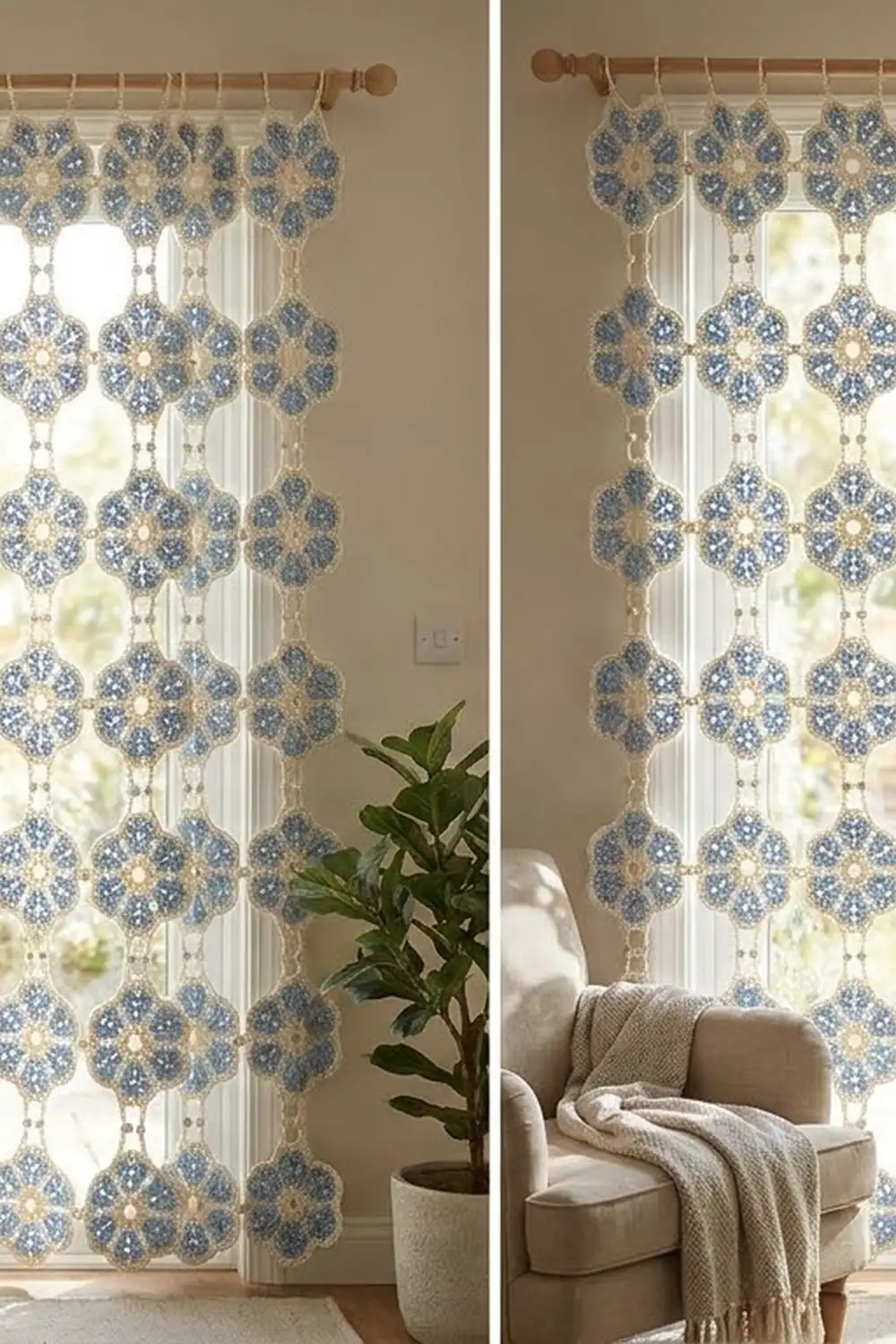
The Coastal Bloom curtain is a light, airy pair of panels made from six-petal flower motifs strung into long vertical strands. Each flower has a cream center ring, three powder-blue petals, and three cream petals, so the panels read as a soft seaside pattern when the light comes through.
The palette is just cream and powder blue. Every petal is a double-crochet fan outlined with a thick single-crochet edge, which gives each flower a raised, almost embroidered look. Short chain links with a small bead knot connect the flowers tip to tip, and that is what gives the strands their delicate beaded look.
This pattern uses US crochet terms. Each panel measures 18 in (45.7 cm) wide and 78.5 in (199.4 cm) long, including the rod-pocket header. You’ll make two panels, as shown.
Construction is simple. You make all the motifs first, then join them into strands of 14 with chain links. Next you crochet a solid header band with a rod pocket and hang four strands from each header.
Finished Size and Construction
- Finished panel size: 18 in (45.7 cm) wide x 78.5 in (199.4 cm) long
- Skill level: Intermediate
- Terminology: US crochet terms
- Yarn weight: DK / light (#3) cotton
- Hook: 3.5 mm (E-4)
- Number of pieces: 112 flower motifs (56 per panel) plus 2 header bands
- Layout per panel: 4 strands x 14 motifs
- Motif size: 4.5 in (11.4 cm) tip to tip
- Size before border (strands only): 76 in (193.0 cm) long; 4 strands spread across 18 in (45.7 cm)
- Border depth: 1.5 in (3.8 cm) folded header plus a 1 in (2.5 cm) top link
Materials
Choose a smooth mercerized cotton or a cotton blend in DK weight. Cotton holds the petal shape, keeps the stitches crisp, and doesn’t stretch much while hanging.
- Cream: 550 g / 1155 m (eleven 50 g / 105 m balls)
- Powder blue: 300 g / 630 m (six 50 g / 105 m balls)
Quantities are for two panels and include a margin of about 10%.
Tools:
– 3.5 mm (E-4) crochet hook
– Tapestry needle
– Stitch markers (at least 4)
– Scissors
– Blocking mats, rustproof pins, and a spray bottle
– Curtain rod up to 3/4 in (1.9 cm) in diameter
Abbreviations (US Terms)
- ch – chain
- sl st – slip stitch
- sc – single crochet
- dc – double crochet
- st(s) – stitch(es)
- sp – space
- RS / WS – right side / wrong side
- rep – repeat
Special stitches:
- 3-dc cluster (cl): [Yarn over, insert hook in the indicated sp or st, pull up a loop, yarn over, pull through 2 loops] 3 times. Then yarn over and pull through all 4 loops on the hook.
- Bead knot (bk): Ch 3, then work a 3-dc cl into the 3rd ch from hook. This makes a small round knot.
Gauge and Checkpoints
Make one complete motif before anything else and block it. This motif is your gauge.
- After Rnd 1: the ring measures 1.25 in (3.2 cm) across the outside.
- After Rnd 2: 2.75 in (7.0 cm) across, from loop tip to loop tip.
- After Rnd 3: 4.5 in (11.4 cm) from petal tip to opposite petal tip.
Header gauge: 22 sc = 4.5 in (11.4 cm) and 6 rows = 1 in (2.5 cm).
If your motif is bigger than 4.5 in (11.4 cm), go down to a 3.25 mm hook. If it’s smaller, go up to a 3.75 mm hook. Every 0.25 in (0.6 cm) of difference per motif adds up to 3.5 in (8.9 cm) over a 14-motif strand. Don’t skip the gauge check.
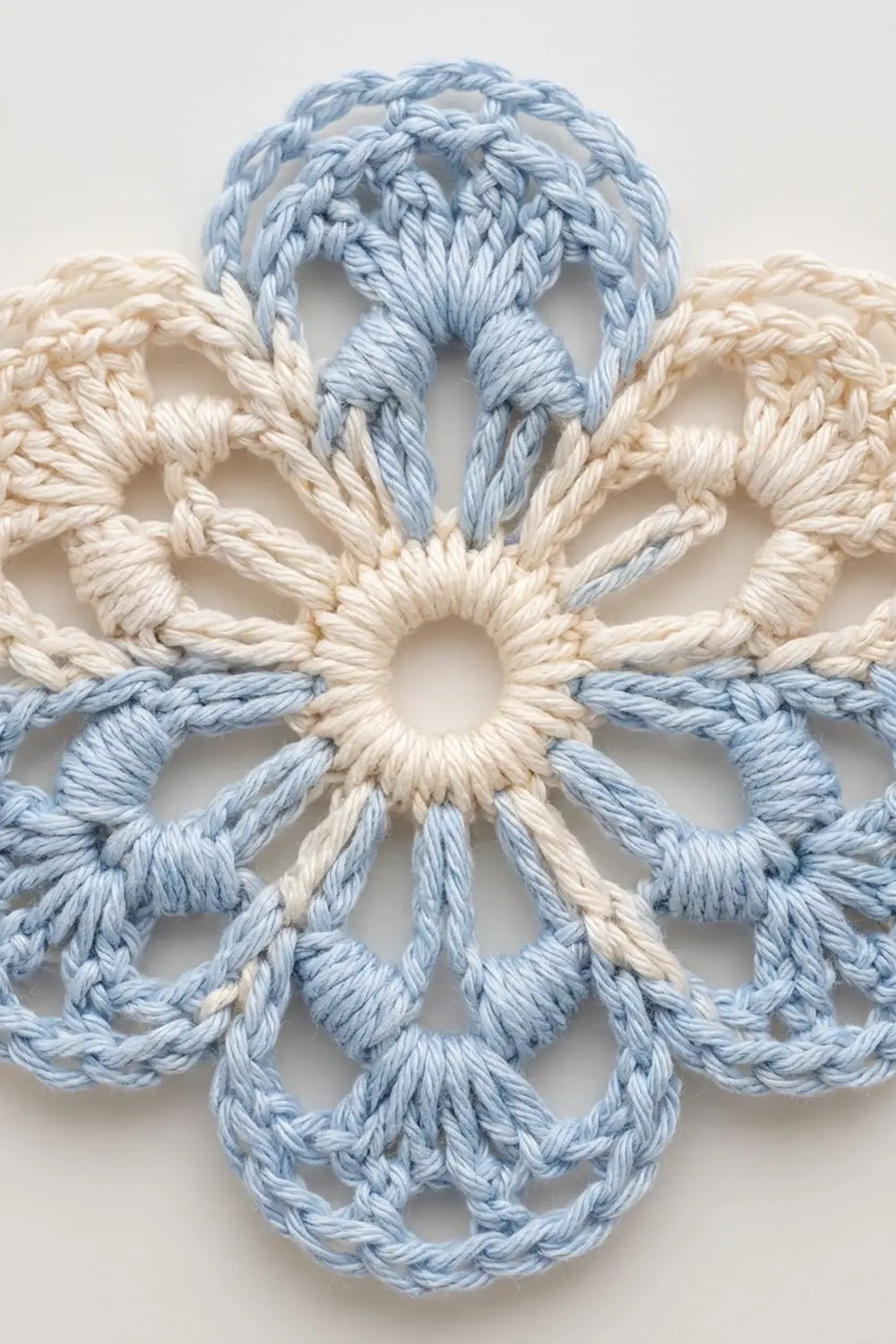
Flower Motif (make 112)
Use cream for Rnds 1–2. In Rnd 3 you switch between both colors and carry the unused yarn inside the petal bases, so there are only four ends per motif.
Rnd 1 (cream): Ch 10 and sl st to the first ch to form a ring. Ch 1, then work 24 sc into the ring. Sl st to the first sc. (24 sc)
Rnd 2 (cream): Ch 1, sc in the same st, ch 7, skip 3 sts. Sc in next st, ch 7, skip 3 sts. Rep from * 4 more times. Sl st to the first sc and change to blue on the final yarn over. (6 sc, 6 ch-7 loops)
Check: each repeat uses 4 sts (1 sc + 3 skipped), and 6 x 4 = 24.
Rnd 3 (petals): Keep the cream strand lying along the top of the loop you are working into, and crochet over it so it is hidden.
Petal 1 (blue):
- Row A (RS): Work into the next ch-7 loop: cl, 7 dc, cl. (9 sts) This makes the fan, with a cluster at each base corner.
- Row B (WS): Ch 1 and turn. Sc in the first st, [ch 3, skip next st, sc in next st] 4 times. (5 sc, 4 ch-3 sps)
- Row C (RS): Ch 1 and turn. Sc in the first sc, [4 sc in next ch-3 sp, sc in next sc] 4 times. (21 sc)
Row C ends at the left base of the petal, right next to the carried strand.
Next, sc in the next Rnd 2 sc and change to cream on the final yarn over. That makes Petal 2 cream.
Petals 2–6: Repeat Rows A–C in each of the remaining ch-7 loops, alternating cream, blue, cream, blue, cream. Carry the unused color inside each Row A. Work 1 sc in each Rnd 2 sc between petals, changing color on the last yarn over. After Petal 6, sl st into the first sc of Rnd 2 instead of working the sc.
Rnd 3 count: 6 petals of 21 sc each, which is 126 outline sc, plus 5 sc and 1 sl st between the petals.
Fasten off both colors and weave in the ends through the petal bases.
Mark the tips: Sc 11 of Row C is the center tip of each petal. Mark the tip of Petal 1 (blue) as the top and the tip of Petal 4 (cream, on the opposite side) as the bottom. Every motif hangs the same way, so the colors line up down each strand.
Make All Pieces
- Per panel: 56 motifs (4 strands x 14)
- Total for two panels: 112 motifs
- Per motif: about 7 m cream and 4.5 m blue
Layout for one panel (each M is one motif, and each | is a chain link):
HEADER  [22 sc][22 sc][22 sc][22 sc]
           |      |      |      |
Row 1      M      M      M      M
           |      |      |      |
Row 2      M      M      M      M
          ...    ...    ...    ...
Row 14     M      M      M      M
Columns are free-hanging strands, and the rows line up horizontally.
Joining
Method: Chain links with a bead knot, worked between finished motifs.
- Lay two blocked motifs one above the other with the RS facing up. Turn them so the bottom tip (Petal 4) of the upper motif points at the top tip (Petal 1) of the lower one.
- Join cream with a sl st in sc 11 of the upper motif’s Petal 4.
- Ch 3, bk, ch 3.
- Sl st into sc 11 of the lower motif’s Petal 1. Fasten off.
Stitch logic: Each link connects one center tip stitch to the next center tip stitch. Because the link never touches the side petals, the motifs hang straight and don’t tilt.
Tension: Work the chains at the same relaxed tension each time. Tight links shorten the strand, and uneven links make motifs in neighboring strands drift out of line. If you can, crochet all the links in one sitting.
Make 13 links per strand to join 14 motifs.
Size checkpoint: Two linked motifs should measure 10 in (25.4 cm), worked out as 4.5 + 1 + 4.5 in. A full strand is 14 x 4.5 in = 63 in (160.0 cm), plus 13 x 1 in = 13 in (33.0 cm), for 76 in (193.0 cm) in total.
Border: Rod-Pocket Header
Each panel’s header is a solid band. It is folded into a rod pocket, and the four strands hang from its lower edge.
Border gauge: 22 sc = 4.5 in (11.4 cm) and 6 rows = 1 in (2.5 cm).
Row 1: With cream, ch 89. Sc in the 2nd ch from hook and in each ch across. (88 sc)
Rows 2–18: Ch 1 and turn, then sc in each st across. (88 sc each row)
The piece now measures 18 in x 3 in (45.7 cm x 7.6 cm).
Rnd 19 (edging, conversion round): Ch 1 but don’t turn.
- Short side: 1 sc in each row end. (18 sc) Ch 1 at the corner.
- Bottom long side: Work into the free loops of the foundation chain, 1 sc in each. (88 sc) Ch 1 at the corner.
- Short side: 1 sc in each row end. (18 sc) Ch 1 at the corner.
- Top long side: 1 sc in each st. (88 sc) Ch 1 at the corner.
- Sl st to the first sc.
Rnd 19 count: 212 sc worked 1 per existing st or row end (88 + 18 + 88 + 18), plus 4 corner ch-1 sps added. The corner chains sit outside the side counts.
Why the math works: Each strand gets 22 sc of header. That is 4.5 in (11.4 cm), the same as one motif from tip to tip. So 4 strands x 22 sc = 88 sc = 18 in (45.7 cm), which is exactly the header width. The motifs measure about 3.9 in (9.9 cm) across the side petals, so neighboring strands keep a gap of about 0.6 in (1.5 cm), just like in the photo. At 6 rows per inch, 1 sc per row end lies flat, so the short sides don’t ruffle.
Attach the strands: On the bottom long side, place a marker in sts 11 and 12 of each 22-sc section (sts 11–12, 33–34, 55–56, and 77–78). For each strand, join cream in sc 11 of Petal 1 of the top motif. Ch 3, bk, ch 3, then sl st into the first marked st and sl st into the second. Fasten off. This top link adds 1 in (2.5 cm).
Fold: With the WS facing you, fold the top long edge down behind the band to meet the bottom long edge. Whipstitch through the back loops of both edges, matching all 88 sts. The finished rod pocket is 1.5 in (3.8 cm) deep.
Final Blocking
- Wet-block every motif before joining. Soak it in cool water, press out the water in a towel, and pin it to 4.5 in (11.4 cm), with a pin at each petal tip.
- Shape each petal’s Row C outline into a smooth arch. Let the motifs dry completely.
- After joining, lay the header flat and pin it to 18 in x 1.5 in (45.7 cm x 3.8 cm). Mist it and let it dry.
- Hang the panel on its rod and mist the strands lightly. Gravity straightens the links as they dry.
- Hand-straighten any twisted links while they are still damp.
Final Quality-Control Checklist
- [ ] Every motif measures 4.5 in (11.4 cm) from tip to tip.
- [ ] Each motif has 3 blue petals and 3 cream petals, alternating, with 21 outline sc per petal.
- [ ] No carried yarn shows through the petal bases.
- [ ] Blue Petal 1 points up on every motif.
- [ ] Each strand has 14 motifs and 13 links and measures 76 in (193.0 cm).
- [ ] The header has 88 sc per long side and measures 18 in (45.7 cm).
- [ ] The strands hang from sts 11–12 of each 22-st section.
- [ ] The panel measures 78.5 in (199.4 cm) from the top fold to the bottom tip.
- [ ] All ends are woven in securely.
Troubleshooting
Petals cup forward: Your Row A dc are too tight. Loosen your tension or go up a hook size for Rnd 3 only.
Petal outline ruffles: Work 3 sc in each ch-3 sp instead of 4, and note the new count (16 sc per petal). Or tighten the ch-3 sps.
Carried yarn peeks through: Keep it snug along the top of the loop, and don’t let it sag between the Row A stitches.
Motifs hang tilted: The link isn’t on sc 11. Count the stitches again from the petal’s base.
Strands are different lengths: Your link tension varies. Measure each link against a 1 in (2.5 cm) mark and redo any that are off.
Header is wider than 18 in (45.7 cm): Work it again with a smaller hook. Don’t remove stitches, because the 88-st count keeps the strands centered.
Care
Hand wash in cool water with a mild detergent and press out the water gently. Lay the panel flat to dry, or re-hang it while damp so it straightens as it dries.
Final Notes
The whole curtain depends on one measurement chain. One motif is 4.5 in (11.4 cm). Fourteen motifs plus thirteen 1 in (2.5 cm) links make a 76 in (193.0 cm) strand. Four strands with 22 sc each fill an 88-st header that is 18 in (45.7 cm) wide. The header, the top link, and the strand together make a 78.5 in (199.4 cm) panel. Check your first motif carefully and everything else follows from it.
Happy crocheting!