

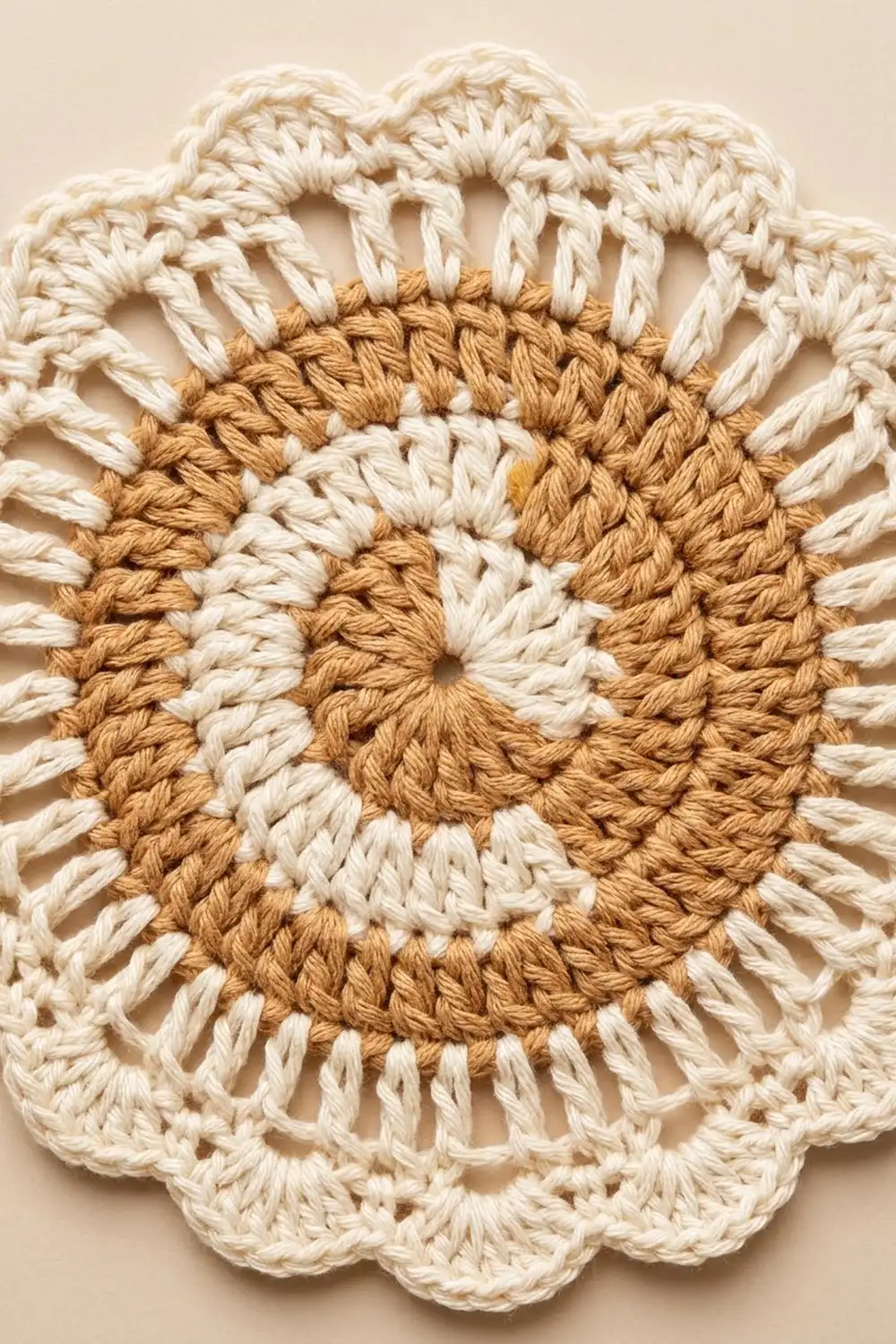
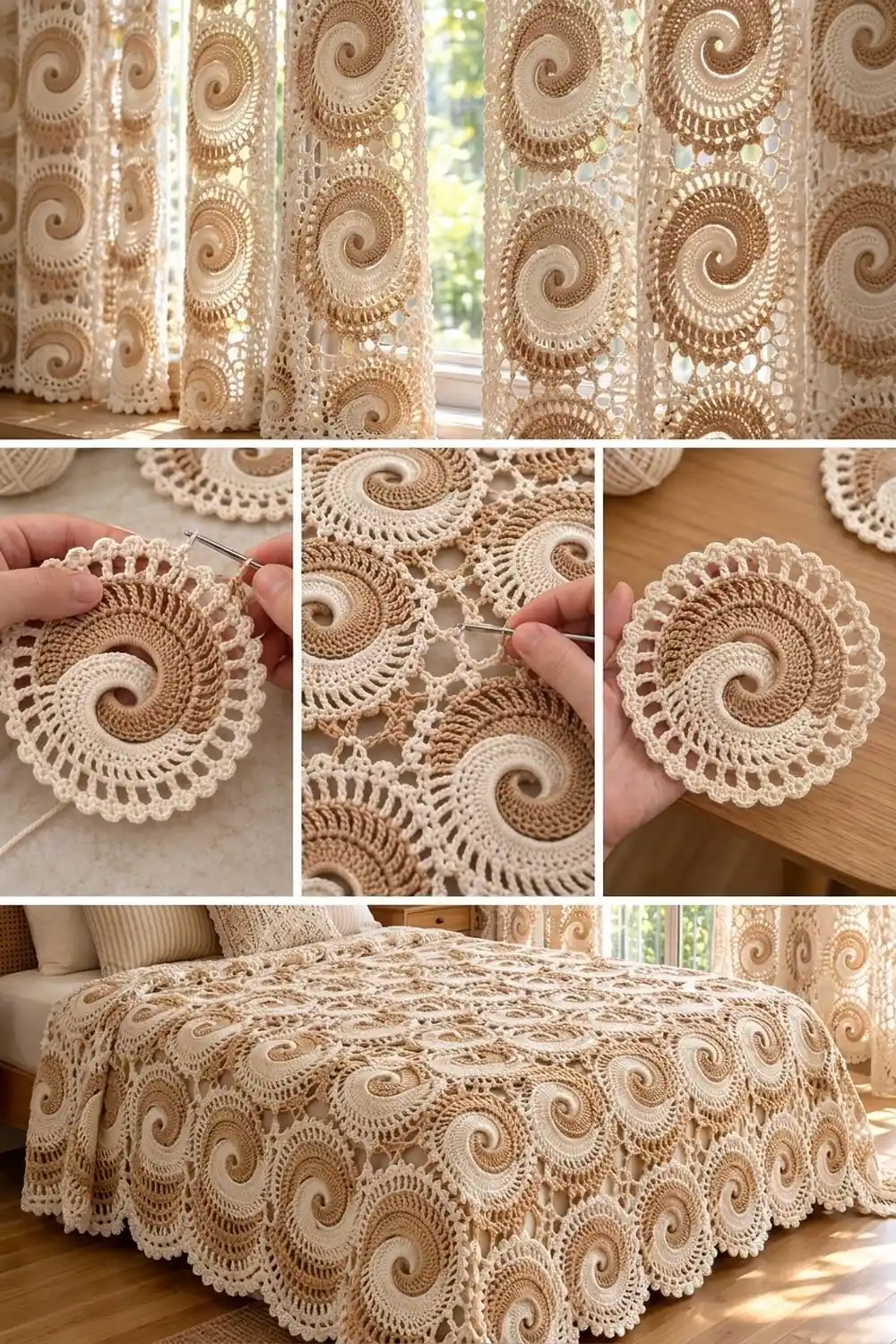
The Caramel Tide Spiral Motif is a round lace medallion with a lot of movement. Two arms, one cream and one caramel tan, wind out from a small open center like a seashell. A solid tan ring holds the spiral in place, and a cream openwork band with a scalloped edge frames it.
The palette is soft and neutral: ivory cream with a warm toffee tan. The style falls between vintage Irish-crochet lace and modern boho décor. One motif works as a doily, coaster or appliqué.
This pattern uses US crochet terms. The finished motif measures 7.5 in (19.1 cm) in diameter after blocking.
You work the motif in the round from the center out. To make the spiral, the two colors take turns: each color covers the other color’s arm, so you never carry a color. A leveling round evens out the spiral edge. Then you work two tan rounds and four cream border rounds.
Finished Size and Construction
- Finished size: 7.5 in (19.1 cm) diameter
- Skill level: Intermediate (two-color spiral technique)
- Terminology: US crochet terms
- Yarn weight: DK / light worsted (#3) cotton
- Hook: US G-6 (4.0 mm)
- Number of pieces: 1 motif
- Layout: single round motif, worked center-out
- Piece size: 7.5 in (19.1 cm) diameter
- Size before border (after Round 8): 4.75 in (12.1 cm) diameter
- Border depth: about 1.375 in (3.5 cm) all the way around
Materials
Yarn: Choose a smooth DK-weight cotton or cotton blend with about 136 yd (125 m) per 50 g. Mercerized cotton gives crisp stitch definition and a gentle sheen. Matte cotton gives a softer, more rustic look. Avoid fuzzy yarns, which blur the spiral lines.
- Color A – Cream / Ivory: 12 g, about 30 m (33 yd)
- Color B – Caramel Tan: 9 g, about 23 m (25 yd)
These amounts include about 20% extra for a test motif and for weaving in ends.
Tools:
- US G-6 (4.0 mm) crochet hook
- 2 locking stitch markers (one per color)
- Tapestry needle
- Scissors
- Measuring tape or ruler
- Blocking mat, rustproof pins and a spray bottle
Abbreviations (US Terms)
- ch – chain
- sl st – slip stitch
- sc – single crochet
- hdc – half double crochet
- dc – double crochet
- tr – treble crochet
- BLO – back loop only
- sk – skip
- sp(s) – space(s)
- st(s) – stitch(es)
- ( ) ×N – repeat the steps in brackets N times
Special technique – Dropped loop: To pause a color, pull its working loop up a little longer and take the hook out. Put a locking marker through the loop so it can’t unravel. To pick the color up again, put the hook back into the loop, remove the marker and tighten the loop.
Scallop: (sc, hdc, 2 dc, hdc, sc) all worked in the same ch-5 loop, for 6 sts.
Gauge and Checkpoints
Gauge isn’t critical for a single motif, but it controls the finished diameter and how flat the motif lies. Make one test motif first. Lay it flat without stretching and measure it at each checkpoint:
- After Round 3: 2.25 in (5.7 cm)
- After Round 5: 3.25 in (8.3 cm)
- After Round 6 (spiral complete): 3.5 in (8.9 cm)
- After Round 8 (tan ring complete): 4.75 in (12.1 cm)
- After Round 9: 5.75 in (14.6 cm)
- After Round 10: 6.25 in (15.9 cm)
- After Round 11: 7 in (17.8 cm)
- After Round 12, blocked: 7.5 in (19.1 cm)
If your motif is too big (more than 0.25 in / 0.6 cm over at any checkpoint), go down to a 3.75 mm hook. If it’s too small, go up to a 4.5 mm hook. If the size is right but the spiral cups like a bowl, you’re working the increase stitches too tightly, so loosen your grip. If it ruffles, you’re working too loosely or have added stitches, so recount.
Pattern
Center Ring
With Color A, ch 6 and join with a sl st to the first ch to form a ring. Keep the ring loose. It forms the small open hole at the center, about 0.5 in (1.3 cm) across.
Round 1 (Starting the Two Arms)
Color A: Ch 1. Into the ring work sc, hdc, 4 dc. (6 sts) Drop the loop and secure it with a marker.
Color B: Join B with a sl st into the ring just after A’s last dc. Into the ring work sc, hdc, 4 dc. (6 sts) Drop the loop and secure it with a marker.
Round total: 12 sts (6 per arm). Each arm goes from short stitches to tall ones, and this change in height starts the spiral.
Round 2
Pick up A. Work 2 dc in each of B’s 6 sts from Round 1. (12 sts in A) Drop A.
Pick up B. Work 2 dc in each of A’s 6 sts from Round 1. (12 sts in B) Drop B.
Round total: 24 sts.
This rule applies to every spiral round: each color works across the other color’s arm and stops when it reaches its own stitches. When you reach a dropped loop, move its marker aside and work into that stitch as usual.
Round 3
A: Over B’s arm, (dc in next st, 2 dc in next st) ×6. (18 sts) Drop A.
B: Over A’s arm, (dc in next st, 2 dc in next st) ×6. (18 sts) Drop B.
Round total: 36 sts. Checkpoint: 2.25 in (5.7 cm).
Round 4
A: (dc in next 2 sts, 2 dc in next st) ×6. (24 sts) Drop A.
B: (dc in next 2 sts, 2 dc in next st) ×6. (24 sts) Drop B.
Round total: 48 sts.
Round 5
A: (dc in next 3 sts, 2 dc in next st) ×6. (30 sts) Drop A.
B: (dc in next 3 sts, 2 dc in next st) ×6. (30 sts) Drop B.
Round total: 60 sts. Checkpoint: 3.25 in (8.3 cm).
Round 6 (Leveling Round)
This round has no increases. The stitches get shorter along each arm, which turns the stepped spiral edge into an even circle.
A: Dc in next 12 sts, hdc in next 8 sts, sc in next 6 sts, sl st in next 4 sts. (30 sts) Fasten off A, leaving a 4 in (10.2 cm) tail.
B: Dc in next 12 sts, hdc in next 8 sts, sc in next 6 sts, sl st in next 4 sts. (30 sts) Don’t fasten off.
Round total: 60 sts. The spiral is now complete, with two full arms of equal length. Checkpoint: 3.5 in (8.9 cm).
Round 7 (Tan Ring, Ridged)
Continue with B. Sl st into the next st, which is the first st of A’s Round 6 section. Ch 3 (counts as dc). Working in BLO throughout, dc in next 3 sts, 2 dc in next st, then (dc in next 4 sts, 2 dc in next st) ×11. Join with a sl st to the top of the ch-3.
Round total: 72 dc (60 worked 1 per stitch + 12 increases).
Working in BLO leaves the unused front loops as a fine ridge around the spiral, which gives the tan ring its ribbed look.
Round 8
With B, ch 3 (counts as dc). Working through both loops, dc in next 4 sts, 2 dc in next st, then (dc in next 5 sts, 2 dc in next st) ×11. Join with a sl st to the top of the ch-3. Fasten off B.
Round total: 84 dc (72 worked 1 per stitch + 12 increases). Checkpoint: 4.75 in (12.1 cm). This is your size before the border.
Border
The border is the cream frame, made of spokes, a solid sc round, chain loops and scallops. A round motif has no straight sides, so counts are given per repeat and per round.
Border gauge: Rounds 9–12 together add about 1.375 in (3.5 cm) all the way around, or 2.75 in (7.0 cm) to the diameter. Round 9 alone should add about 1 in (2.5 cm) to the diameter.
Round 9 (Treble Spokes)
Join A with a sl st in any st of Round 8. Ch 6 (counts as tr + ch 2). Sk next st, then (tr in next st, ch 2, sk next st) ×41. Join with a sl st to the 4th ch of the starting ch-6.
Round total: 42 tr and 42 ch-2 sps. The math: 84 sts ÷ 2 sts per repeat (1 worked + 1 skipped) = 42 repeats. Checkpoint: 5.75 in (14.6 cm).
Round 10 (Solid Sc Round)
Ch 1. (Sc in tr, 2 sc in next ch-2 sp, sc in next tr, sc in next ch-2 sp) ×21. Join with a sl st to the first sc.
Round total: 105 sc, 5 sc per repeat. The math: each repeat covers 2 tr and 2 ch-2 sps, so 42 tr ÷ 2 = 21 repeats, and 21 × 5 = 105. This round is 84 sc worked 1 per stitch or space + 21 extra sc, one in every other space. That’s just enough to keep the wider round flat. Checkpoint: 6.25 in (15.9 cm).
Round 11 (Chain Loops)
Ch 1, sc in the same st. (Ch 5, sk next 2 sts, sc in next st) ×34. Ch 5, sk the last 2 sts and join with a sl st to the first sc.
Round total: 35 ch-5 loops. The math: 105 sts ÷ 3 sts per repeat (1 sc + 2 skipped) = 35 loops, with no stitches left over. Checkpoint: 7 in (17.8 cm).
Round 12 (Scallops)
Sl st into the first ch-5 loop. Work 1 scallop (sc, hdc, 2 dc, hdc, sc) in each of the 35 loops. Join with a sl st to the first sc. Fasten off.
Round total: 35 scallops, 210 sts (35 × 6). This forms the soft scalloped cream edge. Checkpoint after blocking: 7.5 in (19.1 cm).
Why the math works: The spiral adds 12 sts per round (6 per arm), which is the standard increase for a flat dc circle, and Rounds 7 and 8 keep that +12 rate. Each border round then divides exactly by its repeat (84 ÷ 2, 42 ÷ 2, 105 ÷ 3), so no repeat is ever short or crowded.
Final Blocking
- Weave in all ends on the wrong side, through stitches of the same color. Keep cream tails in cream areas and tan tails in tan areas so they don’t show.
- Soak the motif in cool water for 10 minutes. Gently press out the water in a towel, without wringing.
- Lay the motif face up on a blocking mat. Draw or mark a 7.5 in (19.1 cm) circle as a guide.
- Pin the center ring open so the hole stays round, about 0.5 in (1.3 cm) across.
- Pin the tops of the treble spokes at even intervals. Place 6 evenly spaced pins first, then fill in between.
- Pin the tip of every scallop to the guide circle. Ease the chain loops so all 35 are the same size.
- Mist lightly and let the motif dry completely, at least 12 hours, before you unpin it.
Final Quality-Control Checklist
- The center hole is open and round, about 0.5 in (1.3 cm) across.
- Both spiral arms are the same length and wind in the same direction.
- The spiral edge is level, with no step where each color ends.
- The tan ring shows a clean ridge line from the BLO round.
- There are 42 treble spokes, evenly spaced and upright.
- There are 35 scallops, all the same size.
- The motif lies flat, with no cupping or rippling.
- The diameter measures 7.5 in (19.1 cm).
- All ends are woven in invisibly.
Troubleshooting
The spiral looks like stripes instead of a swirl. One color probably worked into its own stitches. Each color should only cover the other color’s arm. Rip back to the last correct round.
A step is still visible after Round 6. Check that both colors used the full height change (12 dc, 8 hdc, 6 sc, 4 sl st). Work the sl sts snugly.
The motif cups after Round 8. Your dc rounds are too tight. Use a hook 0.5 mm larger for Rounds 7–8 only.
The border ruffles. Count Round 10, which should have exactly 105 sc and no more. Check that your chains in Round 11 aren’t loose.
The spokes lean sideways. Wrap the yarn over the same way every time and pull each tr fully upright. Blocking fixes slight leaning.
A dropped loop came undone. Put the loop back on the hook, remake any lost stitches, and make sure the marker is fully closed next time.
Care
Hand wash in cool water with a mild detergent, then reshape and dry flat. Don’t use a dryer, because heat can shrink cotton and distort the scallops.
Final Notes
The measurement chain is short and easy to check. The spiral reaches 3.5 in (8.9 cm) after Round 6. The ridged tan ring brings the motif to 4.75 in (12.1 cm) at 84 sts, and the treble spokes take it to 5.75 in (14.6 cm). The sc round reaches 6.25 in (15.9 cm) at 105 sts. The chain loops bring it to 7 in (17.8 cm), and the scallops finish at 7.5 in (19.1 cm) after blocking. If you check each stage against your test motif, every Caramel Tide motif will come out the same size and lie flat.
Happy crocheting!