

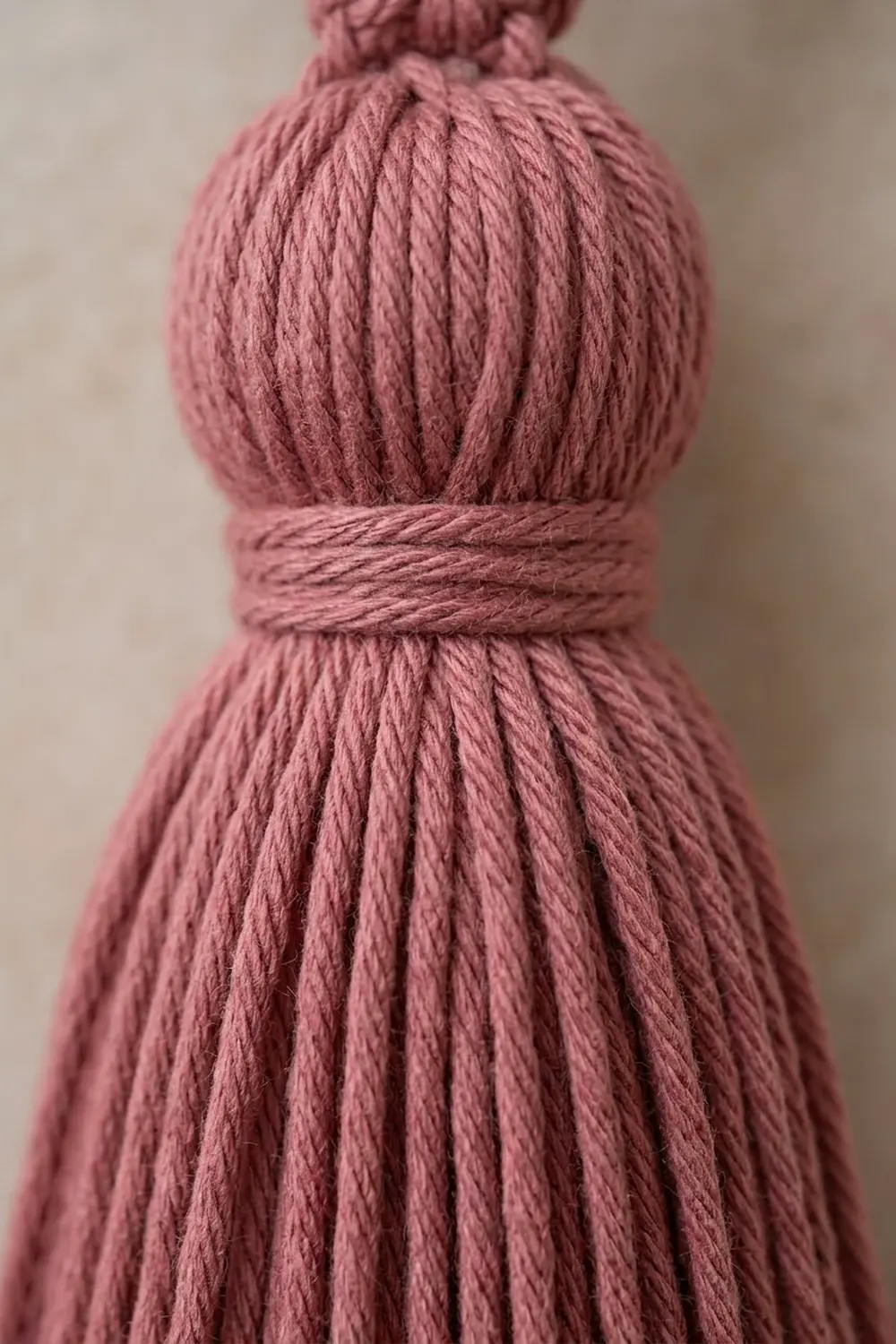
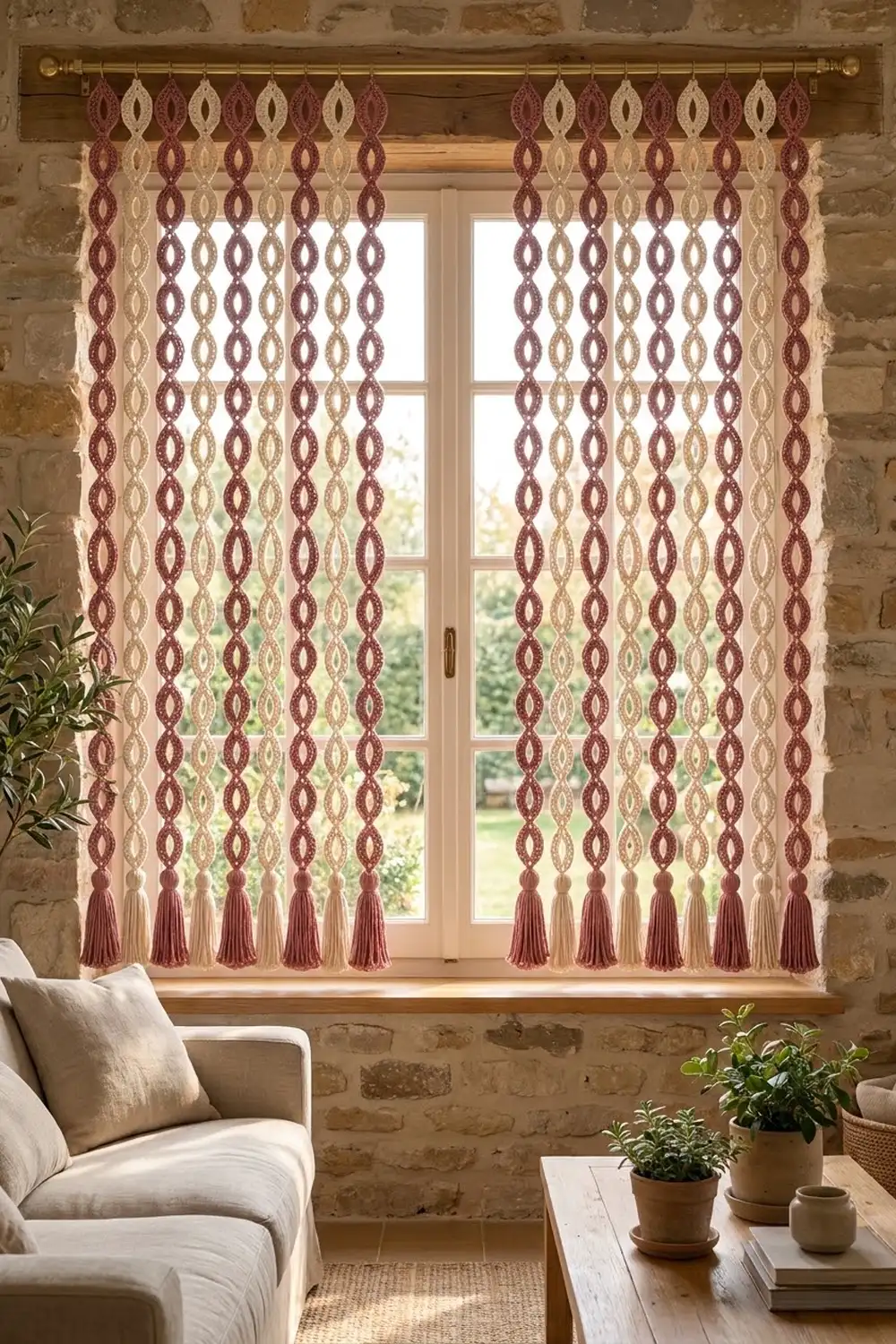
This strand curtain is made of long, airy columns of almond-shaped “eyes.” Each eye has a slim open center and a curved band of radiating stitches on both sides. A short neck pinches the strand between eyes, and every strand ends in a full tassel with a rounded head.
The palette is dusty rose and soft cream, alternating strand by strand. The look is boho but tidy, and it filters light without blocking it. The pattern uses US crochet terms throughout.
One panel is 8 strands. Hung on the rod, it measures 23 in (58.4 cm) wide and 82.25 in (208.9 cm) from the rod to the tassel tips. The photo shows two identical panels on one window, so make two panels for the matching pair.
Each strand is worked as one continuous piece in four passes: down, up, down, up. The first two passes build a chain “skeleton” with two chain arcs for each eye. The last two passes work shaped stitches into those arcs. You add the tassel last, then hang each strand on its own loop.
Finished Size and Construction
- Finished panel size: 23 in (58.4 cm) wide x 82.25 in (208.9 cm) long, hanging
- Skill level: Intermediate
- Terminology: US crochet terms
- Yarn weight: Worsted (#4) cotton or cotton blend
- Hook: 5.0 mm (H-8)
- Number of pieces per panel: 8 strands + 8 tassels
- Layout: One row of 8 strands, alternating rose and cream
- Piece size: 2 in (5.1 cm) wide x 74 in (188.0 cm) strand body, plus a 1.25 in (3.2 cm) hanging loop and a 7 in (17.8 cm) tassel
- Size before border: Same as the piece size. This design has no separate border; the outer stitch band of each eye is the finished edge.
- Border depth: 0 in (0 cm) added. The edge stitches are part of each eye.
Materials
Yarn: Use a smooth worsted-weight cotton or cotton blend. Cotton keeps its shape when hanging, shows stitch texture clearly and doesn’t fuzz in sunlight. Avoid very stretchy acrylics, because long strands can grow under their own weight.
- Dusty Rose: 150 g (about 255 m) per panel; 300 g (about 510 m) for a pair
- Cream: 150 g (about 255 m) per panel; 300 g (about 510 m) for a pair
These quantities include a margin of roughly 15% for gauge differences and tassel trimming. Each finished strand, including its tassel, uses about 52 m.
Tools:
– 5.0 mm (H-8) crochet hook
– Tapestry needle
– Sharp scissors
– Stiff card 8 in (20.3 cm) tall for the tassels
– Stitch markers
– Tape measure
– Curtain rod, up to 1 in (2.5 cm) in diameter
Abbreviations (US Terms)
- ch – chain
- sl st – slip stitch
- sc – single crochet
- hdc – half double crochet
- dc – double crochet
- st(s) – stitch(es)
- sk – skip
Special term – Eye Side (worked into 14 ch): Sc in first ch, hdc in next ch, dc in next 2 ch, 2 dc in next ch, dc in next ch, 2 dc in each of next 2 ch, dc in next ch, 2 dc in next ch, dc in next 2 ch, hdc in next ch, sc in last ch. (18 sts worked into 14 ch.)
Check: 1+1+2+1+1+2+1+1+2+1+1 = 14 ch used, and 1+1+2+2+1+4+1+2+2+1+1 = 18 sts made.
Gauge and Checkpoints
Gauge: 16 dc and 9 rows = 4 in (10.2 cm) square. At this gauge, 14 ch measure about 3.5 in (8.9 cm).
Test one strand first. Before starting a full panel, make a test strand with only 4 eyes and work all four passes.
Checkpoints on the test strand:
– One finished eye is 3 in (7.6 cm) from tip to tip and 2 in (5.1 cm) wide at its widest point.
– The open center is about 2.25 in (5.7 cm) long.
– One repeat (eye + 2-ch neck) measures 3.5 in (8.9 cm).
– 4 repeats measure 14 in (35.6 cm), not counting the top neck.
If your eyes are too big (a repeat is longer than 3.5 in / 8.9 cm), go down 0.5 mm in hook size. If they are too small, go up 0.5 mm. If the eyes come out round instead of pointed, your chain is looser than your stitches. Keep the hook size and tighten your chains slightly.
Every eye you add or remove changes the strand length by 3.5 in (8.9 cm). This makes it easy to adjust the curtain to your window.
Strand Pattern (Make 8 per Panel)
Each strand has 21 eyes. For each eye, the chain skeleton has a 14-ch arc on each side (arc A and arc B) and a 2-ch neck below it.
Hanging Loop
Ch 16, sl st in first ch to form a loop. (16 ch loop.)
The loop is about 4 in (10.2 cm) around. It slips over a rod up to 1 in (2.5 cm) thick and hangs about 1.25 in (3.2 cm) below the rod.
Pass 1 (Down): Chain Skeleton, Arc A
Ch 2 (top neck).
Ch 14 (arc A), ch 2 (neck); repeat from * 20 more times. (21 arcs and 21 necks.)*
Count: 2 + (21 x 16) = 338 ch after the loop. Place a marker every 5 eyes to make counting easier.
Do not fasten off.
Pass 2 (Up): Chain Skeleton, Arc B
Turn. Sl st in each of the 2 ch of the bottom neck.
*Ch 14 (arc B), sk the 14 ch of arc A, sl st in the first neck ch above arc A, sl st in the next neck ch; repeat from * 20 more times.
The last 2 sl sts land in the top neck, at the base of the hanging loop.
Result: Each eye is now an open loop of 28 ch, with arc A on one side and arc B on the other. The two arcs meet at the neck above and the neck below. Lay the strand flat and check that no arc is twisted before moving on.
Pass 3 (Down): Eye Sides, Arc A
Turn. Sl st in each of the 2 top-neck sl sts.
*Work an Eye Side into the 14 ch of arc A, then sl st in each of the 2 neck sl sts below; repeat from * 20 more times.
Count: 18 sts on arc A of each eye; 21 x 18 = 378 sts down this side of the strand.
The arc now curves outward. That happens because 18 stitches sit on the outer edge and only 14 chains sit on the inner edge.
Pass 4 (Up): Eye Sides, Arc B
Turn. Sl st in each of the 2 bottom-neck sl sts.
*Work an Eye Side into the 14 ch of arc B, then sl st in each of the 2 neck sl sts above; repeat from * 20 more times.
Count: 18 sts on arc B of each eye; 36 shaped sts per eye; 21 x 36 = 756 shaped sts per strand.
Sl st in the base of the hanging loop. Fasten off, leaving a 6 in (15.2 cm) tail, and weave it in through the top neck. Leave the bottom area clear for the tassel.
Strand checkpoint: Measured from the base of the loop to the bottom neck, the strand body is 74 in (188.0 cm): a 0.5 in (1.3 cm) top neck plus 21 repeats of 3.5 in (8.9 cm). Each eye should be 2 in (5.1 cm) wide.
Tassel (Make 1 per Strand, Matching Color)
- Cut a 12 in (30.5 cm) tie strand and lay it across the top of your 8 in (20.3 cm) card.
- Wrap the yarn 40 times around the card from top to bottom, over the tie.
- Knot the tie tightly at the top. Slide the wraps off the card.
- With a new 36 in strand, wrap tightly 8 times around the bundle, 1.25 in (3.2 cm) below the top. This makes the rounded head. Knot the strand and thread the ends down into the skirt.
- Cut the bottom loops. Trim the skirt to 5.75 in (14.6 cm) below the wrap, so the whole tassel is 7 in (17.8 cm).
- Thread both tie ends through the 2 bottom-neck sts of the strand. Knot securely and bury the ends inside the tassel head.
To make the head rounder, push the top of the tassel gently down into the wrap before tightening it.
Make All Pieces
For one panel:
– Dusty Rose: 4 strands + 4 rose tassels
– Cream: 4 strands + 4 cream tassels
For the matching pair: 8 strands + 8 tassels in each color.
Layout grid (one panel, left to right, R = Rose, C = Cream):
| R | C | R | C | R | C | R | C |
  1   2   3   4   5   6   7   8
For the second panel, you can either repeat the same order or mirror it (C R C R C R C R) so both panels have a rose strand at the window edge.
Joining (Hanging the Strands)
The strands are not stitched together. They are “joined” only by hanging them on the rod, so the curtain moves freely and you can still reach through it.
Method: Slip each hanging loop onto the rod in grid order.
Spacing: Space the strands 3 in (7.6 cm) apart, center to center. Seven gaps of 3 in plus half a strand (1 in / 2.5 cm) at each end gives 21 + 2 = 23 in (58.4 cm) of panel width.
Strand-to-strand logic: Each eye is 2 in (5.1 cm) wide, so there is about 1 in (2.5 cm) of open space between neighboring strands. This gap keeps the eyes from catching on each other.
Tension advice: If the loops slide together on a smooth rod, add a small dot of removable putty, or add a tiny clear ring behind each loop. Don’t tighten the loops. A tight loop pulls the top eye out of shape.
Size checkpoint: Each panel spans 23 in (58.4 cm) on the rod. All 8 tassel tips should hang level, within 0.5 in (1.3 cm) of each other.
Border (Edge Finish)
There is no separate border round on this curtain. The finished edge of each strand is the 18-st Eye Side band worked in Passes 3 and 4.
Border gauge: Same as the main gauge, 16 dc = 4 in (10.2 cm).
Edge counts per side of one eye:
– Arc A (Pass 3): 18 sts
– Arc B (Pass 4): 18 sts
– These counts include the sc at each tip. The tips are shared with the neck sl sts and are not counted twice.
Edge counts per long side of one strand: 21 eyes x 18 sts = 378 sts down each side, with 2 neck sl sts between eyes that are not counted as edge sts.
Why the math works: The inner edge of each Eye Side is 14 ch long, and the outer edge holds 18 sts. The 4 extra stitches sit in the middle six positions, where the curve is widest. That spreads the outer edge into a smooth arc. The sc and hdc at each end stay short and add no extra stitches, which keeps both tips pointed so the eye pinches cleanly into its neck. Because both arcs use the same 14 ch and the same 18 sts, the eye stays symmetrical.
Final Blocking
- Lay each strand flat on a long towel or blocking mats. Work it in sections if space is short.
- Spritz with water until damp but not soaked.
- Shape each eye to 3 in (7.6 cm) tall and 2 in (5.1 cm) wide, opening the center to about 2.25 in (5.7 cm) long.
- Pinch each neck straight so all eyes line up on one center line.
- Let the strand dry completely.
- Steam the tassel skirts lightly and comb them straight with your fingers. Re-trim to 7 in (17.8 cm) if needed.
- Hang the panel for 24 hours, then check strand lengths and adjust any strand that has dropped.
Final Quality-Control Checklist
- [ ] Each strand has 21 eyes and 22 necks (top neck + 21 below).
- [ ] Every eye has 18 sts on arc A and 18 sts on arc B.
- [ ] No arc is twisted, and every center is open.
- [ ] All strands measure 74 in (188.0 cm) from the loop base to the bottom neck.
- [ ] All tassels are 7 in (17.8 cm), with heads 1.25 in (3.2 cm).
- [ ] Each tassel matches its strand color.
- [ ] Colors alternate correctly on the rod.
- [ ] The panel is 23 in (58.4 cm) wide, with strands 3 in (7.6 cm) apart.
- [ ] All tails are woven in securely.
Troubleshooting
The eyes are round, not almond-shaped. Your chains are too loose. Chain more firmly, or check that your Eye Side has only 4 increases.
The eyes ruffle or cup. You may have added extra 2-dc increases. Recount: 18 sts per side.
The open center closes up. Make sure you work into the chain loops of the arc, not around the whole arc.
The arcs cross over each other. Arc B twisted in Pass 2. Undo back to that eye, lay it flat and re-chain.
The strands are different lengths. Count the eyes first. If the counts match, the difference is tension, so block the shorter strand slightly longer.
The tassel head looks flat. Fill it with a few extra wraps folded into the top before wrapping the neck.
The strand stretches after hanging. This is normal for heavy cotton. Allow 24 hours, then shorten by removing one eye if needed.
Care
Hand wash in cool water with mild soap. Lay flat to dry, reshaping the eyes as in blocking. Don’t wring the strands, and don’t hang them wet, because the weight of the water stretches them.
Final Notes
The measurement chain keeps this curtain predictable. 16 dc per 4 in (10.2 cm) gives a 14-ch arc of 3.5 in (8.9 cm). With 18 sts on each side, that arc becomes an eye 3 in (7.6 cm) tall and 2 in (5.1 cm) wide, and one eye plus its neck repeats every 3.5 in (8.9 cm). 21 repeats plus the top neck make a 74 in (188.0 cm) strand body. A 1.25 in (3.2 cm) loop and a 7 in (17.8 cm) tassel bring each strand to 82.25 in (208.9 cm). Eight strands spaced 3 in (7.6 cm) apart make a 23 in (58.4 cm) panel. Check your test strand and the rest follows.
Happy crocheting!