

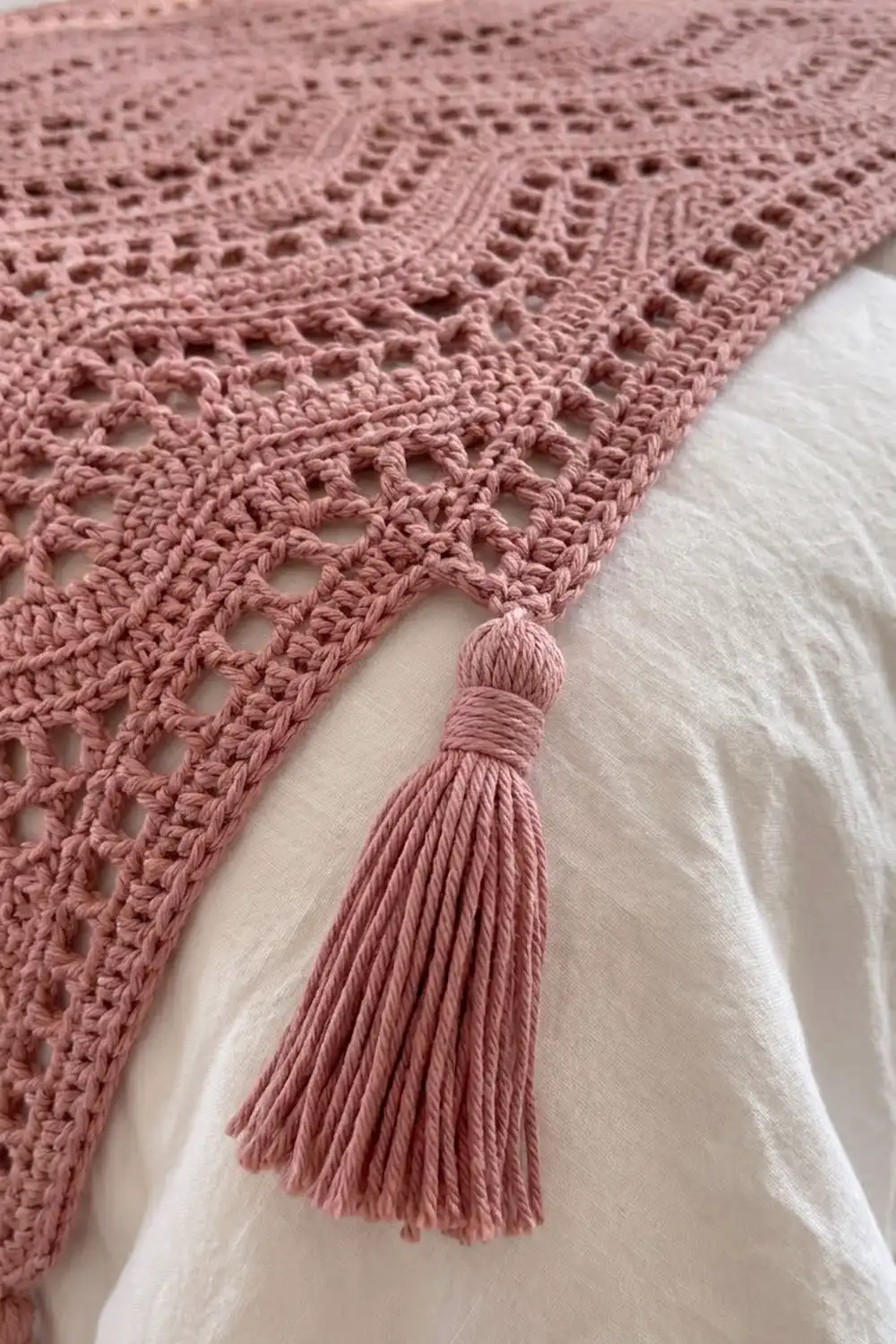
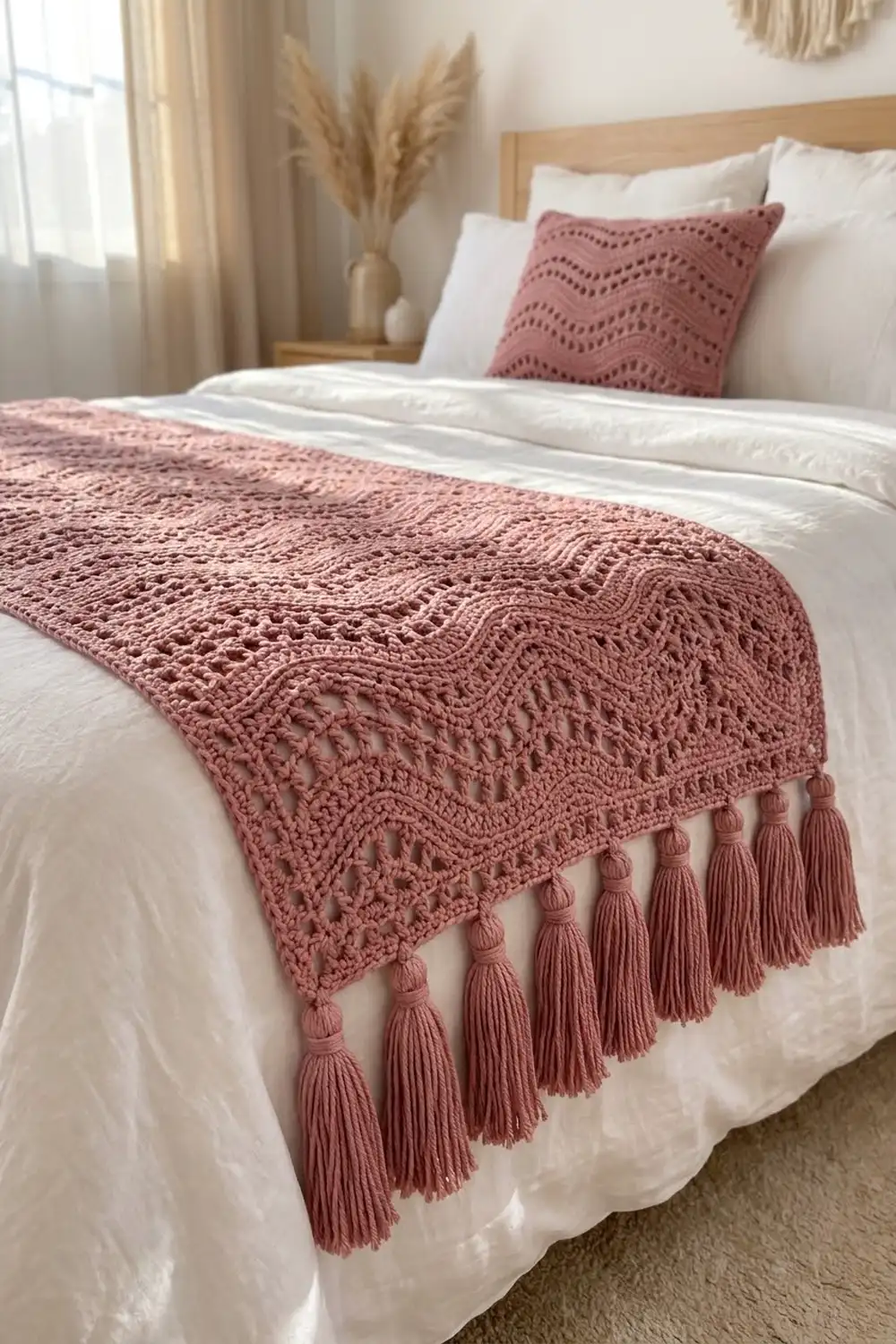
The Rosewater Ripple Bed Runner is a long, single-panel bed scarf worked in one soft dusty rose. Gentle waves run across its width, with solid ridged bands between open mesh rows. A neat ribbed border frames the panel, and chunky tassels hang from both short ends.
The style is calm and textured. With only one color, the waves, the mesh, and the tassels carry all the decoration. Lay the runner across the foot of the bed so the tasseled ends drape over each side.
This pattern uses US crochet terms. The finished runner measures 19.75 in (50.2 cm) wide by 61.75 in (156.8 cm) long. The 4.5 in (11.4 cm) tassels at each end bring it to 70.75 in (179.7 cm) from tip to tip.
You work one rectangle in turned rows, from one short end to the other, using an 8-row wave repeat. Then you add a 3-round border, attach 13 tassels to each short end, and block.
Finished Size and Construction
- Finished size: 19.75 in x 61.75 in (50.2 cm x 156.8 cm), plus tassels
- Length with tassels: 70.75 in (179.7 cm)
- Skill level: Intermediate (easy repeat, long project, careful counting)
- Terminology: US crochet terms
- Yarn weight: Worsted (#4)
- Hook: 5.0 mm (US H-8)
- Number of pieces: 1 single panel (no joining)
- Layout: one rectangle, with the rows running across the width
- Panel size before border: 18.25 in x 60.25 in (46.4 cm x 153.0 cm)
- Border depth: 0.75 in (1.9 cm) on every side
- Tassels: 13 per short end, each 4.5 in (11.4 cm) long
Materials
Choose a smooth worsted-weight cotton or cotton blend with good stitch definition. Cotton keeps the waves crisp and makes heavy, swingy tassels. Avoid fuzzy yarns, which blur the mesh holes.
Yarn (one color):
- Dusty Rose: 500 g / 1,000 m (1,094 yd) in total, for example 5 balls of 100 g / 200 m (219 yd)
- Panel and border: about 390 g / 780 m
- Tassels: about 110 g / 220 m
These quantities include a margin of roughly 10-12%. Buy all your yarn from one dye lot.
Tools:
- 5.0 mm (US H-8) crochet hook
- 8 stitch markers
- Tape measure
- Stiff card, 5 in (12.7 cm) tall, for the tassels
- Scissors and a tapestry needle
- Blocking mats, rust-proof pins, and a spray bottle
Abbreviations (US Terms)
- ch: chain
- sl st: slip stitch
- sc: single crochet
- hdc: half double crochet
- dc: double crochet
- tr: treble crochet
- sk: skip
- sp(s): space(s)
- st(s): stitch(es)
- tch: turning chain
- RS / WS: right side / wrong side
Special rows:
- Wave Row: each 12-st repeat rises from sc up to tr and back down to sc, which builds a crest in the middle of the repeat.
- Counter Row: the mirror of the Wave Row. Tr stitches sit over the low points and sc stitches sit over the crests, so the waves shift by half a repeat.
- Mesh Row: (dc, ch 1, sk 1) across. Each ch-1 counts as 1 st.
Gauge and Checkpoints
Gauge in pattern: 16 sts = 4 in (10.2 cm) wide; one 8-row repeat = 3 in (7.6 cm) tall.
Test one piece first. Ch 26, work the Foundation Row (25 sc), then work Rows 1-8 twice. Block the swatch lightly. It should measure 6.25 in (15.9 cm) wide by 6.25 in (15.9 cm) tall.
Checkpoints on the runner:
- After the Foundation Row: 18.25 in (46.4 cm) wide.
- After 4 repeats: 12.25 in (31.1 cm) long.
- After 10 repeats: 30.25 in (76.8 cm) long.
- After 20 repeats: 60.25 in (153.0 cm) long.
- After the border: 19.75 in x 61.75 in (50.2 cm x 156.8 cm).
If your swatch is too big, go down to a 4.5 mm hook. If it is too small, go up to a 5.5 mm hook. Change the hook, never the stitch count, so the 12-st repeat stays intact.
The Panel
The stitch pattern is a multiple of 12 sts + 1. The runner is 6 repeats wide, so every row has 73 sts. Each repeat is symmetrical, so every row reads the same in either direction.
Foundation: Ch 74.
Foundation Row (WS): Sc in 2nd ch from hook and in each ch across. Turn. (73 sc)
For the first few rows, place markers after sts 13, 25, 37, 49, and 61 to mark the repeats.
The 8-Row Repeat
Row 1 (RS, Wave Row): Ch 1 (does not count as a st). Sc in first st, hdc in next 2 sts, dc in next 2 sts, tr in next 3 sts, dc in next 2 sts, hdc in next 2 sts, sc in next st; rep from * 5 more times. Turn. (73 sts: 1 sc + 6 repeats of 12)*
The top edge now rises into 6 crests over the tr groups.
Row 2: Ch 1. Sc in each st across. Turn. (73 sc)
Row 3 (Mesh Row): Ch 4 (counts as dc + ch 1). Sk next st, dc in next st, ch 1, sk next st, dc in next st; rep from * across. Turn. (37 dc including tch + 36 ch-1 sps = 73 sts)*
Row 4: Ch 1. Sc in first dc, sc in next ch-1 sp, sc in next dc; rep from * across, working the last sc in the 3rd ch of the tch. Turn. (73 sc)*
Row 5 (Counter Row): Ch 4 (counts as tr). Dc in next 2 sts, hdc in next 2 sts, sc in next 3 sts, hdc in next 2 sts, dc in next 2 sts, tr in next st; rep from * 5 more times. The final tr goes in the last st. Turn. (73 sts: 1 tch tr + 6 repeats of 12)*
Now the tall stitches sit in the low points and the sc stitches sit on the crests. The top edge levels out, while the bands below keep their wave shape.
Row 6: Ch 1. Sc in each st across, working the last sc in the top of the tch. Turn. (73 sc)
Row 7 (Mesh Row): Work as Row 3. (73 sts)
Row 8: Work as Row 4. (73 sc)
Continue the Panel
Work Rows 1-8 a total of 20 times. That makes 161 rows, counting the Foundation Row. End with a Row 8. It follows a Counter Row, so the top edge is level and ready for the border.
Panel check: 73 sts; 18.25 in x 60.25 in (46.4 cm x 153.0 cm). Fasten off and weave in the ends.
Border
The border has 3 rounds. It gives a firm, ribbed frame and a stable base for the tassels.
Border gauge: Work Round 1 at the panel gauge, 4 sc per inch (16 sc = 4 in / 10.2 cm), on all four sides.
Long-side logic: Work into the row ends as follows:
- 1 sc per sc row end (the Wave Row starts and ends with sc, so it counts here)
- 2 sc per Mesh Row end
- 3 sc per Counter Row (tr) end
For each 8-row repeat that gives 1 + 1 + 2 + 1 + 3 + 1 + 2 + 1 = 12 sc. Twelve sc over 3 in is exactly 4 sc per inch. Each long side gets 1 (Foundation Row) + 20 x 12 = 241 sc, and 241 / 4 = 60.25 in, the exact panel length.
The corners are ch-2 sps and are not included in the side counts below.
Round 1 (RS): With RS facing, join with sc in the first st of the last row. Sc in the next 72 sts, for 73 sc across the short side. Ch 2 (corner). Sc 241 evenly down the long side. Ch 2. Sc in each ch along the opposite side of the foundation chain (73 sc). Ch 2. Sc 241 up the second long side. Ch 2. Join with sl st to the first sc.
Per side: 73 sc on each short side, 241 sc on each long side. Total: 2 x 73 + 2 x 241 = 628 sc + 4 corner ch-2 sps.
Round 2: Ch 3 (counts as dc), dc in each remaining sc to the corner. *Work (2 dc, ch 2, 2 dc) in the corner ch-2 sp, then dc in each sc to the next corner; rep from * around. Join with sl st to the top of the ch-3.
Per side: 73 + 4 = 77 dc on each short side and 241 + 4 = 245 dc on each long side, since each side gets 2 dc from each of its 2 corners. Total: 628 (1 per existing sc) + 16 (4 at each of 4 corners) = 644 dc + 4 corner ch-2 sps.
At this point the border should measure about 0.5 in (1.3 cm) deep.
Round 3: Ch 1. Sc in each dc around, working 3 sc in each corner ch-2 sp. Join with sl st to the first sc and fasten off.
Per side: 77 sc on each short side, 245 sc on each long side, and 3 sc at each corner. Total: 644 (1 per existing dc) + 12 (3 at each of 4 corners) = 656 sc.
Why the math works: Round 1 matches the panel exactly, at 73 sts across and 241 sts down, both at 4 sts per inch. Rounds 2 and 3 add stitches only at the corners, where the outer edge needs the extra length to turn flat. The sides never gain stitches mid-edge, so they stay straight. The three rounds add 0.75 in (1.9 cm) per side, for a total of 19.75 in x 61.75 in (50.2 cm x 156.8 cm).
Tassels
Make 26 tassels:
- Wrap yarn 24 times around the 5 in (12.7 cm) card.
- Slide a 12 in (30.5 cm) strand under the wraps at the top and tie it tightly. Leave the tails long.
- Cut through the wraps at the bottom.
- Wrap a 20 in (50.8 cm) strand about 8 times around the bundle, 0.75 in (1.9 cm) below the top, to form the neck. Tie it off and bury the ends inside the tassel.
- Trim the tassel to 4.5 in (11.4 cm) long.
Placement: Along one short end, count the 77 sc of Round 3 and leave out the corner sc. Place markers in sts 3, 9, 15, 21, 27, 33, 39, 45, 51, 57, 63, 69, and 75. That gives 13 tassels spaced 1.5 in (3.8 cm) apart. Pull the tie tails through each marked st, knot them firmly on the WS, and weave them in. Repeat on the other short end.
Final Blocking
- Soak the runner in cool water for 15 minutes, then gently press out the water without wringing.
- Roll the runner in towels to remove more moisture.
- Lay it RS up on blocking mats.
- Pin the four corners to 19.75 in x 61.75 in (50.2 cm x 156.8 cm).
- Pin along both long sides every 3-4 in (7.6-10.2 cm), keeping the edges straight.
- Nudge the crests into line across the width and open each mesh hole slightly.
- Let the tassels hang off the edge of the mat so they dry straight.
- When the runner is completely dry, unpin it and trim any uneven tassels.
Final Quality-Control Checklist
- Every panel row has 73 sts.
- There are 20 full repeats, ending with Row 8.
- Each Wave Row has 6 evenly spaced crests, aligned along the length.
- The mesh holes are even, with no missing ch-1 sps.
- Border Round 1 counts 73 / 241 / 73 / 241 sc.
- Border Round 3 totals 656 sc.
- The long edges are straight, with no ruffles.
- The blocked size is 19.75 in x 61.75 in (50.2 cm x 156.8 cm).
- There are 13 tassels per end, all 4.5 in (11.4 cm) long.
Troubleshooting
Flat-looking waves: Check that the tr groups sit in the center of each repeat and that the Counter Row puts sc directly over them.
Drifting stitch count: The tch counts as a st in Rows 3, 5, and 7 only. Mark the top of the tch on those rows.
Ruffled long border: You worked too many sc into the row ends. Recount to 12 per repeat.
Long border pulling in: You worked too few sc, usually at the Counter Row ends. Each of those ends needs 3 sc.
Narrowing panel: You are probably missing the last st of a row, often the tch.
Thin tassels: Add 4 wraps per tassel and allow about 20 g (40 m) of extra yarn.
Care
Hand wash cool, or machine wash on a gentle cycle inside a laundry bag. Lay flat to dry and smooth the tassels while they are damp.
Final Notes
The measurement chain runs like this. At 16 sts = 4 in, 73 sts make the panel 18.25 in (46.4 cm) wide. At 8 rows = 3 in, the Foundation Row plus 20 repeats make it 60.25 in (153.0 cm) long. Twelve border sc per repeat give 241 sc per long side, which matches that length exactly. The 3 border rounds add 0.75 in (1.9 cm) per side, for 19.75 in x 61.75 in (50.2 cm x 156.8 cm). The 4.5 in (11.4 cm) tassels bring the runner to 70.75 in (179.7 cm). Check your swatch, count every row, and the waves will line up on their own.
Happy crocheting!