

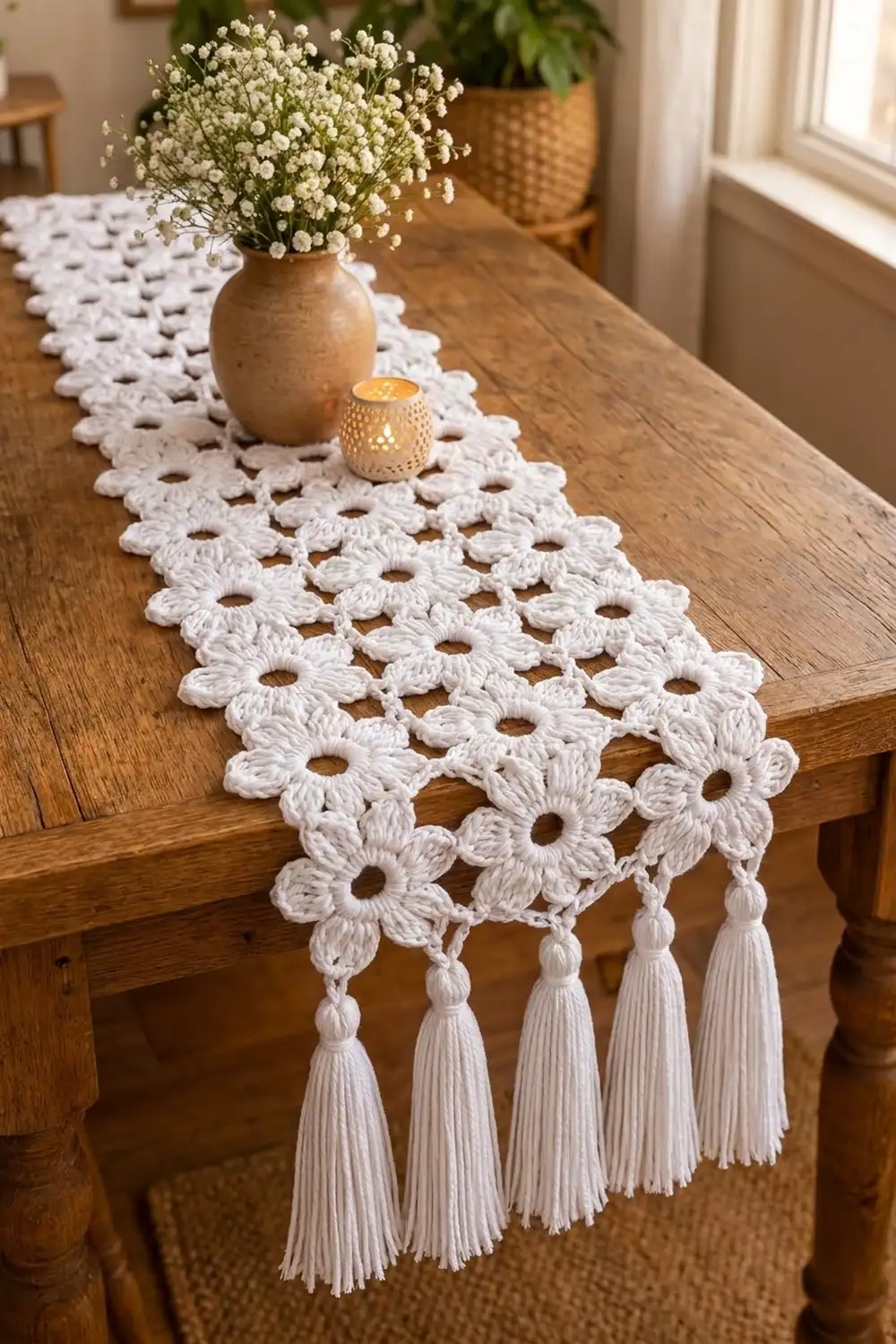
The Snowdrift Daisy Table Runner is a light, lacy runner made of white six-petal flowers. Each flower has a wide open center and six puffy, pointed petals. The flowers join at their petal tips, so the open spaces between them become part of the design. Lines of chains and single crochet frame the outer edge, and seven full tassels finish each short end.
The runner is all white, so the stitch texture stands out. It suits a farmhouse, cottage, or boho table in any season. A cotton yarn gives it crisp petals and lets it be washed often.
This pattern uses US crochet terms. The finished runner measures 16.1 in x 54.5 in (40.9 cm x 138.4 cm) without tassels. With 5 in (12.7 cm) tassels at both ends, the total length is 64.5 in (163.8 cm).
You make one flower first. Every flower after that is joined join-as-you-go in its last round, to the flower above and the flower on its left, until the grid is 4 flowers wide and 12 flowers long. Then you add a two-round lacy edging and 14 tassels.
Finished Size and Construction
- Finished size: 16.1 in x 54.5 in (40.9 cm x 138.4 cm), plus 5 in (12.7 cm) tassels at each end
- Skill level: Intermediate
- Terminology: US
- Yarn weight: Worsted (#4), 100% cotton
- Hook: 5.0 mm (H-8)
- Number of pieces: 48 flower motifs, joined as you go
- Layout: 4 flowers wide x 12 flowers long
- Motif size: 4.5 in (11.4 cm) from top tip to bottom tip and 3.9 in (9.9 cm) across the side tips
- Size before border: 15.6 in x 54 in (39.6 cm x 137.2 cm)
- Border depth: 0.25 in (0.6 cm) beyond the petal tips on every edge
Materials
Pick a smooth, mercerized or soft cotton in worsted weight. Cotton holds the petal shape and survives the spills a table runner gets. Avoid fuzzy blends, because they blur the open center rings.
- White, worsted cotton: 426 g (654 m) in total. That is six balls of 71 g / 109 m each.
- 48 motifs: about 250 g (384 m)
- Edging: about 20 g (30 m)
- 14 tassels: about 75 g (115 m)
These quantities include a margin of about 20% for gauge differences and test swatches.
Tools:
– 5.0 mm (H-8) crochet hook
– Tapestry needle
– Sharp scissors
– A stiff card 5 in (12.7 cm) wide, or a tassel maker
– Locking stitch markers
– Rust-proof pins and a blocking mat
– Spray bottle
– Measuring tape
Abbreviations (US Terms)
- ch: chain
- sl st: slip stitch
- sc: single crochet
- hdc: half double crochet
- dc: double crochet
- tr: treble crochet (yarn over twice, insert hook, pull up a loop, [yarn over, pull through 2 loops] 3 times)
- sp(s): space(s)
- st(s): stitch(es)
- rep: repeat
Special stitch: Joining tip (JT). Use this in place of a “ch 2” petal tip. Ch 1, then sl st into the ch-2 tip sp of the matching petal on the finished neighbor flower. Ch 1 and carry on. The joined tip keeps the same height as a free ch-2 tip.
Gauge and Checkpoints
Before you start the runner, crochet one full flower and lightly block it. Measure it at each stage:
- After Round 1: the ring is 1.5 in (3.8 cm) across on the outside, and the center hole is about 0.75 in (1.9 cm).
- After Round 2: 2 in (5.1 cm) across.
- After Round 3: 4.5 in (11.4 cm) from top tip to bottom tip, and 3.9 in (9.9 cm) between the two upper-right and two upper-left side tips.
If your flower is too big, go down to a 4.5 mm hook. If it is too small, go up to a 5.5 mm hook. Each 0.1 in (0.3 cm) of difference per motif adds up to about 1.2 in (3 cm) over the 12-flower length, so getting this right matters.
Flower Motif (Make 48)
Round 1: Center Ring
Ch 12, then sl st into the first ch to form a ring.
Ch 1 (does not count as a st). Work 24 sc into the ring. Sl st into the first sc.
(24 sc)
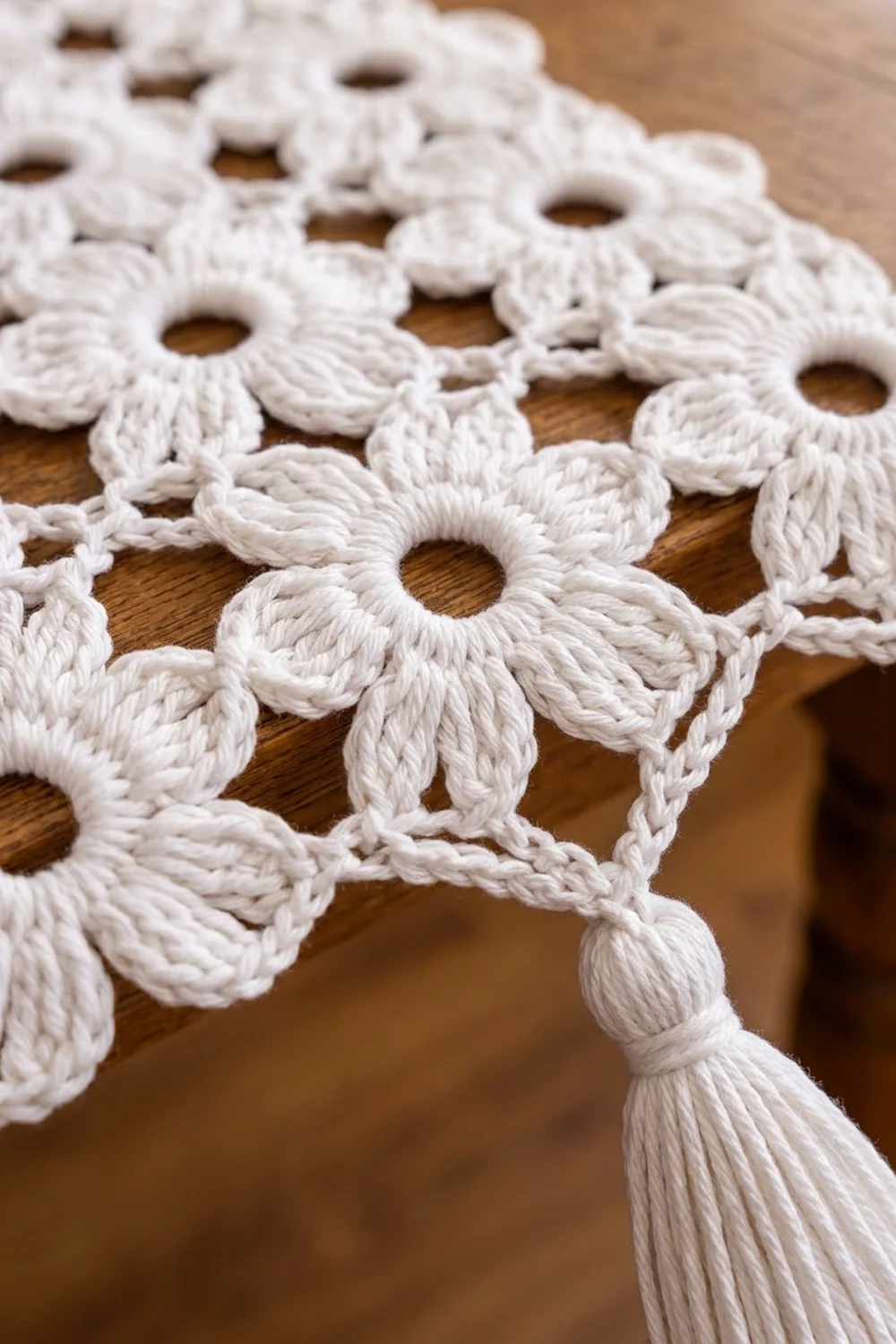
Working over the ring keeps the center open and round, like the large hole in the photo.
Round 2: Petal Base
Ch 1. Sc in the same st as the join, ch 4, skip 3 sc. Sc in the next sc, ch 4, skip 3 sc. Rep from * 4 more times. Sl st into the first sc.
(6 sc, 6 ch-4 sps)*
Check: 6 repeats x 4 sts used (1 sc + 3 skipped) = 24, which matches Round 1.
Round 3: Petals (First Motif Only)
Work the petals in this order: Petal 1 points up, Petal 2 upper left, Petal 3 lower left, Petal 4 down, Petal 5 lower right, Petal 6 upper right. Put a marker in Petal 1 so you can turn the motif the right way when joining.
*In the next ch-4 sp, work (sc, hdc, 2 dc, tr, ch 2, tr, 2 dc, hdc, sc). Sl st in the next sc of Round 2. Rep from * 5 more times. Fasten off and weave in the ends.
Per petal: 10 sts plus 1 ch-2 tip.
Round total: 60 sts, 6 ch-2 tips, and 6 sl sts between petals.
The two tr on either side of the ch-2 make the pointed tip. The dc and hdc on each side round out the petal.
Round 3: Joining Motifs
Make Rounds 1 and 2 as written. In Round 3, replace the ch 2 at a petal tip with a JT wherever that petal meets a finished flower:
- Petal 1 joins the Petal 4 of the flower directly above.
- Petal 2 joins the Petal 6 of the flower to the left.
- Petal 3 joins the Petal 5 of the flower to the left.
- Petals 4, 5, and 6 always use a plain ch 2. They are joined later by the next flowers.
The joins always fall in the first three petals, so you finish all joining early in the round. The stitch count stays at 60 sts per motif.
Make All Pieces
You need 48 white motifs in total: 1 made as a stand-alone flower, then 47 joined as you go. Work the grid in rows, from left to right:
       Col 1  Col 2  Col 3  Col 4
Row 1    F      F      F      F
Row 2    F      F      F      F
Row 3    F      F      F      F
 ...    ...    ...    ...    ...
Row 12   F      F      F      F
- Row 1, Col 1: no joins.
- Row 1, Cols 2–4: join Petals 2 and 3 only.
- Rows 2–12, Col 1: join Petal 1 only.
- Rows 2–12, Cols 2–4: join Petals 1, 2, and 3.
Joining
Method: join-as-you-go with a sl st through the matching ch-2 tip (the JT).
Stitch-to-stitch logic: every inside petal tip pairs with exactly one tip on a neighboring flower. Flowers next to each other in a row meet at two tip pairs (Petal 6 to Petal 2 and Petal 5 to Petal 3). Flowers stacked in a column meet at one tip pair (Petal 4 to Petal 1). Because of this:
- The column pitch is 3.9 in (9.9 cm), which equals the width across the side tips.
- The row pitch is 4.5 in (11.4 cm), which equals the height from tip to tip.
Tension: keep the ch 1 on each side of the joining sl st as loose as a normal ch. If you pull it tight, the tips pucker and the grid narrows.
Size checkpoint: after Row 3, the piece should measure 15.6 in (39.6 cm) wide and 13.5 in (34.3 cm) long. At the end it should measure 15.6 in x 54 in (39.6 cm x 137.2 cm).
Border
Border gauge: a ch 7 spans the 2.25 in (5.7 cm) gap between two neighboring tips without pulling. Five sc fit across a ch-5 sp, and seven across a ch-7 sp.
Free tips on each side:
– Each long side: 12 flowers x 2 free tips (Petals 2 and 3 on the left, Petals 5 and 6 on the right) = 24 tips.
– Each short end: 4 flowers x 1 free tip (Petal 1 at the top, Petal 4 at the bottom) = 4 tips.
– Total: 24 + 24 + 4 + 4 = 56 tips.
In this border, a “side” means its tip groups plus the gaps between them. The 4 corner gaps are counted separately, so no stitch is counted twice.
Border Round 1
With the right side facing, join yarn in the Petal 1 tip of the top-left flower.
Tip group (TG): (sc, ch 2, sc) in the ch-2 tip sp.
- First tip and corner: work a TG in the starting tip, then ch 7 (corner).
- Left long side: TG in the next free tip, ch 7, TG in the next free tip. Rep from * 22 more times. (24 TGs, 23 ch-7 gaps)*
- Corner: ch 7.
- Bottom end: TG in the Petal 4 tip of the bottom-left flower. Ch 5, sc around the next join (under both ch-1s of the JT), ch 5, TG in the next Petal 4 tip. Rep from * 2 more times. (4 TGs, 3 bridges)*
- Corner: ch 7.
- Right long side: work it the same way as the left side, going upward. (24 TGs, 23 ch-7 gaps)
- Corner: ch 7.
- Top end: work it the same way as the bottom end, with bridges, ending just before the starting TG. (3 bridges; the 4th TG is the first one you made)
- Sl st into the first sc.
Counts:
– Each long side: 48 sc, 24 ch-2 sps, 23 ch-7 sps
– Each short end: 11 sc (8 from tips + 3 from bridges), 4 ch-2 sps, 6 ch-5 sps
– Corners: 4 ch-7 sps
– Round total: 118 sc, 56 ch-2 sps, 50 ch-7 sps, 12 ch-5 sps
Border Round 2
Ch 1. Work 1 sc in each sc, 3 sc in each ch-2 sp, 7 sc in each ch-7 sp, and 5 sc in each ch-5 sp. Sl st into the first sc and fasten off.
Counts:
– Each long side: 48 + 72 + 161 = 281 sc
– Each short end: 11 + 12 + 30 = 53 sc
– Corners: 4 x 7 = 28 sc
– Round total: 118 sc worked one into each existing sc, plus 578 sc worked into spaces = 696 sc
Why the math works: each side’s starting count comes straight from flowers x free tips (12 x 2 and 4 x 1). Nothing is added at the seams, because the join points are already part of the bridges. In the spaces you work 1 sc per chain, so the edge lies flat. The 3 sc in each tip keeps the points sharp.
Tassels (Make 14)
- Wrap yarn 30 times around the 5 in (12.7 cm) card.
- Slide a 12 in (30.5 cm) strand under the wraps at the top edge and tie it tightly.
- Cut the wraps along the bottom edge.
- Wrap a separate 20 in (50.8 cm) strand around the bundle 0.75 in (1.9 cm) below the top, about 8 times. Knot it and hide the ends inside the tassel.
- Trim the tassel to 5 in (12.7 cm).
Tie on 7 tassels at each short end, using the top strand:
– 4 tassels go in the center sc of each Petal 4 tip (Petal 1 tip at the top end).
– 3 tassels go in the center sc of each bridge, the sc that sits above the join.
Final Blocking
- Soak the runner in cool water for 10 minutes. Press the water out gently; do not wring it.
- Roll it in a towel to remove more water.
- Lay it flat on the mats with the tassels hanging off the edge.
- Pin the outer corners to 16.1 in x 54.5 in (40.9 cm x 138.4 cm).
- Pin each outer petal tip, then shape the center rings into circles.
- Check the column pitch (3.9 in / 9.9 cm) and the row pitch (4.5 in / 11.4 cm) with the tape.
- Let it dry completely. Comb the tassels straight and trim them again if needed.
Final Quality-Control Checklist
- All 48 motifs are joined, and no petal tip is left loose inside the grid.
- Every center hole is open and round.
- The long sides each have 24 tip groups, and the short ends each have 4.
- Border Round 2 totals 696 sc.
- Both long sides measure 54.5 in (138.4 cm).
- Both short ends measure 16.1 in (40.9 cm).
- There are 7 tassels on each end, all 5 in (12.7 cm) long and evenly spaced.
- All ends are woven in securely.
Troubleshooting
- Petals curl forward: your tr stitches are tight. Loosen them, or go up a hook size for Round 3 only.
- Center ring ruffles: you have too many sc. Count exactly 24.
- Grid pulls into a curve: your JT chains are too short. Keep ch 1 relaxed on both sides of the sl st.
- Border waves: you worked too many sc in the spaces. Use exactly 7 per ch-7 and 5 per ch-5.
- Border cups: your chains are too tight. Go up 0.5 mm for Round 1 of the border.
- Tassels look thin: add 5 wraps to each tassel and keep all 14 the same.
Care
Hand wash or machine wash on a gentle cycle in a laundry bag, using cool water. Reshape the runner and dry it flat; never hang it wet.
Final Notes
The size depends on one chain of measurements. A Round 1 ring of 1.5 in (3.8 cm) gives a motif of 4.5 in x 3.9 in (11.4 cm x 9.9 cm). Four columns and twelve rows of motifs give 15.6 in x 54 in (39.6 cm x 137.2 cm). A 0.25 in (0.6 cm) border brings that to 16.1 in x 54.5 in (40.9 cm x 138.4 cm). Check your gauge at each link and the runner will block to size.
Happy crocheting!