

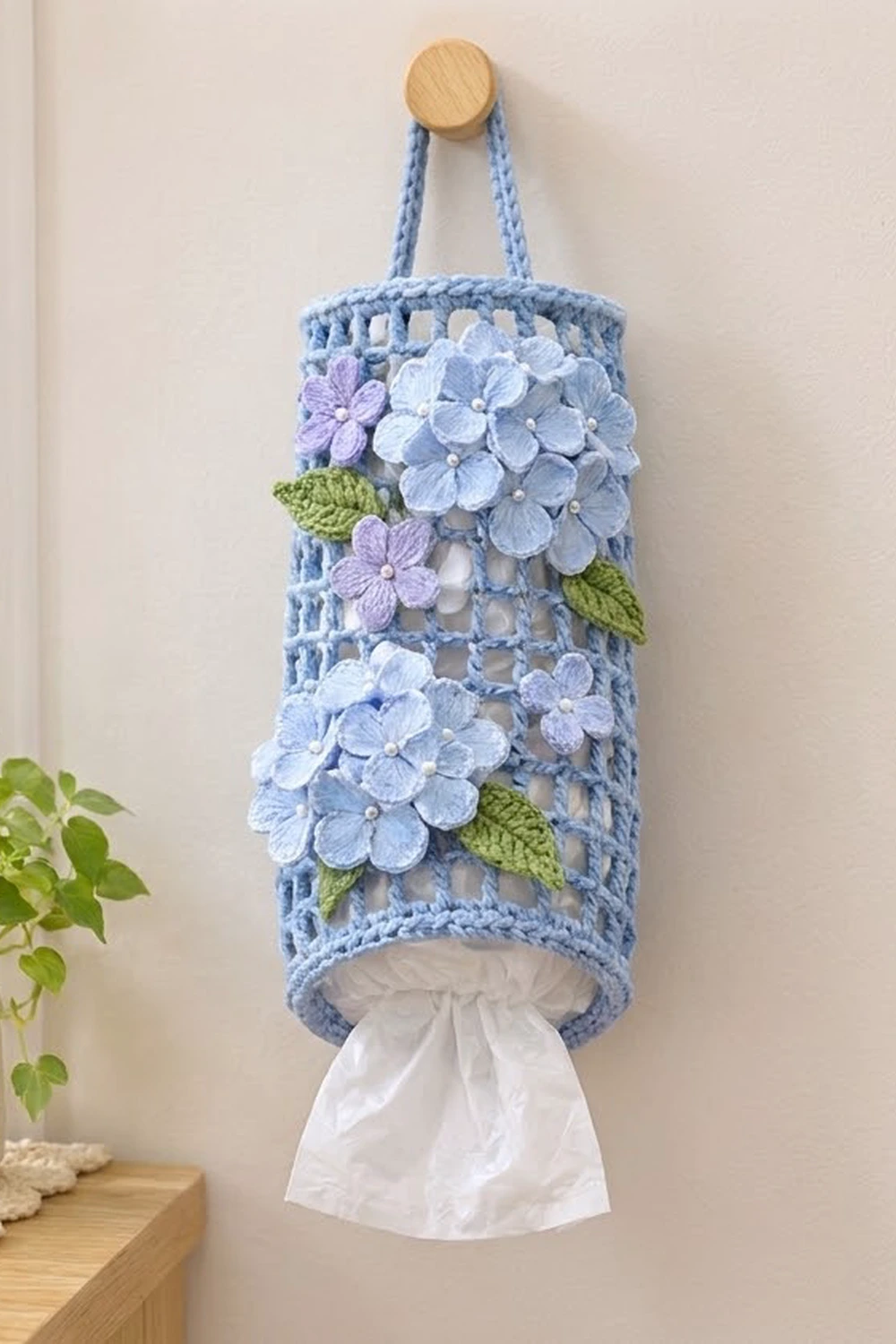
This hanging grocery bag holder is a tall, open-mesh tube in cornflower blue, finished with a solid band at each end and a single strap that loops over a wall peg. You stuff plastic bags in at the top and pull them out, one at a time, from the bottom.
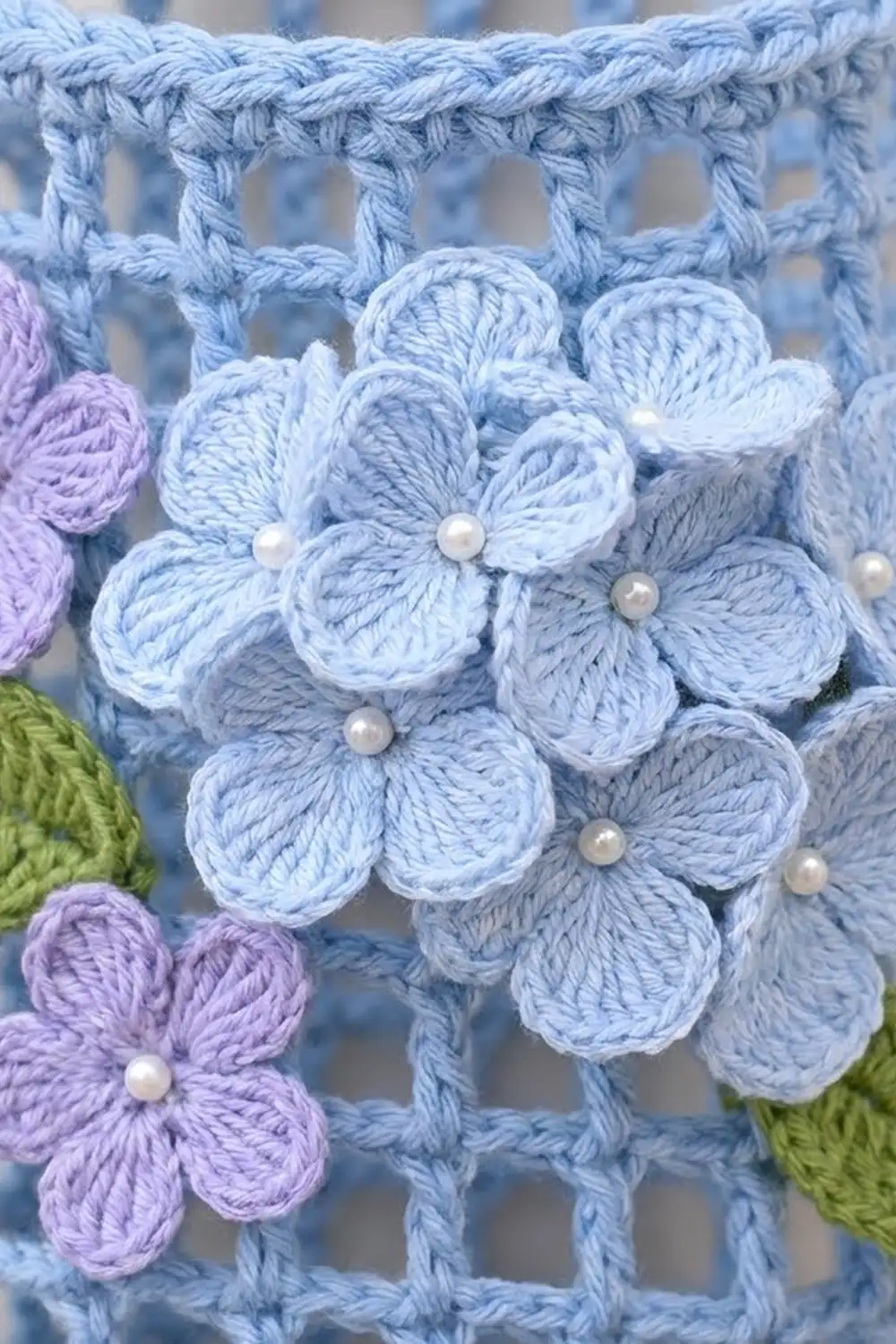
The front is decorated with two hydrangea clusters made from pale blue four-petal florets, each with a white pearl bead in the center. Small lavender five-petal flowers and green leaves sit around the clusters, so the holder works as a piece of wall decor as well as storage.
The pattern uses US crochet terms. The finished tube is 15 in (38.1 cm) around, about 4.8 in (12.2 cm) across, and 13.5 in (34.3 cm) tall, not counting the strap. Laid flat, it measures 7.5 in (19.1 cm) wide.
Construction is simple. You crochet the body in joined rounds from the bottom up: a solid single crochet band, 24 rounds of filet mesh, then a solid top band. The strap is worked straight off the top band and sewn to the opposite side. Last, you make the florets, flowers, and leaves separately and sew them to the front.
Finished Size and Construction
- Finished size: 15 in (38.1 cm) circumference x 13.5 in (34.3 cm) tall; 7.5 in (19.1 cm) wide when flat
- Strap: 0.75 in (1.9 cm) wide x 8 in (20.3 cm) long
- Skill level: Easy (advanced beginner)
- Terminology: US
- Yarn weight: Worsted (#4) cotton
- Hooks: 5.0 mm (US H-8) for the body, 4.0 mm (US G-6) for the appliqués
- Number of pieces: 1 body with strap, plus 21 sewn-on appliqués (13 florets, 4 flowers, 4 leaves)
- Layout: one seamless tube; no joining of panels
- Piece size: 60 stitches around; 30 stitches per flattened side
- Size before border: 12.75 in (32.4 cm) tall (bottom band plus mesh)
- Border depth: 0.75 in (1.9 cm) top band
Materials
Choose a smooth, mercerized or matte cotton in worsted weight. Cotton holds the mesh open and square, and it won’t stretch much under the weight of a full load of bags. Acrylic also works, but the tube will sag more.
- Color A, cornflower blue (body and strap): 125 g / 195 m
- Color B, pale sky blue (florets): 40 g / 62 m
- Color C, lavender (flowers): 15 g / 23 m
- Color D, leaf green (leaves): 10 g / 15 m
- White pearl beads, 4 mm: 17 (one per floret and flower). You can use white French knots instead.
Tools:
- 5.0 mm (US H-8) crochet hook
- 4.0 mm (US G-6) crochet hook
- Tapestry needle
- Sewing needle and white thread for the beads
- Stitch markers
- Straight pins
- Measuring tape
- Scissors
All yarn amounts include a margin of about 15 percent for your gauge swatch and for differences in tension.
Abbreviations (US Terms)
- ch – chain
- sl st – slip stitch
- sc – single crochet
- hdc – half double crochet
- dc – double crochet
- sk – skip
- sp – space
- st(s) – stitch(es)
- MR – magic ring
- RS – right side
Special stitch – mesh square: (dc, ch 1, sk 1). One mesh square uses 2 stitches of width: 1 dc and 1 ch-1 space.
Petal: (ch 2, dc in the stated number of stitches, ch 2, sl st), all worked in the same stitch.
Gauge and Checkpoints
Body gauge with the 5.0 mm hook:
- 16 sc and 16 rounds = 4 in (10.2 cm)
- 8 mesh squares (16 sts) and 8 mesh rounds = 4 in (10.2 cm)
That means 1 sc round is 0.25 in (0.6 cm) tall and 1 mesh round is 0.5 in (1.3 cm) tall.
The body is a single piece, so treat the first 3 rounds as your test. Make the bottom band and lay it flat before you go on.
Checkpoints:
- After Rnd 3: flattened width 7.5 in (19.1 cm), height 0.75 in (1.9 cm).
- After Rnd 15 (12 mesh rounds): height 6.75 in (17.1 cm).
- After Rnd 27 (all 24 mesh rounds): height 12.75 in (32.4 cm).
- After Rnd 30: height 13.5 in (34.3 cm), flattened width still 7.5 in (19.1 cm).
If your work is too big, switch to a smaller hook, usually by 0.5 mm. If it’s too small, go up 0.5 mm. If only the height is off, add or remove mesh rounds; each one changes the height by 0.5 in (1.3 cm). Don’t change the stitch count, because the mesh repeat needs an even number of stitches.
Body
Use Color A and the 5.0 mm hook. Join every round with a sl st; don’t work in a spiral. Joined rounds keep the mesh columns straight and put the seam at one side, where the strap will hide it.
Bottom Band
Foundation: Ch 60. Make sure the chain isn’t twisted, then join with a sl st to the first ch to form a ring.
Rnd 1: Ch 1, sc in each ch around, sl st to the first sc. (60 sc)
Rnds 2–3: Ch 1, sc in each st around, sl st to the first sc. (60 sc)
Place a marker in the first st of the round. This is st 1. Its column marks one side of the holder.
Mesh Section
Rnd 4 (first mesh round): Ch 4 (counts as dc and ch 1), sk next st, dc in next st, ch 1, sk next st; repeat from * 28 more times, sl st in the 3rd ch of the beginning ch-4. (30 dc and 30 ch-1 sps = 60 sts; 30 mesh squares)*
Rnds 5–27: Ch 4 (counts as dc and ch 1), dc in next dc, ch 1; repeat from * 28 more times, sl st in the 3rd ch of the beginning ch-4. (30 dc and 30 ch-1 sps = 60 sts each round)*
Each dc sits on top of the dc below it, which makes straight vertical bars and square holes. Check every few rounds that the joins stay in one column.
This gives 24 mesh rounds. At checkpoint 3, the piece should be 12.75 in (32.4 cm) tall.
Top Band and Strap (Border)
The top band acts as the border of the holder. It closes the mesh and makes a firm rim for the strap.
Border gauge: 16 sc = 4 in (10.2 cm); 4 sc rounds = 1 in (2.5 cm).
Rnd 28 (conversion round): Ch 1, sc in the same st as the join, sc in the next ch-1 sp, sc in the next dc, sc in the next ch-1 sp; repeat from * 28 more times, sl st to the first sc. (30 sc in the dc + 30 sc in the ch-1 sps = 60 sc)*
Rnds 29–30: Ch 1, sc in each st around, sl st to the first sc. (60 sc)
When the tube is flattened, each side has 30 sc: 60 ÷ 2 = 30. Thirty stitches at 4 sts per inch is 7.5 in (19.1 cm), the same as the bottom band.
Why the math works: Every mesh round has 30 dc and 30 ch-1 spaces. Putting exactly 1 sc in each one gives back 60 stitches, the same as the foundation. Because the top and bottom openings have the same count, the tube stays straight and doesn’t flare or pull in. The three sc rounds add 0.75 in (1.9 cm) to the 12.75 in (32.4 cm) body, for a total of 13.5 in (34.3 cm).
Strap
Don’t fasten off after Rnd 30.
Row 1: Ch 1, sc in the first 3 sts, turn. (3 sc)
Rows 2–32: Ch 1, sc in each of the 3 sts, turn. (3 sc)
The strap should be 8 in (20.3 cm) long. Fasten off and leave a 10 in (25.4 cm) tail.
Flatten the tube so that st 1 is on one fold. Count to sts 31–33 on the opposite fold. These stitches are exactly 30 stitches away from sts 1–3, so the strap hangs centered.
Bring the end of the strap over, check that it isn’t twisted, and whipstitch the last row to the inside of sts 31–33. Go through twice for strength.
Count around the tube to find the front center: it’s the mesh column that sits on st 17. All the appliqués go on the face centered on that column.
Appliqués
Use the 4.0 mm hook. The smaller hook makes firm, rounded petals. Leave an 8 in (20.3 cm) tail on every piece for sewing.
Hydrangea Floret (make 13 in Color B)
Rnd 1: MR, ch 1, 4 sc in the ring, pull the ring closed, sl st to the first sc. (4 sc)
Rnd 2: (Ch 2, 3 dc, ch 2, sl st) in the next sc; repeat from * 3 more times. The last petal goes into the sc where you joined Rnd 1. (4 petals)*
Each floret is about 1.5 in (3.8 cm) across. Sew a white bead into the center.
Lavender Flower (make 4 in Color C)
Rnd 1: MR, ch 1, 5 sc in the ring, pull the ring closed, sl st to the first sc. (5 sc)
Rnd 2: (Ch 2, 2 dc, ch 2, sl st) in the next sc; repeat from * 4 more times. (5 petals)*
Each flower is about 1.25 in (3.2 cm) across. Sew a white bead into the center.
Leaf (make 4 in Color D)
Foundation: Ch 8.
Rnd 1: Starting in the 2nd ch from the hook, work sc, hdc, dc, dc, hdc, sc. In the last ch, work (sc, ch 2, sc) to make the tip. Turn the piece and work along the other side of the foundation chain: sc, hdc, dc, dc, hdc, sc. Sl st into the first skipped ch. (14 sts, plus a ch-2 tip and a closing sl st)
Each leaf is about 1.75 in (4.4 cm) long and 0.9 in (2.3 cm) wide. Using the tail, backstitch a center vein down the middle of the leaf.
Assembly
Lay the tube flat with the front center column facing up. Pin everything in place before you sew anything.
- Upper cluster: 6 florets in a rounded mound about 3.5 in (8.9 cm) across, centered about 10 in (25.4 cm) above the bottom edge. Overlap each floret about 0.25 in (0.6 cm) on the one beside it.
- Lower cluster: 7 florets in the same kind of mound, about 3.5 in (8.9 cm) across, centered about 4.5 in (11.4 cm) above the bottom edge.
- Leaves: Tuck 1 leaf under the upper left edge of the upper cluster and 1 under its lower right edge. Tuck 1 under the left side of the lower cluster and 1 under its lower right edge.
- Lavender flowers: Put 2 at the upper left of the upper cluster, 1 on the left between the clusters, and 1 on the right between the clusters.
Sew from the bottom layer up: leaves first, then the lavender flowers, then the florets. Catch the mesh bars and the sc bands only, so the stitches don’t show through the holes. Put a needle or a rolled towel inside the tube so you don’t sew the front to the back.
Final Blocking
- Dampen the finished holder with cool water and roll it in a towel to press out the extra water.
- Slide it over a tube or cylinder about 4.8 in (12.2 cm) across. A rolled towel works too.
- Pull the mesh columns straight and square up the holes.
- Fluff the petals and shape the leaf tips with your fingers.
- Leave it to dry completely, standing upright.
- Check that the height is 13.5 in (34.3 cm) and the flat width is 7.5 in (19.1 cm).
Final Quality-Control Checklist
- Every round from 1 to 30 has 60 stitches
- The tube has 30 mesh squares around and 24 mesh rounds
- All joins line up in one column, under one end of the strap
- The strap is 3 sc wide, 32 rows long, sewn to sts 31–33, and not twisted
- There are 13 florets, 4 lavender flowers, 4 leaves, and 17 beads
- No appliqué stitches go through to the back of the tube
- All ends are woven in on the inside
Troubleshooting
The tube twisted. The foundation ring was twisted when you joined it. Rip back and rejoin it.
The mesh is leaning or spiraling. Make sure each round starts at the join and that each dc goes into the dc directly below.
The rim is ruffled or tight. You have the wrong count in Rnd 28. Put exactly 1 sc in each dc and 1 sc in each space, for 60 total.
The holes are tall and narrow. Your dc stitches are too loose. Go down 0.5 mm in hook size for the mesh rounds only.
The strap is stretching. Use a smaller hook for the strap, or sew a length of cotton ribbon behind it.
The appliqués are sagging. Add a few tacking stitches near the tip of each petal.
Care
Hand wash in cool water and lay flat or hang to dry. Take the pearl beads off first if they’re not colorfast.
Final Notes
Here’s the measurement chain. A 60-stitch foundation at 4 sts per inch gives a circumference of 15 in (38.1 cm) and a flat width of 7.5 in (19.1 cm). The 3 bottom rounds add 0.75 in (1.9 cm). The 24 mesh rounds add 12 in (30.5 cm), for 12.75 in (32.4 cm). The 3 top rounds bring the total to 13.5 in (34.3 cm). The 3-stitch strap is 8 in (20.3 cm) long and joins two opposite points on the rim. If you check these numbers at each stage, the holder will hang straight and the hydrangeas will fit the front.
Happy crocheting!