
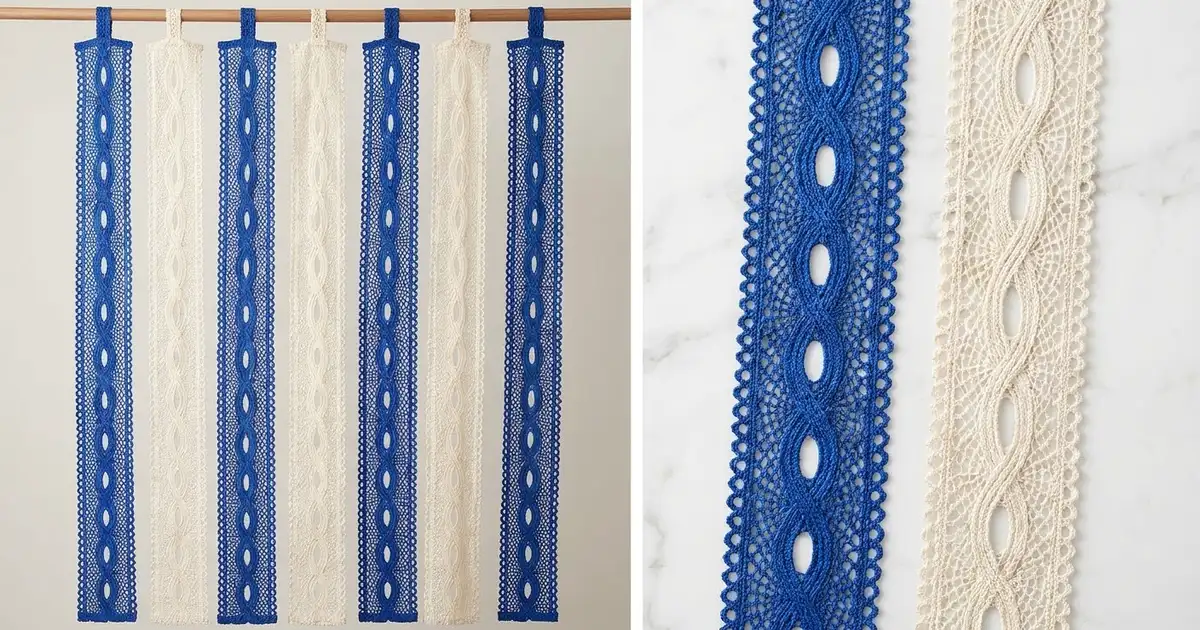
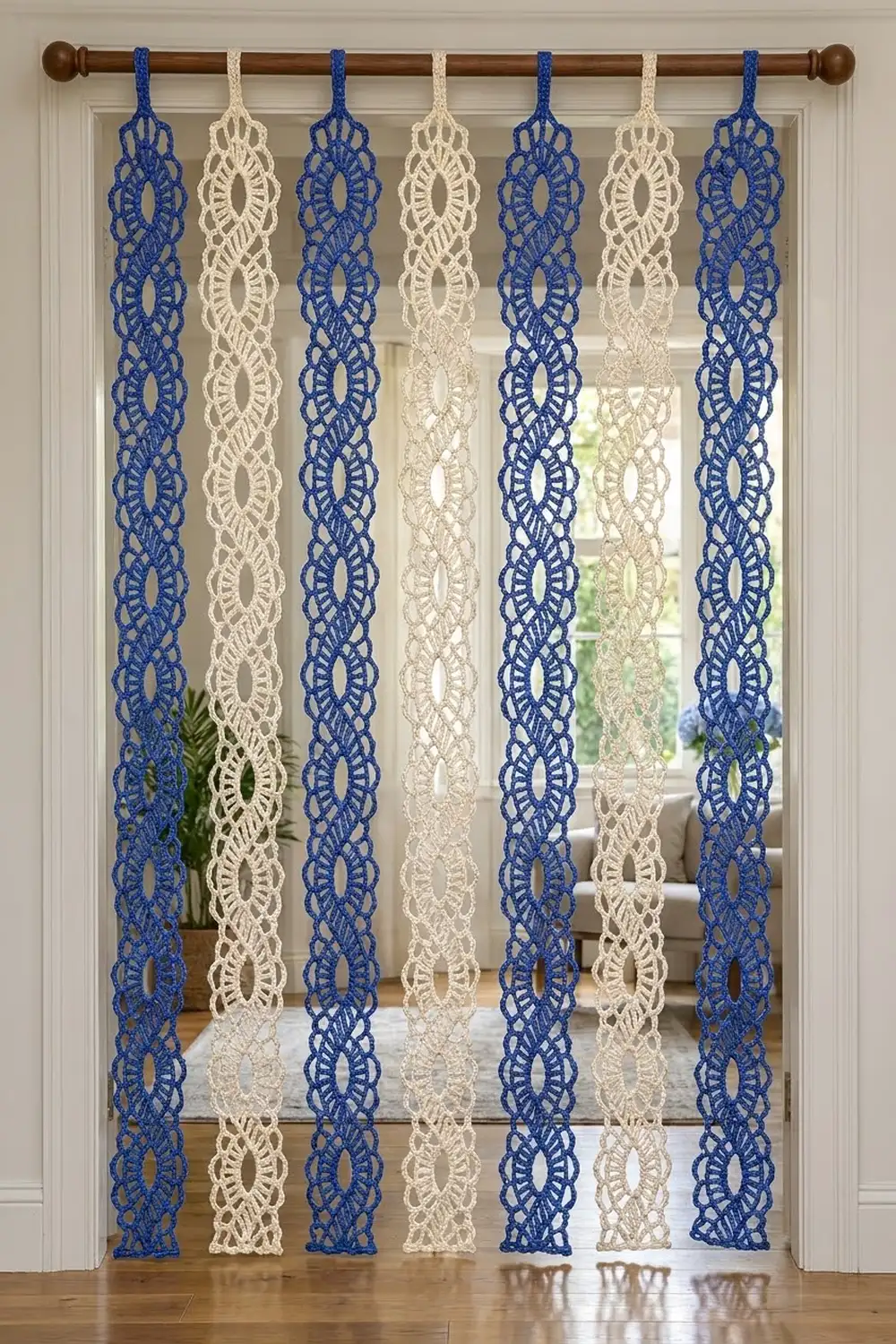
The Blue Tide Twist curtain is a doorway curtain made from seven long lace strips. They hang side by side from a wooden rod and are not stitched to each other. Each strip has a row of open oval “eyes” down its center. Fans of tall spoke stitches sit around the eyes and switch sides from one eye to the next, so the strip looks like a twisted ribbon. A row of small chain loops trims both long edges.
The sample alternates four royal blue strips with three cream strips. Strong contrast like this shows off the openwork best when light comes through the doorway. A single color also works well.
This pattern uses US crochet terms. Each finished strip measures 4.5 in (11.4 cm) wide and 77.5 in (196.9 cm) long. A 3 in (7.6 cm) hanging loop brings the drop from the rod to 80.5 in (204.5 cm).
Each strip is made in one piece. You chain a long foundation, then work a row of single-crochet blocks separated by chain arches, which opens up the eyes. Next you add spoke fans along each side of the foundation. Finally you work two edging rounds around the whole strip: a leveling round, then a round of chain loops. The last step is a hanging loop at the top.
Finished Size and Construction
- Finished strip size: 4.5 in (11.4 cm) wide × 77.5 in (196.9 cm) long
- Drop including hanging loop: 80.5 in (204.5 cm)
- Skill level: Intermediate
- Terminology: US crochet terms
- Yarn weight: Worsted weight (#4) mercerized cotton
- Hook: 5.0 mm (US H-8)
- Number of pieces: 7 separate strips (4 blue, 3 cream)
- Layout: Strips hung side by side, not joined, with 2 in (5.1 cm) gaps between them
- Curtain width on the rod: 43.5 in (110.5 cm), which suits a standard 36 in (91.4 cm) doorway
- Repeat: 15 eyes per strip, 5 in (12.7 cm) per repeat
- Width before edging: about 3 in (7.6 cm) across the widest fan
- Width after leveling round: 3.5 in (8.9 cm)
- Edging loop depth: 0.5 in (1.3 cm) on each long side
Materials
Use a smooth, firm cotton. It holds the spokes open, shows the stitches clearly and doesn’t fuzz with handling. Avoid acrylic: a long strip hanging for weeks can stretch out of shape. Mercerized cotton gives the slight sheen you see in the sample.
- Color A (royal blue): 350 g, about 595 m (for 4 strips)
- Color B (cream): 260 g, about 442 m (for 3 strips)
These amounts assume worsted cotton at about 170 m per 100 g. One strip uses about 85 g. The quantities include a margin for your test strip and for weaving in ends.
Tools
- 5.0 mm (US H-8) crochet hook
- Tapestry needle
- Stitch markers (at least 4)
- Measuring tape at least 80 in (203.2 cm) long
- Rust-proof pins and a long blocking surface
- Spray bottle
- Curtain rod up to 1.5 in (3.8 cm) in diameter
Abbreviations (US Terms)
- ch: chain
- sl st: slip stitch
- sc: single crochet
- dc: double crochet
- tr: treble crochet (yarn over twice)
- sp: space
- st(s): stitch(es)
- rep: repeat
Special technique: working over a chain. The ch-14 arches and the skipped foundation chains are both treated as spaces. Put your hook under the whole chain strand, not into individual chains, and work each stitch around it. This lets you fit as many stitches as you need along the arch.
Gauge and Checkpoints
Make a 3-repeat test strip first. Ch 67, then work Rows 1–3 with 3 eyes instead of 15: eyes 1 and 3 get large fans on the right, and eye 2 gets a large fan on the left. Block it lightly.
Checkpoints:
- Foundation chain: 20 ch = 5 in (12.7 cm), relaxed and not stretched.
- After Row 1: One repeat (one eye plus one 6-sc block) measures 5 in (12.7 cm) along the strip. Each eye opens to about 1 in (2.5 cm) wide.
- After Rows 2–3: About 3 in (7.6 cm) across the widest fan.
- After Rnd 1: 3.5 in (8.9 cm) wide, with a fairly even edge.
- After Rnd 2: 4.5 in (11.4 cm) wide.
If your repeat is longer than 5 in (12.7 cm), your chain is too loose. Use a 4.5 mm hook for the foundation chain only. If it’s shorter, use a 5.5 mm hook for the chain. Fix width problems in the fan rows with the main hook. An error of 0.5 in (1.3 cm) per repeat adds up to 7.5 in (19.1 cm) over 15 repeats, so check this before you chain 307.
Strip Pattern (Make 7)
Eyes are numbered 1 to 15 from the bottom of the strip, which is the end where Row 1 begins. The solid sc sections are called blocks. There are 16 blocks: block 0 at the bottom, blocks 1–14 between the eyes, and block 15 at the top.
The right side is the side that holds the ch-14 arches. The left side is the opposite side of the foundation chain.
Foundation
Ch 307.
Check: 1 turning ch + 6 ch for block 0 + 15 × (14 skipped ch + 6 block ch) = 307.
Row 1 (Eyes)
Sc in 2nd ch from hook and in each of the next 5 ch (block 0). *Ch 14, skip the next 14 ch, sc in each of the next 6 ch; rep from * 14 more times.
Count: 96 sc (16 blocks of 6) and 15 ch-14 arches.
Each eye is the opening between a ch-14 arch on the right and the 14 skipped foundation chains on the left. Lay the strip out and check that the chain isn’t twisted.
Row 2 (Right-Side Fans)
Ch 1, turn. You’re now working down the right side, from top to bottom.
Sc in each of the next 6 sc (block 15).
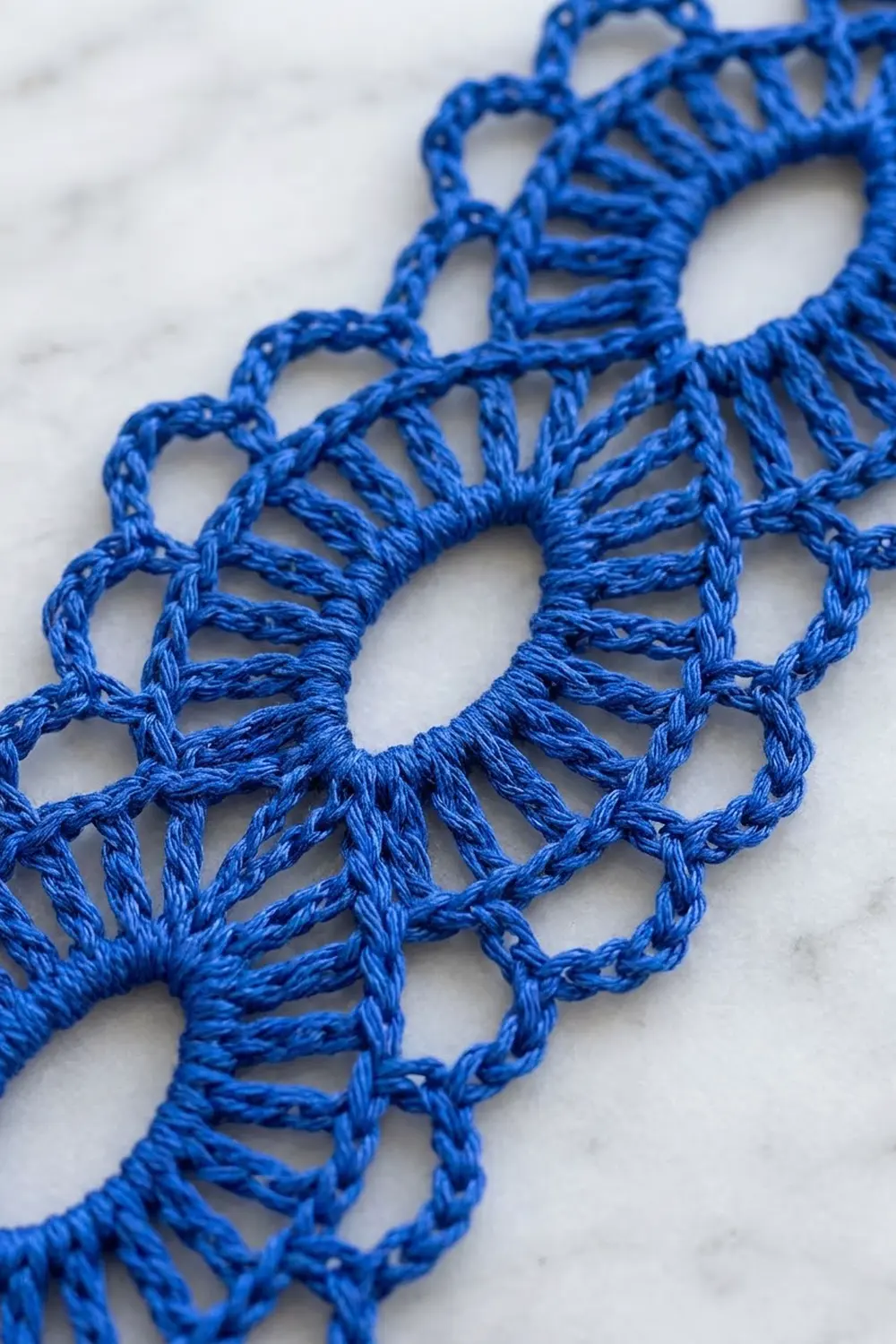
Eye 15 (large fan): Into the ch-14 arch, work tr, (ch 2, tr) 9 times. That makes 10 tr and 9 ch-2 sps.
Sc in each of the next 6 sc (block 14).
Eye 14 (small fan): Work 12 sc into the ch-14 arch.
Continue down the strip. Odd-numbered eyes get large fans, even-numbered eyes get small fans, and every block gets 6 sc. End with block 0.
Count: 96 block sc + 84 small-fan sc (7 × 12) = 180 sc; 80 tr (8 large fans × 10); 72 ch-2 sps.
The tr stitches in each large fan should spread out like the spokes of a half wheel. If a fan cups, make your ch-2 spaces looser.
Row 3 (Left-Side Fans)
Ch 1 and rotate the strip. You’re now working up the left side, from bottom to top, along the foundation chain.
Sc in each of the 6 free loops of block 0.
Eye 1 (small fan): Working over the 14 skipped foundation ch, work 12 sc.
Sc in each of the 6 free loops of block 1.
Eye 2 (large fan): Working over the 14 skipped foundation ch, work tr, (ch 2, tr) 9 times.
Continue up the strip. On this side, even-numbered eyes get large fans and odd-numbered eyes get small fans. End with block 15.
Count: 96 block sc + 96 small-fan sc (8 × 12) = 192 sc; 70 tr (7 large fans × 10); 63 ch-2 sps.
Every eye now has a large fan on one side and a small, flat sc fan on the other, and the large fans switch sides at each eye. This creates the S-shaped twist. The strip should measure about 3 in (7.6 cm) across a large fan. Don’t fasten off.
Make All Pieces
Make 4 strips in Color A and 3 in Color B. All seven use the same pattern with no changes.
Layout (left to right):
| A | B | A | B | A | B | A |
Joining (Hanging the Strips)
The strips are not stitched together. Each one hangs from its own loop, and the curtain comes together on the rod.
Method: Slide the loops onto the rod in the layout order. Leave 2 in (5.1 cm) between strips: 7 × 4.5 in + 6 × 2 in = 43.5 in (110.5 cm). On a shorter rod, make the gaps smaller instead of overlapping the strips.
Tension advice: Leave all seven strips hanging for 24 hours before you make any adjustments. Cotton lace relaxes a little under its own weight.
Size checkpoint: The bottoms of all seven strips should be within 0.5 in (1.3 cm) of each other. If one strip hangs longer, re-block it slightly shorter instead of taking out stitches.
Border (Edging, Worked on Each Strip)
Border gauge: Each ch-5 loop spans 4 Rnd 1 sts, about 0.75 in (1.9 cm), and stands out 0.5 in (1.3 cm) from the edge.
Each strip gets its own edging. The starting count for each side comes from that strip’s own Rows 2 and 3, and no seam stitches are involved. The 3 sts at each short end are counted separately from the long sides.
Rnd 1 (Leveling Round)
You’re at the top end, where Row 3 finished. Ch 1.
Top end: Work 3 sc across the short end, one into the side of each of Rows 3, 1 and 2.
Right side (top to bottom):
– Over each block: dc in each of the 6 sc.
– Over each large fan: sc in each tr and 2 sc in each ch-2 sp, for 10 + 18 = 28 sc.
– Over each small fan: tr in each of the 12 sc.
Bottom end: Work 3 sc across the short end.
Left side (bottom to top): Work the same way: dc over blocks, 28 sc over large fans and 12 tr over small fans.
Join with a sl st to the first sc.
Count per side:
– Right side: 96 dc + 224 sc (8 × 28) + 84 tr (7 × 12) = 404 sts
– Left side: 96 dc + 196 sc (7 × 28) + 96 tr (8 × 12) = 388 sts
– Each end: 3 sts
– Total: 404 + 388 + 3 + 3 = 798 sts
The tall tr stitches over the small fans and the dc over the blocks bring the edge up level with the large fans. This gives the scallops an even line to sit on.
Rnd 2 (Loop Scallops)
Ch 1.
Top end: Sc in the first end st, ch 5, skip the center end st, sc in the 3rd end st.
Right side: *Sc in next st, ch 5, skip next 3 sts; rep from * 101 times in total.
Bottom end: Sc in the first end st, ch 5, skip the center end st, sc in the 3rd end st.
Left side: *Sc in next st, ch 5, skip next 3 sts; rep from * 97 times in total.
Join with a sl st to the first sc and fasten off.
Count: 101 + 97 + 1 + 1 = 200 ch-5 loops.
Why the math works: Each repeat uses exactly 4 sts (1 sc plus 3 skipped). Since 404 ÷ 4 = 101 and 388 ÷ 4 = 97, each side finishes exactly at its corner with nothing left over. At each end, the sc stitches go into the two outer sts, which keeps the corners square.
Hanging Loop
Join yarn with a sl st in the skipped center st of Rnd 1 at the top end, working behind the ch-5 loop. Ch 24, then sl st in the same st. Ch 1, work 32 sc over the ch-24 loop, sl st to the first sc and fasten off.
The loop measures about 6 in (15.2 cm) around and hangs 3 in (7.6 cm) above the strip. It fits rods up to 1.5 in (3.8 cm) in diameter. Weave in all ends through the solid sc blocks.
Final Blocking
- Soak the strip in cool water for 15 minutes, then gently press out the water without wringing.
- Roll the strip in a towel to remove more moisture.
- Lay it straight on your blocking surface. If the surface is too short, block one half at a time.
- Pin both ends so the strip measures 77.5 in (196.9 cm) long.
- Open each eye to about 1 in (2.5 cm) wide and pin both sides.
- Spread each large fan into an even half circle, pinning at the 1st, 5th and 10th tr.
- Pin each ch-5 loop outward so the strip measures 4.5 in (11.4 cm) wide all along its length.
- Spray lightly and let it dry for at least 24 hours.
- Hang the strip for a day and measure again. It should be 77.5–78 in (196.9–198.1 cm) long.
Final Quality-Control Checklist
- 15 eyes per strip, each about 1 in (2.5 cm) wide
- Large fans on the right at odd eyes and on the left at even eyes
- Row 2: 180 sc and 80 tr. Row 3: 192 sc and 70 tr
- Rnd 1: 404 sts on the right side, 388 on the left side, 3 at each end
- Rnd 2: 200 ch-5 loops
- Strip measures 4.5 × 77.5 in (11.4 × 196.9 cm)
- Hanging loop firmly attached at the top center
- 4 blue and 3 cream strips, with lengths within 0.5 in (1.3 cm) of each other
- All ends woven in through solid sections
Troubleshooting
The strip spirals. The foundation chain was twisted when you worked Row 1. Blocking can correct a mild twist, but a strong one means remaking the strip.
The large fans ruffle. Use ch 1 between the tr instead of ch 2. Keep 10 tr per fan, and work 2 sc in each ch-1 sp in Rnd 1 so each fan still has 28 sts.
The eyes close up. Chain the ch-14 arches more loosely, and pin each eye open when you block.
A side of Rnd 2 doesn’t end at the corner. Recount Rnd 1 on that side, one segment at a time, until you find the segment that’s off.
The strip is short. You can block in up to 1 in (2.5 cm) of extra length. Beyond that, remake the strip with a looser foundation chain.
The edges wave. Check that you worked tr, not dc, over the small fans in Rnd 1.
Care
Hand wash in cool water with a mild detergent, then dry flat, pinning to size if needed. Shake the strips out now and then to keep dust from settling in the lace.
Final Notes
All the measurements start from the foundation chain. At 20 ch = 5 in (12.7 cm), 306 working chains give a body of 76.5 in (194.3 cm), and the edging at the ends brings the strip to 77.5 in (196.9 cm). Across the strip, the fans measure 3 in (7.6 cm), the leveling round brings it to 3.5 in (8.9 cm), and the loops bring it to 4.5 in (11.4 cm). Seven strips with 2 in (5.1 cm) gaps fill 43.5 in (110.5 cm) of rod and hang 80.5 in (204.5 cm). Check each measurement before moving on to the next stage, and the curtain will hang straight.
Happy crocheting!