

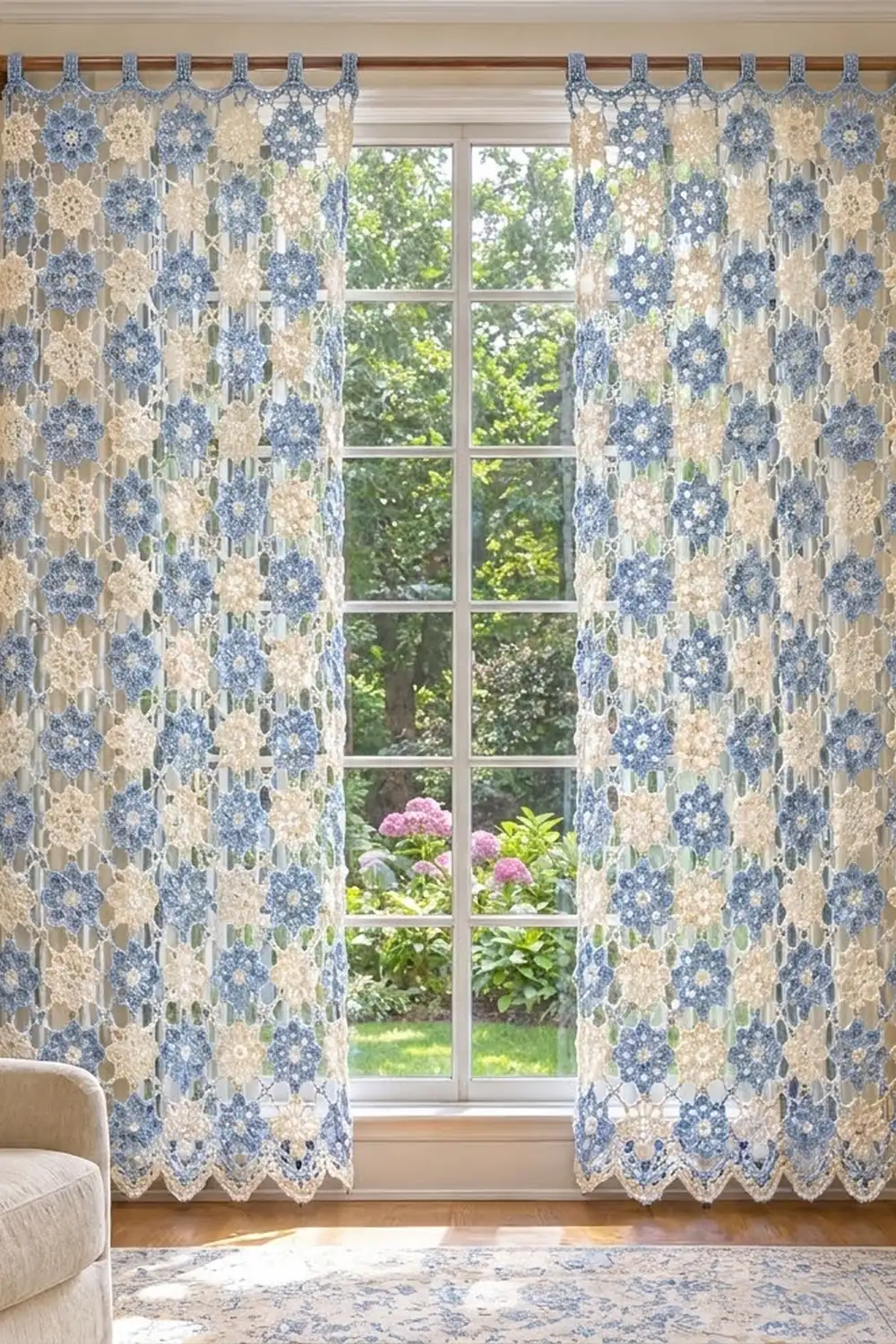
This curtain panel is a grid of square motifs. Each one has an eight-petal flower in the middle and an open cream mesh frame around it. The flowers alternate cornflower blue and cream in a checkerboard. When light comes through the window, the frames read as one continuous lattice between them.
The palette is soft. Every flower has a cream center, which gives the blue flowers a bright little eye. A blue border runs down both sides, six blue tabs hold the panel on the rod, and a row of blue shell scallops finishes the hem. The look is cottage-style and airy.
All instructions use US crochet terms. One finished panel measures 26 in x 77 in (66.0 cm x 195.6 cm) from the top edge to the scallop tips. The tab loops add about 2.5 in (6.4 cm) above that. Most windows take two panels, as shown.
Each panel is 75 square motifs worked in rounds and joined with slip stitches into a grid 5 motifs wide by 15 long. After that you work a two-round border, add tabs along the top and scallops along the bottom, and block.
Finished Size and Construction
- Finished panel size: 26 in x 77 in (66.0 cm x 195.6 cm), not counting the tabs
- Skill level: Intermediate
- Terminology: US crochet terms
- Yarn weight: Worsted (#4) cotton
- Hook: 5.0 mm (H-8)
- Number of pieces: 75 motifs per panel (150 for a pair)
- Layout: 5 motifs wide x 15 long, blue and cream flowers in a checkerboard
- Motif size: 5 in x 5 in (12.7 cm x 12.7 cm), blocked
- Size before border: 25 in x 75 in (63.5 cm x 190.5 cm)
- Border depth: 0.5 in (1.3 cm) on the sides and top, plus 1 in (2.5 cm) of scallops at the hem
Materials
Use a smooth worsted-weight cotton, about 85 m per 50 g. Mercerized cotton gives the crispest petals and holds its shape well on a rod. Avoid acrylic, because a long hanging panel can stretch in warm sun.
Quantities for a pair of panels:
- Color A, Cornflower Blue: 550 g, about 935 m (76 blue flowers, plus borders, tabs, and scallops)
- Color B, Cream: 1,650 g, about 2,805 m (all flower centers, 74 cream flowers, and all mesh frames)
For one panel, use half these amounts. All quantities include about a 10% margin for swatching, joining, and dye-lot safety.
Tools:
- 5.0 mm (H-8) crochet hook
- Tapestry needle
- Stitch markers
- Rust-proof pins and blocking mats
- Spray bottle
- Measuring tape
Abbreviations (US Terms)
- ch: chain
- sl st: slip stitch
- sc: single crochet
- hdc: half double crochet
- dc: double crochet
- tr: treble crochet
- sk: skip
- sp: space
- st(s): stitch(es)
- MR: magic ring
- RS / WS: right side / wrong side
Petal tip: the center (3rd) dc of a petal’s 5 dc. It is the 5th of that petal’s 9 stitches.
Gauge and Checkpoints
Make one full motif and block it before you go further. This motif is your gauge swatch.
Motif gauge: one blocked motif is 5 in x 5 in (12.7 cm x 12.7 cm). Along one side, 19 sc = 5 in (12.7 cm), which is 3.8 sc per inch.
Checkpoints (measure unblocked, lying flat):
- After Round 1: 1.5 in (3.8 cm) across
- After Round 3: 3.5 in (8.9 cm) from one petal tip to the opposite tip
- After Round 5: 4 in (10.2 cm) square
- After Round 7: 4.75 in (12.1 cm) square, which blocks to 5 in (12.7 cm)
If the motif is too big, use a 4.5 mm hook. If it’s too small, use a 5.5 mm hook. Keep the chains in Rounds 4 and 6 relaxed, because tight chains make the frame pucker. Every later measurement depends on this motif.
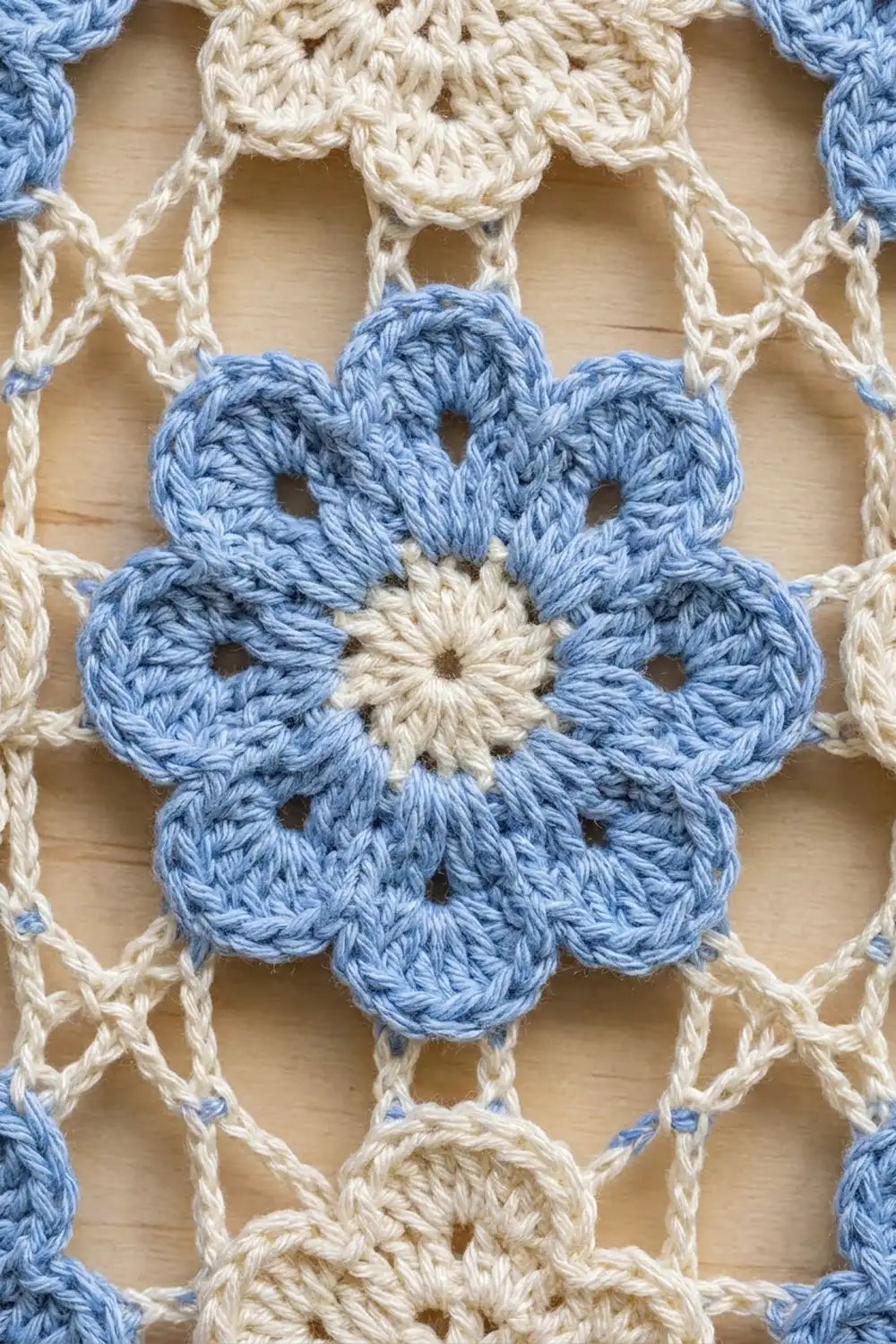
Square Flower Motif
Per panel, make 38 motifs with blue (A) flowers and 37 with cream (B) flowers. Round 1 is always worked in B.
Round 1 (B): MR, ch 3 (counts as dc), 15 dc in ring, join with sl st to top of ch-3. (16 dc)
For a blue flower, fasten off B and join A in any dc. For a cream flower, keep going with B.
Round 2 (flower color): Ch 1, sc in same st, ch 4, sk next st, sc in next st, ch 4, sk next st 7 times, join with sl st to first sc. (8 sc, 8 ch-4 sps)
Round 3 (flower color): Sl st into first ch-4 sp. In each of the 8 ch-4 sps, work (sc, hdc, 5 dc, hdc, sc). Join with sl st to first sc. (8 petals of 9 sts = 72 sts)
Fasten off the flower color. The flower should lie flat, with eight even, rounded petals.
Round 4 (B): Join B with sc in any petal tip, ch 5, sc in next petal tip, ch 5 7 times, join with sl st to first sc. (8 sc, 8 ch-5 sps)
Round 5 (B), squaring round: Sl st into first ch-5 sp, ch 4 (counts as tr), (2 tr, ch 3, 3 tr) in same sp for the first corner. 5 dc in next ch-5 sp, (3 tr, ch 3, 3 tr) in next ch-5 sp 3 times, 5 dc in last ch-5 sp, join with sl st to top of ch-4. (24 tr + 20 dc = 44 sts and 4 ch-3 corner sps. Each side has 11 sts: 3 tr + 5 dc + 3 tr.)
Round 6 (B), mesh round: Sl st in next 2 tr and into the corner ch-3 sp, ch 6 (counts as dc + ch 3), dc in same sp. [Ch 3, sk 2 sts, dc in next st] 3 times, ch 3, sk last 2 sts of the side, (dc, ch 3, dc) in next corner sp 3 times. [Ch 3, sk 2 sts, dc in next st] 3 times, ch 3, sk last 2 sts, join with sl st to 3rd ch of beginning ch-6. (8 corner dc + 12 side dc = 20 dc, with 16 side ch-3 sps and 4 corner ch-3 sps)
Each side now has 4 open mesh windows. These windows form the lattice between the flowers.
Round 7 (B), edge round: Sl st into corner sp, ch 1, (sc, ch 2, sc) in same sp. Sc in next dc, [3 sc in next ch-3 sp, sc in next dc] 3 times, 3 sc in next ch-3 sp, sc in next dc, (sc, ch 2, sc) in corner sp 3 times. Work the side sequence once more, leaving out the final corner, and join with sl st to first sc. Fasten off.
Count check: each side has 1 corner sc + 1 dc + 12 sc in sps (4 sps x 3 sc) + 3 dc + 1 dc + 1 corner sc = 19 sc, including the corner sc at each end. The total is 76 sc plus 4 ch-2 corner sps.
Make All Pieces
Per panel: 38 blue-flower motifs and 37 cream-flower motifs. For a pair: 76 blue and 74 cream.
Lay the motifs out RS up, with Row 1 at the top. A = blue flower, B = cream flower.
Row  1:  A B A B A
Row  2:  B A B A B
Row  3:  A B A B A
 ...    (alternate to Row 15)
Row 15:  A B A B A
The 8 odd rows have 3 blue and 2 cream each, and the 7 even rows have 2 blue and 3 cream. Blue: 24 + 14 = 38. Cream: 16 + 21 = 37.
Joining
Join with sl sts in Color B on the WS. This makes a flat cream seam that blends into the mesh.
- Hold two motifs RS together with their edges matched.
- Sl st through both corner ch-2 sps.
- Sl st through the back loops of each matching pair of sc: 19 sts to 19 sts, one to one.
- Finish with a sl st through the next pair of corner ch-2 sps.
Join each horizontal row of 5 motifs first. Then join the 15 rows with long seams, working straight across the corners already joined. Where four corners meet, work through all the meeting corner sps so you don’t leave a hole.
Tension: each sl st should be about as long as the sc under it. If a seam pulls tighter than the motifs beside it, go up one hook size for joining only.
Size checkpoint: the joined panel should measure 25 in x 75 in (63.5 cm x 190.5 cm). If each motif comes up 0.25 in (0.6 cm) short, the panel will be more than 3.5 in (8.9 cm) short over 15 rows, so check often.
Border
Border gauge: 19 sc = 5 in (12.7 cm), which matches the motif edges.
Starting counts:
- Short sides: 5 motifs x 19 sc = 95 sc
- Long sides: 15 motifs x 19 sc = 285 sc
At seams, don’t work into the joined corner ch-2 sps. Step straight from the last sc of one motif to the first sc of the next, so each side stays exactly (motifs x 19).
Round 1 (A): With RS facing, join A in the top-right panel-corner ch-2 sp, ch 1, sc in same sp (corner st). Sc in each sc along the side, sc in next panel-corner ch-2 sp (corner st) around, ending the last side at the starting corner. Join with sl st to first sc. (95 + 285 + 95 + 285 = 760 side sts + 4 corner sts = 764 sts)
Round 2 (A): Ch 1, 3 sc in corner st, sc in each sc to next corner st, 3 sc in corner st around, then sc in each sc back to the start. Join and fasten off. (Short sides: 95 + 2 = 97 sc. Long sides: 285 + 2 = 287 sc. Total: 97 + 287 + 97 + 287 + 4 corner sts = 772 sts.)
Why the math works: the border keeps the motifs’ 3.8 sc per inch with no ease stitches, so the sides lie flat. The only extra stitches are the 2 per side from the corner increases, and they sit on the corner curves.
Top Tabs (A)
Work across the 97 top-edge sc of Round 2, leaving the corner sts unworked. You’ll make 6 tabs of 7 sts with 11-st gaps between them: 6 x 7 + 5 x 11 = 42 + 55 = 97.
Mark sts 1–7, 19–25, 37–43, 55–61, 73–79, and 91–97.
Each tab: With RS facing, join A in the first marked st.
– Row 1: Ch 1, sc in same st and next 6 sts, turn. (7 sc)
– Rows 2–22: Ch 1, sc in each st across, turn. (7 sc)
Fasten off, leaving a long tail. Each tab is about 5 in (12.7 cm) long. Fold it to the WS and sew the last row behind Border Round 1. This makes a loop about 2.5 in (6.4 cm) tall. Before you sew, check that your rod fits through.
Bottom Scallops (A)
With RS facing, work across the 97 bottom-edge sc of Round 2, leaving the corner sts unworked.
Scallop Row: Join A in first st, ch 1, sc in same st, sk 2 sts, 7 dc in next st, sk 2 sts, sc in next st 16 times. (1 + 16 x 6 = 97 sts; 16 scallops) Fasten off.
Finished panel: width 0.5 + 25 + 0.5 = 26 in (66.0 cm). Length 0.5 + 75 + 0.5 + 1 = 77 in (195.6 cm).
Final Blocking
- Weave all ends along the seams so they hide in the mesh.
- Lay the panel flat on mats or on towels over carpet. You can block it in sections.
- Mist until damp but not soaked.
- Pin the sides 26 in (66.0 cm) apart. Then pin each seam line at 5 in (12.7 cm) intervals down the length.
- Pin each scallop tip so the scallops curve out evenly.
- Open the petals with your fingers so they’re round and even.
- Let each section dry completely before moving the pins.
Final Quality-Control Checklist
- Each motif has 19 sc per side and is 5 in (12.7 cm) square
- Every blue flower has a cream center, and the checkerboard is unbroken
- No holes where four corners meet
- Border Round 2 counts 97 and 287 sts per side
- The 6 tabs are evenly spaced and the same size
- 16 scallops lie flat across the hem
- The panel is 26 in x 77 in (66.0 cm x 195.6 cm)
- Paired panels match in length within 0.5 in (1.3 cm)
Troubleshooting
Petals cup forward: Round 3 is too tight. Loosen your dc tension.
Mesh frame ruffles: the Round 6 chains are too loose. Use a hook a half size smaller for that round.
Motif isn’t square: check that Round 5 has tr corners and 5 dc in each side sp.
Border ripples: you probably worked into the seam sps. Rip back so each side is motifs x 19 again.
Border pulls in: loosen up, or use a 5.5 mm hook for the border.
Panel grows on the rod: cotton relaxes when it hangs. Re-block and dry it flat.
Care
Hand wash in cool water, or machine wash on a gentle cycle inside a mesh bag. Dry flat and reshape. Don’t hang it while it’s wet, because the weight will stretch it.
Final Notes
Here’s how the measurements connect. Each motif has 19 sc per side and blocks to 5 in (12.7 cm). Five motifs across and 15 down make 25 in x 75 in (63.5 cm x 190.5 cm). The border sides start at exactly 95 and 285 sts, and the tabs and scallops both divide evenly into 97. The finished panel is 26 in x 77 in (66.0 cm x 195.6 cm). If your first motif matches the gauge, every later measurement will work out.
Happy crocheting!