

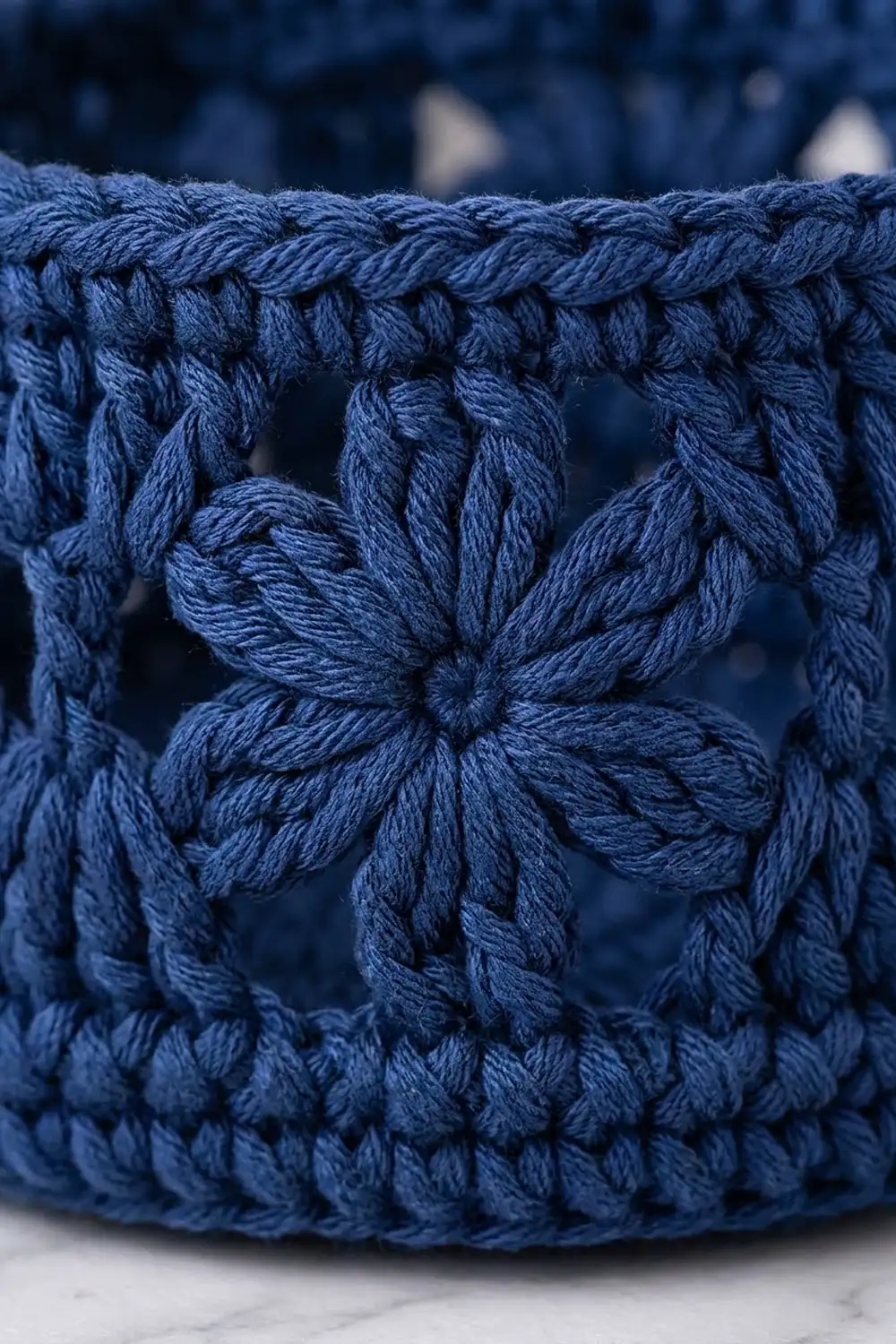
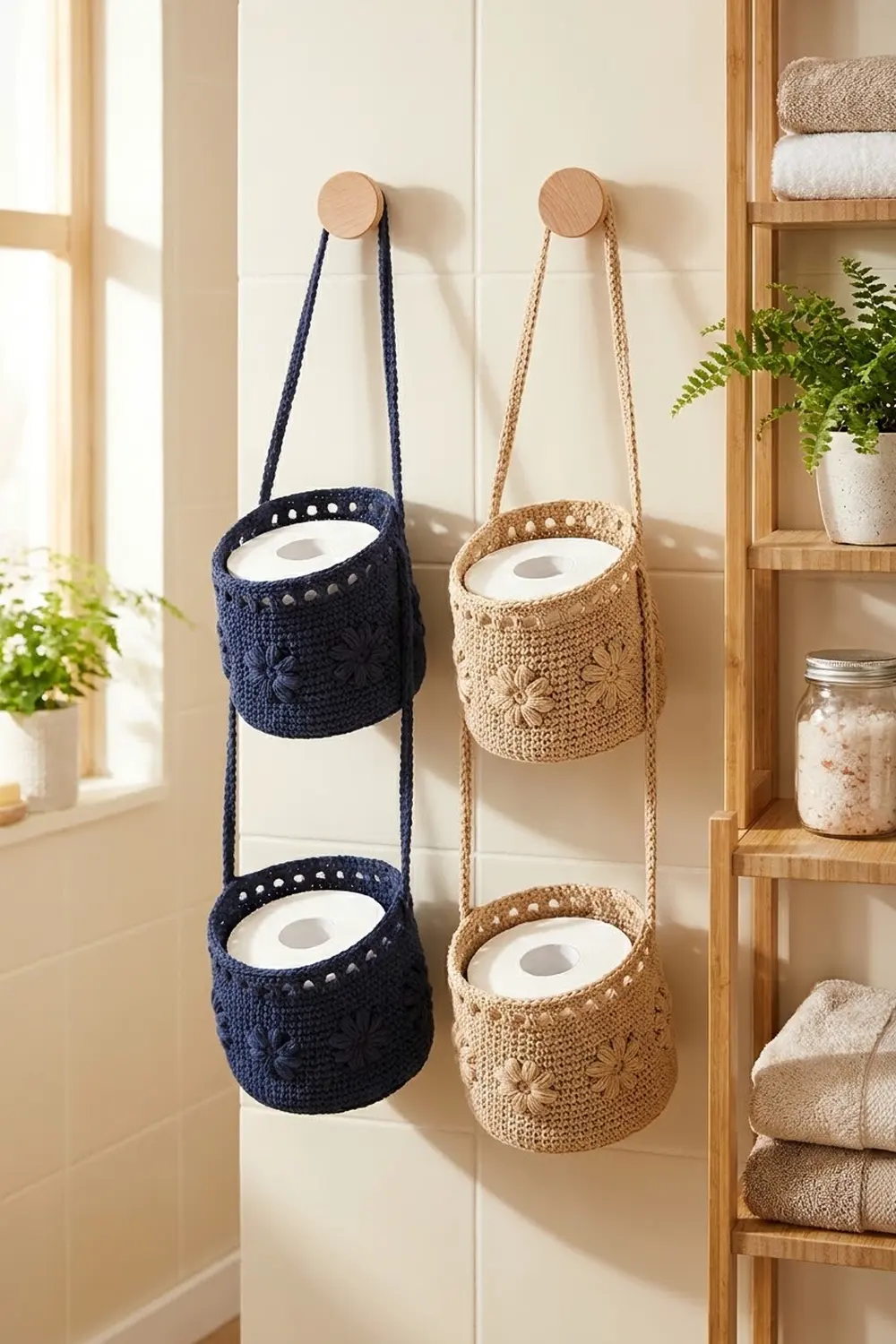
This two-tier hanging holder keeps two spare toilet rolls on one wall hook. It has two oval baskets with flat bottoms. Each basket has a band of puffy flowers around the lower side, a row of eyelets above it, and a firm rope-like rim. Two cords link the baskets, and a long cord forms a triangle at the top for hanging.
The sample is worked in deep navy cotton, which looks calm and tidy in a bathroom. A warm beige version looks just as good. The style is soft farmhouse: textured but simple, with nothing extra to sew on.
All instructions use US crochet terms. Each basket base measures about 6.75 in x 5 in (17.1 cm x 12.7 cm), and each basket is 3.5 in (8.9 cm) tall. A standard roll, about 4.5 in (11.4 cm) wide and 4 in (10.2 cm) tall, sits inside with its top showing. Once hung, the holder is about 23.25 in (59.1 cm) from the hanging point to the bottom basket.
Construction is simple. You work each base in joined oval rounds, turn the sides up with a back-loop round, then add the flower band, the eyelet rim and a crab-stitch edge. Last, you make three cords and sew everything together.
Finished Size and Construction
- Basket base: 6.75 in x 5 in (17.1 cm x 12.7 cm)
- Basket height: 3.5 in (8.9 cm)
- Total hanging length: about 23.25 in (59.1 cm)
- Skill level: Intermediate
- Terminology: US
- Yarn weight: Worsted/aran (#4) cotton or cotton cord
- Hook: 5 mm (H-8)
- Number of pieces: 5 (2 baskets, 2 connector cords, 1 hanging cord)
- Layout: 2 baskets stacked vertically, linked at their short ends
- Basket height before rim: 2.5 in (6.4 cm)
- Rim depth: 1 in (2.5 cm)
Materials
Use a smooth, firm cotton or cotton cord in worsted/aran weight. Cotton holds its shape under load and stretches very little along the cords. Avoid acrylic blends that sag, because the cords carry the weight of both rolls.
- Navy (sample color): 160 g, about 270 m (295 yd)
- Optional beige colorway: the same amount, 160 g, about 270 m (295 yd)
These quantities include a margin of about 15% for your gauge check and weaving in ends.
Tools:
- 5 mm (H-8) crochet hook
- Tapestry needle
- 4 stitch markers
- Measuring tape
- Scissors
- Pins and a spray bottle for blocking
Abbreviations (US Terms)
- ch – chain
- sl st – slip stitch
- sc – single crochet
- dc – double crochet
- tr – treble crochet
- BLO – back loop only
- inc – 2 sc in the same stitch
- sp – space
- st(s) – stitch(es)
- rep – repeat
Cluster (cl): [Yarn over, insert hook in the stitch, pull up a loop, yarn over, draw through 2 loops] 3 times in the same stitch, then yarn over and draw through all 4 loops on the hook.
Crab stitch (reverse sc): Work sc from left to right (right to left if you crochet left-handed), inserting the hook into the next stitch to the right.
Gauge and Checkpoints
Gauge: 14 sc x 15 rounds = 4 in (10.2 cm) in sc.
Make one full basket before you start the second. It works as a large swatch and shows you whether a roll fits.
Checkpoints:
- After Round 5 (42 sts): base about 4.75 in x 3 in (12.1 cm x 7.6 cm)
- After Round 9 (66 sts): base 6.75 in x 5 in (17.1 cm x 12.7 cm); outer edge about 18.75 in (47.6 cm)
- After Round 12: sides about 0.75 in (1.9 cm) tall
- After Round 15: sides 2.5 in (6.4 cm) tall
- After Round 18: basket 3.5 in (8.9 cm) tall
If your basket is too big, use a hook 0.5 mm smaller. If it is too small, use a hook 0.5 mm larger. The base must be at least 4.75 in (12.1 cm) across the short side, or a standard roll will not drop in. Change the hook, not the stitch counts, because the flower band needs exactly 66 sts.
Basket (Make 2)
Join every round with a sl st to the first st. The ch 1 at the start of a round does not count as a stitch.
Oval Base
The base has two straight sections of 6 sts and two curved ends. Each end gains 3 sts per round, so every round grows by 6 sts.
Round 1: Ch 9. Work 3 sc in 2nd ch from hook, sc in next 6 ch, 3 sc in last ch. Rotate and work along the free loops: sc in next 6 ch. Join. (18 sts: 3 + 6 + 3 + 6)
Round 2: Ch 1, [2 sc in each of next 3 sts, sc in next 6] twice. Join. (24 sts)
Round 3: Ch 1, [(sc in next st, inc) 3 times, sc in next 6] twice. Join. (30 sts)
Round 4: Ch 1, [(sc in next 2 sts, inc) 3 times, sc in next 6] twice. Join. (36 sts)
Round 5: Ch 1, [(sc in next 3 sts, inc) 3 times, sc in next 6] twice. Join. (42 sts)
Round 6: Ch 1, [(sc in next 4 sts, inc) 3 times, sc in next 6] twice. Join. (48 sts)
Round 7: Ch 1, [(sc in next 5 sts, inc) 3 times, sc in next 6] twice. Join. (54 sts)
Round 8: Ch 1, [(sc in next 6 sts, inc) 3 times, sc in next 6] twice. Join. (60 sts)
Round 9: Ch 1, [(sc in next 7 sts, inc) 3 times, sc in next 6] twice. Join. (66 sts: 27 + 6 + 27 + 6)
The increases stack on top of each other, so each end gets three soft corners. This makes the base a rounded rectangle rather than an egg shape. Put a marker in the 14th stitch of each 27-st end. These are the end centers, where the cords will attach.
Sides
Round 10: Ch 1, sc in BLO of each st around. Join. (66 sts) This round makes a crisp fold where the sides rise.
Rounds 11–12: Ch 1, sc in each st around. Join. (66 sts)
Flower Band
Round 13 (lower petals): Ch 1, sc in first st, skip 2 sts, (cl, ch 2, cl, ch 2, cl) in next st, skip 2 sts, sc in next st; rep from * 10 more times, but leave out the final sc on the last repeat. Join to the first sc. (11 fans of 3 cl, 11 sc, 22 ch-2 sps)*
Each repeat uses 6 sts, and 11 x 6 = 66, so the round ends exactly where it began.
Round 14 (top petals): Ch 4 (counts as tr), ch 2, sc in top of first cl of the fan, ch 2, cl in top of center cl, ch 2, sc in top of third cl, ch 2; tr in next sc, ch 2, sc in top of first cl, ch 2, cl in top of center cl, ch 2, sc in top of third cl, ch 2; rep from * 9 more times. Join to the top of the beginning ch-4. (11 tr, 22 sc, 11 cl, 44 ch-2 sps)*
The center cluster stacks on top of the fan, so each flower ends up with four plump petals. The tr fills the dip between two flowers.
Round 15 (conversion): Ch 1, sc in tr, skip ch-2 sp, sc in sc, sc in ch-2 sp, sc in cl, sc in ch-2 sp, sc in sc, skip ch-2 sp; rep from * 10 more times. Join. (66 sts: 44 worked into stitches + 22 worked into ch-2 sps)*
The sides should now be 2.5 in (6.4 cm) tall.
Make All Pieces
Connector Cord (Make 2)
Row 1: Ch 29, sc in back bump of 2nd ch from hook and each ch across. (28 sc)
Row 2: Do not turn. Ch 1, rotate, and sl st in each free loop of the foundation ch. (28 sl sts) Fasten off, leaving a 10 in (25.4 cm) tail.
Cord length: 8 in (20.3 cm). Cord gauge: 7 sc = 2 in (5.1 cm).
Hanging Cord (Make 1)
Row 1: Ch 78, sc in back bump of 2nd ch from hook and each ch across. (77 sc)
Row 2: Work as for the connector cord. (77 sl sts) Fasten off, leaving a 10 in (25.4 cm) tail.
Cord length: 22 in (55.9 cm).
Piece totals, all in navy: 2 baskets, 2 connector cords, 1 hanging cord.
Layout grid:
         /\         hanging cord
        /  \
   [ TOP BASKET ]
     |        |     connector cords
     |        |
   [ LOW BASKET ]
Joining
Sew the pieces together with the cord tails and a tapestry needle, using whipstitch. On each basket, attach the cords at the marked end centers so the weight hangs evenly from both short ends.
Hanging cord to top basket: Lay 0.75 in (1.9 cm) of one cord end (about 3 sts) flat against the inside wall, just below the rim at an end marker. Whipstitch around all edges of the overlap, going through both the cord and the basket wall. Repeat at the other end marker without twisting the cord.
Connectors to top basket: Lay 3 sts of a connector against the outside wall at an end marker, starting at the Round 10 fold and running upward. Sew it in place. Repeat at the other end.
Connectors to lower basket: Sew the free end of each connector to the inside wall of the lower basket at the matching end marker. Overlap 3 sts just below the rim, the same way you attached the hanging cord.
Tension: Make each stitch snug, but don’t pull so hard that the wall puckers. Sew through whole stitches, not just through a loop on the surface, because these seams carry the weight.
Size checkpoint: Hold the holder up by the hanging cord. The gap between the bottom of the top basket and the rim of the lower basket should be 6.5 in (16.5 cm). Both baskets should hang level.
Border (Rim)
Work these rounds on each basket straight after Round 15. The rim gauge matches the body: 14 sts = 4 in (10.2 cm).
Round 16 (eyelets): Ch 4 (counts as dc + ch 1), skip next st, dc in next st, ch 1, skip next st; rep from * 31 more times. Join to 3rd ch of beginning ch-4. (33 dc + 33 ch-1 sps)*
Round 17: Ch 1, sc in each dc and in each ch-1 sp around. Join. (66 sts: 33 + 33; by section 27 + 6 + 27 + 6)
Round 18: Ch 1, crab stitch in each st around. Join. (66 sts: 27 + 6 + 27 + 6) Fasten off and weave in the end.
Why the math works: 66 is even, so the eyelet pattern of 1 dc and 1 skipped stitch divides into 33 pairs with nothing left over. Round 17 puts one sc into each of the 66 positions (every dc and every space), so the counts on the curved ends and straight sides match Round 9 again. The rim stays the same size as the base and does not flare. These three rounds add 1 in (2.5 cm), taking the basket from 2.5 in (6.4 cm) to 3.5 in (8.9 cm).
Final Blocking
- Weave in all ends before you block.
- Mist each basket until it is damp but not soaked.
- Stuff each basket firmly with a towel, or put a roll inside, so the walls stand straight.
- Press the base flat against a table and check that it is 6.75 in x 5 in (17.1 cm x 12.7 cm).
- Pin the cords out straight and mist them lightly.
- Let everything dry completely, for at least 12 hours.
- Hang the holder empty for a day so the cords settle before you add rolls.
Final Quality-Control Checklist
- Both baskets have 66 sts in Rounds 9, 15, 17 and 18.
- Each base is 6.75 in x 5 in (17.1 cm x 12.7 cm).
- Each basket is 3.5 in (8.9 cm) tall.
- Each basket has 11 complete flowers.
- The connector cords are 8 in (20.3 cm) and the hanging cord is 22 in (55.9 cm).
- No cord is twisted.
- Every seam overlaps 0.75 in (1.9 cm) and is stitched along all edges.
- Both baskets hang level, with a 6.5 in (16.5 cm) gap between them.
Troubleshooting
The base cups upward: Your tension is tight or you missed an increase. Check your counts against the totals. If they are correct, use a hook 0.5 mm larger.
The base ruffles: You probably added extra stitches. Recount; Round 9 must have exactly 66 sts.
The flower band doesn’t line up with the start: One repeat used 5 or 7 sts. Each repeat must use exactly 6 sts.
The rim flares: You worked 2 sc into some ch-1 spaces. Work only 1 sc per space in Round 17.
The baskets tilt: The cords are off-center. Reattach them at the 14th stitch of each 27-st end.
The cords stretch: Switch to a firmer cotton cord, or add a second row of sl sts along the cord.
Care
Hand wash in cool water with mild soap. Reshape and dry flat over a roll so the walls stay straight.
Final Notes
Each measurement builds on the one before. At 14 sc = 4 in (10.2 cm), Round 9 gives a 66-st base of 6.75 in x 5 in (17.1 cm x 12.7 cm). The sides reach 2.5 in (6.4 cm) at Round 15, and the rim adds 1 in (2.5 cm) for a 3.5 in (8.9 cm) basket. Each 8 in (20.3 cm) connector leaves a 6.5 in (16.5 cm) gap, and the 22 in (55.9 cm) hanging cord completes a holder about 23.25 in (59.1 cm) long. Check each stage against these numbers and your holder will match.
Happy crocheting!