
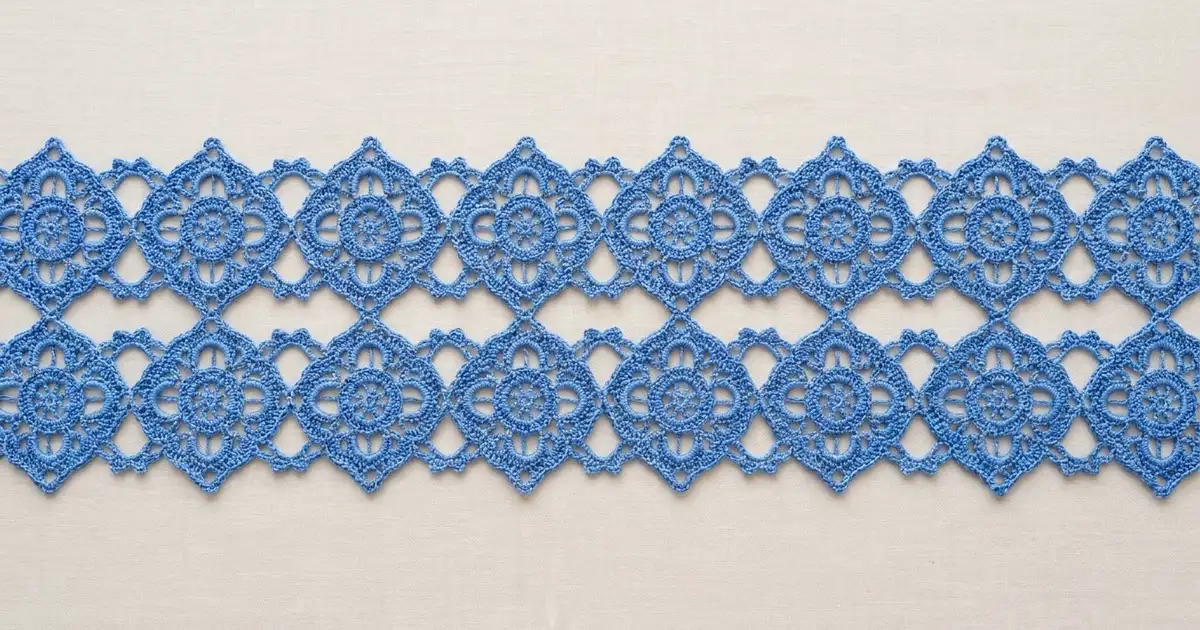
The Bluebell Wheel Lace Table Runner is a long, airy strip of square lace motifs in a single shade of cornflower blue. Each motif has a small spoked wheel at its center, a solid ring around the wheel, and four large arched windows that open toward the sides. The motif corners come to neat points, so the runner has a softly pointed, scalloped outer edge and small open spaces where the motifs meet.
The style is classic thread lace, but it’s worked in sport-weight cotton, so it goes quickly and lies flat on a wooden table. Using one color keeps the focus on the texture: the wheel spokes, the round openings, and the crisp picot border.
This pattern uses US crochet terms. The finished runner measures 10.5 x 40.5 in (26.7 x 102.9 cm) after blocking, including the border.
Construction is simple. You make one motif in 7 rounds, then join 15 more motifs to it on their final round (join-as-you-go). The layout is 2 motifs wide and 8 motifs long. A 2-round picot border finishes the outer edge, and a final wet block opens up the lace.
Finished Size and Construction
- Finished size: 10.5 x 40.5 in (26.7 x 102.9 cm)
- Skill level: Intermediate
- Terminology: US crochet terms
- Yarn weight: Sport / fine (#2) mercerized cotton
- Hook: 3.5 mm (E-4)
- Number of pieces: 16 identical square motifs
- Layout: 2 motifs wide x 8 motifs long
- Motif size: 5 x 5 in (12.7 x 12.7 cm), blocked
- Size before border: 10 x 40 in (25.4 x 101.6 cm)
- Border depth: 0.25 in (0.6 cm) on every side
Materials
Choose a smooth, mercerized cotton in sport weight, about 330 m per 100 g. Mercerized cotton gives crisp stitch definition and holds the shape of the arches after blocking. Avoid fuzzy or very soft yarns, which blur the spokes and the open windows.
Yarn:
– Cornflower blue: 150 g (about 495 m)
That covers 16 motifs at about 7 g (about 23 m) each, plus about 10 g (33 m) for the border, plus a margin of about 20%. Because the quantities include that margin, you’ll have yarn left for a gauge swatch and any repairs.
Tools:
– 3.5 mm (E-4) crochet hook
– Tapestry needle
– Scissors
– Stitch markers (4-6)
– Measuring tape or ruler
– Blocking mats and rust-proof pins
– Spray bottle
Abbreviations (US Terms)
- ch: chain
- sl st: slip stitch
- sc: single crochet
- dc: double crochet
- sp: space
- st(s): stitch(es)
- beg: beginning
- rep: repeat
Special stitch (picot): Ch 3, sl st in the 3rd ch from hook. A picot is decorative and doesn’t count as a stitch.
Special technique (drop-loop join): Take the hook out of the working loop. Insert the hook from front to back through the stitch or space on the neighboring motif, pick up the dropped loop, and pull it through. This adds no stitches.
Gauge and Checkpoints
Make one complete motif before you buy all your yarn or commit to the layout. Measure it, block it, and measure it again.
Checkpoints for one motif (lightly steamed or pinned flat):
– After Round 2 (spoked wheel): 1.75 in (4.4 cm) across
– After Round 4 (solid ring): 2.75 in (7.0 cm) across
– After Round 7 (complete motif): 5 x 5 in (12.7 x 12.7 cm), side to side
Final-round gauge: 17 sc = 5 in (12.7 cm) along one motif side, corner to corner. That’s 3.4 sc per 1 in (2.54 cm).
If your motif is too big (more than 5.25 in / 13.3 cm), go down one hook size to 3.25 mm. If it’s too small (less than 4.75 in / 12.1 cm), go up to 3.75 mm. A difference of 0.25 in (0.6 cm) per motif adds up to 2 in (5.1 cm) over the 8-motif length, so this check matters.
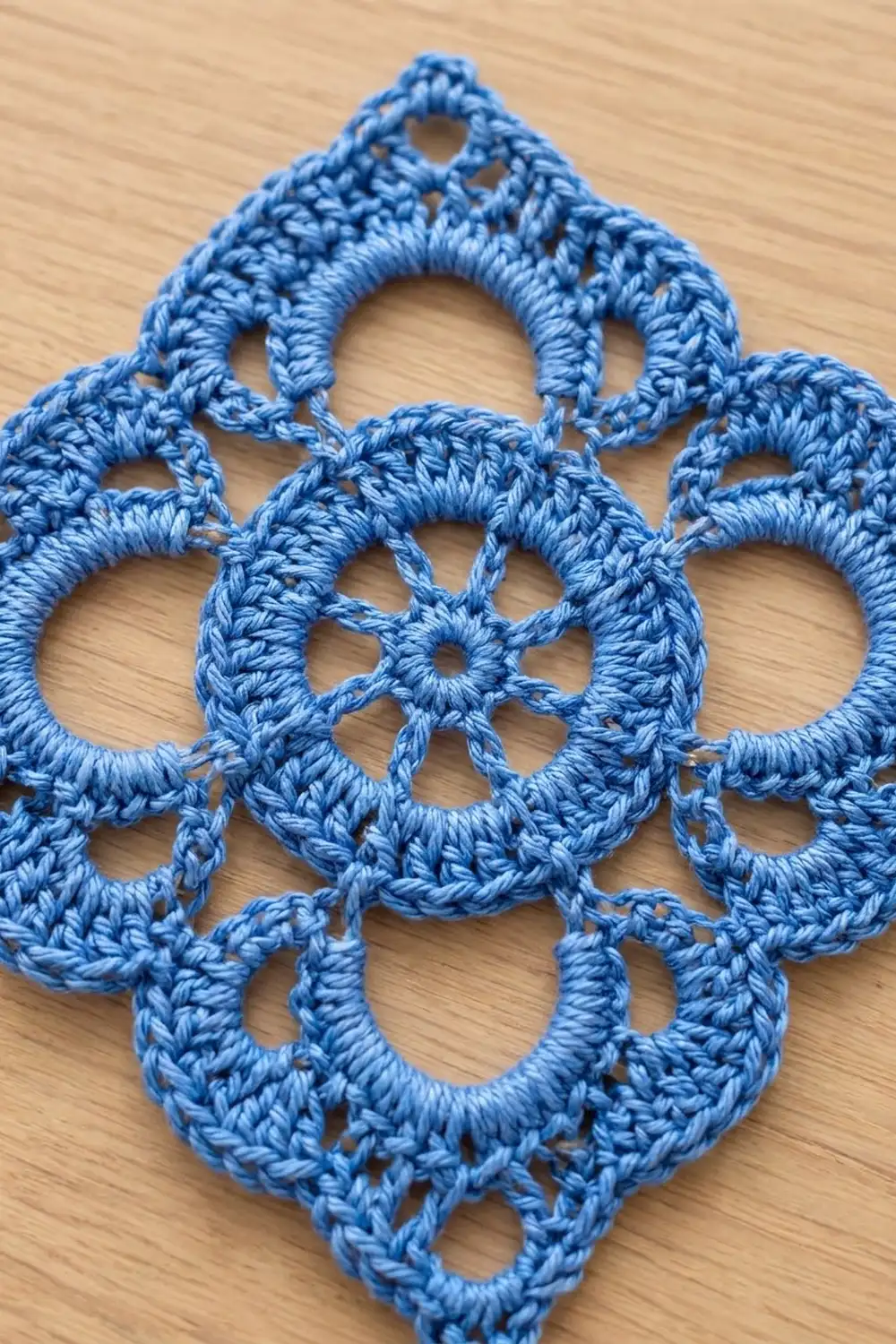
Motif (Make 16)
Work Motif 1 completely. Work Motifs 2-16 the same way through Round 6, then join them on Round 7 (see Joining).
Round 1: Make a magic ring. Ch 1, 8 sc in ring, sl st to first sc. Pull the ring tightly closed. (8 sc)
Round 2: Ch 6 (counts as dc + ch 3), dc in next sc, ch 3; rep from * 6 more times, sl st to 3rd ch of beg ch-6. (8 dc, 8 ch-3 sps)
This round makes the 8 wheel spokes. Keep the ch-3 sps even so the spokes spread out cleanly.
Round 3: Sl st into first ch-3 sp, ch 1, 5 sc in each ch-3 sp around, sl st to first sc. (40 sc)
Work the sc over the chains and skip the dc spokes, so the spokes stay visible between the groups.
Round 4: Ch 3 (counts as dc), dc in each sc around, sl st to top of beg ch-3. (40 dc)
Rounds 3 and 4 together form the thick solid ring around the wheel. Checkpoint: 2.75 in (7.0 cm) across.
Round 5: Ch 1, sc in same st as join, ch 9, skip next 9 dc, sc in next dc, ch 9, skip next 9 dc; rep from * 2 more times, sl st to first sc. (4 sc, 4 ch-9 loops)
Each repeat uses exactly 10 dc (1 sc + 9 skipped), and 4 x 10 = 40. The 4 sc become the motif corners. The ch-9 loops arch away from the ring and leave the 4 large windows.
Round 6: Ch 5 (counts as dc + ch 2), dc in same sc (first corner made), 13 dc in next ch-9 loop, (dc, ch 2, dc) in next sc; rep from * 2 more times, 13 dc in last ch-9 loop, sl st to 3rd ch of beg ch-5. (60 dc, 4 corner ch-2 sps)
Each side now has 15 dc between corner sps: 1 corner dc + 13 arch dc + 1 corner dc. Packing 13 dc into each ch-9 loop makes the arch firm and round.
Round 7 (Motif 1 only): Sl st into first ch-2 sp, ch 1, (sc, ch 2, sc) in same sp, sc in each of next 15 dc, (sc, ch 2, sc) in next ch-2 sp; rep from * 2 more times, sc in each of next 15 dc, sl st to first sc. Fasten off. (68 sc, 4 corner ch-2 sps)
Stitches per side: 1 corner sc + 15 sc + 1 corner sc = 17 sc. This count already includes both corner sc. 4 sides x 17 = 68 sc, which matches the round total.
Block Motif 1 and confirm it measures 5 x 5 in (12.7 x 12.7 cm).
Make All Pieces
You need 16 motifs, all in cornflower blue:
– 1 motif worked completely (Motif 1)
– 15 motifs worked through Round 6, then joined on Round 7
Weave in the center tail of each motif before Round 7. It’s hard to reach once the motif is joined.
Layout grid (2 wide x 8 long), numbered in working order:
[ 1] [ 2]
[ 3] [ 4]
[ 5] [ 6]
[ 7] [ 8]
[ 9] [10]
[11] [12]
[13] [14]
[15] [16]
Work one row at a time. The left motif in each row joins to the motif above it. The right motif joins to the motif on its left and the motif above it.
Joining
All joins happen during Round 7, using the drop-loop join. Each shared side is joined at 3 points: both corners and the side center. The rest of each side stays free, so small open spaces form between the motifs.
Corner join: In the corner ch-2 sp, work sc, ch 1, drop-loop join into the neighbor’s corner ch-2 sp, ch 1, then sc in the same sp on your motif. The ch 1 + join + ch 1 counts as that corner’s ch-2 sp.
Center join: Along a shared side, work the first 7 of the 15 sc. Work the 8th sc, then drop-loop join into the 8th sc on the neighbor’s matching side, counting from the same corner. Work the remaining 7 sc. The join sits between stitches and adds no stitch.
One joined side: Corner join, 7 sc, 8th sc + center join, 7 sc, corner join. Each joined side still has exactly 17 sc, and each motif still has 68 sc.
Four-corner points: Where 4 motifs meet, join the 3rd and 4th motifs into the existing join loop instead of the ch-2 sp. That way all four corners lock at one point without bulk.
Tension: Keep the joining chains as relaxed as your regular ch-2 corners. Tight joins pull the corners in and make the runner pucker. Loose joins let the motifs drift apart.
Size checkpoint: After joining all 16 motifs, lay the runner flat. It should measure 10 x 40 in (25.4 x 101.6 cm): 2 x 5 in (12.7 cm) wide and 8 x 5 in (12.7 cm) long.
Border
Border gauge: The border keeps the final-round gauge of 3.4 sc per 1 in (2.54 cm), so each motif side gives exactly 17 sc.
Starting counts:
– Each short side: 2 motifs x 17 sc = 34 sc
– Each long side: 8 motifs x 17 sc = 136 sc
No stitches are added at the seams. At each seam, skip the joined corner sps and go straight from the last sc of one motif to the first sc of the next.
Round 1: Join yarn with a sl st in the ch-2 sp at one outer corner of the runner. Ch 1. Working along the side, sc in each sc of each motif, skipping the joined corner sps at the seams; at the next outer runner corner, ch 2 over the corner ch-2 sp; rep from * around, sl st to first sc.
Counts: 34 sc per short side, 136 sc per long side, 4 corner ch-2 sps. Total: 34 + 136 + 34 + 136 = 340 sc.
Round 2 (picot round): Sl st into the corner ch-2 sp, ch 1, (sc, ch 3, sc) in same sp. [Sc in next 2 sc, picot] across the side, (sc, ch 3, sc) in next corner ch-2 sp; rep from * around, leaving out the last corner, sl st to first sc. Fasten off.
Counts per side: each short side has 34 sc worked 1 per stitch + 2 corner sc added = 36 sc, with 17 picots. Each long side has 136 sc worked 1 per stitch + 2 corner sc added = 138 sc, with 68 picots. Total: 340 sc worked 1 per stitch + 8 corner sc added = 348 sc, plus 170 picots and 4 corner ch-3 loops.
Why the math works: The motif’s 17-stitch side is an odd number, but every runner side holds an even number of motifs (2 or 8). That makes both side counts (34 and 136) even. The picot repeat uses 2 stitches, so 34 / 2 = 17 picots and 136 / 2 = 68 picots, with no stitches left over. Because the border keeps the motif gauge, the two rounds add only 0.25 in (0.6 cm) per side, for a finished size of 10.5 x 40.5 in (26.7 x 102.9 cm).
Final Blocking
- Weave in all remaining ends along the back of solid stitches, not through the open chains.
- Soak the runner in cool water for 10-15 minutes, then gently press out the water. Don’t wring it.
- Roll it in a towel to remove extra moisture.
- Lay it on blocking mats and shape it to 10.5 x 40.5 in (26.7 x 102.9 cm).
- Pin each outer motif corner first, then each four-corner join point. Check that every motif is 5 x 5 in (12.7 x 12.7 cm).
- Pin the center of each large arch outward so the windows open into round shapes.
- Pin each corner ch-3 loop. If you like, pin every few picots too so they stand out.
- Let it dry completely, at least 24 hours, before taking out the pins.
Final Quality-Control Checklist
- Every motif has 8 even spokes and a closed center ring.
- Every motif has 68 sc on Round 7, with 17 sc per side.
- All 4 arches on each motif are rounded and the same size.
- Each shared side is joined at exactly 3 points: 2 corners and the center.
- Four-corner points meet in one join loop.
- Border Round 1 has 340 sc. Round 2 has 348 sc and 170 picots.
- The runner measures 10.5 x 40.5 in (26.7 x 102.9 cm) and lies flat.
- All ends are woven in securely and can’t be seen from the front.
Troubleshooting
The wheel center won’t close. Pull the magic ring tight before Round 2, then weave the tail in a circle around the ring.
The arches look flat or ruffled. Count the dc in each ch-9 loop on Round 6. Fewer than 13 flattens the arch, and more than 13 makes it ruffle.
The motif isn’t square. Check that all 4 sc on Round 5 sit exactly 10 stitches apart.
The runner puckers along the seams. The joining chains are too tight. Redo the joins with more relaxed tension, or go up a hook size for Round 7 only.
The border waves. Recount Round 1. Extra stitches at the seams make it ripple, and skipped motif stitches make it draw in.
The runner is too long or too wide. Your motif gauge drifted. Measure several motifs. If they vary, re-block them to 5 x 5 in (12.7 x 12.7 cm) before you add the border.
Care
Hand wash in cool water with mild soap and lay flat to dry, re-pinning the corners if needed. To refresh the lace, press lightly with a warm iron through a cloth.

Final Notes
The measurement chain is short and reliable. Round 2 measures 1.75 in (4.4 cm), Round 4 measures 2.75 in (7.0 cm), and each finished motif measures 5 x 5 in (12.7 x 12.7 cm) with 17 sc per side. Sixteen motifs joined 2 x 8 make 10 x 40 in (25.4 x 101.6 cm). The border starts with 34 and 136 sc per side, adds 0.25 in (0.6 cm) all around, and brings the runner to 10.5 x 40.5 in (26.7 x 102.9 cm).
If your first motif hits its checkpoints, the rest of the runner will follow. Enjoy the rhythm of the wheels and arches, and enjoy setting your table with the finished runner.
Happy crocheting!