

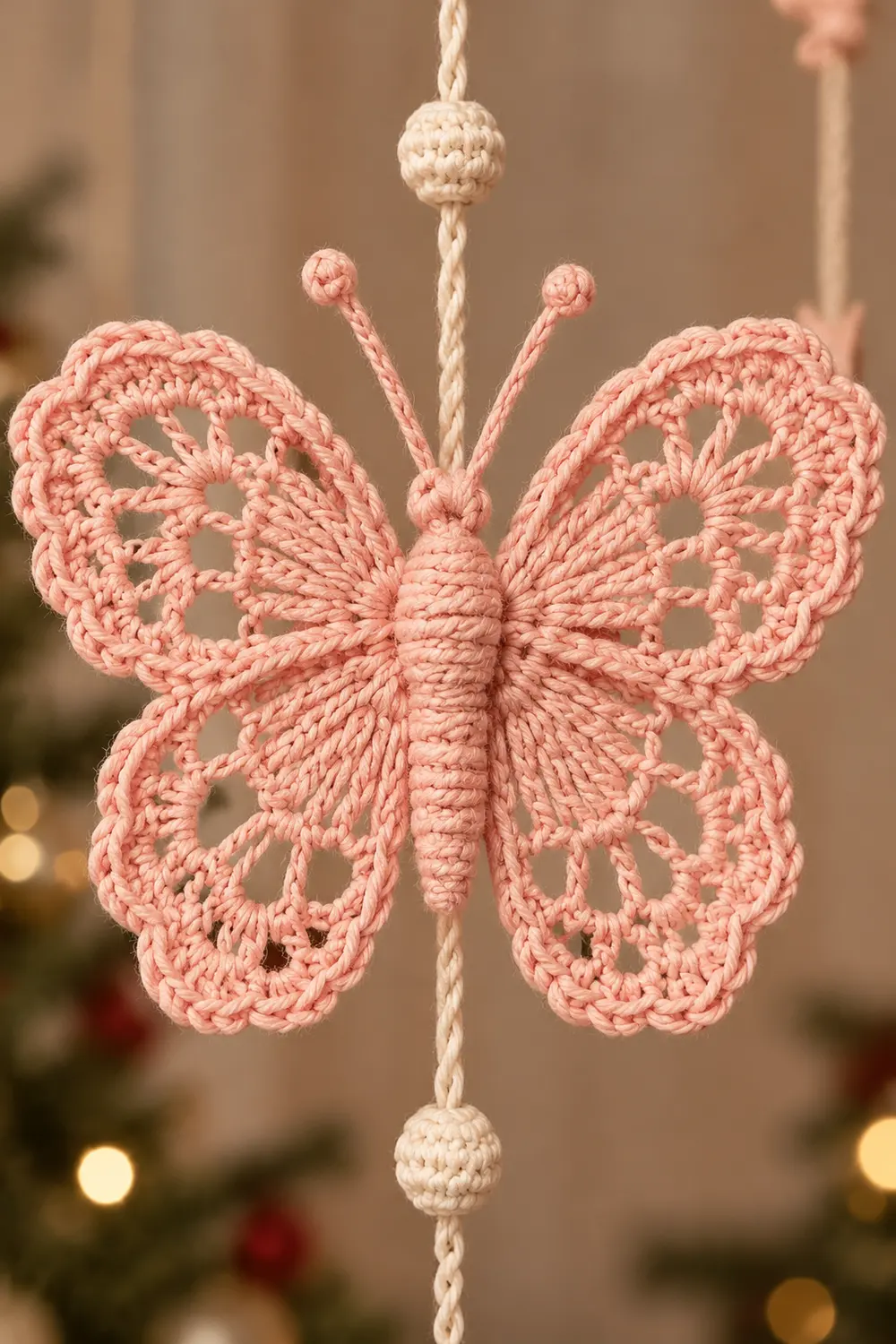
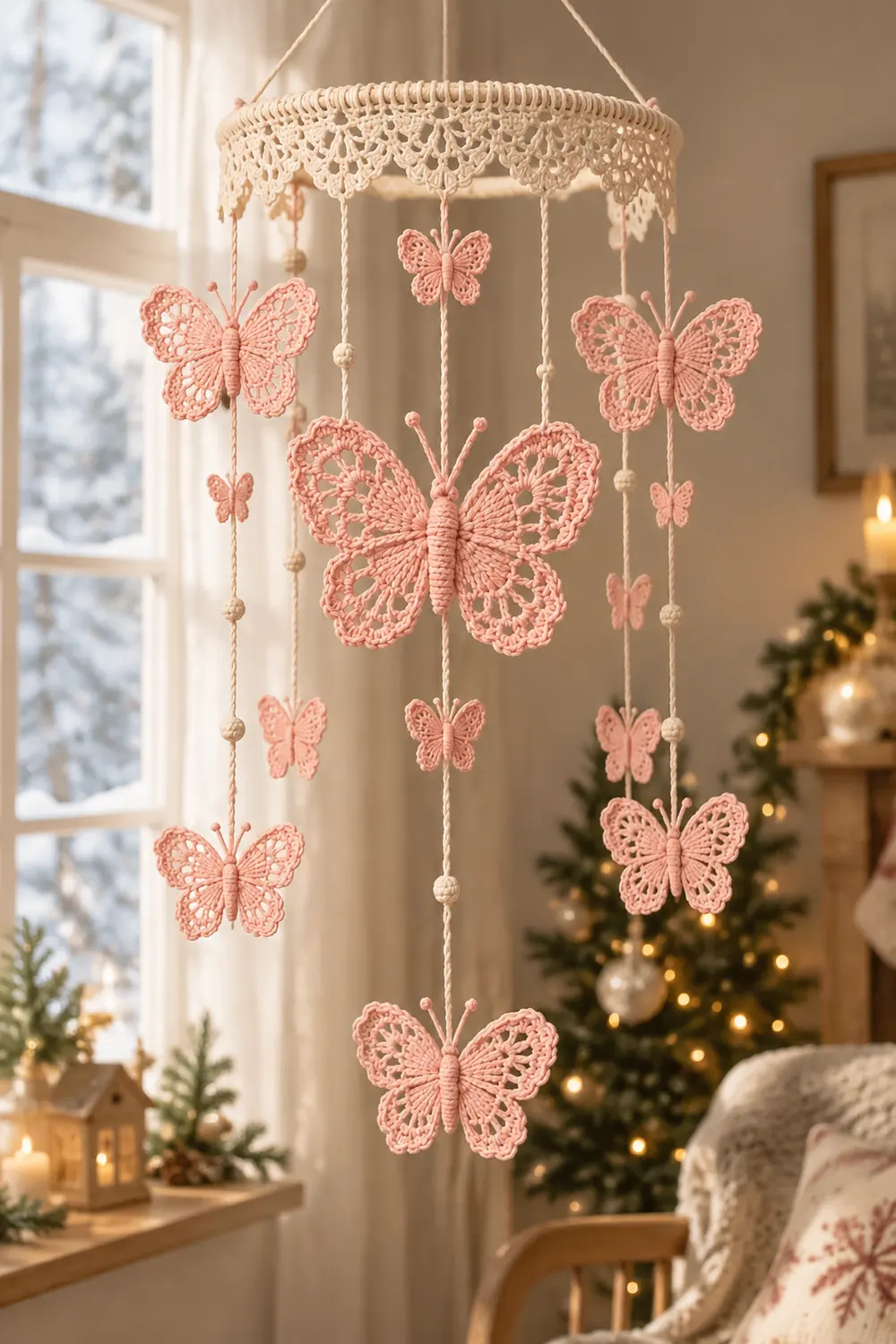
This mobile has thirteen dusty pink butterflies drifting below a cream lace crown. Each butterfly has open, lacy mesh wings with scalloped shell edges and a ribbed, rounded body. A seam runs down the front of each body, which makes it look three-dimensional. The butterflies hang at different heights on natural cotton strands dotted with cream beads, so the whole piece cascades in layers.
The palette is soft and romantic: light dusty pink for every butterfly, cream for the lace band and beads, and natural cream-tan cotton for the strands and hanging cord. It looks lovely in a nursery, by a window, or with holiday décor.
This pattern uses US crochet terms. The finished mobile measures about 10 in (25.4 cm) wide and hangs about 18 in (45.7 cm) below the ring. Including the hanging cord, it is about 30 in (76.2 cm) tall. The butterflies come in three sizes: small at 2 in (5.1 cm), medium at 3 in (7.6 cm), and one large center butterfly at 4.5 in (11.4 cm) wide.
Each butterfly is assembled from four fan-shaped mesh wings and a ribbed body tube. The lace band is worked directly over a 7 in (17.8 cm) metal ring. The butterflies are then sewn to beaded strands that are tied to the ring.
Finished Size and Construction
- Finished size: about 10 in (25.4 cm) wide × 18 in (45.7 cm) drop below the ring; about 30 in (76.2 cm) tall with the hanger
- Skill level: Intermediate
- Terminology: US
- Yarn weight: DK / light (3) cotton
- Hook: 3.25 mm (US D-3)
- Number of pieces:
- 13 butterflies made from 65 crocheted pieces (52 wings and 13 bodies)
- 1 lace band
- 4 beaded strands
- Layout: 1 center strand and 3 outer strands spaced evenly around the ring
- Piece size: butterflies are 2 in (5.1 cm), 3 in (7.6 cm), and 4.5 in (11.4 cm) wide
- Size before border: 7 in (17.8 cm) ring, with a 22 in (55.9 cm) circumference
- Border depth: the lace band is about 2 in (5.1 cm) from the ring to the scallop tips
Materials
Choose a smooth mercerized cotton. It gives crisp mesh and holds its shape after stiffening. Avoid fuzzy or acrylic yarns, because they blur the lace.
Yarn (about 120 m per 50 g):
- Dusty pink: 60 g (144 m), for all butterflies
- Cream: 20 g (48 m), for the lace band
- Natural cream-tan cotton: 10 g (24 m), for the strands
Tools and notions:
- 3.25 mm (US D-3) hook
- 7 in (17.8 cm) metal ring
- 16 cream wooden beads, 10 mm, with holes of at least 3 mm
- 1.5 m of 3 mm natural cotton or jute cord, for hanging
- Tapestry needle
- Scissors
- Small amount of fiberfill or pink yarn scraps
- Stitch markers
- Blocking mat and rustproof pins
- Fabric stiffener or heavy spray starch
- Measuring tape
All quantities include a margin of about 25%.
Abbreviations (US Terms)
- ch: chain
- sl st: slip stitch
- sc: single crochet
- dc: double crochet
- tr: treble crochet
- sp: space
- st(s): stitch(es)
- blo: back loop only
- rep: repeat
Special stitches:
- Shell: 5 dc in the same space (on the band, a shell is 7 dc).
- Picot: (sc, ch 3, sl st into the sc just made).
Gauge and Checkpoints
Gauge: 22 sc and 24 rows = 4 in (10.2 cm) in sc.
Before making everything, make one medium upper wing and measure it.
Checkpoints for the upper wing (measured from the ring center to the shell tip):
- After Row 1: 0.5 in (1.3 cm)
- After Row 2: 0.8 in (2.0 cm)
- Finished small wing: 1 in (2.5 cm)
- Finished medium wing: 1.5 in (3.8 cm)
- Finished large wing: 2.2 in (5.6 cm)
Checkpoints for the lower wing:
- Finished small wing: 0.75 in (1.9 cm)
- Finished medium wing: 1 in (2.5 cm)
- Finished large wing: 1.5 in (3.8 cm)
If your wing is more than 0.25 in (0.6 cm) too big, go down 0.25 mm in hook size. If it is too small, go up 0.25 mm. Check the band after Round 1: 120 sc should cover the ring snugly without bunching.
Upper Wing (make 2 per butterfly)
With pink, ch 5 and sl st to the first ch to form a ring.
Row 1: Ch 4 (counts as dc + ch 1). Work [dc, ch 1] 6 times in the ring, then dc in the ring. Turn. (8 dc, 7 ch-1 sp)
Row 2: Ch 4 (counts as dc + ch 1) and dc in the same st. Work [ch 1, (dc, ch 1, dc) in next dc] 7 times. The last group goes into the 3rd ch of the turning ch. Turn. (16 dc, 15 ch-1 sp)
Small wings: go to Edging.
Row 3 (medium and large only): Ch 5 (counts as dc + ch 2). Dc in the next dc, then work [ch 2, dc in next dc] across. Turn. (16 dc, 15 ch-2 sp)
Medium wings: go to Edging.
Row 4 (large only): Ch 7 (counts as tr + ch 3). Tr in the next dc, then work [ch 3, tr in next dc] across. Turn. (16 tr, 15 ch-3 sp)
Edging (all sizes): Ch 1 and sc in the first st. Work [shell in next sp, sc in next sp] 7 times. Shell in the last sp, then sc in the top of the turning ch. (8 shells, 9 sc; 15 spaces used)
Fasten off, leaving an 8 in (20.3 cm) tail.
Lower Wing (make 2 per butterfly)
Ch 4 and sl st to form a ring.
Row 1: Ch 4 (counts as dc + ch 1). Work [dc, ch 1] 4 times in the ring, then dc in the ring. Turn. (6 dc, 5 ch-1 sp)
Small wings: go to Edging.
Row 2 (medium and large only): Ch 4 (counts as dc + ch 1) and dc in the same st. Work [ch 1, (dc, ch 1, dc) in next dc] 5 times. Turn. (12 dc, 11 ch-1 sp)
Medium wings: go to Edging.
Row 3 (large only): Ch 5 (counts as dc + ch 2). Dc in the next dc, then work [ch 2, dc in next dc] across. Turn. (12 dc, 11 ch-2 sp)
Edging: Ch 1 and sc in the first st. Work [shell in next sp, sc in next sp] across to the last sp. Shell in the last sp, then sc in the last st.
- Small: 3 shells
- Medium and large: 6 shells
Fasten off, leaving a 6 in (15.2 cm) tail.
Body (make 1 per butterfly)
Small and medium: Ch 7.
- Row 1: Sc in the 2nd ch from the hook and in each ch across. (6 sc)
- Following rows: Ch 1, turn, and sc blo in each st. (6 sc)
- Small: 8 rows total, about 1.3 in (3.3 cm).
- Medium: 11 rows total, about 1.8 in (4.6 cm).
Large: Ch 9 and work as above with 8 sc per row for 16 rows, about 2.7 in (6.9 cm).
To shape the body:
- Fold the piece so the two long row-end edges meet.
- Whipstitch them together. This seam becomes the center seam detail on the front.
- Stuff the tube lightly and cinch both ends closed.
- Wrap pink yarn twice, tightly, 0.25 in (0.6 cm) below the top to form a head.
Antennae: Thread a 6 in (15.2 cm) length of pink yarn through the head so both ends exit at the top. Knot each end 1 in (2.5 cm) from the head and trim close to the knots.
Assemble the butterfly:
- Place the two upper wings with their rings pointing inward and the rings touching.
- Place the two lower wings just below them.
- Sew all four ring centers together using the wing tails.
- Sew the body over the center with the seam facing out.
Make All Pieces
| Size | Butterflies | Upper wings | Lower wings | Bodies | Pink per butterfly |
|---|---|---|---|---|---|
| Small | 5 | 10 | 10 | 5 | about 2 g |
| Medium | 7 | 14 | 14 | 7 | about 4 g |
| Large | 1 | 2 | 2 | 1 | about 8 g |
That makes 13 butterflies from 65 pieces, using about 46 g of pink before the margin.
Strand layout (top to bottom):
CENTER:   SMALL – LARGE – SMALL – MEDIUM
STRAND A: MEDIUM – SMALL – MEDIUM
STRAND B: MEDIUM – SMALL – MEDIUM
STRAND C: MEDIUM – SMALL – MEDIUM
Joining (Butterflies to Strands)
Each strand is natural cotton held double.
Cut the strands (each length is folded in half before you start):
- Center strand: 60 in (152.4 cm)
- Strand A: 34 in (86.4 cm)
- Strand B: 36 in (91.4 cm)
- Strand C: 38 in (96.5 cm)
Butterfly positions (measured from the ring plane down to each butterfly’s center):
- Strand A: 2 in (5.1 cm), 7 in (17.8 cm), 12 in (30.5 cm)
- Strand B: 3 in (7.6 cm), 8 in (20.3 cm), 13 in (33.0 cm)
- Strand C: 4 in (10.2 cm), 9 in (22.9 cm), 14 in (35.6 cm)
- Center strand: 2 in (5.1 cm), 6 in (15.2 cm), 11 in (27.9 cm), 16 in (40.6 cm)
Beads: Place one bead between the ring and the first butterfly, and one bead midway between each pair of butterflies.
- Each outer strand: 3 beads
- Center strand: 4 beads
- Total: 13 beads, with 3 spares
Tie an overhand knot under each bead so it can’t slide.
Attaching each butterfly: Lay the strand behind the body. Tack it with pink yarn at the top and bottom of the body, stitching through the wing ring centers. This makes a stitch-to-stitch anchor at two points, so the butterfly can’t spin loose.
Pull each tack snug but not tight. Puckered wings mean too much tension.
Size checkpoint: Hold each strand from its top. The bottom butterfly’s center should hang at the stated measurement, within 0.5 in (1.3 cm).
Border (Lace Band)
The band is worked directly over the ring, not around crocheted pieces. Its starting count comes from the ring itself. The ring’s circumference is 22 in (55.9 cm), and 22 in × 5.5 sc per in = 121, which rounds to 120 sc. This matches the main gauge of 22 sc per 4 in (10.2 cm).
For counting, the band is divided into three equal sections, one for each outer strand.
Rnd 1: Join cream to the ring with a sl st. Ch 1 and work 120 sc over the ring. Join. Place markers in sc 1, 41, and 81.
(120 sc; 40 sc per section)
Rnd 2: Hold the ring so the work hangs downward. Ch 4 (counts as dc + ch 1) and skip the next sc. Work dc in next sc, ch 1, skip next sc; rep from * around. Join to the 3rd ch.
(60 dc, 60 ch-1 sp; 20 of each per section)
Rnd 3: Sl st into the first ch-1 sp. Ch 4 (counts as dc + ch 1). Work dc in next ch-1 sp, ch 1; rep from * around. Join.
(60 dc, 60 ch-1 sp; 20 of each per section)
Rnd 4 (scallops): Ch 1 and sc in the first sp. Work skip next sp, 7 dc in next sp, skip next sp, sc in next sp; rep from * around, ending with skip next sp. Join.
(15 shells, 15 sc; 5 scallops per section)
Rnd 5 (picots): Ch 1 and sc in the first sc. Work sc in next 3 dc, picot in the center dc, sc in next 3 dc, sc in next sc; rep from * around, omitting the final sc. Join and fasten off.
(120 sc, 15 picots; 40 sc and 5 picots per section)
Why the math works:
- 120 is divisible by 2, giving 60 mesh spaces in Rounds 2 and 3.
- Those 60 spaces divide by 4 for the scallop repeat, giving 15 scallops.
- The 15 scallops divide by 3 for the strands, so each section holds exactly 5 scallops.
- The count never increases, so the band hangs straight down as a cylinder instead of flaring outward.
Attach the strands and cord:
- Tie Strands A, B, and C to the ring at the three markers, passing behind Round 1.
- Cut the hanging cord into three 18 in (45.7 cm) lengths.
- Tie one cord at each marker on top of the ring.
- Gather the three cords about 12 in (30.5 cm) above the ring and knot them together, forming a loop.
- Tie the center strand to that knot so it drops through the middle of the ring. The first small butterfly should sit 2 in (5.1 cm) below the ring plane.
Final Blocking
- Before assembly, dampen all wings and the band with diluted stiffener.
- Pin each wing flat, opening every mesh space and pinning each shell tip.
- Shape the antennae upward and let them dry.
- Stand the band upright over a container the same diameter as the ring. Pin the scallops evenly and let it dry for 24 hours.
- Check the measurements again: butterflies at 2 in, 3 in, and 4.5 in (5.1 cm, 7.6 cm, 11.4 cm), and band depth at 2 in (5.1 cm).
Final Quality-Control Checklist
- Wings match their checkpoint sizes, and all shells are open.
- Every body seam faces forward.
- Antennae are knotted and even.
- The band has 15 even scallops, with 5 per section.
- Strands sit at sc 1, 41, and 81.
- All bead knots are secure.
- Butterfly heights match the layout.
- The mobile hangs level.
Troubleshooting
- Wings cupping: Your ch spaces are too tight. Loosen your chains or go up 0.25 mm in hook size.
- Wings ruffling: Your chains are too loose. Go down 0.25 mm in hook size.
- Band flaring outward: Recount Round 1. You should have 120 sc, not more.
- Mobile tilting: Adjust the hanging cord knot until the ring sits level.
- Butterflies spinning: Add a third tack through the body’s center.
- Beads sliding: Double the knot under each bead.
Care
Dust gently or spot clean with cool water. If a piece softens, re-stiffen it and reshape it flat to dry.
Final Notes
The measurement chain is simple:
- A gauge of 22 sc per 4 in (10.2 cm) sets your wing sizes of 1 in, 1.5 in, and 2.2 in (2.5 cm, 3.8 cm, 5.6 cm).
- Those wings build butterflies 2 in, 3 in, and 4.5 in (5.1 cm, 7.6 cm, 11.4 cm) wide.
- The same gauge fits 120 sc around the 22 in (55.9 cm) ring, which divides cleanly into 15 scallops and 3 strand sections.
Check each stage, and the finished mobile will hang balanced and airy. Optionally, you could make a few extra small butterflies to tuck onto the strands. Happy crocheting!