

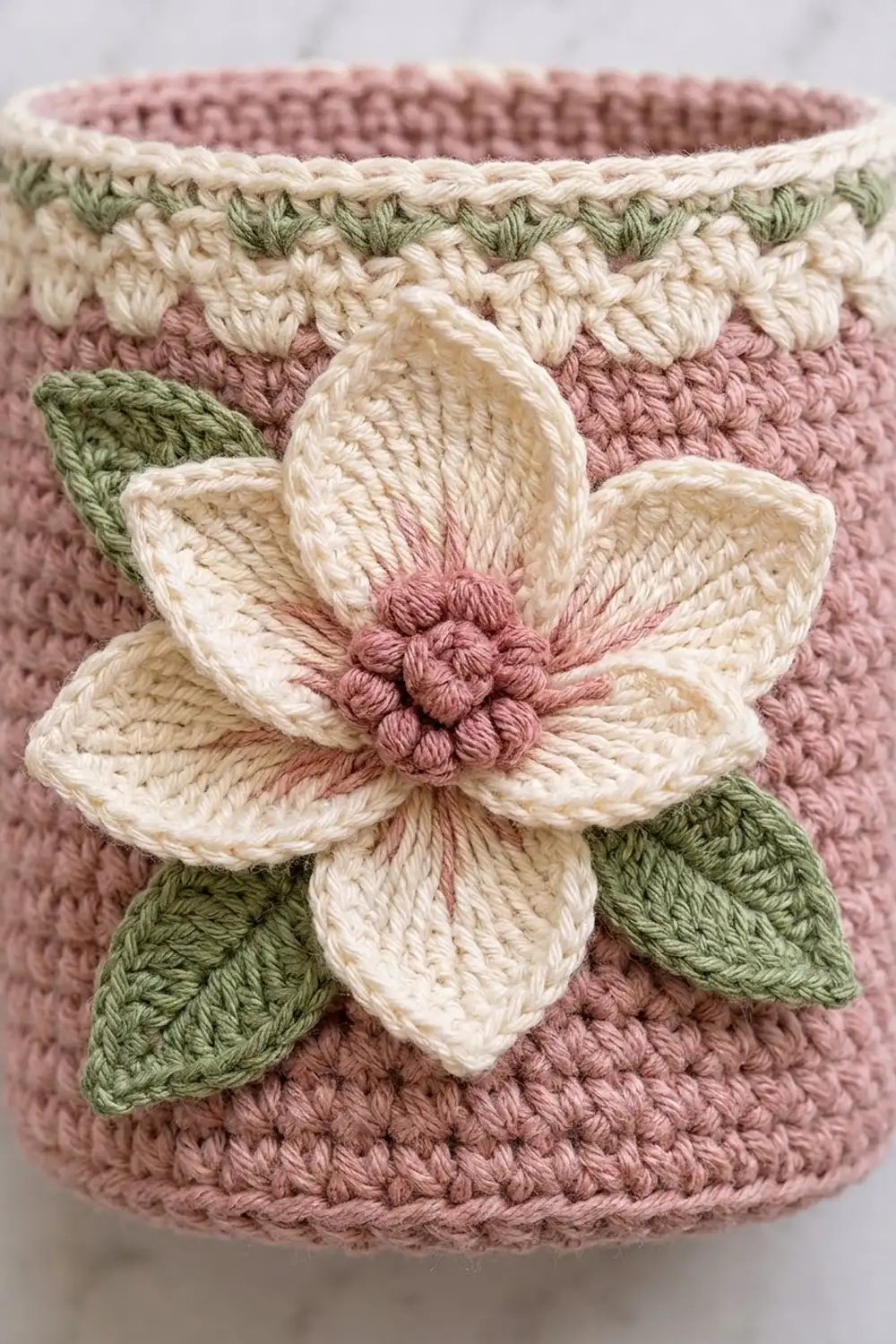
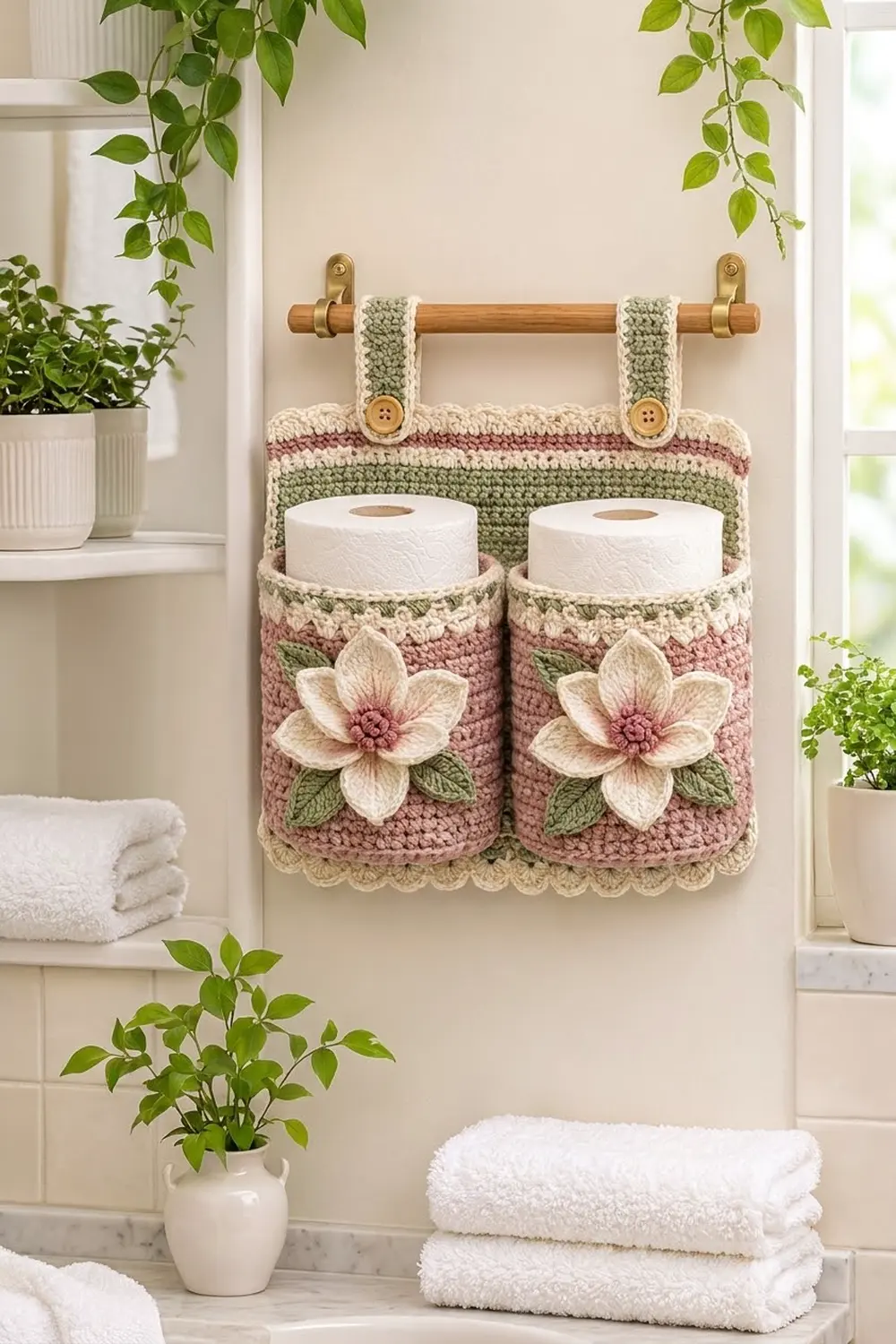
This hanging holder stores two spare toilet rolls in soft, structured pockets. Each pocket has a layered magnolia-style flower on the front. The holder hangs from a short wooden dowel by two buttoned straps, so it lifts off the wall easily for washing.
The palette is calm and botanical. Sage green is used for the back panel and leaves, dusty pink for the pockets and flower centers, and cream for the scalloped trims and petals. The style is cottage bathroom: dense single crochet fabric, small shell edges, and a raised floral accent.
The pattern uses US crochet terms. The finished back panel measures 14.25 in wide x 10 in tall (36.2 cm x 25.4 cm). Each pocket is about 4.8 in (12.2 cm) across and 4.25 in (10.8 cm) tall.
Construction is simple. Crochet a flat back panel in rows and add a two-round border. Make two pockets in the round, starting from a flat base. Then make the straps, petals, centers, and leaves, and sew everything together.
Finished Size and Construction
- Finished panel size: 14.25 in x 10 in (36.2 cm x 25.4 cm)
- Skill level: Easy-intermediate
- Terminology: US
- Yarn weight: Worsted (#4), cotton or cotton blend
- Hook: 5 mm (H-8)
- Number of pieces: 23 (1 panel, 2 pockets, 2 straps, 12 petals, 2 centers, 4 leaves)
- Layout: 2 pockets side by side on 1 panel
- Panel size before border: 13.25 in x 8 in (33.7 cm x 20.3 cm)
- Pocket size: 4.8 in (12.2 cm) diameter, 4.25 in (10.8 cm) tall
- Border depth: 1 in (2.5 cm) top and bottom, 0.5 in (1.3 cm) at the sides
Materials
Choose a smooth, firm cotton or cotton blend. Cotton holds the pocket shape and stands up to bathroom humidity and washing. The amounts below assume about 170 m per 100 g.
- Sage green: 150 g / 255 m (panel, straps, pocket stripe, leaves)
- Dusty pink: 200 g / 340 m (pockets, panel stripe, flower centers)
- Cream: 100 g / 170 m (panel stripes and border, strap edging, scallops, petals)
The quantities include a margin of about 15 percent.
Tools:
- 5 mm (H-8) crochet hook
- Tapestry needle
- Stitch markers
- 2 wooden buttons, 0.75 in (1.9 cm)
- Wooden dowel, 16 in (40.6 cm) long, 0.75 in (1.9 cm) in diameter
- 2 rod brackets with screws
- Scissors, tape measure, rust-proof pins
Abbreviations (US Terms)
- ch – chain
- sl st – slip stitch
- sc – single crochet
- hdc – half double crochet
- dc – double crochet
- BLO – back loop only
- MR – magic ring
- st(s) – stitch(es)
- sp – space
- sk – skip
- rep – repeat
- rnd – round
Bobble: (Yo, insert hook in st, yo, pull up a loop, yo, draw through 2 loops) 4 times in the same st. Then yo and draw through all 5 loops on the hook.
Gauge and Checkpoints
Gauge: 16 sc and 18 rows = 4 in (10.2 cm), in sc worked in rows.
Make one pocket base first as your test piece.
Checkpoints:
- Pocket base after Rnd 10: 4.8 in (12.2 cm) diameter.
- Panel Row 1: 13.25 in (33.7 cm) wide.
- Panel after Row 36: 8 in (20.3 cm) tall.
- Panel after the border: 14.25 in x 10 in (36.2 cm x 25.4 cm).
If your pieces come out too big, go down one hook size. If they’re too small, go up one size. A pocket that’s too small won’t fit a standard roll, so check the pocket first.
Back Panel
With green, ch 54.
Row 1: Sc in 2nd ch from hook and in each ch across, turn. (53 sts)
Rows 2–30: Ch 1, sc in each st across, turn. (53 sts)
Checkpoint: the panel should now be about 6.7 in (17.0 cm) tall. Change to cream on the last yo of Row 30.
Rows 31–32: With cream, ch 1, sc in each st across, turn. (53 sts)
Rows 33–34: With pink, ch 1, sc in each st across, turn. (53 sts)
Rows 35–36: With cream, ch 1, sc in each st across. Do not fasten off. (53 sts)
Checkpoint: 13.25 in x 8 in (33.7 cm x 20.3 cm). Leave the cream yarn attached for the border, and weave in the green and pink ends.
Pockets (make 2)
Base (pink):
Rnd 1: Ch 1, 6 sc in MR, join with sl st to first sc. (6 sts)
Rnd 2: Ch 1, 2 sc in each st around, join. (12 sts)
Rnd 3: Ch 1, (sc in next st, 2 sc in next st) around, join. (18 sts)
Rnd 4: Ch 1, (sc in next 2 sts, 2 sc in next st) around, join. (24 sts)
Rnds 5–10: Keep increasing 6 sts per round, working 1 more sc between increases each round. Rnd 5 = 30 sts, Rnd 6 = 36 sts, Rnd 7 = 42 sts, Rnd 8 = 48 sts, Rnd 9 = 54 sts, Rnd 10 = 60 sts.
Checkpoint: 4.8 in (12.2 cm) in diameter when lying flat.
Walls:
Rnd 11: Ch 1, sc in BLO of each st around, join. (60 sts) This round turns the wall upward.
Rnds 12–24: Ch 1, sc in each st around, join. (60 sts)
Rnd 25: With green, ch 1, sc in each st around, join. (60 sts)
Rnd 26: With cream, ch 1, *sc in next st, sk 1, 3 dc in next st, sk 1; rep from * around, join. (15 scallops: 15 sc + 45 dc = 60 sts)
Rnd 27: With pink, ch 1, sc in each sc and dc around, join. (60 sts)
Rnd 28: Ch 1, sc in each st around, join. Fasten off. (60 sts)
Checkpoint: the wall should be about 4.25 in (10.8 cm) tall. A standard roll should slide in easily and stick out about 0.5 in (1.3 cm) above the rim.
Straps (make 2)
With green, ch 7.
Row 1: Sc in 2nd ch from hook and in each ch across, turn. (6 sts)
Rows 2–28: Ch 1, sc in each st across, turn. (6 sts)
Row 29 (buttonhole): Ch 1, sc in next 2 sts, ch 2, sk 2, sc in last 2 sts, turn. (4 sc + 1 ch-2 sp)
Row 30: Ch 1, sc in next 2 sts, 2 sc in ch-2 sp, sc in last 2 sts, turn. (6 sts)
Rows 31–32: Ch 1, sc in each st across. Fasten off green. (6 sts)
Edging: Join cream in any corner.
– Work 3 sc in each corner st.
– On each short end, sc in each of the 4 sts between the corners.
– On each long side, work 1 sc in each of the 32 row ends.
Join and fasten off. Each short end has 10 sts (including the corner groups) and each long side has 32 sts, for 84 sts total.
Checkpoint: 2 in x 7.6 in (5.1 cm x 19.3 cm).
Flower Centers (make 2)
With pink:
Rnd 1: Ch 1, 8 sc in MR, join. (8 sts)
Rnd 2: Ch 1, (bobble in next st, sc in next st) 4 times, join. Fasten off, leaving a long tail. (4 bobbles + 4 sc = 8 sts)
Each center is about 1 in (2.5 cm) across, with a raised, berry-like texture.
Petals (make 12)
With cream, ch 9.
Rnd 1: Work in the back bumps of the chain.
– First side: Sc in 2nd ch from hook, hdc in next ch, dc in next 3 ch, hdc in next ch, sc in next ch.
– Tip: (Sc, ch 2, sc) in last ch.
– Second side: Rotate and work along the other side of the chain: sc in next ch, hdc in next ch, dc in next 3 ch, hdc in next ch, sc in last ch.
Join with sl st to first sc. Fasten off, leaving a tail. (16 sts + ch-2 tip)
Each petal is about 2.25 in (5.7 cm) long and comes to a point. For the pink blush, work 3 or 4 short straight stitches in pink at the base of each petal.
Leaves (make 4)
With green, ch 8.
Rnd 1: Work in the back bumps of the chain.
– First side: Sc in 2nd ch from hook, hdc in next ch, dc in next 2 ch, hdc in next ch, sc in next ch.
– Tip: (Sc, ch 2, sc) in last ch.
– Second side: Sc in next ch, hdc in next ch, dc in next 2 ch, hdc in next ch, sc in last ch.
Join and fasten off. (14 sts + ch-2 tip)
Each leaf is about 1.75 in (4.4 cm) long.
Make All Pieces
| Piece | Qty | Color |
|---|---|---|
| Back panel | 1 | Green, cream, pink |
| Pockets | 2 | Pink, green, cream |
| Straps | 2 | Green, cream |
| Petals | 12 | Cream |
| Centers | 2 | Pink |
| Leaves | 4 | Green |
Layout (front view):
     [STRAP]              [STRAP]
========== dowel ======================
[ cream / pink / cream stripes        ]
[           green panel               ]
[ [POCKET + FLOWER][POCKET + FLOWER]  ]
[ ~~~~~~~~ cream scallops ~~~~~~~~~~  ]
Joining
Flowers:
1. Pin three petals in a Y shape, with the points 120 degrees apart.
2. Lay the other three petals on top, turned 60 degrees so they sit between the lower petals.
3. Tuck two leaves under the lower-left and lower-right petals.
4. Sew the center on top, stitching through all layers.
5. Sew each flower to the front of a pocket, centered below Rnd 25.
Pockets to panel: Finish the border (next section) before attaching the pockets.
– Place the two pockets side by side, touching. Their bases should rest on border Rnd 1, just above the bottom scallops, with about 1.8 in (4.6 cm) of panel showing at each side.
– Whipstitch each pocket to the panel along a strip about 2 in (5.1 cm) wide at the back of the pocket, from the base up to Rnd 27.
– With each pass of the needle, catch one loop of a pocket st and one loop of a panel st so the seam lies flat.
– Tack the two pockets to each other where they touch, from the base up to Rnd 26.
Keep your tension snug but not tight. Pulling too hard will pucker the panel. Checkpoint: after the pockets are sewn on, the panel should still measure 14.25 in (36.2 cm) across.
Straps:
1. Center each strap 4.25 in (10.8 cm) from one side edge of the panel body (the panel without its border).
2. Sew the end without the buttonhole to the back of the panel, overlapping it by 1.5 in (3.8 cm).
3. Sew a button to the front of the top border, directly below each strap.
4. Pass each strap over the dowel and button it at the front.
Border
Border gauge: The same as the body: 16 sc = 4 in (10.2 cm). Row ends run 4.5 per inch, so the side edges skip a few row ends to stay flat.
Rnd 1: With the cream still attached from Row 36, ch 1.
– Top edge: 3 sc in first st, sc in next 51 sts, 3 sc in last st.
– First side: Sc in the row ends, skipping every 9th row end, for 32 sc.
– Bottom edge (along the foundation chain): 3 sc in first st, sc in next 51 sts, 3 sc in last st.
– Second side: 32 sc, the same as the first side.
Join to first sc.
Rnd 1 counts: The middle sc of each 3-sc group is a corner st.
– Between corner sts there are 53 sts along the top and bottom (1 + 51 + 1) and 34 sts along each side (1 + 32 + 1).
– Including both corner sts, the top and bottom have 55 sts each and each side has 36.
– Total: 53 + 53 + 34 + 34 + 4 corners = 178 sts.
Rnd 2:
1. Sl st into the next st, which is the first corner st.
2. Top edge: Ch 1, sc in the corner st, sk 2, 5 dc in next st, sk 2, sc in next st; rep from * 8 more times. The last sc lands in the next corner st. (9 scallops)
3. First side: Sc in each of the 34 sts.
4. Bottom edge: Starting with sc in the corner st, work the same scallop sequence. (9 scallops)
5. Second side:* Sc in each of the 34 sts.
Join and fasten off. Count: 55 top + 34 side + 55 bottom + 34 side = 178 sts.
Why the math works: Each scallop repeat uses 6 sts. Counting from just after a corner st, there are 53 sts plus the next corner st, which makes 54. 54 / 6 = 9 exact repeats, so each edge ends with an sc in its corner and both ends match. The sides have only sc, which keeps them slim, as in the photo.
Checkpoint: 14.25 in x 10 in (36.2 cm x 25.4 cm).
Final Blocking
- Before assembly, soak the panel and straps in cool water, then press out the water in a towel.
- Pin the panel to 14.25 in x 10 in (36.2 cm x 25.4 cm), pinning out each of the 18 scallops.
- Pin the straps to 2 in x 7.6 in (5.1 cm x 19.3 cm).
- Mist the petals and leaves and pin them flat, keeping the points sharp.
- Fill each pocket with a rolled towel so it dries as an even cylinder.
- Let everything dry completely before you assemble the holder.
Final Quality-Control Checklist
- The panel measures 14.25 in x 10 in (36.2 cm x 25.4 cm).
- The top and bottom edges each have 9 even scallops, with matching corners.
- Both pockets have 60 sts, a crisp fold at the BLO round, and 4.25 in (10.8 cm) walls.
- The scallop rounds on the two pockets sit at the same height.
- Each flower has 6 petals in two staggered layers, a center, and 2 leaves.
- The straps button easily and hang straight.
- All ends are securely woven in.
Troubleshooting
- Pocket base cups upward: You’re short on stitches or crocheting too tightly. Recount each round, or go up a hook size.
- Pocket base ruffles: You have too many increases. Check that each round adds exactly 6 sts.
- Panel sides wave: There are too many side sts. Skip every 9th row end so each side has 32 sc.
- Scallops miss the corner: The count along that edge is off. You need 53 sts between the corner sts.
- Roll doesn’t fit: Check the base diameter and remake the pocket with a larger hook.
- Petals curl: Block them flat, or work the dc a little looser.
Care
Hand wash in cool water with a mild soap. Reshape the pockets and dry flat, away from direct heat.
Final Notes
Each stage sets up the next measurement. A gauge of 16 sc = 4 in (10.2 cm) gives a panel body of 13.25 in x 8 in (33.7 cm x 20.3 cm). The border brings the panel to 14.25 in x 10 in (36.2 cm x 25.4 cm). A 60-stitch base makes a 4.8 in (12.2 cm) pocket that fits a standard roll. If you check each stage as you go, the finished holder will hang neat and square.
Happy crocheting!