
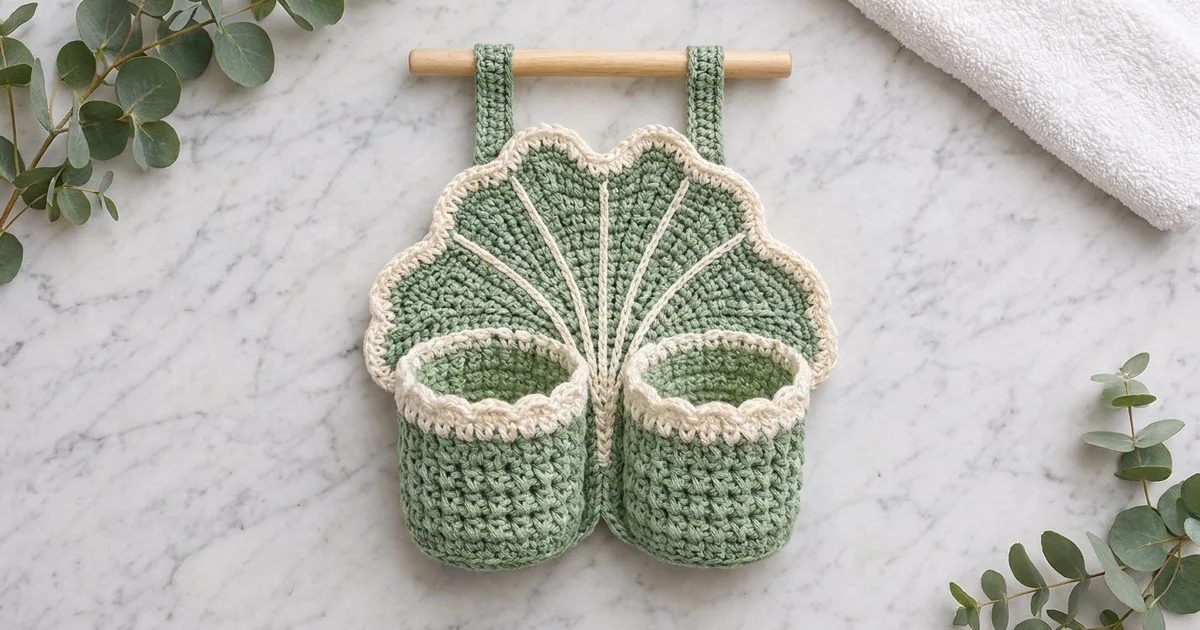
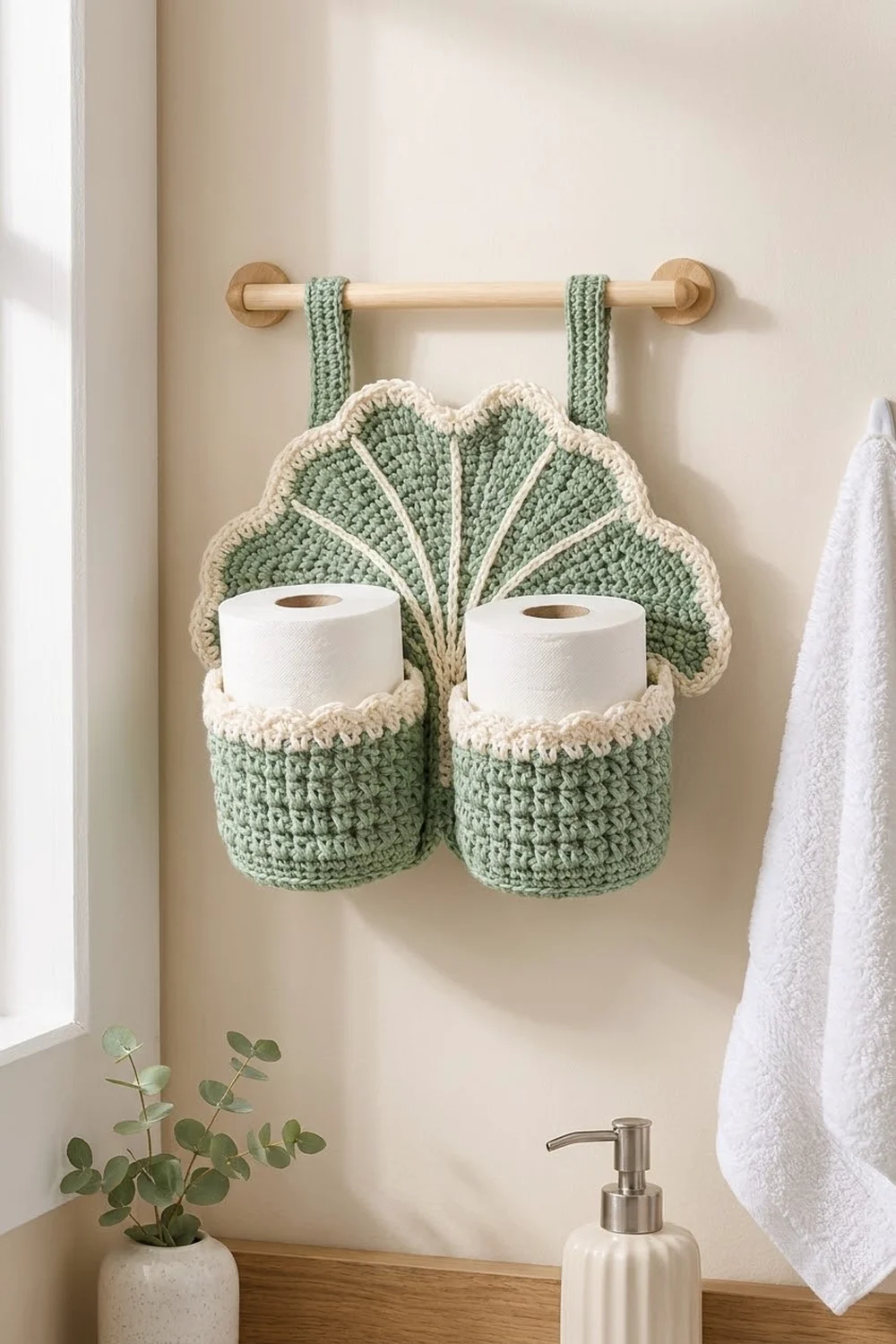
This hanging holder pairs a wide ginkgo-leaf backing panel with two snug round baskets, and each basket holds one standard toilet-paper roll. The leaf is fan-shaped, with a gently scalloped top, a center notch and seven cream veins that run from the stem out to the edge.
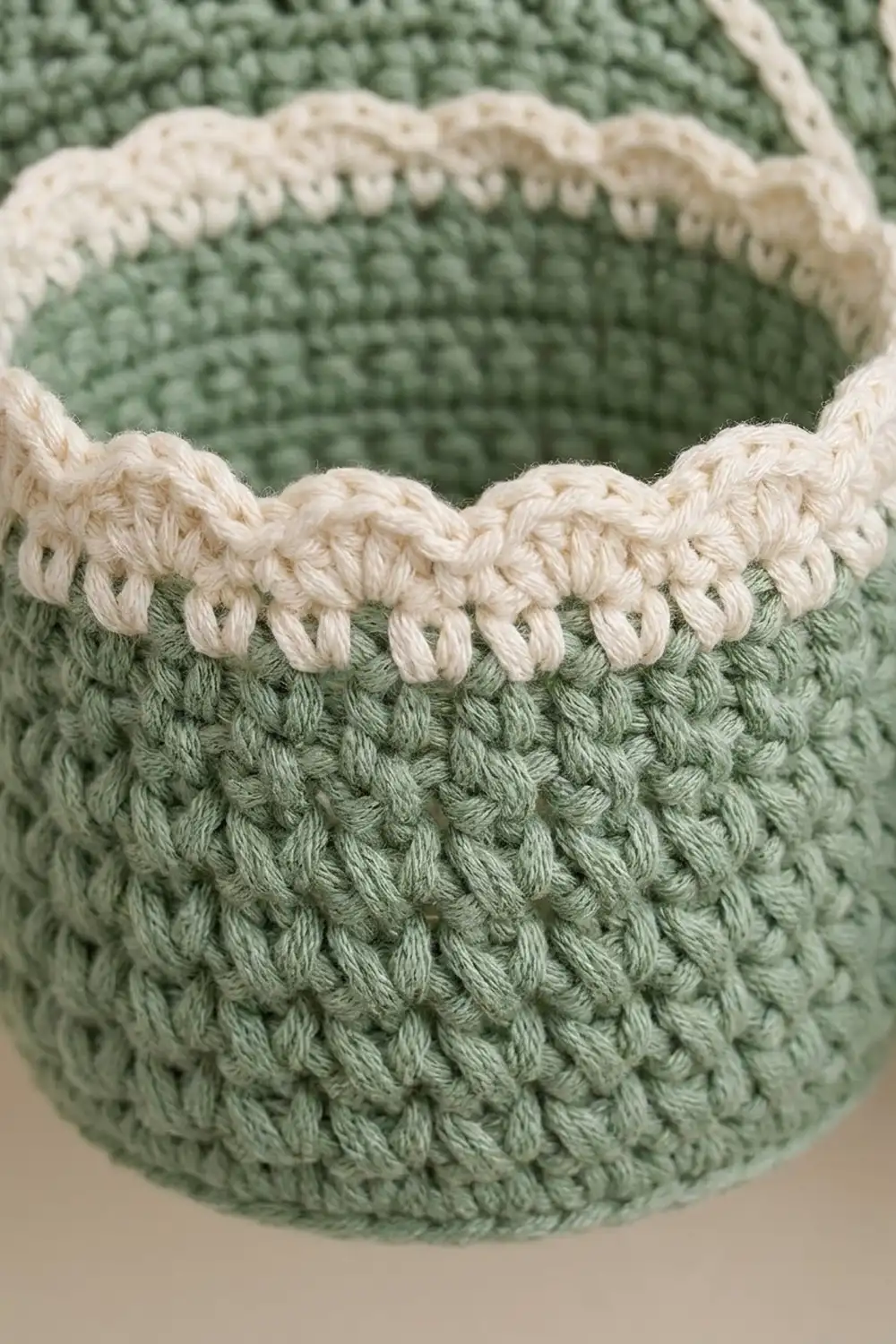
The palette is soft sage green with creamy off-white accents. A rope-textured crab-stitch border outlines the leaf, and each basket is topped with a round of small cream shells. Together they give the piece a calm, botanical, spa-bathroom look.
This pattern uses US crochet terms. The finished panel measures about 12.75 in (32.4 cm) wide and 7 in (17.8 cm) tall. Each basket is about 4.75 in (12.1 cm) across and 3.75 in (9.5 cm) tall. With the tabs looped over the dowel, the whole holder hangs about 9.5 in (24.1 cm) tall.
The panel is worked in turned rows of double crochet as a half-circle fan that starts at the stem. A final shaped row forms the lobes. The veins are added with surface slip stitches, and a two-round border finishes the edge. Each basket has a flat single-crochet base plus a single-crochet side strip that is seamed into a tube and sewn to the base. The baskets and tabs are then sewn to the panel.
Finished Size and Construction
- Finished size: panel 12.75 in x 7 in (32.4 x 17.8 cm); hanging height about 9.5 in (24.1 cm)
- Skill level: Intermediate
- Terminology: US
- Yarn weight: Worsted (#4) cotton
- Hook: 5.0 mm (H-8)
- Number of pieces: 7 (1 panel, 2 basket bases, 2 basket sides, 2 tabs)
- Layout: 2 baskets side by side on the lower panel, 2 tabs at the top
- Piece sizes: panel half-circle radius 6 in (15.2 cm) before the lobe row; basket base 4.75 in (12.1 cm) across; side strip 15 in x 3.125 in (38.1 x 7.9 cm)
- Panel size before border: 12 in x 6.5 in (30.5 x 16.5 cm)
- Border depth: about 0.375 in (1.0 cm)
Materials
Choose a firm, smooth worsted cotton or cotton blend so the baskets keep their shape. These amounts assume about 197 yd (180 m) per 100 g.
- Sage green (MC): 250 g, about 450 m
- Cream (CC): 60 g, about 108 m
Both quantities include a margin of roughly 10–15% for your gauge swatch and seams.
Tools:
– 5.0 mm (H-8) crochet hook
– Tapestry needle
– 8–10 locking stitch markers
– Rust-proof pins and a blocking mat
– Spray bottle
– Wooden dowel, 14 in (35.6 cm) long and 0.625 in (1.6 cm) in diameter
– 2 wall hooks or small dowel brackets
– Scissors and a measuring tape
Abbreviations (US Terms)
- ch – chain
- sl st – slip stitch
- sc – single crochet
- hdc – half double crochet
- dc – double crochet
- tr – treble crochet
- st(s) – stitch(es)
- sk – skip
- rep – repeat
- rev sc – reverse single crochet (crab stitch)
- MC / CC – main color / contrast color
Reverse single crochet (rev sc): Work from left to right (or right to left if you crochet left-handed). Insert the hook into the next stitch to the right, yarn over, pull up a loop, yarn over and draw through both loops on the hook. This makes a twisted, rope-like edge.
Surface slip stitch: Hold the yarn behind the work. Insert the hook from front to back through the fabric, pull up a loop, and draw it through the loop already on the hook. Repeat to “draw” a chain line across the surface.
Gauge and Checkpoints
- Double crochet (panel): 16 dc x 8 rows = 4 in (10.2 cm)
- Single crochet (baskets and tabs): 16 sc x 18 rows = 4 in (10.2 cm)
Before you start the full project, make one basket base as your test piece. It should measure 4.5–4.75 in (11.4–12.1 cm) across after Round 10. A toilet-paper roll should sit loosely on top of it without hanging over the edge.
Checkpoints:
– Panel after Row 3: radius 1.5 in (3.8 cm)
– Panel after Row 6: radius 3 in (7.6 cm)
– Panel after Row 12: 12 in (30.5 cm) across the straight bottom edge
– Base after Round 5: about 2.4 in (6.1 cm) across
– Side strip after Row 14: 15 in x 3.125 in (38.1 x 7.9 cm)
If your pieces are too big, go down 0.5 mm in hook size. If they are too small, go up 0.5 mm. If only the panel is off, change the hook for the panel alone. The baskets need to stay at the stated size so the rolls fit.
Ginkgo Panel (Make 1, MC)
The panel is worked in turned rows from the stem outward. The ch 3 at the start of each row counts as 1 dc. The 6 increases in each row stack on top of each other, which keeps the fan flat.
Row 1: Make a magic ring. Ch 3, then work 5 dc in the ring. Pull the ring closed, then turn. (6 dc)
Row 2: Ch 3, dc in the same st, then 2 dc in each st across. Turn. (12 dc)
Row 3: Ch 3, dc in the same st, dc in the next st. 2 dc in the next st, dc in the next st; rep from * 4 more times. Turn. (18 dc)
Row 4: Ch 3, dc in the same st, dc in each of the next 2 sts. 2 dc in the next st, dc in each of the next 2 sts; rep from * 4 more times. Turn. (24 dc)
Rows 5–12: Follow the same pattern. In each row, add one more plain dc between increases than in the row before, and keep the 6 increases stacked above the ones below. Each row is a complete growth row with these totals:
- Row 5: 30 dc
- Row 6: 36 dc
- Row 7: 42 dc
- Row 8: 48 dc
- Row 9: 54 dc
- Row 10: 60 dc
- Row 11: 66 dc
- Row 12: 72 dc
For any Row n, the repeat is (2 dc in the next st, dc in each of the next n−2 sts) x 6. The total is always 6n.
Checkpoint: Measured along the row ends, each straight edge should be 6 in (15.2 cm), and the full straight bottom edge 12 in (30.5 cm).
Row 13 (lobe row): This row is worked 1-for-1, so it makes 72 sts from 72 sts. Each lobe uses 12 sts:
Lobe: sc, hdc, dc, dc, tr, tr, tr, tr, dc, dc, hdc, sc.
Ch 1 (does not count as a st). Work Lobe 3 times across the first 36 sts.
To shape the center notch, change the first sc of the 4th lobe to a sl st: sl st, hdc, dc, dc, tr, tr, tr, tr, dc, dc, hdc, sc. Then work Lobe 2 more times. (72 sts: 6 lobes; the notch falls between sts 36 and 37)
Fasten off MC.
Checkpoint: The panel should measure 12 in x 6.5 in (30.5 x 16.5 cm) from the stem tip to the top of the tallest lobe.
Veins (CC)
Count the 72 sts of Row 13 from the right-hand corner and place markers at sts 9, 18, 27, 46, 55 and 64, plus a 7th marker in the gap between sts 36 and 37. The markers are placed symmetrically: 73 − 9 = 64, 73 − 18 = 55 and 73 − 27 = 46.
For each vein, start at the magic ring and work surface slip stitches in a straight line up to a marker. Use 2 sl sts per dc row and 1 sl st in Row 13, for 25 sl sts per vein. Keep the stitches the same height as the fabric underneath. Fasten off and weave in the ends on the back.
Basket Base (Make 2, MC)
Work in continuous spiral rounds and mark the first st of each round.
Round 1: In a magic ring, work 6 sc. (6 sc)
Round 2: 2 sc in each st around. (12 sc)
Round 3: sc in the next st, 2 sc in the next st; rep around. (18 sc)
Round 4: sc in each of the next 2 sts, 2 sc in the next st; rep around. (24 sc)
Rounds 5–10: Keep working 6 evenly spaced increases per round, adding 1 more plain sc between increases each round. The totals are:
- Round 5: 30 sc
- Round 6: 36 sc
- Round 7: 42 sc
- Round 8: 48 sc
- Round 9: 54 sc
- Round 10: 60 sc
Sl st into the next st. Fasten off, leaving a 30 in (76.2 cm) tail for sewing.
Checkpoint: The base should measure 4.5–4.75 in (11.4–12.1 cm) across and lie flat.
Basket Side (Make 2, MC + CC)
Foundation: With MC, ch 61.
Row 1: Sc in the 2nd ch from the hook and in each ch across. Turn. (60 sc)
Rows 2–14: Ch 1, sc in each st across. Turn. (60 sc in each row)
Checkpoint: The strip should measure 15 in x 3.125 in (38.1 x 7.9 cm).
Fasten off, leaving a 12 in (30.5 cm) tail. Fold the strip so the short ends meet. Whipstitch the 14 row ends together, 1 stitch per row, to make a tube with a circumference of 15 in (38.1 cm). This seam will become the back of the basket.
Top Edging (worked in the round along Row 14):
Round 1: Join CC at the seam. Ch 1, then sc in each st around. Sl st to the first sc. (60 sc)
Round 2 (scallops): Ch 1, sc in the first st. Sk 1, 3 dc in the next st, sk 1. Sc in the next st, sk 1, 3 dc in the next st, sk 1; rep from * 13 more times. Sl st to the first sc. (15 sc + 45 dc = 60 sts; 15 scallops)
Fasten off and weave in the ends.
Attach the base: Line up the foundation-chain edge of the tube (60 sts) with Round 10 of the base (60 sts), wrong sides together. Use the base tail to whipstitch them together, 1 stitch per stitch, working through the outer loops. The counts match exactly, so you shouldn’t need to ease or pleat the fabric.
Checkpoint: The finished basket should be 4.75 in (12.1 cm) across and about 3.75 in (9.5 cm) tall.
Hanging Tab (Make 2, MC)
Foundation: Ch 7.
Row 1: Sc in the 2nd ch from the hook and in each ch across. Turn. (6 sc)
Rows 2–32: Ch 1, sc in each st across. Turn. (6 sc in each row)
Checkpoint: Each tab should measure 1.5 in x 7.125 in (3.8 x 18.1 cm).
Fasten off, leaving a 12 in (30.5 cm) tail.
Make All Pieces
Totals:
– MC only: 1 panel, 2 bases, 2 tabs
– MC with CC edging: 2 basket sides
– CC: 7 panel veins, panel border, 2 basket top edgings
Layout (front view):
      [ tab ]              [ tab ]
 ===========================================  dowel
 [            ginkgo panel (fan)            ]
 [   [ basket A ]      [ basket B ]         ]
          (stem tip hidden between baskets)
Work order:
1. Panel
2. Veins
3. Panel border
4. Baskets
5. Tabs
6. Joining
7. Final blocking
The border section comes after Joining below, but work the border before you sew anything to the panel.
Joining
Method: Whipstitch with MC, catching the back bumps of the panel stitches so the seams don’t show on the front. Each basket is sewn only to the panel; it is never sewn into the border.
Placement: The two baskets together measure 9.5 in (24.1 cm) wide. Center them on the panel, leaving 1.625 in (4.1 cm) of the panel showing on each side. Set the bottom of each basket level with the stem tip, with the two baskets touching at the center line. Turn each basket so its side seam lies against the panel.
Stitch-to-stitch logic: On each basket, mark 5 sts on each side of the seam to make a back strip 10 sts wide, about 2.5 in (6.4 cm). Sew each vertical edge of that strip to the panel, working 1 whipstitch per sc row. That’s 14 rows plus the CC sc round, or 15 stitches per line, and 2 lines per basket.
Each dc row on the panel is about as tall as 2 sc rows. That means you catch a panel stitch on roughly every second basket row. Where the two baskets touch, tack them to each other with 4 whipstitches across Rows 6–9.
Tension: Pull each stitch snug but not tight. If the seams are tight, the panel will pucker behind the baskets.
Tabs: Center one tab above each basket, 4.75 in (12.1 cm) apart center to center. Pass each tab over the dowel and fold it in half. Lay both tab ends on the back of the panel, 1 in (2.5 cm) below the top edge. Sew a rectangle through both layers.
Size checkpoint: The panel should still lie flat at 12.75 in (32.4 cm) wide, and the full hanging height should be about 9.5 in (24.1 cm).
Border (Panel, CC)
Border gauge: This border uses the same sc gauge as the baskets. Each round adds about 0.1875 in (0.5 cm), so 2 rounds come to about 0.375 in (1.0 cm).
The panel has 4 edges: the lobed top, 2 straight sides, and the stem tip.
Round 1: With the right side facing, join CC in the first st of Row 13. Ch 1, then work:
- First corner: 3 sc in the corner st
- Top: 1 sc in each of the next 70 sts, working into the notch sl st as normal
- Second corner: 3 sc in the last st
- Side 1: 2 sc in each of the 12 dc row ends, plus 1 sc in the Row 13 row end (25 sc)
- Stem tip: 3 sc in the magic ring
- Side 2: 25 sc, worked the same way as Side 1
Sl st to the first sc.
Count: Top 76 (70 + 3 + 3) + Side 1 (25) + Stem tip (3) + Side 2 (25) = 129 sc.
Round 2: Ch 1, then rev sc in each st around. Sl st to the first st. (129 rev sc)
Fasten off and weave in the ends.
Why the math works: A dc row end is about twice as tall as an sc is wide, so 2 sc per dc row end keeps the straight sides flat. The Row 13 row end is only 1 sc tall, so it gets 1 sc. Each corner and the stem tip get 3 sc so the border turns without cupping. Rev sc uses 1 st per st, so the count stays at 129 for both rounds.
Why this border math applies to one piece only: The border goes around the panel by itself and doesn’t cross any seams, so no stitches are added at joins.
Final Blocking
- Weave in all the ends, keeping the cream tails behind cream stitches.
- Before joining, pin the panel flat on the mat at 12.75 in x 7 in (32.4 x 17.8 cm), with the straight edges perfectly straight and each lobe pinned at its highest point.
- Spray the panel until it is damp and let it dry completely.
- Stuff each basket firmly with a towel or a spare roll and spray it lightly. Shape the scallops with your fingers.
- Let the baskets dry for at least 12 hours before you join them.
- After joining, give the seams a light steam from the back, holding the iron 1 in (2.5 cm) away. Never press the iron onto the fabric.
Final Quality-Control Checklist
- [ ] The panel counts are 72 sts in Row 12 and Row 13, and 129 sts in each border round.
- [ ] There are 7 veins, evenly spaced and mirrored on each side of the center notch.
- [ ] Each base and side has 60 sts, and each basket has 15 scallops.
- [ ] Each basket is 4.75 in (12.1 cm) across, and a roll drops in easily.
- [ ] The basket seams face the panel and can’t be seen from the front.
- [ ] The tabs are 4.75 in (12.1 cm) apart, and the holder hangs level.
- [ ] No seams pucker, and the panel lies flat.
Troubleshooting
- Panel ruffles: Your dc rows are too short for the stitch count. Go up a hook size, or work taller, looser stitches.
- Panel cups: Your stitches are too loose. Go down a hook size and re-check the 3 in (7.6 cm) checkpoint at Row 6.
- Base won’t lie flat: You may be stacking the increases too tightly. Stagger them by starting each round’s repeat 1 st later.
- Roll won’t fit: The base is too small. Remake both bases and sides with a hook 0.5 mm larger.
- Veins wander: Work along a guide thread pinned from the stem to the marker.
- Basket leans forward: Extend each seam line up through the CC sc round, and add 2 stitches at the lower back corners.
Care
Hand wash the holder in cool water. Press out the extra water, reshape the baskets over a rolled towel, and lay everything flat to dry.
Final Notes
The measurement chain is:
- Gauge: 16 sts = 4 in (10.2 cm)
- Panel: 72 dc for a 12 in (30.5 cm) fan, then a 2-round, 129-st border for 12.75 in (32.4 cm)
- Baskets: each base and side has 60 sts, for a 15 in (38.1 cm) circumference and a 4.75 in (12.1 cm) basket
Check each link as you go, and the pieces will fit together without any easing.
Happy crocheting!