

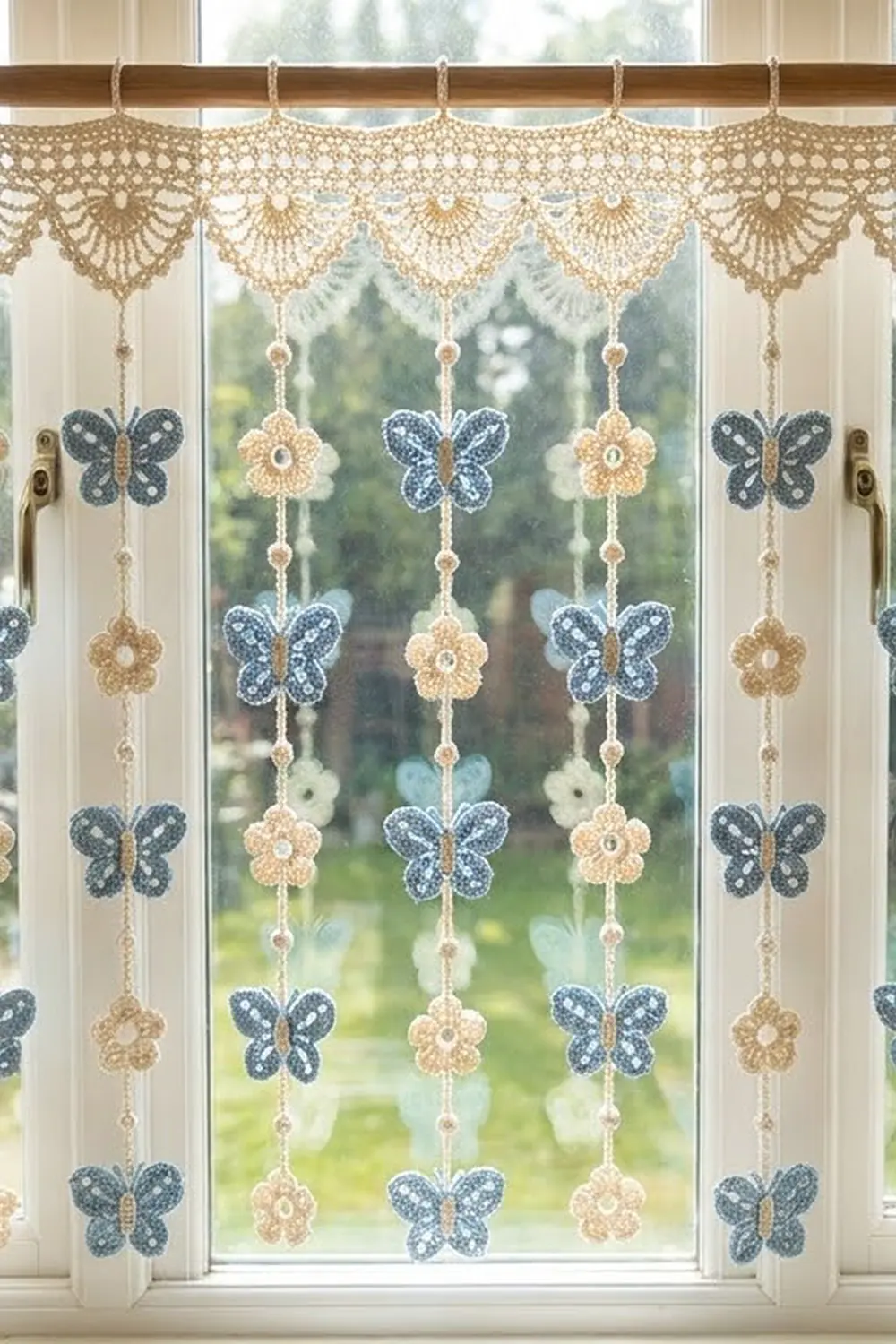
This curtain brings a garden right into your window. A cream lace header with soft scalloped edges hangs from a rod. Below it, long chain strands carry powder-blue butterflies and little cream flowers, spaced out with small round beads.
The palette is just two colors: warm cream and a gentle powder blue. The look is cottage-style and airy, so light still pours through while the motifs float against the glass. The pattern uses US crochet terms throughout.
The finished curtain measures 35.4 in (89.9 cm) wide and 40 in (101.6 cm) long, including a 1 in (2.5 cm) rod pocket.
You’ll crochet the header in rows, add the rod pocket along the top edge, and then make the butterflies and flowers separately. Finally, you chain each strand down from the center of a scallop and attach the motifs as you go.
Finished Size and Construction
- Finished size: 35.4 in (89.9 cm) wide × 40 in (101.6 cm) long
- Skill level: Intermediate
- Terminology: US crochet terms
- Yarn weight: Sport (#2) cotton
- Hook: 3.25 mm (US D/3)
- Number of pieces: 1 header, 30 butterflies, 30 butterfly bodies, 25 flowers, 11 strands
- Layout: 11 strands, alternating butterfly and flower strands, one per scallop
- Piece sizes: butterfly 2.75 in (7.0 cm) wide × 2.5 in (6.4 cm) tall; flower 1.5 in (3.8 cm) across; scallop 3.2 in (8.1 cm) wide
- Size before border: 35.4 × 39 in (89.9 × 99.1 cm)
- Border depth: 1 in (2.5 cm) rod pocket, folded
Materials
Use a smooth, mercerized sport-weight cotton of about 155 m (169 yd) per 50 g. Cotton hangs straight, keeps the picots crisp, and doesn’t fade much in window light.
- Cream: 100 g, about 310 m (339 yd), for the header, strands, beads and flowers
- Powder blue: 75 g, about 233 m (255 yd), for the butterflies and bodies
These quantities include a comfortable margin for gauge swatches and small differences in tension.
Tools:
– 3.25 mm (US D/3) crochet hook
– Tapestry needle
– Stitch markers (at least 11)
– Rust-proof pins and a blocking mat
– Measuring tape
– Spray bottle
– Curtain rod or tension rod up to 5/8 in (1.6 cm) in diameter
Abbreviations (US Terms)
- ch – chain
- sl st – slip stitch
- sc – single crochet
- hdc – half double crochet
- dc – double crochet
- sk – skip
- sp – space
- st(s) – stitch(es)
- rep – repeat
- RS / WS – right side / wrong side
Special stitch: Bead (BD). Ch 3, then work 4 dc in the 3rd ch from the hook. Remove the hook from the loop and insert it front to back into the top of the first dc. Pick up the dropped loop, pull it through, and ch 1 to close. This makes a small round ball, about 0.5 in (1.3 cm) long, sitting on the chain.
Picot: (sc, ch 2, sc) worked into the same space.
Gauge and Checkpoints
Gauge: 20 sc × 22 rows = 4 in (10.2 cm) square. Chain gauge: 6 ch = 1 in (2.5 cm).
Test one piece before starting the header. Crochet a 20-st sc swatch, then make 1 butterfly and 1 flower. The butterfly should measure 2.75 in (7.0 cm) wide and the flower 1.5 in (3.8 cm) across.
Checkpoints:
– Row 1 of the header: 177 sc = 35.4 in (89.9 cm)
– Rows 1–3 together: 1 in (2.5 cm) deep
– Rows 4–7, measured at a scallop center: 2 in (5.1 cm) deep
– Each scallop: 3.2 in (8.1 cm) wide
– Each strand repeat (33 ch plus 1 BD): 6 in (15.2 cm)
– Each finished strand: 36 in (91.4 cm)
If your pieces are too big, go down to a 3.0 mm hook. If they’re too small, go up to a 3.5 mm hook. Measure the chain gauge separately: if your chains run long, tighten your chain stitches rather than switching hooks for the whole project.
Header
The header is worked downward from a foundation chain. The other side of that chain is used later for the rod pocket.
With cream, ch 178.
Row 1 (RS): Sc in 2nd ch from hook and in each ch across. Turn. (177 sc)
Row 2: Ch 3 (counts as dc), dc in each st across. Turn. (177 dc)
Row 3: Ch 1, sc in each st across. Turn. (177 sc)
Checkpoint: the band is 35.4 in (89.9 cm) wide and 1 in (2.5 cm) deep.
The scallops use a 16-st repeat plus 1: 11 × 16 + 1 = 177.
Row 4: Ch 1, sc in first st, ch 4, sk 7 sts, (dc, ch 3, dc) in next st, ch 4, sk 7 sts, sc in next st; rep from * 10 more times. Turn.
(12 sc, 22 dc, 11 ch-3 sps, 22 ch-4 sps)*
Row 5: Ch 1, sc in first sc, ch 3, 9 dc in next ch-3 sp, ch 3, sc in next sc; rep from * 10 more times. Turn.
(12 sc, 99 dc, 22 ch-3 sps)*
Row 6: Ch 1, sc in first sc, ch 3, dc in next dc, (ch 1, dc in next dc) 8 times, ch 3, sc in next sc; rep from * 10 more times. Turn.
(12 sc, 99 dc, 88 ch-1 sps, 22 ch-3 sps)*
Row 7 (picot edge): Ch 1, sc in first sc, 3 sc in ch-3 sp, sc in next dc, [picot in next ch-1 sp, sc in next dc] 8 times, 3 sc in next ch-3 sp, sc in next sc; rep from * 10 more times. Fasten off.
(353 sc: 1 + 11 × 32; 88 picots)*
In each scallop, the sc worked into the 5th dc of the fan is the center sc. Mark all 11 center sc with stitch markers, because each strand starts there.
Checkpoint: each scallop is 3.2 in (8.1 cm) wide and 2 in (5.1 cm) deep at the center.
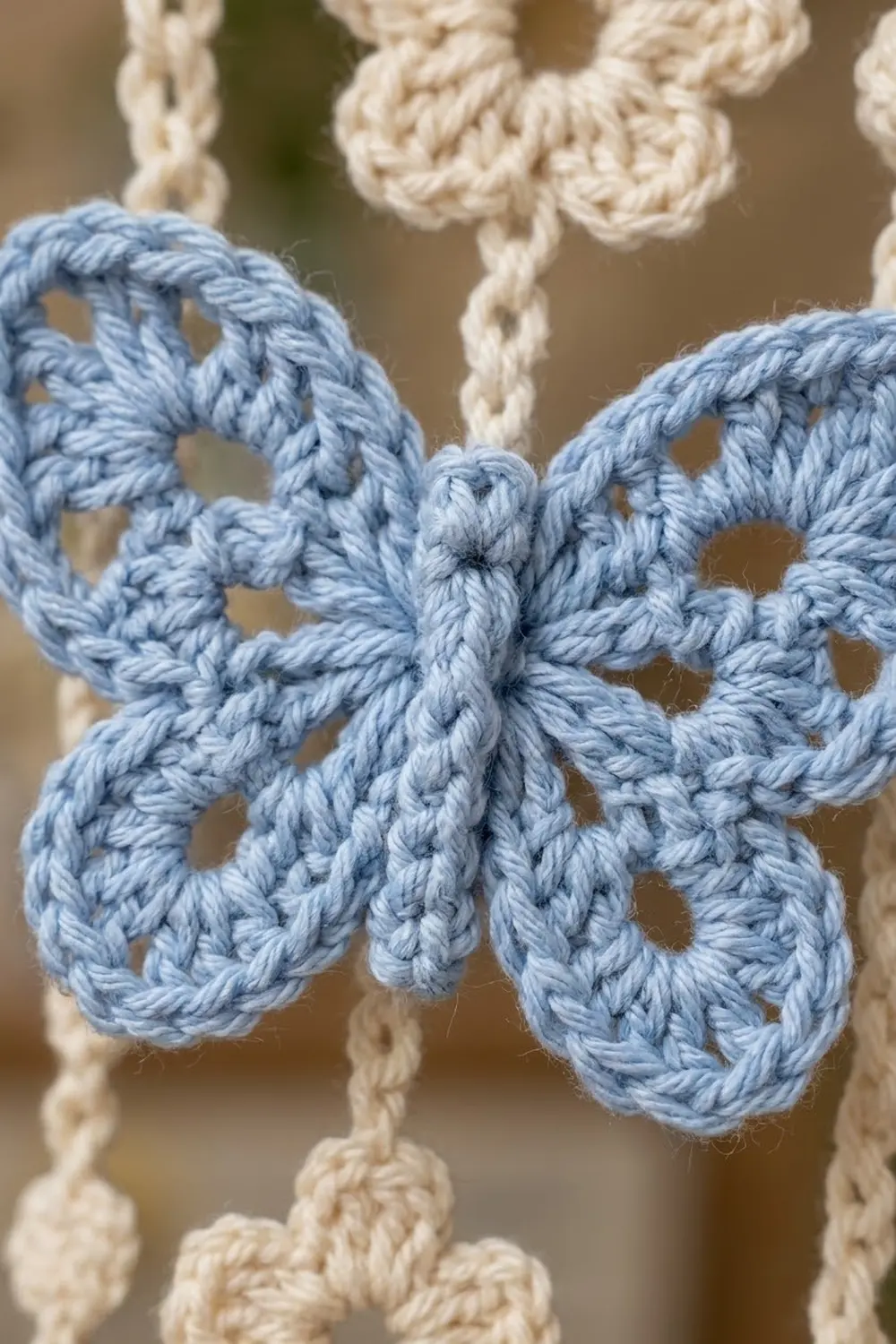
Butterflies (make 30)
With blue:
Rnd 1: Magic ring, ch 1, 12 sc in ring, sl st to first sc. (12 sc)
Rnd 2: Ch 1, sc in same st (sc 1), ch 10, sk sc 2, sc in sc 3, sc in sc 4, ch 7, sk sc 5, sc in sc 6, sc in sc 7, ch 7, sk sc 8, sc in sc 9, sc in sc 10, ch 10, sk sc 11, sc in sc 12, sl st to first sc.
(8 sc, 2 ch-10 loops, 2 ch-7 loops)
Rnd 3:
– In the first ch-10 loop work (3 sc, 3 hdc, 6 dc, 3 hdc, 3 sc), then sl st in each of the next 2 sc.
– In each ch-7 loop work (2 sc, 2 hdc, 5 dc, 2 hdc, 2 sc), then sl st in each of the next 2 sc.
– Work the last ch-10 loop like the first and sl st in the last 2 sc.
(Upper wings 18 sts each, lower wings 13 sts each = 62 sts, plus 8 sl sts)
The skipped ring stitches leave an open eyelet inside each wing.
Rnd 4: Sl st into the first sc of the wing. Working around each wing, sc in each sc and hdc and 2 sc in each dc. Sl st in each sl st between the wings. Join and fasten off.
(Upper wings 24 sc each, lower wings 18 sc each = 84 sc)
Body (make 30): With blue, ch 13. Sc in 2nd ch from hook and each ch across, turn. (12 sc) Ch 1 and work 12 sc across. Fasten off, leaving a 10 in (25.4 cm) tail.
Fold the body strip in half lengthwise. Lay it vertically over the ring, running from between the upper wings to between the lower wings, and sew it down along the fold line so it forms a raised ridge. The body is 2.4 in (6.1 cm) long.
Flowers (make 25)
With cream:
Rnd 1: Ch 6, sl st to first ch to form a ring. Ch 1, 10 sc in ring, sl st to first sc. (10 sc) The chain ring keeps the center open.
Rnd 2: Ch 3, sk 1 sc, sc in next sc; rep from * 4 more times, placing the last sc in the joining st. (5 ch-3 loops)*
Rnd 3: In each ch-3 loop work (sc, hdc, 3 dc, hdc, sc). Sl st to the first sc and fasten off. (5 petals, 35 sts)
Make All Pieces
Cream: 1 header, 25 flowers, 11 strands (72 beads in total)
Blue: 30 butterflies, 30 bodies
Strand layout (left to right, one per scallop):
SCALLOPS 1–11: B F B F B F B F B F B
That gives 6 butterfly strands (B) and 5 flower strands (F), so both outer edges end with a butterfly strand.
Strand B, top to bottom: lead chain, then BD / BUTTERFLY repeated 5 times, then BD, BD.
Strand B totals: 5 butterflies, 7 BD.
Strand F, top to bottom: lead chain, then BD / FLOWER repeated 5 times, then BD.
Strand F totals: 5 flowers, 6 BD.
Totals: 6 × 5 = 30 butterflies; 5 × 5 = 25 flowers; 6 × 7 + 5 × 6 = 72 BD.
Joining: Strands and Motifs
The strands are chained directly from the header, and the motifs are joined into them as you go with sl sts. Hold the motifs RS facing you so the strand chain runs behind them.
Strand B: Join cream with a sl st in the center sc of the scallop. Ch 12 (2 in / 5.1 cm).
Unit (rep 5 times):
1. Ch 9, BD, ch 10.
2. Sl st through the top end of a butterfly body.
3. Ch 14 behind the butterfly.
4. Sl st through the bottom end of the body.
Tail: Ch 9, BD, ch 9, BD. Fasten off.
The count is 12 + 5 × 33 + 18 = 195 ch, plus 7 BD = 36 in (91.4 cm).
Strand F: Join with a sl st in the center sc. Ch 27 (4.5 in / 11.4 cm).
Unit (rep 5 times):
1. Ch 12, BD, ch 12.
2. Sl st into the center dc of one petal.
3. Ch 9 behind the flower; the chain shows through the open center.
4. Sl st into the sc between the two opposite petals.
Tail: Ch 6, BD. Fasten off.
The count is 27 + 5 × 33 + 6 = 198 ch, plus 6 BD = 36 in (91.4 cm).
Stitch-to-stitch logic: Each unit in both strand types is 33 ch plus 1 BD, which equals 6 in (15.2 cm). The different lead chains stagger the motifs: butterflies start about 5.5 in (14.0 cm) down and flowers about 9 in (22.9 cm) down, so they don’t line up in rows.
Tension: Chain at an even, relaxed tension. The chain behind each motif should lie flat without bunching or stretching the motif. Hang the header from the rod after every 2 strands and compare their lengths.
Size checkpoint: every strand hangs 36 in (91.4 cm) from its center sc, and the curtain measures 35.4 × 39 in (89.9 × 99.1 cm).
Border: Rod Pocket
Border gauge: 20 hdc = 4 in (10.2 cm). Rows B1–B6 measure 2 in (5.1 cm) flat.
Row B1: With RS facing, join cream in the first loop on the other side of the foundation chain. Ch 1 and sc in each of the 177 loops. Turn. (177 sc)
Rows B2–B6: Ch 2 (does not count as a st), hdc in each st across. Turn. (177 hdc each row)
Fold Rows B4–B6 to the WS. Whipstitch each of the 177 sts of Row B6 to the base of Row B1, one to one. Leave the short ends of the pocket open for the rod.
Side edges: Work 4 sc into the row ends of header Rows 1–3 on each side: 1 sc in Row 1, 2 sc in Row 2 and 1 sc in Row 3.
Why the math works: 177 = 11 × 16 + 1, the same count as the header band. Every pocket row matches the band stitch for stitch, so the pocket lies flat without fullness. The whipstitch also joins 177 sts to 177 sts. Folded, the pocket is 1 in (2.5 cm) deep and fits a rod up to 5/8 in (1.6 cm) across.
Final Blocking
- Weave in all ends, sewing body tails securely through the wings.
- Pin the header flat to 35.4 in (89.9 cm) wide.
- Pin each scallop to 3.2 in (8.1 cm) wide, and open each picot with a pin tip.
- Lay the strands straight down, pinning them at 36 in (91.4 cm).
- Pin the butterfly wings open to 2.75 in (7.0 cm) and the flower petals to 1.5 in (3.8 cm).
- Mist the whole piece evenly until it’s damp, not soaked.
- Let it dry completely, then hang it.
Final Quality-Control Checklist
- Header Row 1 has 177 sc and measures 35.4 in (89.9 cm).
- All 11 scallops are equal, with 9-dc fans and 8 picots each.
- Each strand starts from the center sc of a scallop.
- Strands alternate B F B F, with butterfly strands at both edges.
- Each B strand has 5 butterflies and 7 BD; each F strand has 5 flowers and 6 BD.
- All strands measure 36 in (91.4 cm).
- Butterfly bodies are centered and raised.
- The rod pocket is closed along its full length and open at both ends.
Troubleshooting
Header too wide: Your sc gauge is loose. Rework with a smaller hook rather than dropping stitches, because the 16-st repeat must stay intact.
Scallops look flat or ruffled: Check that each fan has exactly 9 dc and that you skipped 7 sts on each side of every V in Row 4.
Strands are uneven: Count the chains in each unit (33) and compare your chain gauge with the swatch.
Butterfly droops forward: The chain behind it is too long. Remove a ch or two so the chain is snug against the body.
Beads look flat: Make sure you close each BD by pulling the loop through the top of the first dc.
Pocket too tight: Add one more hdc row before folding.
Care
Hand wash in cool water with a mild soap. Lay the curtain flat in its blocked shape to dry, and press lightly through a cloth if needed.
Final Notes
The measurement chain is simple:
– 20 sc = 4 in (10.2 cm), so 177 sc gives 35.4 in (89.9 cm).
– 16 sts make one 3.2 in (8.1 cm) scallop, and 11 scallops fill the width.
– Each 33-ch unit plus a bead equals 6 in (15.2 cm), so every strand hangs 36 in (91.4 cm).
– The header adds 3 in (7.6 cm) and the pocket 1 in (2.5 cm), for 40 in (101.6 cm) in total.
Check these numbers as you go, and your butterflies will float evenly across the glass.
Happy crocheting!