

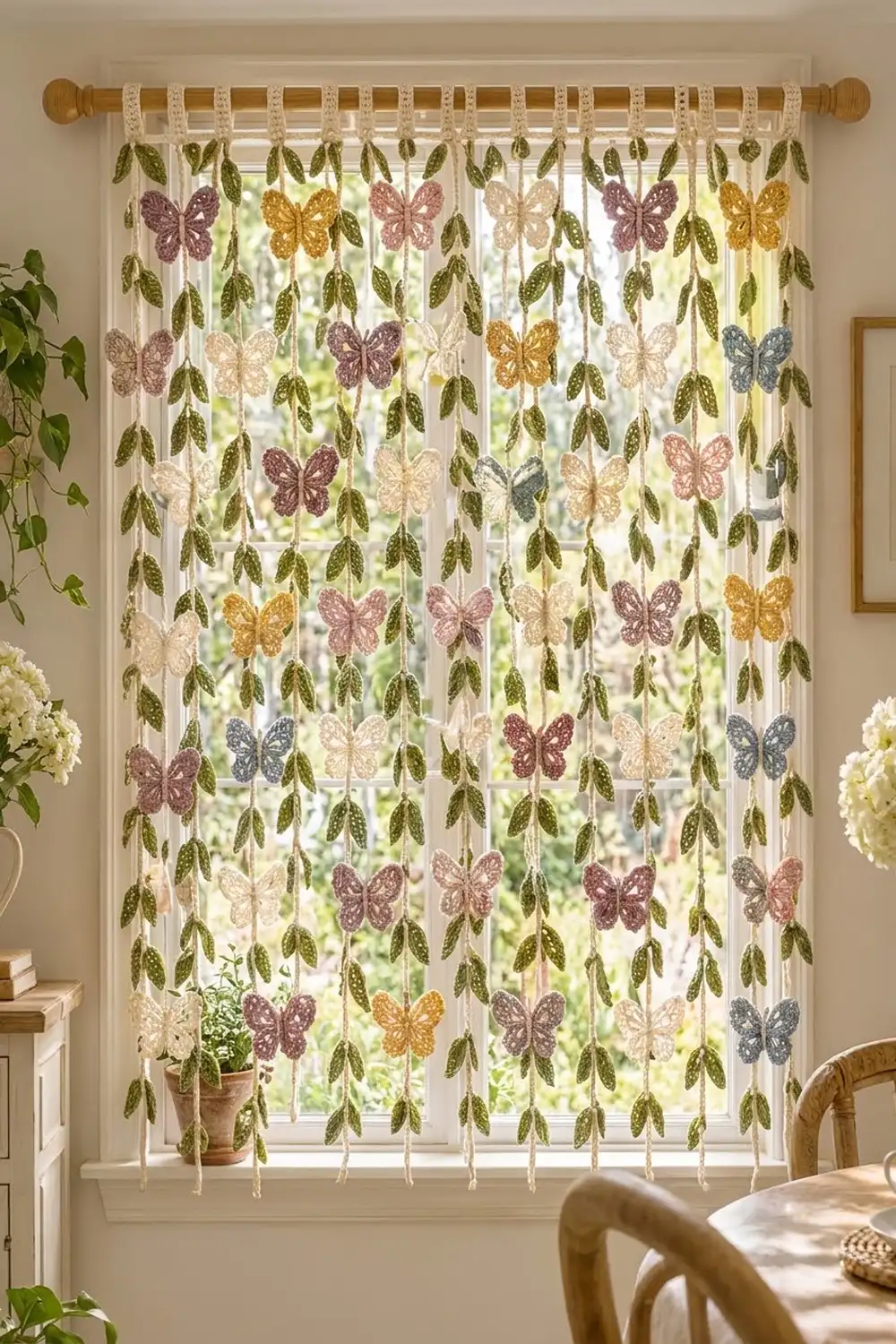
This curtain fills a window with soft, filtered light. Fifteen slim cream strands hang from a solid header band. Each strand has sage-green leaf pairs and lacy butterflies in mauve, mustard, dusty pink, cream and dusty blue. The butterflies are staggered from strand to strand, so the panel looks like a meadow that someone stopped mid-flight.
The style is cottage-boho: natural cotton, muted colors and plenty of open space between the strands. The pattern uses US crochet terms throughout.
The finished curtain is 41.25 in (104.8 cm) wide and 46 in (116.8 cm) long, measured from the top of the header band to the strand tips. The tab loops add about 2 in (5.1 cm) above the band.
You make three kinds of pieces: butterflies, leaves and chain strands. Leaves and butterflies are sewn onto marked points on each strand. The finished strands are then sewn to a single-crochet header band, and tab loops are worked off its top edge.
Finished Size and Construction
- Finished size: 41.25 in (104.8 cm) wide × 46 in (116.8 cm) long, plus about 2 in (5.1 cm) of tab loops
- Skill level: Intermediate (simple stitches, a lot of repetition and careful placement)
- Terminology: US
- Yarn weight: Worsted (#4) cotton
- Hook: H/8 (5 mm)
- Number of pieces: 60 butterflies, 240 leaves, 15 strands, 1 header band, 9 tabs
- Layout: 15 strands side by side, each with 12 nodes spaced 3.5 in (8.9 cm) apart
- Piece size: butterfly 3.5 in (8.9 cm) wide × 3 in (7.6 cm) tall; leaf 1.5 in (3.8 cm) long
- Size before border: the strand field is 41.25 in (104.8 cm) wide × 44 in (111.8 cm) long
- Border depth: a header band 2 in (5.1 cm) deep
Materials
Use a smooth 100% cotton worsted yarn of about 1.54 m per gram (for example, 109 m per 71 g ball). Cotton holds the lace shape crisply and doesn’t stretch much on long hanging strands.
- Cream: 250 g (about 385 m). This covers the header, tabs, strands, body wraps and 12 cream butterflies.
- Sage green: 150 g (about 231 m). This covers 240 leaves.
- Mauve: 60 g (about 92 m)
- Mustard: 60 g (about 92 m)
- Dusty pink: 60 g (about 92 m)
- Dusty blue: 60 g (about 92 m)
Tools:
- H/8 (5 mm) crochet hook
- Tapestry needle
- At least 12 locking stitch markers (more makes it easier)
- Rust-proof pins and a blocking board
- Tape measure
- Spray bottle
- Curtain rod up to 1.25 in (3.2 cm) in diameter
All quantities include a margin of roughly 20–35% for gauge differences and sewing tails.
Abbreviations (US Terms)
- ch: chain
- sl st: slip stitch
- sc: single crochet
- hdc: half double crochet
- dc: double crochet
- tr: treble crochet (yarn over twice, insert hook, pull up a loop, [yarn over, pull through 2 loops] 3 times)
- sp: space
- st(s): stitch(es)
- Rnd: round
Special technique, back-bump slip stitch: working back along a chain, insert the hook under the bump on the back of each chain only, and sl st. This firms up the chain and stops long strands from stretching.
Gauge and Checkpoints
Header gauge: 16 sc × 16 rows = 4 in (10.2 cm).
Strand gauge: 16 ch = 4 in (10.2 cm), measured after the back-bump slip stitch pass.
Make one butterfly and one leaf before anything else, and check them at each stage:
- Butterfly after Rnd 1: 0.75 in (1.9 cm) across
- Butterfly after Rnd 3: 3 in (7.6 cm) wide × 2.5 in (6.4 cm) tall
- Butterfly after Rnd 4: 3.5 in (8.9 cm) wide × 3 in (7.6 cm) tall
- Leaf: 1.5 in (3.8 cm) long × 0.75 in (1.9 cm) wide
- Strand test: chain 56 and slip stitch back. It should measure 14 in (35.6 cm), which is four nodes.
If your pieces are too big, go down to a G/6 (4 mm) hook. If they are too small, go up to an I/9 (5.5 mm) hook. Strand gauge matters most, because node spacing controls where the butterflies sit. If the leaves alone are off, change hook for the leaves only.
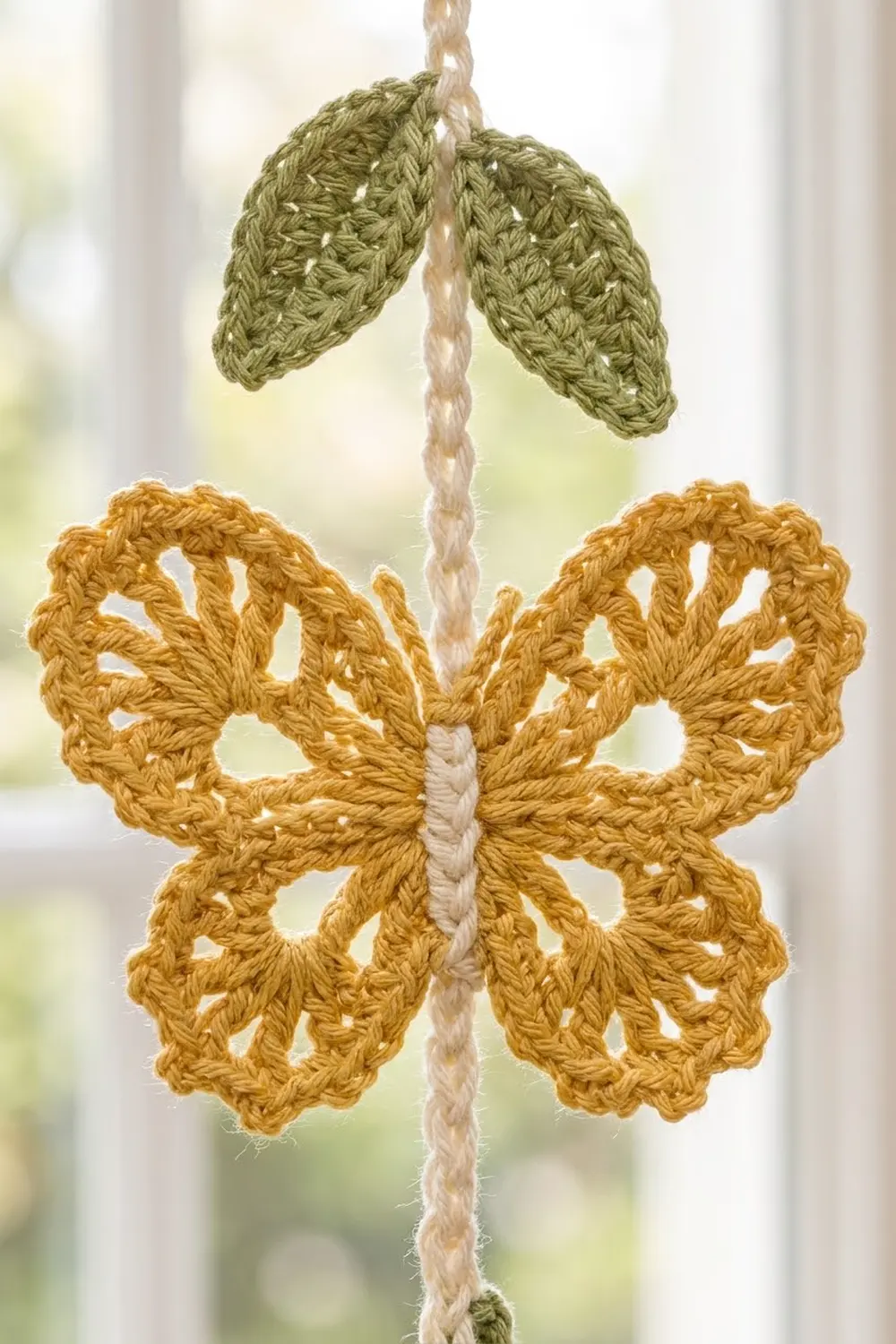
Butterfly (make 60)
Leave a 6 in (15.2 cm) starting tail.
Rnd 1: Make a magic ring. Ch 1, then work 12 sc into the ring. Pull the ring closed and sl st to the first sc. (12 sc)
Rnd 2 (wing frames): Ch 1. Each wing frame uses 3 stitches.
- Upper wing 1: sc in st 1, ch 9, skip st 2, sc in st 3.
- Lower wing 1: sc in st 4, ch 6, skip st 5, sc in st 6.
- Lower wing 2: sc in st 7, ch 6, skip st 8, sc in st 9.
- Upper wing 2: sc in st 10, ch 9, skip st 11, sc in st 12.
Sl st to the first sc. (8 sc, two ch-9 loops, two ch-6 loops)
Rnd 3 (wing fill): Sl st into the first ch-9 loop.
- Upper wing 1: in the ch-9 loop, work (sc, hdc, 3 dc, ch 1, 3 tr, ch 1, 3 tr, ch 1, 3 dc, hdc, sc). That’s 16 sts and 3 ch-1 sps. Sl st in each of the next 2 sc.
- Lower wing 1: in the ch-6 loop, work (sc, hdc, 2 dc, ch 1, 3 dc, ch 1, 2 dc, hdc, sc). That’s 11 sts and 2 ch-1 sps. Sl st in each of the next 2 sc.
- Lower wing 2: repeat lower wing 1, then sl st in each of the next 2 sc.
- Upper wing 2: repeat upper wing 1, then sl st in the last sc and the first sc.
(54 sts and 10 ch-1 sps across the wings, plus 8 sl sts between the wings)
The tr fans make the upper wings taller and wider than the lower wings. That gives the classic butterfly silhouette.
Rnd 4 (looped edge): For this round, count each ch-1 sp as one stitch. That gives each upper wing 19 positions and each lower wing 13.
- Upper wing: sc in the first sc, then [ch 3, skip 1 position, sc in next position] 9 times. That’s 1 + 18 = 19 positions, for 10 sc and 9 ch-3 loops.
- Lower wing: sc in the first sc, then [ch 3, skip 1 position, sc in next position] 6 times. That’s 1 + 12 = 13 positions, for 7 sc and 6 ch-3 loops.
Between wings, sl st into the Rnd 3 sl sts. Work all four wings in order, then sl st to the first sc. (34 sc and 30 ch-3 loops)
Fasten off and weave in the ends.
Leaf (make 240)
Leave a 2 in (5.1 cm) starting tail.
Row 1: With sage green, ch 6. Starting in the 2nd ch from the hook, work sc, hdc, dc, hdc, sc. (5 sts)
Tip: Ch 2.
Second side: Rotate the leaf and work into the free loops of the foundation chain: sc, hdc, dc, hdc, sc. (5 sts) Sl st to the first sc.
(10 sts plus a ch-2 tip)
Fasten off and leave an 8 in (20.3 cm) tail. The tail comes out at the base of the leaf and is used to sew it on. The dc in the middle of each side gives the leaf its pointed oval shape. Trim the starting tail.
Strand (make 15)
Leave a 10 in (25.4 cm) starting tail.
Chain: With cream, ch 176. As you go, place a marker in every 14th chain: ch 14, 28, 42, 56, 70, 84, 98, 112, 126, 140, 154 and 168. These are Nodes 1–12. The last 8 ch form the bottom tail.
Return: Sl st in the back bump of the 2nd ch from the hook and in each ch back to the top. (175 sl sts)
Fasten off and leave a 10 in (25.4 cm) tail. Keep the markers in place.
Each strand measures 44 in (111.8 cm): 12 nodes × 3.5 in (8.9 cm) = 42 in (106.7 cm), plus a 2 in (5.1 cm) tail.
Make All Pieces
Butterflies: 12 each in mauve (M), mustard (Y), dusty pink (P), cream (C) and dusty blue (B), for 60 in total.
Leaves: 240 sage green, which makes 120 pairs.
Strands: 15 cream.
Each strand follows one of three placement patterns:
- Pattern A (strands 1, 4, 7, 10, 13): butterflies at Nodes 3, 6, 9 and 12
- Pattern B (strands 2, 5, 8, 11, 14): butterflies at Nodes 2, 5, 8 and 11
- Pattern C (strands 3, 6, 9, 12, 15): butterflies at Nodes 1, 4, 7 and 10
Every other node holds a leaf pair, so each strand gets 4 butterflies and 8 leaf pairs.
In the layout grid below, strands run left to right and nodes run top to bottom. A dot (·) is a leaf pair; a letter is a butterfly.
Strand  1  2  3  4  5  6  7  8  9 10 11 12 13 14 15
N1      ·  ·  C  ·  ·  M  ·  ·  P  ·  ·  B  ·  ·  Y
N2      ·  B  ·  ·  Y  ·  ·  C  ·  ·  M  ·  ·  P  ·
N3      M  ·  ·  P  ·  ·  B  ·  ·  Y  ·  ·  C  ·  ·
N4      ·  ·  B  ·  ·  Y  ·  ·  C  ·  ·  M  ·  ·  P
N5      ·  M  ·  ·  P  ·  ·  B  ·  ·  Y  ·  ·  C  ·
N6      Y  ·  ·  C  ·  ·  M  ·  ·  P  ·  ·  B  ·  ·
N7      ·  ·  M  ·  ·  P  ·  ·  B  ·  ·  Y  ·  ·  C
N8      ·  Y  ·  ·  C  ·  ·  M  ·  ·  P  ·  ·  B  ·
N9      P  ·  ·  B  ·  ·  Y  ·  ·  C  ·  ·  M  ·  ·
N10     ·  ·  Y  ·  ·  C  ·  ·  M  ·  ·  P  ·  ·  B
N11     ·  P  ·  ·  B  ·  ·  Y  ·  ·  C  ·  ·  M  ·
N12     C  ·  ·  M  ·  ·  P  ·  ·  B  ·  ·  Y  ·  ·
Each color appears 12 times, and no strand repeats a color.
Joining
Leaf pairs: At each leaf node, hold two leaves with their bases touching the marked chain. Angle each one about 45° down and outward, one to the left and one to the right, to form a V. Thread the 8 in (20.3 cm) tail of each leaf, pass it through the marked chain twice, and knot it at the back. Weave the tail into the leaf.
Butterflies: Place the butterfly behind the strand, with its Rnd 1 center directly over the marked node. The cream chain now runs down the front center and forms the body. Cut 18 in (45.7 cm) of cream. Wrap it 6 times around the strand and the center of the butterfly, between the upper and lower wings. Knot it at the back. Add one tacking stitch at the top of Rnd 1 and one at the bottom so the butterfly can’t spin.
Stitch logic: Each piece attaches to exactly one marked chain, so the 3.5 in (8.9 cm) node spacing stays fixed. With leaf tips reaching about 1 in (2.5 cm) below their node, there is clear space above each 3 in (7.6 cm) butterfly.
Tension: Wrap the body snugly, but don’t pull it tight. Over-tight wraps cup the wings and shorten the strand.
Size checkpoint: Hang a finished strand from its top tails. It should still measure 44 in (111.8 cm). Remove the markers.
Border: Header Band and Tabs
Border gauge: 16 sc × 16 rows = 4 in (10.2 cm).
Each strand gets an 11-stitch segment of the band, which is 2.75 in (7.0 cm). That gives 15 strands × 11 sts = 165 sts across.
Row 1: With cream, ch 166. Sc in the 2nd ch from the hook and in each ch across. (165 sc)
Rows 2–8: Ch 1 and turn. Sc in each st across. (165 sc per row)
Don’t fasten off yet.
Side edges: Ch 1 and turn the work 90°. Sl st once into the end of each row down the short side, for 8 sl sts. Fasten off. Join cream at the other short side and work the same 8 sl sts.
The band now measures 41.25 in (104.8 cm) × 2 in (5.1 cm).
Attaching the strands: Along the bottom edge of the band (the free loops of the foundation chain), mark stitches 6, 17, 28, 39, 50, 61, 72, 83, 94, 105, 116, 127, 138, 149 and 160. That’s stitch 6 + 11 × (strand number − 1).
- Each strand sits at the center of its segment, with 5 sts on either side. The first strand has sts 1–5 to its left and the last strand has sts 161–165 to its right, so the panel is symmetrical.
- Thread both top tails of strand 1 and pass them through st 6 three times. Knot them at the back and weave them into the band.
- Repeat for all 15 strands, in the order shown in the layout grid.
Tabs (make 9): The 9 tabs are 5 sts wide, so they use 45 sts. The remaining 120 sts are split into 8 gaps of 15 sts. Tab k starts at stitch 1 + 20 × (k − 1): stitches 1, 21, 41, 61, 81, 101, 121, 141 and 161. The last tab ends exactly at st 165.
- Tab Row 1: Join cream in the starting stitch of the tab on Row 8. Ch 1, then sc in the same st and the next 4 sts. (5 sc)
- Tab Rows 2–20: Ch 1 and turn. Work 5 sc. (5 sc per row)
- Finish: Fasten off and leave a 12 in (30.5 cm) tail.
Each tab strip is 5 in (12.7 cm) long. Fold it to the back so its last 3 rows overlap the top of the band, then whipstitch them down. This leaves a loop about 2 in (5.1 cm) tall, which fits a rod up to 1.25 in (3.2 cm) across.
Why the math works: 15 strands × 11 sts = 165 sts. For the tabs, 9 × 5 + 8 × 15 = 165 sts. No stitches are added at the seams or edges, so the band matches the strand layout exactly.
Final Blocking
- Lightly mist all butterflies and leaves before attaching them, or spot-block afterwards.
- Pin each butterfly to 3.5 in (8.9 cm) × 3 in (7.6 cm). Open every ch-3 loop and fan out the tr stitches.
- Pin the header band flat to 41.25 in (104.8 cm) × 2 in (5.1 cm). Mist it and let it dry completely.
- Hang the curtain on its rod.
- Mist the strands and gently straighten each one by hand. Their own weight sets them to 44 in (111.8 cm).
- Tweak the leaf V angles and center each butterfly behind its strand while everything is still damp.
Final Quality-Control Checklist
- 15 strands, each 44 in (111.8 cm) long
- 12 nodes per strand, spaced 3.5 in (8.9 cm) apart
- 4 butterflies and 8 leaf pairs on every strand
- 12 butterflies of each color, placed as in the grid
- Each butterfly has 34 sc and 30 ch-3 loops on Rnd 4
- Header band has 165 sts per row and 8 rows
- Strands are attached at the 15 calculated stitches
- 9 tabs are evenly spaced, with the end tabs flush to the edges
- All tails are knotted and woven in
Troubleshooting
- Strands are longer than 44 in (111.8 cm): Chain tighter, or use a smaller hook for the chain only.
- Butterflies are cupped or ruffled: Rnd 4 is too loose or too tight. Change to ch 2 or ch 4 loops, or block harder.
- Butterflies spin on the strand: Add the top and bottom tacking stitches.
- Leaves droop flat: Pass the leaf tail through the chain at the angle you want, and add a second anchoring pass.
- The band ripples: Your sc row is looser than the strand spacing. Re-block it to 41.25 in (104.8 cm) or redo it with a smaller hook.
- Tabs are too tight on the rod: Add 2 rows to every tab.
Care
Hand wash the curtain in cool water and press out the water in a towel. Lay it flat or hang it to dry, then re-mist and reshape the butterflies as needed.
Final Notes
Everything in this curtain follows one chain of measurements. A 3.5 in (8.9 cm) butterfly fits within the 3.5 in (8.9 cm) node spacing. Twelve nodes plus the tail make a 44 in (111.8 cm) strand. Fifteen strands at 11 stitches each make a 165-stitch, 41.25 in (104.8 cm) header. The 2 in (5.1 cm) band brings the curtain to 46 in (116.8 cm) long. If your gauge matches at each checkpoint, your curtain will match too.
Happy crocheting!