

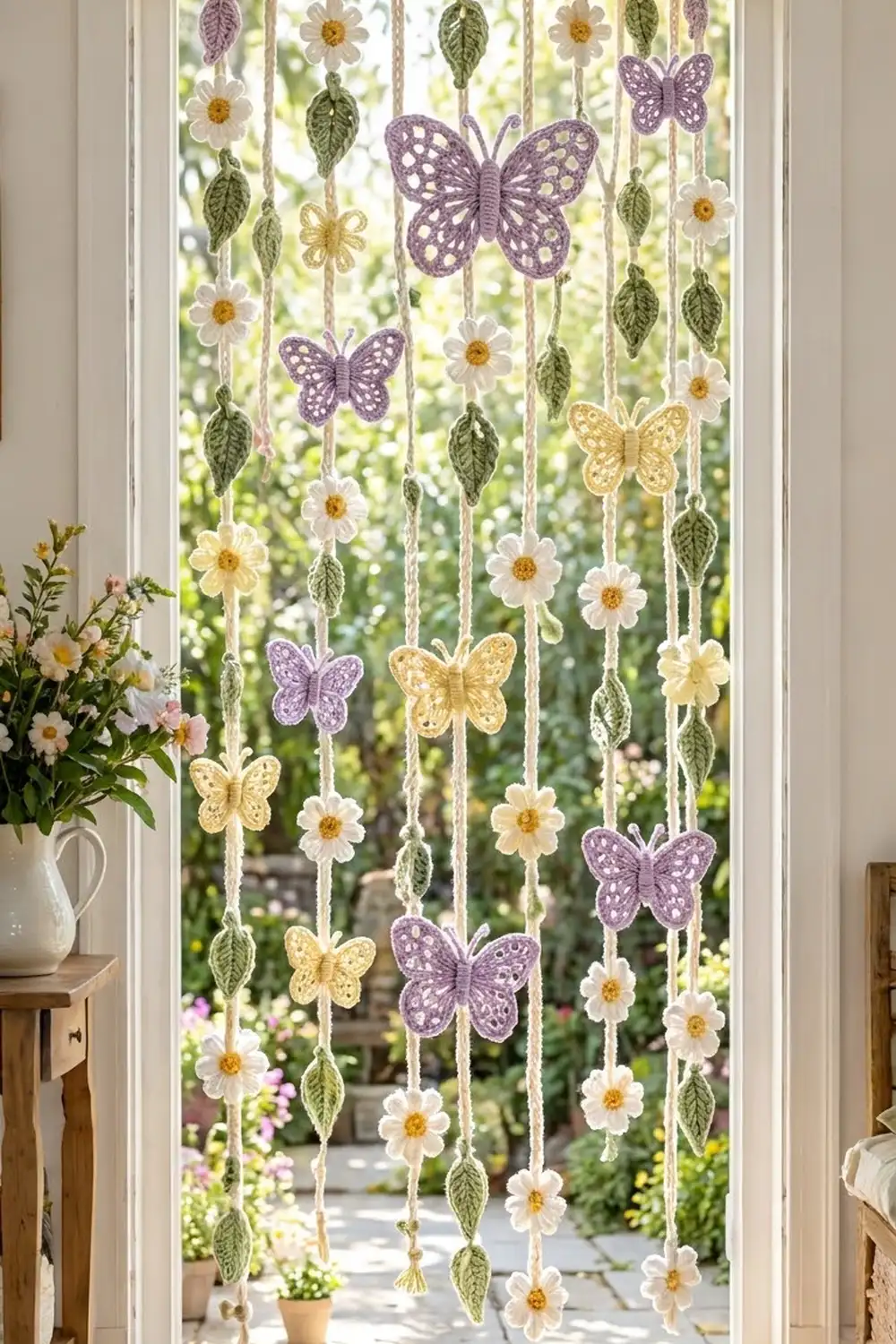
This curtain turns a plain doorway into a small garden. Ten cream cords hang from a wooden dowel, and each one carries a column of lacy butterflies, white daisies, and soft green leaves that move and catch the light every time someone walks through.
The palette is gentle: lavender and buttercup-yellow butterflies, white daisies with golden centers, sage leaves, and cream cords. The butterflies have open, lacy wings with a firm single-crochet rim and a ribbed body wrapped in yarn, so they look dimensional without stuffing.
This pattern uses US crochet terms. The finished curtain is 36 in (91.4 cm) wide at the dowel with a 75 in (190.5 cm) drop. That fits a standard interior doorway, and you can shorten it easily.
You make every motif separately, crochet ten long slip-stitch cords, sew the motifs to the cords in a fixed sequence, and tie each cord over the dowel. Test one butterfly before you commit to the full set.
Finished Size and Construction
- Finished size: 36 in (91.4 cm) wide × 75 in (190.5 cm) drop below the dowel
- Skill level: Intermediate (simple stitches, lots of finishing)
- Terminology: US
- Yarn weight: DK / light (3) cotton
- Hooks: 3.5 mm (E-4) for motifs; 4.0 mm (G-6) for cords
- Number of pieces: 10 cords, 30 butterflies, 30 daisies, 60 leaves
- Layout: 10 cords, 12 motifs per cord, spaced 6 in (15.2 cm) apart
- Piece sizes: butterfly 4 in (10.2 cm) wide × 3 in (7.6 cm) tall; daisy 2.25 in (5.7 cm) across; leaf 2.75 in (7.0 cm) × 1.25 in (3.2 cm)
- Cord spacing: 3.5 in (8.9 cm) center to center
- Size before finishing: each cord 85 in (215.9 cm), including a 10 in (25.4 cm) heading allowance
- Edge finish: knotted dowel heading at the top and knotted cord tails at the bottom (no fabric border)
Materials
Use a smooth mercerized or soft matte cotton in DK weight. Cotton keeps the wing holes crisp and holds its shape when hanging. Choose a fiber that won’t pill, because people will brush past the curtain.
- Lavender: 100 g (230 m) – 15 butterflies
- Pale yellow: 150 g (345 m) – 15 butterflies plus 30 daisy centers
- White: 100 g (230 m) – 30 daisies’ petals
- Sage green: 100 g (230 m) – 60 leaves
- Cream: 150 g (345 m) – 10 cords, held double
All quantities include a margin of about 20–25% for gauge differences and sewing tails.
Tools:
– 3.5 mm (E-4) and 4.0 mm (G-6) crochet hooks
– Wooden dowel, 36 in (91.4 cm) long, 1 in (2.5 cm) diameter
– Two cup hooks or curtain brackets
– Tapestry needle
– Scissors
– Locking stitch markers
– Tape measure
– Blocking mat and rustproof pins
– Spray bottle
Abbreviations (US Terms)
- ch – chain
- sl st – slip stitch
- sc – single crochet
- hdc – half double crochet
- dc – double crochet
- tr – treble crochet
- sk – skip
- sp – space
- st(s) – stitch(es)
- MR – magic ring
- rnd – round
Special stitch – Back-bump slip stitch cord: Make a chain, then work a sl st into the back bump (the ridge on the back) of each chain. This makes a firm, round cord that won’t stretch under the weight of the motifs.
Gauge and Checkpoints
Motif gauge (3.5 mm hook, single strand): 20 sc and 22 rows = 4 in (10.2 cm).
Cord gauge (4.0 mm hook, held double): 16 ch = 4 in (10.2 cm), measured after the slip-stitch row.
Make one complete butterfly first and check it at each stage:
- Upper wing after Rnd 1: about 0.75 in (1.9 cm) × 2 in (5.1 cm)
- Upper wing after Rnd 3: 1.75 in (4.4 cm) wide × 2.5 in (6.4 cm) long
- Lower wing after Rnd 3: 1.25 in (3.2 cm) wide × 1.75 in (4.4 cm) long
- Assembled butterfly: 4 in (10.2 cm) × 3 in (7.6 cm)
If your motifs are too big, go down half a hook size. If they’re too small, go up half a size. Small differences in motif size won’t affect the curtain’s layout, because spacing is measured along the cords. Cord gauge does matter: if a cord comes out short, add chains until it measures 85 in (215.9 cm).
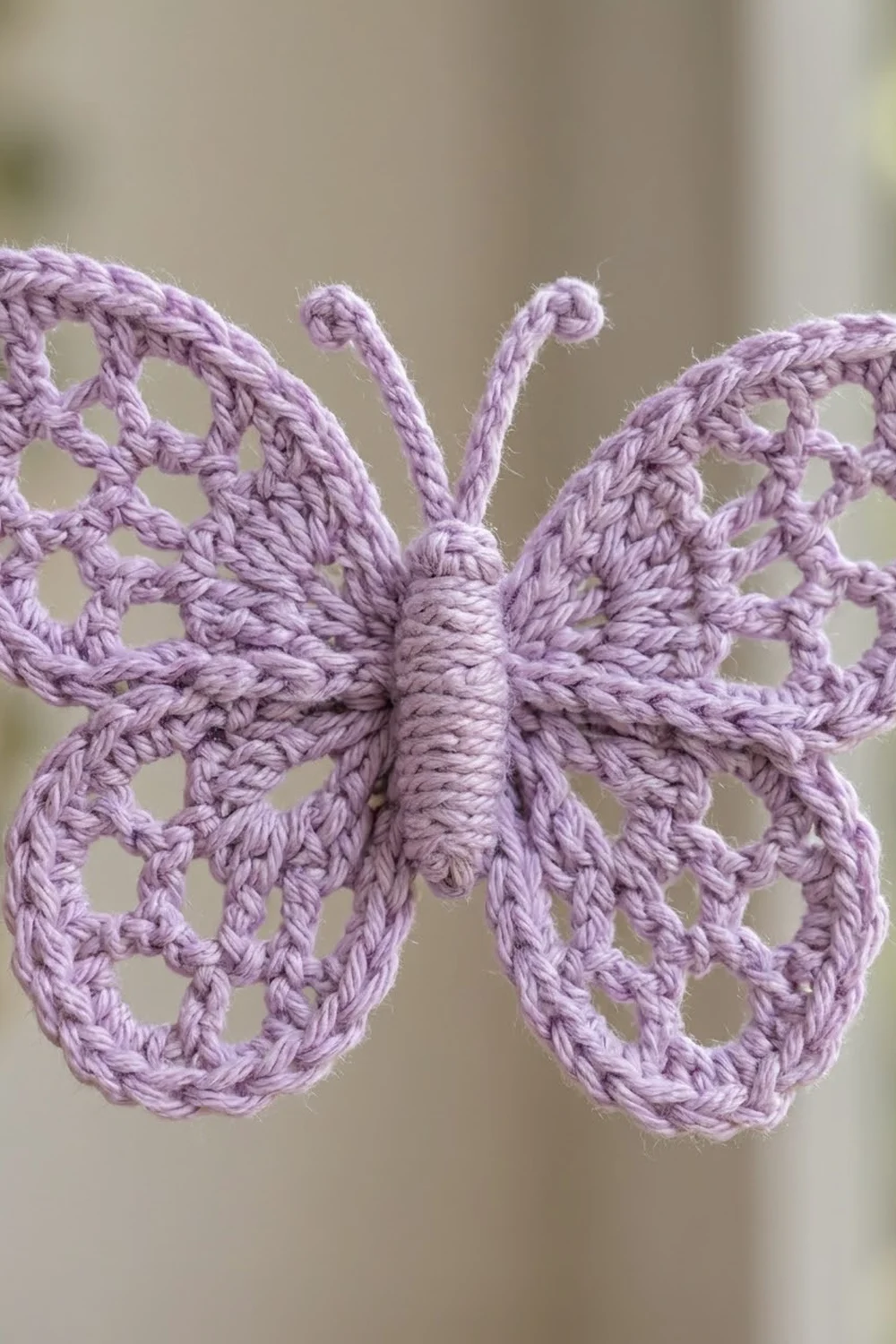
Butterfly (Make 30: 15 Lavender, 15 Yellow)
Each butterfly has two upper wings, two lower wings, one body strip, and two antennae, all worked in the same color with the 3.5 mm hook.
Upper Wing (Make 2 per butterfly)
Ch 9.
Rnd 1: Sc in 2nd ch from hook, hdc in next ch, dc in next 5 ch, 7 dc in last ch (this is the rounded wide end). Rotate and work along the opposite side of the foundation: dc in next 5 ch, hdc in next ch, sc in last ch. Sl st to first sc. (21 sts)
The sc stitches at both ends sit at the narrow tip, which will attach to the body.
Rnd 2 (lace): Ch 1, sc in first st, (ch 3, sk 1, sc in next st) 10 times. The last sc lands in st 21. Sl st to first sc. (11 sc and 10 ch-3 sps)
The ch-3 spaces become the open holes in the wing.
Rnd 3 (rim): Ch 1, sc in first sc, (4 sc in next ch-3 sp, sc in next sc) 10 times. Sl st to first sc. (51 sts: 1 + 10 × 5)
Fasten off, leaving an 8 in (20.3 cm) tail.
Lower Wing (Make 2 per butterfly)
Ch 7.
Rnd 1: Sc in 2nd ch from hook, hdc in next ch, dc in next 3 ch, 7 dc in last ch. Along the opposite side: dc in next 3 ch, hdc in next ch, sc in last ch. Sl st to first sc. (17 sts)
Rnd 2 (lace): Ch 1, sc in first st, (ch 3, sk 1, sc in next st) 8 times. The last sc lands in st 17. Sl st to first sc. (9 sc and 8 ch-3 sps)
Rnd 3 (rim): Ch 1, sc in first sc, (4 sc in next ch-3 sp, sc in next sc) 8 times. Sl st to first sc. (41 sts: 1 + 8 × 5)
Fasten off, leaving an 8 in (20.3 cm) tail.
Body
Ch 9. Sc in 2nd ch from hook and in each ch across. (8 sc)
This makes a strip about 1.5 in (3.8 cm) long. Fasten off and leave a 30 in (76.2 cm) tail for wrapping.
Antennae (Make 2 per butterfly)
Ch 6. Sl st in 2nd ch from hook (this makes the knob at the tip), then sl st in next 4 ch. (5 sl st)
Each antenna is about 1 in (2.5 cm) long. Fasten off and leave a 6 in (15.2 cm) tail.
Butterfly Assembly
- Lay the two upper wings with their narrow tips touching at the center, wide ends angled up and out.
- Lay the two lower wings below them, narrow tips at the center, angled down and out.
- Use the wing tails to sew the four narrow tips together with a few firm stitches.
- Place the body strip vertically over the center, right side up.
- Wrap the body tail tightly around the body and the stacked wing tips 14 times, spacing the wraps evenly along the 1.5 in (3.8 cm) body. This creates the ribbed segments.
- Secure the wraps by passing the needle under them on the back.
- Sew the antennae to the top of the body so they splay out in a V.
- Keep one 12 in (30.5 cm) tail on the back of the body for attaching the butterfly to its cord. Weave in the rest.
Daisy (Make 30)
Rnd 1 (yellow): Make a MR, ch 1, 6 sc in ring. Pull the ring closed and sl st to first sc. (6 sc)
Rnd 2: Ch 1, 2 sc in each st around. Sl st to first sc. (12 sc)
The center should measure about 0.75 in (1.9 cm) and dome slightly. Fasten off yellow.
Rnd 3 (white petals): Join white with a sl st in any sc. In the same st, ch 6, sc in 2nd ch from hook, hdc in next ch, dc in next 2 ch, hdc in next ch, sl st in next sc of center. Repeat from * around. (12 petals)
The last sl st lands back in the joining st. Fasten off, leaving a 12 in (30.5 cm) tail for attaching. The daisy should measure 2.25 in (5.7 cm) across.
Leaf (Make 60)
Use sage green and the 3.5 mm hook. Ch 11.
Rnd 1:
1. Sc in 2nd ch from hook, hdc in next ch, dc in next 2 ch, tr in next ch, dc in next 2 ch, hdc in next ch, sc in next ch. (9 sts along side 1)
2. In the last ch, work (sc, ch 2, sc) for the pointed tip.
3. Along the opposite side of the foundation: sc in next ch, hdc in next ch, dc in next 2 ch, tr in next ch, dc in next 2 ch, hdc in next ch, sc in last ch. (9 sts along side 2)
4. Sl st to first sc. (20 sts plus tip ch-2 sp)
The foundation chain runs down the middle and forms the center vein.
Stem: Ch 4, then fasten off, leaving a 10 in (25.4 cm) tail. The leaf should measure 2.75 in (7.0 cm) × 1.25 in (3.2 cm).
Cords (Make 10)
Use cream held double and the 4.0 mm hook.
Ch 340. Sl st in the back bump of the 2nd ch from hook and of each ch across. (339 sl st)
Checkpoint: The cord should measure 85 in (215.9 cm): a 75 in (190.5 cm) drop plus a 10 in (25.4 cm) heading allowance. Adjust the chain count if needed. Leave a 6 in (15.2 cm) tail at each end.
Make All Pieces
Totals:
– Lavender: 15 butterflies
– Yellow: 15 butterflies and 30 daisy centers
– White: 30 daisies’ petals
– Green: 60 leaves
– Cream: 10 cords
Each cord carries 12 motifs: 3 butterflies, 3 daisies, and 6 leaves. Odd and even cords are offset so the butterflies stagger across the curtain.
Key: D = daisy, L = leaf, BL = lavender butterfly, BY = yellow butterfly. Positions are measured down from the underside of the dowel.
Position (in / cm)   Odd cords 1,3,5,7,9   Even cords 2,4,6,8,10
 1:  3 in /   7.6 cm        D                   BY
 2:  9 in /  22.9 cm        L                   L
 3: 15 in /  38.1 cm        BL                  D
 4: 21 in /  53.3 cm        L                   L
 5: 27 in /  68.6 cm        D                   BL
 6: 33 in /  83.8 cm        L                   L
 7: 39 in /  99.1 cm        BY                  D
 8: 45 in / 114.3 cm        L                   L
 9: 51 in / 129.5 cm        D                   BY
10: 57 in / 144.8 cm        L                   L
11: 63 in / 160.0 cm        BL                  D
12: 69 in / 175.3 cm        L                   L
Color check:
– Odd cords: 2 lavender + 1 yellow butterfly each, so 5 cords give 10 lavender and 5 yellow.
– Even cords: 1 lavender + 2 yellow each, so 5 cords give 5 lavender and 10 yellow.
– Total: 15 lavender and 15 yellow.
Joining
The motifs are sewn to the cords, not joined to each other.
Mark the cord:
1. Lay a cord flat, and place a marker 10 in (25.4 cm) from the top end. This is the dowel line.
2. Measuring down from the dowel line, place markers at 3 in (7.6 cm) and then every 6 in (15.2 cm), for 12 markers ending at 69 in (175.3 cm).
Sew each motif at its marker:
– Butterflies: Center the body over the cord and sew the back of the body to the cord with 4–5 stitches through the cord’s sl st loops.
– Daisies: Sew the back of the yellow center to the cord with a ring of 4 stitches.
– Leaves: Sew the 4-ch stem to the side of the cord so the leaf hangs at an angle, alternating left and right down the cord.
Tension: Stitch firmly enough that the motif won’t spin, but don’t pinch the cord. If you pull too hard, the cord puckers and the spacing shrinks.
Checkpoint: After sewing, the last motif should still sit at 69 in (175.3 cm), measured with the cord hanging under its own weight.
Border: Heading and Tail Finish
This curtain has no fabric border. The “border” is the knotted heading at the top and the knotted tails at the bottom. Their gauge is the cord gauge: 16 ch = 4 in (10.2 cm).
Step 1 – Top edge (10 heading knots):
1. Mark the dowel at 2.25 in (5.7 cm) from each end, then every 3.5 in (8.9 cm) between, for 10 marks.
2. At each mark, lay the cord’s dowel line across the top of the dowel.
3. Wrap the 10 in (25.4 cm) allowance over the dowel to the back and bring it down in front.
4. Tie the allowance around the main cord with a tight overhand knot 1.5 in (3.8 cm) below the dowel.
5. Sew the end into the knot and trim.
Step 2 – Side edges: Cords 1 and 10 form the side edges. Their outer leaves should face inward so the edges look neat.
Step 3 – Bottom edge (10 tail knots): Tie an overhand knot in each cord at 75 in (190.5 cm) below the dowel. Trim 1 in (2.5 cm) below the knot and sew in the ends.
Why the math works:
– Width: 2.25 + (9 × 3.5) + 2.25 = 36 in (91.4 cm), the full dowel.
– Length: 3 + (11 × 6) + 6 = 75 in (190.5 cm). That’s the first motif, 11 gaps of 6 in, and a 6 in (15.2 cm) tail.
Final Blocking
- Mist each motif lightly before you attach it.
- Pin the butterfly wings open with pins in the rim, opening each ch-3 hole into a rounded shape.
- Pin each daisy’s petals out evenly, and shape each leaf’s tip to a point.
- Let everything dry completely.
- Hang the finished curtain and let the cords relax for 24 hours.
- Recheck the drop and retie any knot that has slipped.
Final Quality-Control Checklist
- Every upper wing has 51 rim sts and every lower wing has 41.
- Every daisy has 12 petals.
- Every leaf has a clear center vein and a pointed tip.
- Each cord measures 85 in (215.9 cm) before tying.
- Motifs sit 6 in (15.2 cm) apart, starting 3 in (7.6 cm) below the dowel.
- Butterflies stagger between odd and even cords.
- There are 15 lavender and 15 yellow butterflies.
- Heading knots are evenly spaced 3.5 in (8.9 cm) apart.
- All ends are woven in securely.
Troubleshooting
- Wing holes are closed up: Your Rnd 2 chains are too tight. Use the larger hook for the ch-3s only.
- Wing rim ruffles: Work 3 sc per space instead of 4 for that wing.
- Body wraps slide: Wrap more tightly, then anchor the wraps with a stitch on the back after every 4 wraps.
- Daisy center cups too much: Work Rnd 2 with a slightly looser tension.
- Leaves curl: Steam-block them flat.
- Cords stretch over time: Hold the yarn double more firmly, or add a third strand.
- Butterflies spin to the side: Add a second attachment stitch at the top of the body.
Care
Dust the curtain with a gentle shake or a cool hair dryer. When it needs cleaning, hand-wash it in cool water, roll each cord in a towel, and hang it to dry.
Final Notes
Each measurement builds on the one before it:
- Motif gauge sets the butterfly at 4 in (10.2 cm) and the daisy at 2.25 in (5.7 cm).
- Cord gauge gives a cord of 85 in (215.9 cm).
- Twelve motifs spaced 6 in (15.2 cm) apart fill the 75 in (190.5 cm) drop.
- Ten cords spaced 3.5 in (8.9 cm) apart span the 36 in (91.4 cm) dowel.
Check each step, and the curtain will hang evenly. Happy crocheting!