

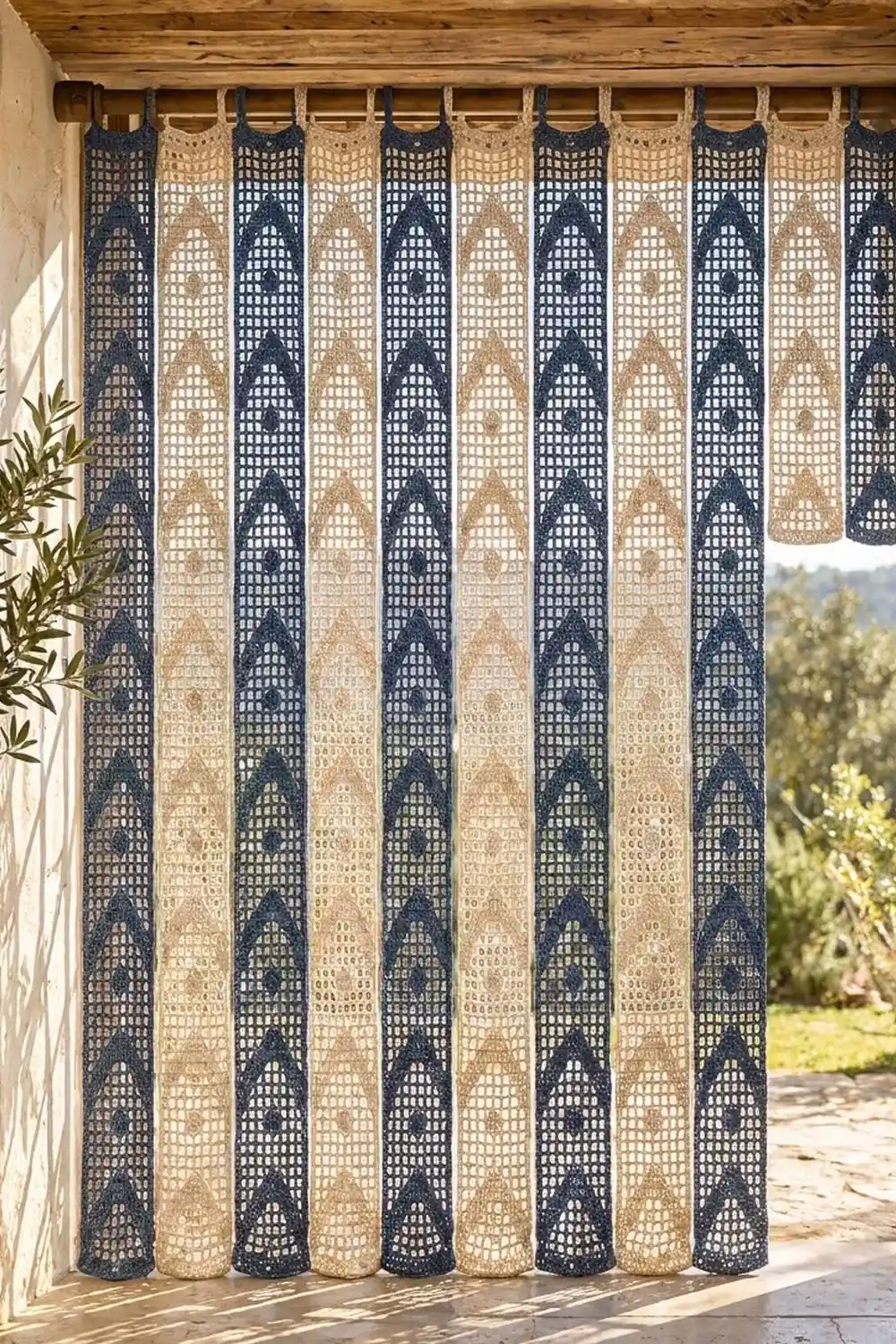
The Casa Arcada Strip Curtain is a light, airy door or window curtain made of eleven separate filet crochet strips. Each strip shows a column of pointed arches with a small diamond inside each one. The arches are worked in solid blocks against an open mesh grid, so light shines through the background and the motifs stand out clearly.
The curtain alternates denim blue and natural cream cotton. It fits Mediterranean, farmhouse, or coastal rooms, and it looks good from both sides because filet has no strong wrong side.
Each finished strip measures 6.3 in (16.0 cm) wide and 74.3 in (188.7 cm) long, not counting the hanging tab. This pattern uses US crochet terms.
Construction is simple. You work each strip from the bottom up in filet mesh, following a 16-row arch repeat. Then you add a two-round single crochet border and crochet a narrow tab at the top, which folds over the rod. The strips are never sewn to each other; they hang side by side.
Finished Size and Construction
- Finished strip size: 6.3 in x 74.3 in (16.0 cm x 188.7 cm), plus tab
- Skill level: Intermediate (easy stitches, long project, chart-style reading)
- Terminology: US crochet terms
- Yarn weight: Sport (#2) cotton
- Hook: US D-3 (3.25 mm)
- Number of pieces: 11 strips (6 blue, 5 cream)
- Layout: 11 strips in one row, alternating colors, hung independently
- Strip size before border: 5.5 in x 73.5 in (14.0 cm x 186.7 cm)
- Border depth: 0.4 in (1.0 cm) on every edge (2 rounds of sc)
- Hanging span: about 71.3 in (181.1 cm) wide
Materials
Use a smooth mercerized or combed sport-weight cotton, about 155 m per 50 g. Cotton holds the filet grid crisply and blocks well. Avoid fuzzy or very stretchy yarns, because long strips will sag.
- Denim blue: 650 g (about 2,015 m), enough for 6 strips
- Natural cream: 550 g (about 1,705 m), enough for 5 strips
Each strip uses about 95 g (about 295 m). The quantities above include a safety margin of roughly 15 percent for gauge differences and swatching.
Tools:
– US D-3 (3.25 mm) crochet hook
– Tapestry needle
– Stitch markers
– Measuring tape
– Blocking mats or a long padded surface, plus rust-proof pins
– Spray bottle
– Curtain rod up to 1.25 in (3.2 cm) in diameter, with brackets
Abbreviations (US Terms)
- ch – chain
- sl st – slip stitch
- sc – single crochet
- dc – double crochet
- sk – skip
- sp – space
- st(s) – stitch(es)
- RS – right side
Special stitches (filet blocks):
– Open block (O): ch 2, sk 2 sts (or the ch-2 sp), dc in next dc.
– Solid block (S) over an open block: 2 dc in the ch-2 sp, dc in next dc.
– Solid block (S) over a solid block: dc in each of next 3 dc.
– Open block over a solid block: ch 2, sk 2 dc, dc in next dc.
Every row has 11 blocks: 12 dc plus 11 two-stitch blocks, for 34 sts in total. The first and last blocks of every row are open. Begin every row with ch 5, which counts as the first dc plus ch 2. The final dc of each row goes into the 3rd ch of the previous row’s turning ch.
Gauge and Checkpoints
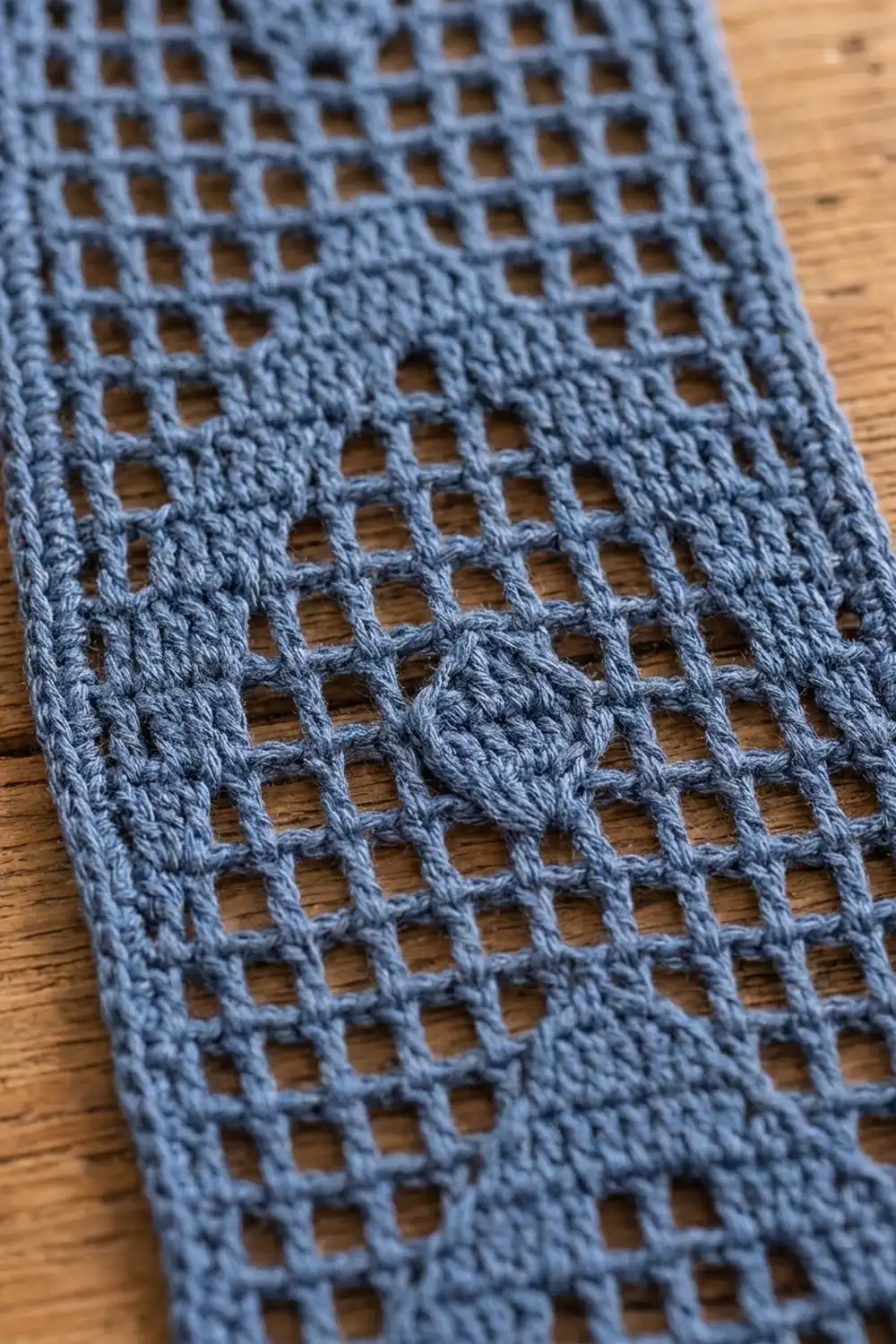
Gauge: 8 blocks and 8 rows = 4 in (10.2 cm) in filet mesh, after blocking. One block is 0.5 in (1.3 cm) wide, and one row is 0.5 in (1.3 cm) tall.
Test your gauge on the first strip before committing to all eleven. Work the first 19 rows, pin the piece out lightly, and measure:
- After Row 3: 5.5 in (14.0 cm) wide, 1.5 in (3.8 cm) tall
- After Row 19 (first full repeat): 9.5 in (24.1 cm) tall
- After Row 83 (5 repeats): 41.5 in (105.4 cm) tall
- After Row 147: 73.5 in (186.7 cm) tall
If your strip is too big, change to a 3.0 mm hook. If it is too small, change to a 3.5 mm hook. Row height matters most, because small errors add up over 147 rows. If your width is correct but your rows run short, pull up the dc loops slightly taller instead of changing hooks.
Strip Pattern
Make 6 strips in blue and 5 in cream. All strips are worked the same way.
In the rows below, the 11 letters give the block order from column 1 to column 11. The design is symmetrical, so you read every row the same way in either direction.
Foundation: Ch 38.
Row 1 (RS): Dc in 8th ch from hook. The skipped chains count as the first dc, the ch-2 sp, and 2 skipped base chains. *Ch 2, sk 2 ch, dc in next ch; repeat from * 9 more times. (11 open blocks; 34 sts)
Rows 2–3: Ch 5, turn. Work open blocks across: O O O O O O O O O O O. (34 sts)
Arch Repeat (16 rows)
Work the following 16 rows 9 times in total: Rows 4–19, 20–35, and so on through Row 147. Every row has 34 sts.
- Repeat Rows 1–4: O S S O O O O O S S O
- Repeat Row 5: O S S O O S O O S S O
- Repeat Row 6: O S S O S S S O S S O
- Repeat Row 7: O S S O O S O O S S O
- Repeat Row 8: O S S O O O O O S S O
- Repeat Rows 9–10: O O S S O O O S S O O
- Repeat Row 11: O O O S S O S S O O O
- Repeat Row 12: O O O O S S S O O O O
- Repeat Row 13: O O O O O S O O O O O
- Repeat Rows 14–16: O O O O O O O O O O O
Here is how the shape builds. Columns 2–3 and 9–10 form the two-block-thick arch legs for 8 rows. In Rows 9–10 the legs step in one column, and in Row 11 they step in again. They meet in a three-block cap in Row 12 and a single-block point in Row 13. The diamond (1, 3, 1 blocks) sits in Rows 5–7 with open mesh around it on every side. The three open rows at the top of the repeat match the three open rows at the bottom of the strip, so the top and bottom margins look the same.
Total after Row 147: 147 rows, 34 sts per row, 5.5 in x 73.5 in (14.0 cm x 186.7 cm). Do not fasten off; go straight into the border.
Make All Pieces
- Denim blue: 6 strips
- Natural cream: 5 strips
- Total: 11 strips
Layout from left to right (B = blue, C = cream):
| B | C | B | C | B | C | B | C | B | C | B |
  1   2   3   4   5   6   7   8   9  10  11
Number each strip with a marker as you finish it so you can hang the colors in order.
Border
Border gauge: 6 sc = 1 in (2.5 cm) along every edge.
The border starts at the top right corner with the RS facing. The center sc of each 3-sc corner group is the corner stitch. Each side count below includes both of that side’s corner stitches.
Round 1: Ch 1. Work 3 sc in the first dc (corner), [2 sc in next ch-2 sp, sc in next dc] 10 times, 2 sc in next ch-2 sp, then 3 sc in the 3rd ch of the turning ch (corner). Rotate the strip.
– Down the long side, work 3 sc around each row-end post, 147 times (441 sc).
– Across the bottom, work 3 sc at the base of the end dc (corner), [2 sc around the next ch-2 sp, sc in the base of the next dc] 10 times, 2 sc around the next ch-2 sp, then 3 sc at the base of the last dc (corner).
– Up the other long side, work 3 sc around each row-end post, 147 times (441 sc).
– Sl st to the first sc.
Round 1 counts:
– Top and bottom: 34 sts worked, plus 2 extra sts at each corner = 38 sc each
– Each long side: 441 sc
– Round total: 38 + 38 + 441 + 441 = 958 sc
– Per side, including corners: 36 on top and bottom, 445 on the long sides
Round 2: Ch 1. Sc in each sc around, working 3 sc in each corner center sc. Sl st to the first sc.
– Round 1’s 958 sts plus 2 extra at each of 4 corners = 966 sc
– Per side, including corners: 38 on top and bottom, 447 on the long sides
Fasten off.
Why the math works: A filet block is 3 sts across 0.5 in (1.3 cm), which equals 6 sts per inch. That matches the border gauge exactly. Along the long sides, each row is 0.5 in (1.3 cm) tall, and 3 sc per row-end also gives 6 sc per inch. The border matches the strip on all four edges, so it neither ruffles nor pulls in.
After the border, each strip measures 5.5 + 0.8 = 6.3 in (16.0 cm) wide and 73.5 + 0.8 = 74.3 in (188.7 cm) long.
Hanging Tab
On the top edge, 36 sts sit between the two corner sts. The tab is worked over the center 6 of them, leaving 15 sts free on each side (15 + 6 + 15 = 36).
With the RS facing, count 15 sts in from the top right corner st. Join yarn in the 16th st.
Tab Row 1: Ch 1, sc in the same st and in the next 5 sts. (6 sc)
Tab Rows 2–24: Ch 1, turn, sc in each sc. (6 sc)
The tab measures 1 in (2.5 cm) wide and 4.8 in (12.2 cm) long. Leave a 12 in (30.5 cm) tail and fasten off.
Joining (Hanging Assembly)
The strips are not joined to each other. The only seam on each strip is the tab, which folds into a loop.
Method: Fold the tab toward the wrong side. Line up its 6 last-row sts with the 6 Round 2 border sts at the base of the tab, one stitch to one stitch. Whipstitch them through the back loops with the tail. This makes a closed loop that fits rods up to 1.25 in (3.2 cm) in diameter. If you have a thicker rod, add 2 more tab rows for each extra 0.25 in (0.6 cm) of diameter.
Tension: Sew snugly, but do not pull so hard that the top border gathers. The top edge should stay a straight 6.3 in (16.0 cm).
Spacing: Slide the strips onto the rod in layout order and center the tabs 6.5 in (16.5 cm) apart. That leaves a 0.2 in (0.5 cm) gap between strips.
Size checkpoint: The total span is 10 x 6.5 + 6.3 = 71.3 in (181.1 cm).
Final Blocking
- Weave in all ends along the border sc, not through the mesh, where they would show.
- Soak each strip in cool water with a little wool wash for 15 minutes.
- Press out the water in a towel. Do not wring.
- Lay the strip flat and pin it to 6.3 in x 74.3 in (16.0 cm x 188.7 cm).
- Pin the long edges every 3 in (7.6 cm) so they stay perfectly straight.
- Tug the mesh gently into square blocks, and smooth each arch point and diamond into a crisp shape.
- Let the strip dry completely. Hang it for 24 hours before you trim or adjust anything, because cotton relaxes slightly under its own weight.
Final Quality-Control Checklist
- Each strip has 147 rows and 9 complete arch repeats.
- Every row has 34 sts (11 blocks).
- The arch legs are 2 blocks thick, and every point is centered on column 6.
- Each diamond is 1, 3, 1 blocks and does not touch the legs.
- The border has 958 sc in Round 1 and 966 sc in Round 2.
- The tab is exactly centered, with 15 sts free on each side.
- All strips measure within 0.5 in (1.3 cm) of each other in length.
- The colors are hung in B-C-B order, starting and ending with blue.
Troubleshooting
The strip is getting narrower. You are probably missing the last dc into the turning ch. Count your 12 dc in every row.
The arches lean to one side. A solid block landed in the wrong column. Check each row against the letter sequence before turning.
The edges ruffle. Your border is too loose. Go down a hook size for the border, or work 5 sc in every 2 row-ends instead of 6.
The edges pull in. Your border is too tight. Go up a hook size for the border only.
One strip is longer than the others. Your row heights vary between sessions. Block the long strip shorter while it is wet, or remove one open row at the bottom.
The tab twists. Sew it stitch-to-stitch exactly in line. Do not offset the seam.
Care
Hand wash in cool water and dry flat, re-pinning if needed. Avoid tumble drying, because heavy wet cotton strips can stretch.
Final Notes
Everything rests on one chain of measurements. With 8 blocks to 4 in (10.2 cm), 11 blocks make 5.5 in (14.0 cm) and 147 rows make 73.5 in (186.7 cm). Two border rounds bring each strip to 6.3 in x 74.3 in (16.0 cm x 188.7 cm). Hung on 6.5 in (16.5 cm) centers, eleven strips span 71.3 in (181.1 cm). Check your gauge early, count your 34 sts, and the arches will stack cleanly from top to bottom.
Happy crocheting!