

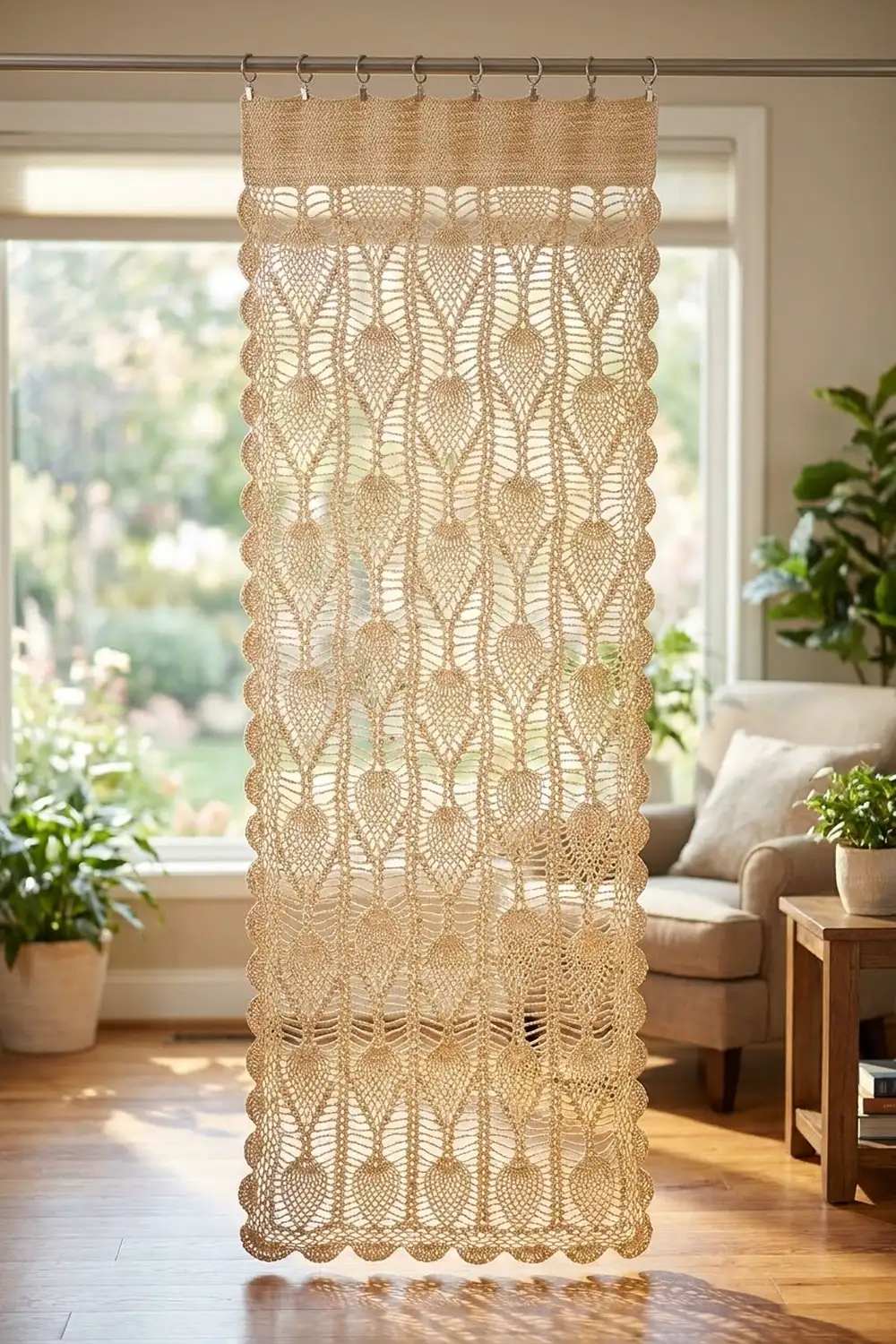
This curtain panel has tall columns of classic pineapple motifs set between narrow shell columns. A row of scallops runs down both long sides and across the bottom, and a solid header band at the top takes clip rings. When light comes through the window, the pineapples stand out against the open chain mesh.
The panel uses one color, a champagne gold mercerized cotton with a soft sheen. It looks vintage, but the solid header and clean scalloped edges keep it from feeling fussy. All instructions use US crochet terms.
The finished panel measures 28.25 in wide x 80.5 in long (71.8 cm x 204.5 cm) after blocking. The pattern makes one panel. To dress a window as a pair, make a second panel the same way. The two panels hang side by side and are never joined.
The construction is simple. You crochet one flat piece from the bottom up: a foundation row of double crochet, two set-up shell rows, then fifteen repeats of an 8-row pineapple pattern. A solid header band closes the top. A two-round border then adds the scallops and squares off the edges.
Finished Size and Construction
- Finished size: 28.25 in x 80.5 in (71.8 cm x 204.5 cm)
- Skill level: Intermediate
- Terminology: US crochet terms
- Yarn weight: DK (#3 light) mercerized cotton
- Hook: 4.5 mm (US 7)
- Number of pieces: 1 (a single panel worked flat)
- Layout: 6 pineapple columns wide, 15 pineapples tall per column, with 7 shell columns between and beside them
- Piece size before border: 25.75 in x 78.75 in (65.4 cm x 200.0 cm)
- Border depth: 1.25 in (3.2 cm) on the sides and bottom; 0.5 in (1.3 cm) along the top
Materials
Choose a smooth mercerized cotton or cotton-blend DK in a pale gold, champagne, or warm ivory. Mercerized cotton shows the stitch definition well, holds the scallops crisply, and stands up to sunlight better than most acrylics. Avoid fuzzy or very stretchy yarn, because the panel will slowly grow lengthwise while it hangs.
- Champagne gold (Main Color): 1,300 g / 2,990 m (about 26 balls of 50 g / 115 m)
The quantity covers one panel and includes a margin of roughly 10% for the gauge swatch and weaving in. For a pair of panels, double it, and buy all the yarn from one dye lot.
Tools:
- 4.5 mm (US 7) crochet hook
- Tapestry needle
- Locking stitch markers
- Tape measure
- Blocking mats or a clean floor area, rust-proof pins, and blocking wires if you have them
- Spray bottle
- Clip curtain rings for hanging (about 8 per panel)
Abbreviations (US Terms)
- ch = chain
- sl st = slip stitch
- sc = single crochet
- dc = double crochet
- tr = treble crochet
- st(s) = stitch(es)
- sp(s) = space(s)
- lp(s) = loop(s)
- sk = skip
- tch = turning chain
- rep = repeat
- RS / WS = right side / wrong side
Special stitches:
- Shell: (2 dc, ch 2, 2 dc) in the same st or sp.
- Fan: (tr, ch 1) 6 times, tr, all in the same sp. That gives 7 tr and 6 ch-1 sps.
- Scallop: 5 dc in the same st.
- Corner scallop: 7 dc in the same sp.
Gauge and Checkpoints
Solid gauge: 16 dc and 8 rows = 4 in (10.2 cm) in dc rows. The header, foundation, and border sc use this gauge.
Pattern gauge (blocked): one 16-st repeat = 4 in (10.2 cm) wide; one 8-row pineapple repeat = 5 in (12.7 cm) tall.
Test first. Work a two-repeat swatch: ch 41, then work Row 0, Rows A and B, and Rows 1–8 once, using 2 repeats where the instructions say 6 (39 dc in Row 0, 5 shells in Row A, 2 pineapples). Wet-block it. It should measure 9.75 in (24.8 cm) wide and 6.5 in (16.5 cm) tall.
- Too big: go down 0.5 mm in hook size, or chain more firmly in the loop rows.
- Too small: go up 0.5 mm. Don’t add stitches; the counts drive the border math.
Checkpoints for the full panel (lightly stretched):
- Row 0: 103 dc, 25.75 in (65.4 cm) wide
- After Row B: 1.5 in (3.8 cm) tall
- After 1 pineapple repeat: 6.5 in (16.5 cm)
- After 5 repeats: 26.5 in (67.3 cm)
- After 10 repeats: 51.5 in (130.8 cm)
- After 15 repeats: 76.5 in (194.3 cm)
- After the header: 78.75 in (200.0 cm)
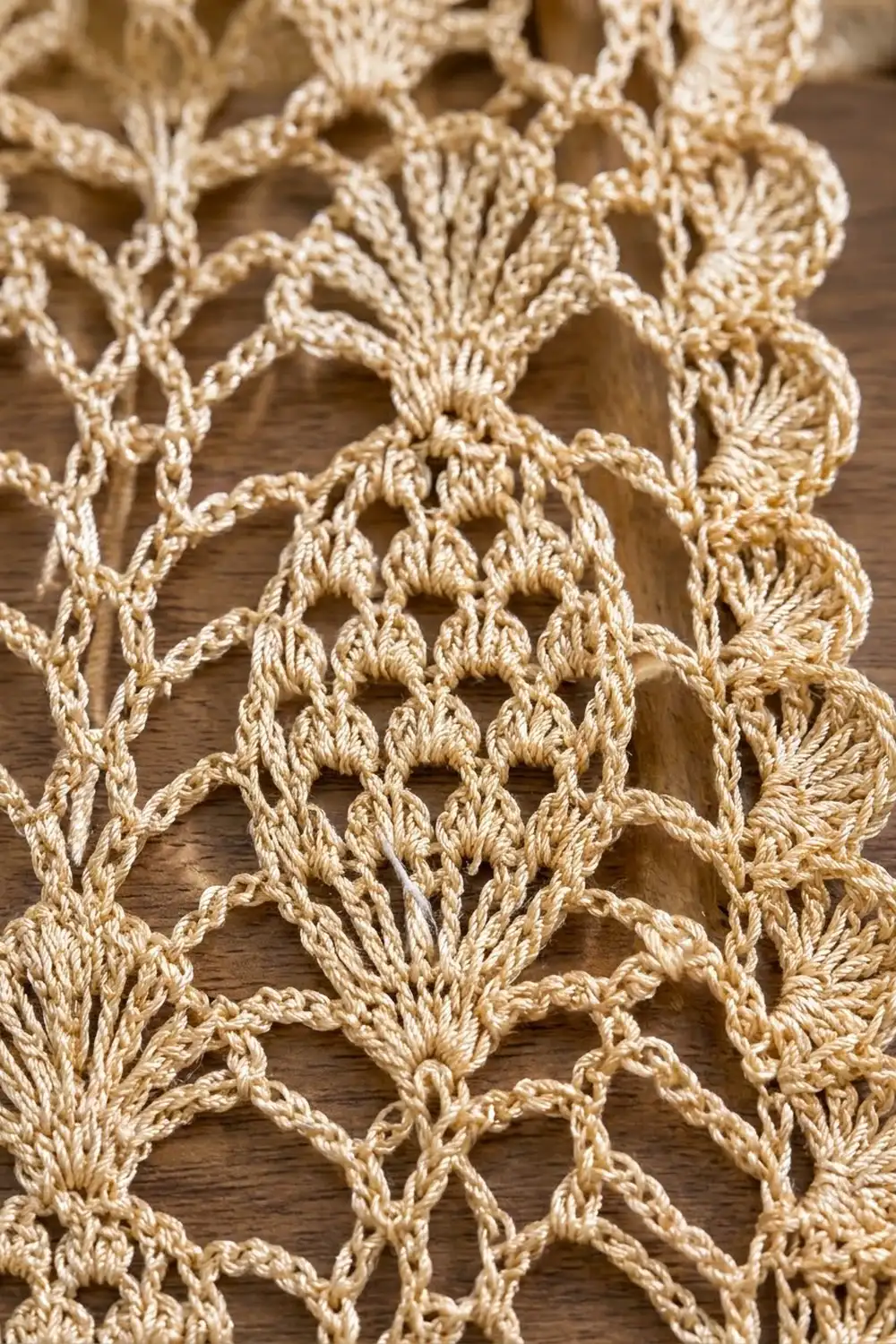
Panel Pattern
Foundation
Ch 105.
Row 0 (WS): Dc in the 4th ch from hook (the skipped chs count as the first dc) and in each ch across. Turn. (103 dc)
Row A (RS): Ch 3 (counts as dc throughout), sk 2 dc, shell in next dc, ch 3, sk 7 dc, shell in next dc; rep from * 11 more times, sk 2 dc, dc in top of tch. Turn. (13 shells, 12 ch-3 sps, 2 edge dc)*
Check: 1 + 2 + 1 + (12 x 8) + 2 + 1 = 103 stitches used.
Counting from the right, shells 1, 3, 5, 7, 9, 11, and 13 are spine shells; these 7 stay shells all the way up. Shells 2, 4, 6, 8, 10, and 12 are center shells; each of these 6 becomes the base of a pineapple.
Row B (WS): Ch 3, shell in ch-2 sp of first shell, ch 3, shell in ch-2 sp of next shell; rep from * across, dc in top of tch. Turn. (13 shells, 12 ch-3 sps)*
Pineapple Repeat (Rows 1–8)
“Shell in shell” always means a shell in the ch-2 sp of the shell below.
Row 1 (RS): Ch 4 (counts as tr), shell in first spine shell, ch 2, Fan in ch-2 sp of next center shell, ch 2, shell in next spine shell; rep from * 5 more times, tr in top of tch. Turn. (7 shells, 6 fans of 7 tr each = 42 tr in fans, 12 ch-2 sps)*
Row 2 (WS): Ch 3, shell in shell, ch 3, sc in first ch-1 sp of fan, (ch 3, sc in next ch-1 sp) 5 times, ch 3, shell in next shell; rep from * across, dc in top of tch. Turn. (7 shells; each pineapple has 6 sc and 5 ch-3 lps)*
Row 3 (RS): Ch 3, shell in shell, ch 4, sc in first ch-3 lp of pineapple, (ch 3, sc in next lp) 4 times, ch 4, shell in next shell; rep from * across, dc in tch. Turn. (each pineapple has 4 lps)*
Row 4 (WS): Ch 3, shell in shell, ch 5, sc in first lp, (ch 3, sc in next lp) 3 times, ch 5, shell in next shell; rep from * across, dc in tch. Turn. (each pineapple has 3 lps)*
Row 5 (RS): Ch 3, shell in shell, ch 6, sc in first lp, (ch 3, sc in next lp) twice, ch 6, shell in next shell; rep from * across, dc in tch. Turn. (each pineapple has 2 lps)*
Row 6 (WS): Ch 3, shell in shell, ch 7, sc in first lp, ch 3, sc in next lp, ch 7, shell in next shell; rep from * across, dc in tch. Turn. (each pineapple has 1 lp)*
The side chains grow by one chain each row as the pineapple loses a loop, which keeps the panel width steady.
Row 7 (RS): Ch 3, shell in shell, ch 4, sk ch-7 sp, shell in the single ch-3 lp at the pineapple tip, ch 4, shell in next shell; rep from * across, dc in tch. Turn. (13 shells, 12 ch-4 sps)*
Row 8 (WS): Ch 3, shell in shell, ch 3, shell in next shell; rep from * across, dc in tch. Turn. (13 shells, 12 ch-3 sps)*
Row 8 matches Row B; the tip shells from Row 7 are now the new center shells. Work Rows 1–8 a total of 15 times, ending after a Row 8. Each column now holds 15 pineapples stacked tip to base.
Header Band
Row H1 (RS, conversion row): Ch 3, *dc in each of next 2 dc, dc in ch-2 sp, dc in each of next 2 dc (5 dc per shell), 3 dc in next ch-3 sp; rep from * across, ending with 5 dc over the last shell and dc in top of tch.
Count: 54 sts worked one-per-stitch (52 shell dc + 2 edge sts) + 49 sts worked into spaces (13 shell sps + 36 in ch-3 sps) = 103 dc, matching Row 0.
Rows H2–H4: Ch 3, dc in each st across. Turn. (103 dc each)
Row H5 (RS): Ch 1, sc in each st across. (103 sc) Fasten off.
Body size: 25.75 in x 78.75 in (65.4 cm x 200.0 cm).
Border
Border gauge: 4 sc per inch (16 sc = 4 in / 10.2 cm) along every edge, the same as the solid dc gauge.
Row-end placement on the sides:
- Rows 0, A, B, and H1–H4: 2 sc per row end
- Row H5: 1 sc
- Each pineapple repeat: 3 sc in Rows 1, 3, 5, and 7; 2 sc in Rows 2, 4, 6, and 8 (20 sc per repeat)
Round 1 (RS): With RS facing, join in the first sc of Row H5. Ch 1, then work:
- 103 sc across the top, ch 1 for the corner
- 315 sc down the side, ch 1
- 103 sc across the bottom (in the free loop at the base of each Row 0 st), ch 1
- 315 sc up the other side, ch 1
Sl st to first sc. (836 sc + 4 corner ch-1 sps) Corner ch-1 sps are not counted in any side total.
Side math: (15 x 20) + (7 x 2) + 1 = 315 sc. At 4 sc per inch that is 78.75 in (200.0 cm), exactly the body length.
Round 2: Sl st into the corner ch-1 sp, ch 1, and work:
- Top corner: 3 sc in corner sp
- Top: sc in each of 103 sc
- Next top corner: 3 sc in corner sp
- Side: sk 1 sc, sc in next sc, sk 1, Scallop in next sc, sk 1; rep from * 77 more times, sc in next sc, sk 1. (78 scallops, 79 sc)*
- Bottom corner: Corner scallop in corner sp
- Bottom: sk 1, sc, sk 1, Scallop, sk 1; rep from * 24 more times, sc in next sc, sk 1. (25 scallops, 26 sc)*
- Bottom corner: Corner scallop in corner sp
- Other side: as first side (78 scallops, 79 sc)
Sl st to first sc. Fasten off.
Why the math works: each scallop repeat uses 4 sts, plus 3 sts per run (the opening skip, closing sc, and closing skip), so every edge needs 4k + 3 sts. 315 = (4 x 78) + 3 and 103 = (4 x 25) + 3, so each run ends evenly at the corners. The flat sc top keeps the clip rings level.
Round 2 adds 1 in (2.5 cm) on the sides and bottom and 0.25 in (0.6 cm) on top. With Round 1’s 0.25 in (0.6 cm), the finished size is 25.75 + (2 x 1.25) = 28.25 in (71.8 cm) wide and 78.75 + 1.25 + 0.5 = 80.5 in (204.5 cm) long.
Final Blocking
- Weave in ends along solid areas or shell posts, never across open chain loops.
- Soak the panel in cool water with a little wool wash for 15 minutes. Press out water; don’t wring.
- Roll in towels to remove more moisture.
- Lay flat. If space is short, block in thirds, keeping the rest rolled in a damp towel.
- Pin the header straight to 28.25 in (71.8 cm), including border.
- Run blocking wires or a string line down each side so the long edges stay straight. Pin each side scallop open.
- Align the pineapple tips vertically in each column, then pin the bottom scallops.
- Check the size: 28.25 in x 80.5 in (71.8 cm x 204.5 cm).
- Let dry completely before unpinning. A light steam pass sets the cotton’s sheen.
Final Quality-Control Checklist
- Row 0 and every header row have 103 sts.
- Every Row 1 has 7 shells and 6 fans; every Row 8 has 13 shells.
- Each pineapple narrows 5, 4, 3, 2, 1 loops.
- There are 15 pineapples in each of the 6 columns.
- Border Round 1 has 103 / 315 / 103 / 315 sc.
- Each side has 78 scallops; the bottom has 25.
- Long edges are straight, not wavy or drawn in.
- Panel measures 28.25 in x 80.5 in (71.8 cm x 204.5 cm).
Troubleshooting
- Panel narrows toward the top: side chains in Rows 3–7 are too tight. Chain more loosely.
- Pineapples bulge: ch-3 loops are too long. Keep them snug and even.
- Side edges ruffle: too many sc in Round 1. Recount against 20 per repeat.
- Side edges pull in: use 3 sc, not 2, in the row ends of Rows 1, 3, 5, and 7.
- Scallops don’t land at a corner: recount Round 1; you need exactly 315 per side and 103 top and bottom.
- Header flares: Row H1 has extra sts. Rework it to 103.
- Panel grows while hanging: normal for cotton. Reblock, and use all 8 clips to spread the weight.
Care
Hand wash cool, or machine wash gently in a mesh bag, then reshape and dry flat. Avoid tumble drying, which stretches the lace.
Final Notes
Each measurement builds on the last. The 16-st repeat at 4 sts per inch gives a 103-st body 25.75 in (65.4 cm) wide. Fifteen 5 in (12.7 cm) pineapple repeats, 1.5 in (3.8 cm) of foundation rows, and a 2.25 in (5.7 cm) header make a 78.75 in (200.0 cm) body. The border’s 315 and 103 sc counts match that body exactly, and the scallops finish it at 28.25 in x 80.5 in (71.8 cm x 204.5 cm). Check counts at each stage and the panel will hang straight and match its pair.
Happy crocheting!