

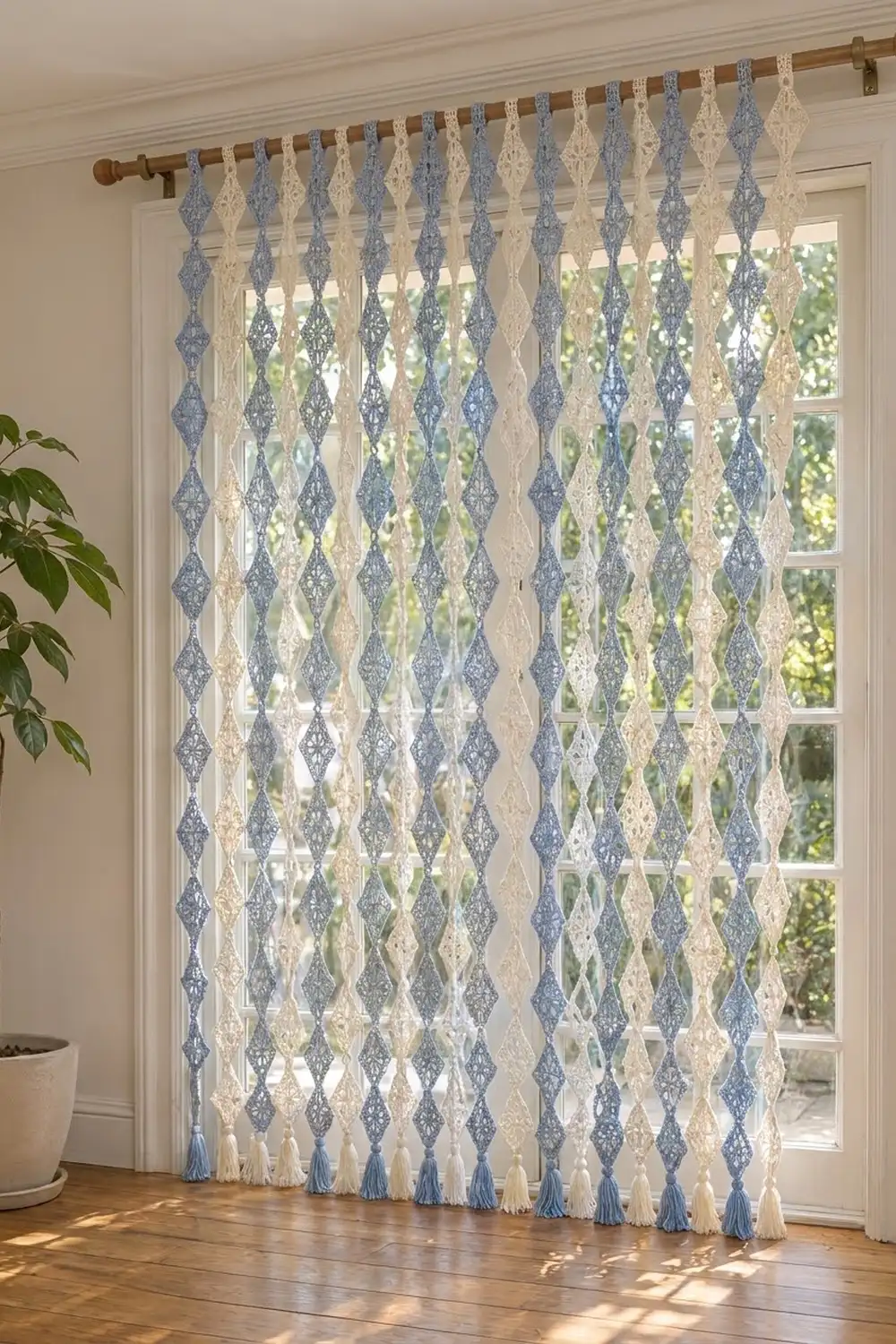
The Coastal Diamond Strand Curtain is a light, airy curtain for a window or doorway. It is made from hanging strands of small lace motifs. Each motif is a classic flower-center square turned on its point, so every strand looks like a chain of diamonds linked tip to tip.
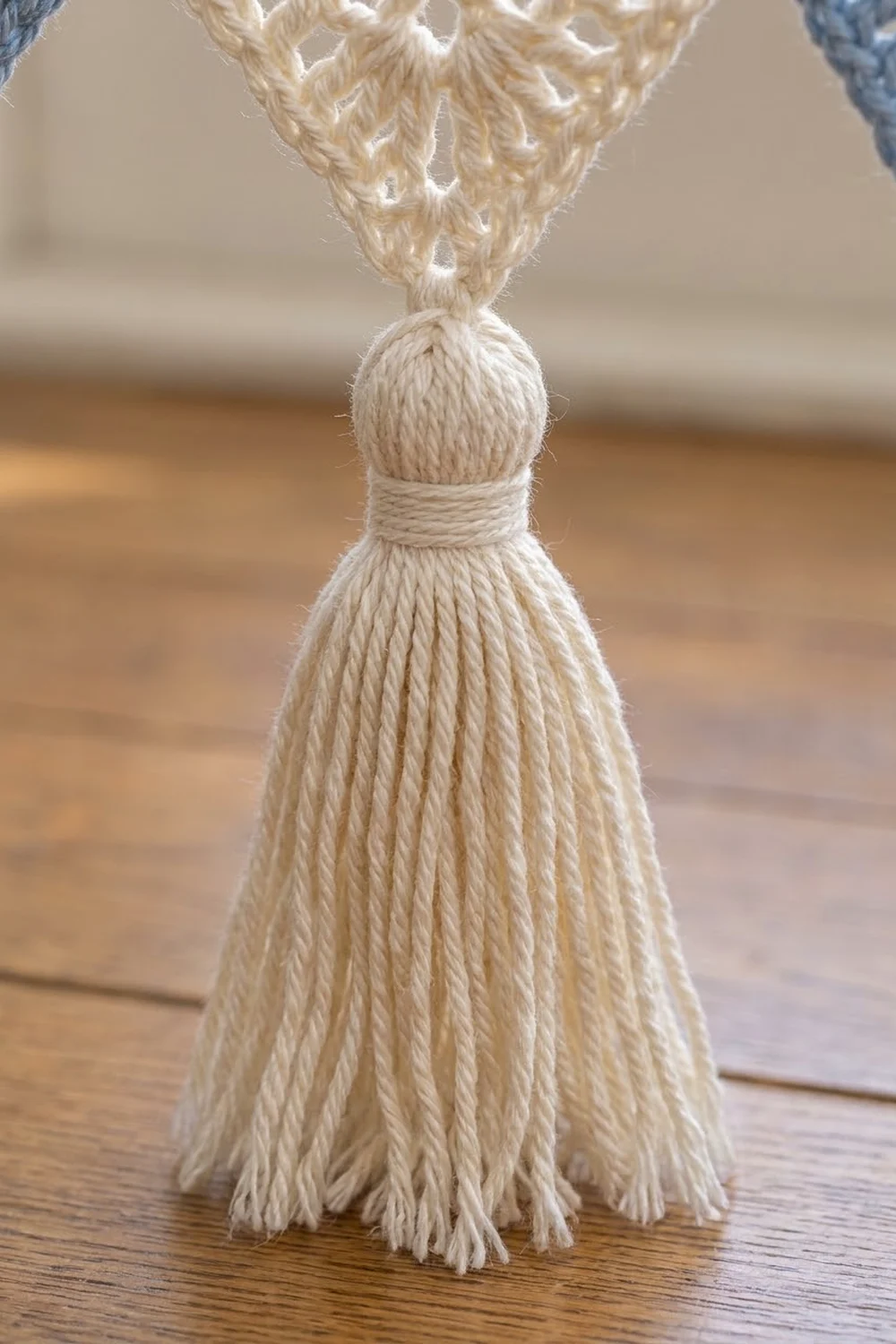
The colors are soft and fresh. Strands in cornflower blue alternate with strands in cream, and each strand is a single color. Each strand hangs from a small tab on the rod and ends in a matching tassel at the bottom. The look is coastal cottage, bright and breezy, and the open lace lets the light through.
This pattern uses US crochet terms. The finished curtain is about 80 in (203.2 cm) wide and 83 in (210.8 cm) long from the top of the tabs to the tassel tips. Each motif is 3.5 in (8.9 cm) per side, or about 5 in (12.7 cm) from point to point.
Construction is simple and repetitive. You make 224 four-round motifs and link them point to point into 16 strands of 14 motifs each. Then you add a hanging tab to the top and a tassel to the bottom of every strand. There is no header band, so the strands hang independently from the rod.
Finished Size and Construction
- Finished size: about 80 in (203.2 cm) wide x 83 in (210.8 cm) long
- Skill level: Easy, with a lot of repetition
- Terminology: US crochet terms
- Yarn weight: DK (#3) cotton or cotton blend
- Hook: 3.5 mm (E-4)
- Number of pieces: 224 motifs (112 blue, 112 cream), plus 16 tabs and 16 tassels
- Layout: 16 strands in alternating colors; 14 motifs per strand, set on point
- Piece size: 3.5 in (8.9 cm) per side; about 5 in (12.7 cm) point to point
- Size before border: each linked strand is 76.5 in (194.3 cm) from top point to bottom point
- Border depth: the hanging tab adds 2 in (5.1 cm) at the top and the tassel adds 4.5 in (11.4 cm) at the bottom
Materials
Choose a smooth mercerized or combed cotton in DK weight. Cotton holds the lace shape and hangs straight without much stretch. It also handles sunlight better than acrylic. A yarn with about 115 m per 50 g ball is ideal.
- Color A, cornflower blue: 500 g, about 1,150 m (10 balls)
- Color B, cream: 500 g, about 1,150 m (10 balls)
Each motif uses about 3.5 g (8 m). Each color covers 112 motifs (392 g), 8 tassels (about 32 g), and tabs and links (about 10 g). The quantities above include a margin of about 15% for gauge differences and swatching.
Tools:
- 3.5 mm (E-4) crochet hook
- Tapestry needle
- Scissors
- A stiff card 5 in (12.7 cm) tall for the tassels
- Locking stitch markers
- Tape measure
- Blocking mats and rust-proof pins
- Spray bottle
- Curtain rod up to 1 in (2.5 cm) in diameter
Abbreviations (US Terms)
- ch = chain
- sl st = slip stitch
- sc = single crochet
- dc = double crochet
- sp = space
- st(s) = stitch(es)
- beg = beginning
- MR = magic ring
- rep = repeat
Special stitch – Corner shell: (3 dc, ch 3, 3 dc) all in the same sp.
Corner stitch: In Round 4, each corner is a group of 3 sc. The center sc of each group is the corner stitch. Mark it if that helps.
Gauge and Checkpoints
Gauge matters here because small errors add up across the 14 motifs in every strand. Make one complete motif first, block it, and measure it before you start production.
Edging gauge: 15 sc = 3.5 in (8.9 cm) along one side of Round 4. That is about 4.3 sc per inch.
Checkpoints for one motif:
- After Round 1: about 1.25 in (3.2 cm) across
- After Round 2: about 2.25 in (5.7 cm) across
- After Round 3: 3 in (7.6 cm) per side
- After Round 4: 3.5 in (8.9 cm) per side, about 5 in (12.7 cm) point to point
If your motif is too big: go down to a 3.25 mm (D-3) hook, or work the chain spaces a little tighter.
If your motif is too small: go up to a 3.75 mm (F-5) hook.
Being off by 0.25 in (0.6 cm) per side changes each strand’s length by about 5 in (12.7 cm). Adjust now rather than later.
Diamond Motif
Make 112 in Color A and 112 in Color B. Work in the round with the right side always facing.
Round 1: Make a MR. Ch 4 (counts as dc and ch 1), then (dc in ring, ch 1) 7 times. Join with a sl st to the 3rd ch of the beg ch-4. Pull the ring closed. (8 dc, 8 ch-1 sp)
Round 2: Sl st into the next ch-1 sp. Ch 3 (counts as dc), 2 dc in the same sp, ch 2. Then (3 dc in next ch-1 sp, ch 2) 7 times. Join with a sl st to the top of the beg ch-3. (24 dc in 8 groups of 3, 8 ch-2 sp)
These eight petal groups form the flower center you see in each diamond.
Round 3 (squaring round): Sl st in the next 2 dc and into the next ch-2 sp. Ch 3 (counts as dc), then (2 dc, ch 3, 3 dc) in the same sp to finish the first corner shell. Ch 2, sc in next ch-2 sp, ch 2. Corner shell in next ch-2 sp, ch 2, sc in next ch-2 sp, ch 2. Rep from * to * 2 more times. Join with a sl st to the top of the beg ch-3. (24 dc, 4 sc, 4 ch-3 corner sp, 8 ch-2 sp)
The motif is now square, with open lace windows between the petals and the corners. It should measure 3 in (7.6 cm) per side.
Round 4 (edging round): Ch 1. Sc in the same st as the join and in the next 2 dc. 3 sc in corner sp, sc in next 3 dc, 2 sc in next ch-2 sp, sc in next sc, 2 sc in next ch-2 sp, sc in next 3 dc. Rep from * to * 2 more times. Then work 3 sc in the last corner sp, sc in next 3 dc, 2 sc in next ch-2 sp, sc in next sc, and 2 sc in the last ch-2 sp. Join with a sl st to the first sc. Fasten off and weave in the ends. (56 sc total)
Count check for Round 4: Each side has 13 sc between its two corner stitches: 1 from the corner group, 3 over dc, 2 in a ch-2 sp, 1 in the sc, 2 in a ch-2 sp, 3 over dc, and 1 from the next corner group. Counting both corner stitches, each side is 15 sts. Total: 4 x 13 + 4 corner stitches = 56 sc.
This round adds 0.25 in (0.6 cm) to every edge, taking each side from 3 in (7.6 cm) to 3.5 in (8.9 cm). It also gives the diamonds the firm outline that stops them from curling.
Make All Pieces
- Color A (blue): 112 motifs, for 8 strands of 14
- Color B (cream): 112 motifs, for 8 strands of 14
Block the motifs in batches before linking them (see Final Blocking). Bag them by color in groups of 14 so that each bag holds one strand.
Layout grid (A = blue strand, B = cream strand, viewed from the room):
Strand:  1  2  3  4  5  6  7  8  9 10 11 12 13 14 15 16
Color:   A  B  A  B  A  B  A  B  A  B  A  B  A  B  A  B
Motifs: 14 14 14 14 14 14 14 14 14 14 14 14 14 14 14 14
Each column is one strand in a single color, and every strand is 14 diamonds tall. Hang the strands 5 in (12.7 cm) apart, center to center.
Joining
Motifs are joined point to point with a short chain link, never side to side. Join each strand separately.
Orientation: Turn each motif so one corner stitch points straight up and the opposite corner stitch points straight down.
Link method:
- In the strand’s color, join with a sl st in the bottom corner stitch of the upper motif.
- Ch 3.
- Sl st in the top corner stitch of the lower motif.
- Turn and sl st in each of the 3 ch, working back up the link.
- Sl st in the bottom corner stitch of the upper motif again. Fasten off and weave in the ends.
Stitch-to-stitch logic: One corner stitch connects to one corner stitch, 1 to 1. Nothing else is joined, so the side corners stay free and the diamonds keep their shape. Each link is about 0.5 in (1.3 cm) long.
Tension: Make the chains the same size as your Round 4 stitches. Tight links pucker the points, and loose links make the strands uneven. The return row of slip stitches makes the link solid, so it won’t stretch under the strand’s weight.
Size checkpoint: One motif plus one link makes a vertical repeat of 5.5 in (14.0 cm). After 5 motifs and 4 links, the strand should measure 27 in (68.6 cm). A finished strand of 14 motifs and 13 links measures 14 x 5 in + 13 x 0.5 in = 76.5 in (194.3 cm) from top point to bottom point. Lay each strand next to the first one and check that they match within 0.5 in (1.3 cm).
Border
There is no band around the whole curtain. Instead, each strand gets a top border (a hanging tab) and a bottom border (a tassel). This leaves the strands free to move.
Border gauge: 17 sc = 4 in (10.2 cm). This is the same 4.3 sc per inch as the motif edging, so the tab won’t stretch or pull at the top point.
Hanging tab (make 16: 8 in each color):
Row 1: Ch 18. Sc in the 2nd ch from the hook and in each ch across. Turn. (17 sc)
Row 2: Ch 1, sc in each st across. Fasten off, leaving a 10 in (25.4 cm) tail. (17 sc)
The tab is 4 in (10.2 cm) long and about 0.5 in (1.3 cm) wide. Each long side has 17 sts and each short side has 2 rows.
Attach: Fold the tab in half so the two short ends meet. Place both ends behind the top corner of the first motif, centered on the 3-sc corner group. Use the tail to whipstitch both ends through the 3 corner sc. The fold forms a loop 2 in (5.1 cm) deep.
Why the math works: At border gauge, a 17-st strip is 4 in (10.2 cm) long. Folded, it makes a loop just under 4 in (10.2 cm) around on the inside. A rod 1 in (2.5 cm) thick is about 3.1 in (7.9 cm) around, so the loop wraps it easily and still slides. Attaching the tab across exactly the 3 corner sc keeps it centered on the corner stitch, so the strand hangs straight down.
Tassel (make 16: 8 in each color):
- Wrap the yarn 30 times around the 5 in (12.7 cm) card.
- Slide a 12 in (30.5 cm) strand under the wraps at the top and tie it tightly.
- Cut the wraps at the bottom and remove the card.
- Wrap another strand 6 times around the tassel 0.75 in (1.9 cm) below the top to form the neck. Knot it and bury the ends inside.
- Trim the bottom so the tassel measures 4.5 in (11.4 cm) from the top tie to the tips.
Attach: Use the ends of the top tie to tie the tassel through the bottom corner stitch of the last motif. Knot securely and bury the ends inside the tassel.
Final length: 2 in (5.1 cm) tab + 76.5 in (194.3 cm) strand + 4.5 in (11.4 cm) tassel = 83 in (210.8 cm).
Final Blocking
- Pin each motif to 3.5 in (8.9 cm) per side on a blocking mat, with one pin in each corner stitch.
- Use a ruler to straighten all four sides and open the petals evenly.
- Mist the motif with water until it is damp but not soaked.
- Let it dry completely before you remove the pins.
- After linking, hang each strand from a hook and mist it lightly. Gravity will even out the links.
- Let the strands dry hanging. Then check that each one is 76.5 in (194.3 cm) from top point to bottom point.
- Steam the tassels lightly and trim any uneven ends.
Final Quality-Control Checklist
- Every motif has 56 sc in Round 4, with 15 sts per side counting the corners.
- Every motif measures 3.5 in (8.9 cm) per side.
- Each strand has 14 motifs and 13 links, all in one color.
- Every link is 3 ch with a slip-stitch return.
- Each strand measures 76.5 in (194.3 cm) before the tab and tassel.
- Each tab is 17 sc long and centered on the top corner group.
- Each tassel is 4.5 in (11.4 cm) and tied through the bottom corner stitch.
- Colors alternate A, B, A, B across all 16 strands.
- All ends are securely woven in.
Troubleshooting
Motif cups or ruffles: Your dc are too loose or too tight compared with your chains. Check your hook size and block again.
Corners look rounded: Make sure you work exactly 3 sc into each ch-3 corner sp in Round 4.
Strand twists when hung: A link was attached next to the corner stitch instead of into it. Redo that link into the center sc of the corner group.
Strands are different lengths: One or more motifs are off gauge. Measure each motif and replace any that are off by more than 0.25 in (0.6 cm) per side.
Tab is too tight on the rod: Add 2 ch to the starting chain for each extra 0.5 in (1.3 cm) of loop you need.
Tassel looks thin: Increase the wraps to 40.
Care
Hand wash in cool water with mild soap, roll in a towel, and dry hanging or flat. Avoid long hours of strong direct sun so the blue doesn’t fade.
Final Notes
The whole curtain depends on one chain of measurements. Each motif is 3 in (7.6 cm) per side after Round 3 and 3.5 in (8.9 cm) after the edging, which makes it 5 in (12.7 cm) point to point. One motif plus a link is 5.5 in (14.0 cm). Fourteen motifs and thirteen links make a 76.5 in (194.3 cm) strand. The 2 in (5.1 cm) tab and the 4.5 in (11.4 cm) tassel bring it to 83 in (210.8 cm). Sixteen strands on 5 in (12.7 cm) centers make a curtain 80 in (203.2 cm) wide.
Get your first motif right, and the rest will follow. Happy crocheting!