

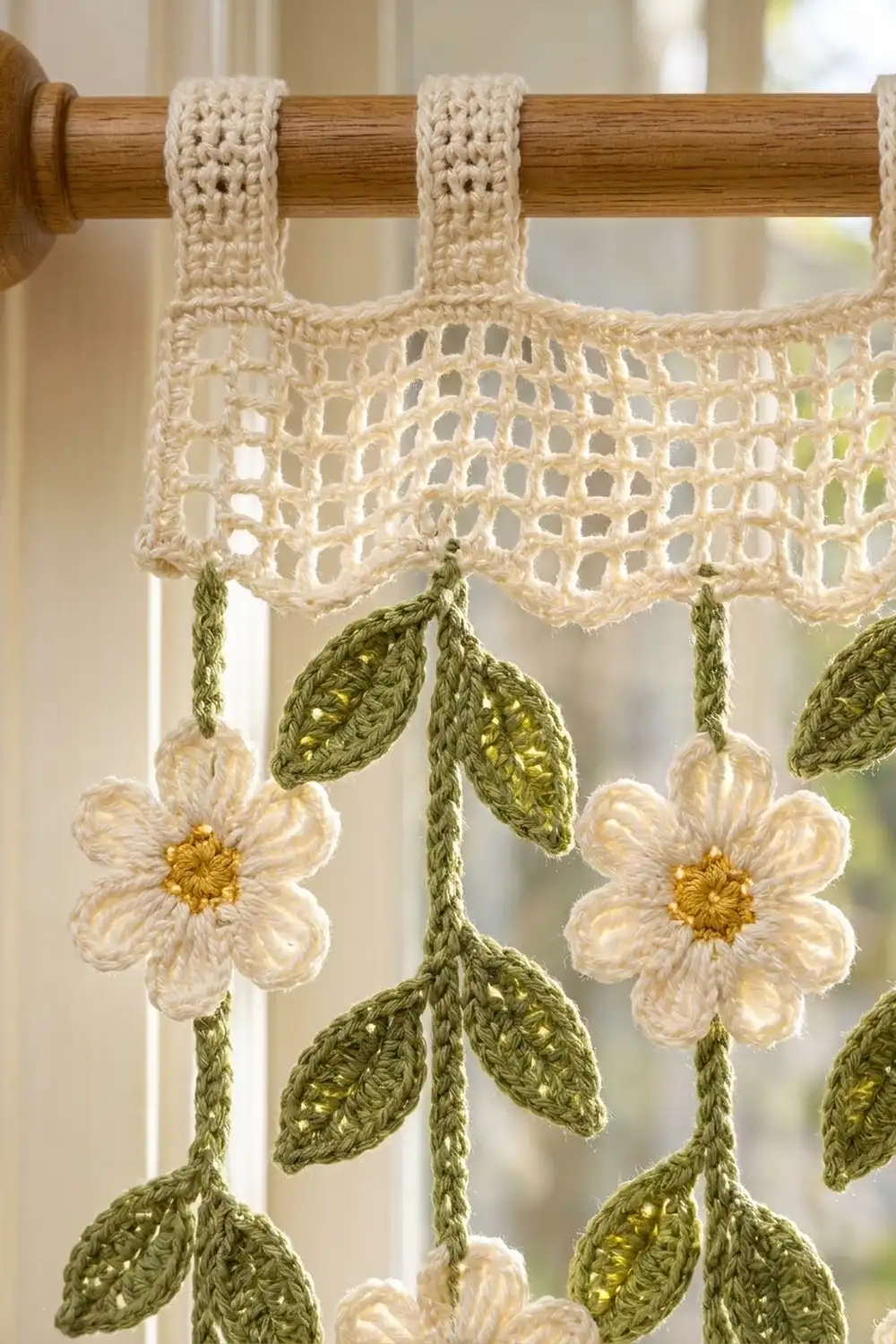
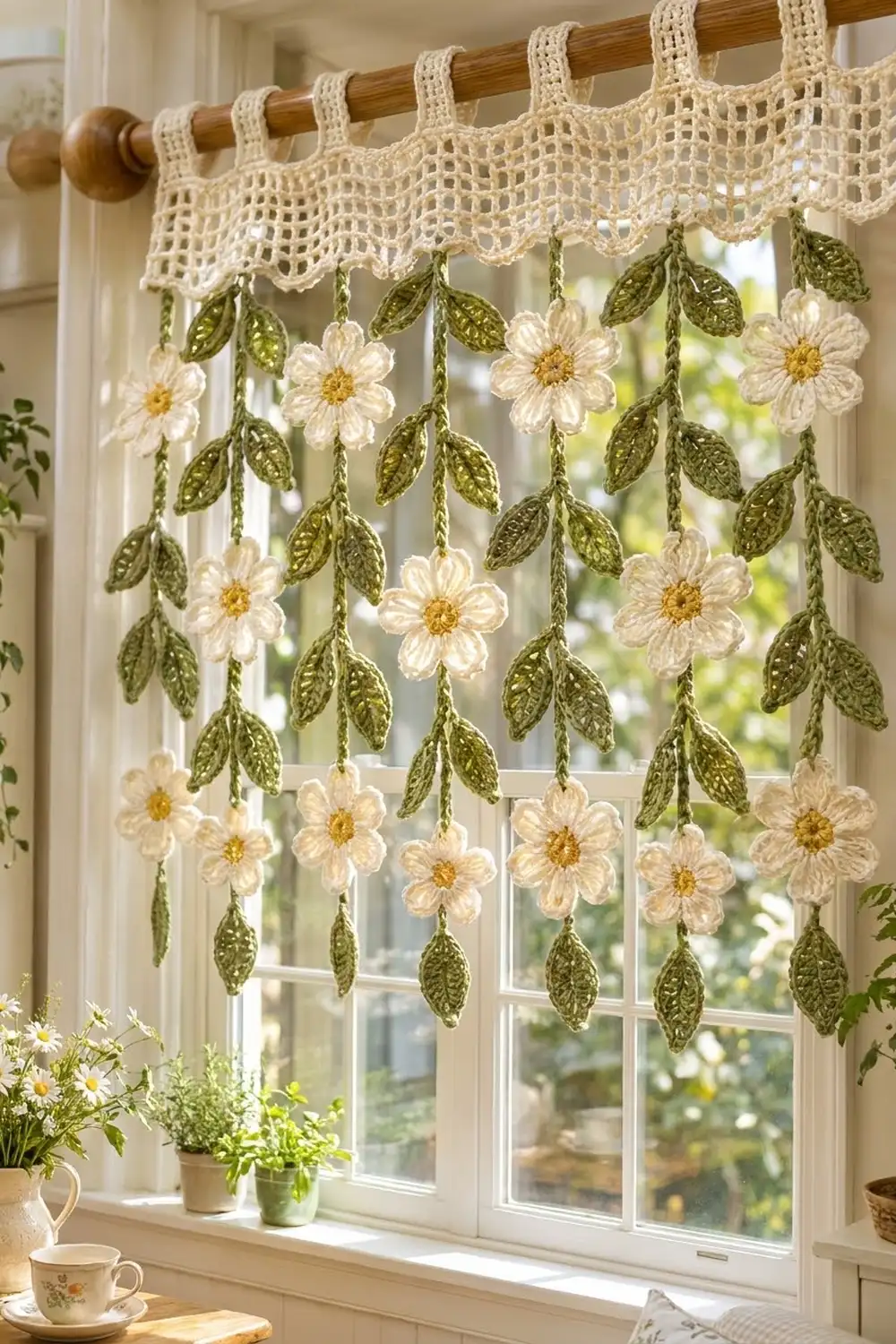
This curtain pairs a cream filet-mesh header with thirteen hanging daisy vines. Sage-green stems carry pairs of pointed leaves, and cream eight-petal daisies with golden-yellow centers sit along each vine. Light comes through the open mesh and between the strands, so the window still feels open.
The palette is three colors: warm cream, golden yellow and sage green. The style is cottage-garden and a little vintage, and it suits a kitchen window or a doorway.
All instructions use US crochet terms. The finished curtain is 40 in (101.6 cm) wide. The header is 8.75 in (22.2 cm) deep including its scallops, and the vines hang about 31 in (78.7 cm) below it. That gives a total drop of 39.75 in (101.0 cm), plus 2.4 in (6.1 cm) tab loops above.
You work the header flat in filet mesh, add the tabs into the foundation chain, and finish the bottom with a scallop border. Each vine is a chain-and-slip-stitch cord with the leaves worked directly on it. The daisies are made separately and sewn on, and cream chain links hang each vine from a scallop point.
Finished Size and Construction
- Finished size: 40 × 39.75 in (101.6 × 101.0 cm), plus 2.4 in (6.1 cm) tabs
- Skill level: Intermediate
- Terminology: US
- Yarn weight: Worsted (#4) cotton
- Hook: 5.0 mm (H-8)
- Number of pieces: 1 header (with 9 tabs worked on), 13 vine strands and 59 daisies
- Layout: 13 strands in one row, 3.2 in (8.1 cm) apart, center to center
- Header size: 40 × 8 in (101.6 × 20.3 cm)
- Size before border: 40 × 8 in (101.6 × 20.3 cm)
- Border depth: 0.75 in (1.9 cm) of scallops along the bottom edge
Materials
Choose a smooth, combed or mercerized worsted-weight cotton, which keeps the mesh crisp and the leaves flat. The amounts below assume about 170 m per 100 g.
- Cream (A): 300 g / 510 m (header, tabs, petals, links)
- Golden yellow (B): 30 g / 51 m (daisy centers)
- Sage green (C): 250 g / 425 m (stems and leaves)
All quantities include a margin of about 20 percent.
Tools:
– 5.0 mm (H-8) hook
– Tapestry needle
– At least 10 stitch markers
– Rust-proof pins and a blocking surface at least 42 in (106.7 cm) wide
– Measuring tape
– Spray bottle
Abbreviations (US Terms)
- ch – chain
- sl st – slip stitch
- sc – single crochet
- hdc – half double crochet
- dc – double crochet
- tr – treble crochet
- sp – space
- MR – magic ring
- RS / WS – right side / wrong side
- st(s) – stitch(es)
Surface slip stitch: Hold the yarn behind the work. Insert the hook from front to back at the given point, pull up a loop and draw it through the loop on the hook. A line of these forms the leaf vein.
Mesh: 1 dc + ch 2, which counts as 3 sts. A row of 50 mesh spans 151 sts: 51 dc posts + 100 ch.
Gauge and Checkpoints
Gauge: 5 mesh × 5 rows = 4 in (10.2 cm), which equals 15 sts = 4 in. One mesh is 0.8 in (2.0 cm) square.
Stem gauge: 4 ch, slip-stitched back, = 1 in (2.5 cm).
Before starting the header, make one daisy, one leaf and a 16-st, 6-row filet swatch.
Checkpoints:
– Daisy: 2.5 in (6.4 cm) across
– Leaf: 1.75 in (4.4 cm) long
– Header after Row 1: 40 in (101.6 cm) wide
– Header after Row 10: 8 in (20.3 cm) deep
– Stem chain (120 ch): 30 in (76.2 cm)
If your work is too big, go down 0.5 mm. If it’s too small, go up 0.5 mm. For the stems, adjust your chain tension but never the chain count.
Header
With A, ch 153.
Row 1 (RS): Dc in 4th ch from hook (the skipped ch count as the first dc), then dc in each remaining ch. Turn. (151 sts)
Row 2: Ch 5 (counts as dc + ch 2), skip 2 dc, dc in next dc. Ch 2, skip 2 dc, dc in next dc; repeat from * 48 more times, working the last dc in the top of the turning ch. Turn. (50 mesh; 51 dc posts = 151 sts)
Rows 3–9: Ch 5, dc in next dc, ch 2, dc in next dc; repeat from * across, working the last dc in the 3rd ch of the turning ch-5. Turn. (50 mesh each)
Row 10: Ch 3 (counts as dc), 2 dc in next ch-2 sp, dc in next dc; repeat from * 50 times, working the last dc in the 3rd ch of the turning ch. Do not fasten off. (151 sts: 1 + 50 × 3)
Checkpoint: 40 × 8 in (101.6 × 20.3 cm).
Tabs (Make 9)
The tabs are worked into the free loops of the foundation chain. With RS facing, number the loops 1–151 from right to left. Tab k starts at loop 1 + 18 × (k − 1), which gives loops 1, 19, 37, 55, 73, 91, 109, 127 and 145.
Each tab is 2 mesh wide, with 4 mesh (11 sts) between tabs: 9 × 2 + 8 × 4 = 50 mesh.
Tab Row 1: Join A in the starting loop, ch 3 (counts as dc), dc in next 6 loops. Turn. (7 sts)
Tab Row 2: Ch 5, skip 2 dc, dc in next dc, ch 2, skip 2 dc, dc in top of ch-3. Turn. (2 mesh)
Tab Rows 3–5: Ch 5, dc in next dc, ch 2, dc in 3rd ch of turning ch. Turn. (2 mesh)
Tab Row 6: Ch 3, 2 dc in ch-2 sp, dc in dc, 2 dc in ch-2 sp, dc in 3rd ch of turning ch. (7 sts) Fasten off, leaving a 12 in (30.5 cm) tail.
Each tab is 4.8 in (12.2 cm) long. Fold it to the WS and whipstitch Tab Row 6 to the back of Row 1. The loop stands 2.4 in (6.1 cm) tall and fits a rod up to 1.5 in (3.8 cm) across.
Daisy (Make 59)
Rnd 1: With B, MR, ch 1, 8 sc in ring, sl st to first sc. Fasten off. (8 sts)
Rnd 2: Join A in any sc, ch 1, 2 sc in each st around, sl st to first sc. (16 sts)
Rnd 3: Sl st in next sc, then (hdc, dc, 2 tr, dc, hdc) in next sc; repeat from * 7 more times, sl st in first sl st. (8 petals; 56 sts: 8 sl st + 48 petal sts)
Fasten off, leaving a 10 in (25.4 cm) A tail. Weave the B tail in on the WS and snug it slightly so the center domes. Checkpoint: 2.5 in (6.4 cm) across.
Leaf (Worked on the Stem)
- From the stem ch, ch 8.
- Side 1: Sl st in 2nd ch from hook, sc in next ch, hdc in next ch, dc in next 2 ch, hdc in next ch, sc in last ch. (7 sts)
- Side 2: Rotate and work in the free loops of the same 7 ch: sc, hdc, 2 dc, hdc, sc, sl st. (7 sts)
- Tip and vein: Sl st in the tip ch. With RS facing, work 6 surface sl sts down the center line to the base.
- Sl st in the stem ch you started from.
Leaf pair: Work 2 leaves from the same stem ch. During blocking, angle one to each side.
Vine Strands
Number the stem chains 1–112 from the top.
Top ring: With C, ch 6, sl st in first ch.
Stem chain: Ch 120: 112 ch of stem plus 8 ch for the end leaf. Checkpoint: 30 in (76.2 cm).
End leaf: Work Leaf steps 2–4 in the last 8 ch. Ch 113 becomes the leaf base.
Return: Sl st in the back bump of each ch from ch 112 up to ch 1 (112 sl sts). Work a leaf pair immediately after the sl st in each leaf-pair ch listed below. Sl st into the ring and fasten off.
Strand A (make 7): Leaf pairs at ch 96, 88, 72, 64, 48, 40, 24 and 16. That’s 8 pairs plus the end leaf, for 17 leaves. Place daisy markers at ch 104, 80, 56, 32 and 8 (5 daisies).
Strand B (make 6): Leaf pairs at ch 104, 88, 80, 64, 56, 40, 32, 16 and 8. That’s 9 pairs plus the end leaf, for 19 leaves. Place daisy markers at ch 96, 72, 48 and 24 (4 daisies).
Features sit 8 ch, or 2 in (5.1 cm), apart.
- Strand A daisies sit 2, 8, 14, 20 and 26 in (5.1, 20.3, 35.6, 50.8 and 66.0 cm) below the ring.
- Strand B daisies sit 6, 12, 18 and 24 in (15.2, 30.5, 45.7 and 61.0 cm) below the ring.
This staggers the flowers across the curtain.
Attach daisies: Center each daisy over its marker, with the stem behind it. Sew through Rnd 2 into the stem with 6–8 small stitches, using the A tail.
Make All Pieces
- Header: 1 with 9 tabs (A)
- Daisies: 59 (A petals, B centers): 35 for Strand A + 24 for Strand B
- Strand A: 7 (C), 119 leaves in total
- Strand B: 6 (C), 114 leaves in total
Scallop: 1  3  5  7  9  11 13 15 17 19 21 23 25
Strand:  A  B  A  B  A  B  A  B  A  B  A  B  A
Joining
Each strand hangs from the center dc (the 4th of 7) of an odd-numbered scallop. Scallop j is centered over header st 4 + 6 × (j − 1), so strand k hangs over header st 4 + 12 × (k − 1): sts 4, 16, 28 and so on, up to 148.
At 3.75 sts per inch, 12 sts is 3.2 in (8.1 cm). Twelve spaces between strands total 38.4 in (97.5 cm), and a 0.8 in (2.0 cm) margin at each end brings this back to 40 in (101.6 cm).
Link: With A and RS facing, sl st in the scallop’s center dc. Ch 3, insert the hook through the green ring, sl st, ch 3, then sl st in the same center dc. Fasten off.
Keep the links at the same tension as the stems, because a loose link makes its strand hang low. The link and ring together drop 1.25 in (3.2 cm).
Checkpoint: hang the curtain. The tips should line up within 0.5 in (1.3 cm), about 31 in (78.7 cm) below the scallop points.
Border
Work the border before joining the strands. The border gauge matches the header: 15 sts = 4 in (10.2 cm).
Border Row 1 (scallops, RS): Continuing from Row 10, ch 1 and turn. Sc in first st, skip 2 sts, 7 dc in next st, skip 2 sts, sc in next st; repeat from * 24 more times. (25 scallops; 201 sts: 26 sc + 175 dc)
This uses 1 + 25 × 6 = 151 sts and ends with a sc in the last st. Each scallop spans 1.6 in (4.1 cm), and 25 × 1.6 = 40 in (101.6 cm).
Border Row 2 (side edges): Ch 1. Sc in the scallop row end, then work 3 sc in each of the 10 dc row ends up the side. (31 sc) Fasten off. For the other side, join A at the top corner with RS facing. Work 3 sc in each of the 10 row ends, then 1 sc in the scallop row end. (31 sc)
Each row is 0.8 in (2.0 cm) tall, so 3 sc per row end equals 3.75 sc per inch. That matches the stitch gauge, so the sides lie flat.
Final Blocking
- Wet the header and gently squeeze out the water.
- Pin it to 40 × 8.75 in (101.6 × 22.2 cm), straightening each mesh row.
- Pin each scallop into a rounded arc.
- Spray the daisies and leaves. Pin the petals open and angle each leaf about 45 degrees from the stem.
- Let everything dry fully.
- Hang the curtain, mist the strands and let them dry hanging straight.
Final Quality-Control Checklist
- Header is 40 × 8.75 in (101.6 × 22.2 cm)
- Every mesh row has 50 squares
- 9 evenly spaced tabs, each sewn securely
- 25 scallops of 7 dc each
- 13 strands in A-B order, 3.2 in (8.1 cm) apart
- Daisies sewn firmly, with the stems hidden behind them
- Strand tips level within 0.5 in (1.3 cm)
- All ends woven in
Troubleshooting
- Mesh slants: Your turning ch-5 is loose. Try ch 4 and work a taller dc.
- Header narrow: Recount Row 1 for 151 sts.
- Leaves curl: Work the vein sl sts looser, then steam-block.
- Daisy cups: Rnd 2 is tight. Go up one hook size for that round.
- Strand twists: Work every return sl st in the back bump.
- Uneven lengths: Recount the stem chain and redo the link.
Care
Hand wash in cool water, roll in a towel, and dry flat or hanging. Reshape the leaves while damp.
Final Notes
The measurements all build on each other:
- Header: each mesh is 0.8 in (2.0 cm), so 50 mesh give a 40 in (101.6 cm) width and 10 rows give an 8 in (20.3 cm) depth.
- Scallops: 25 scallops of 1.6 in (4.1 cm) fill the bottom edge exactly.
- Strands: 13 strands hang every 3.2 in (8.1 cm).
- Stems: each stem is 112 ch at 4 ch per inch, or 28 in (71.1 cm).
Check each of these and the curtain will hang straight and even.
Happy crocheting!