

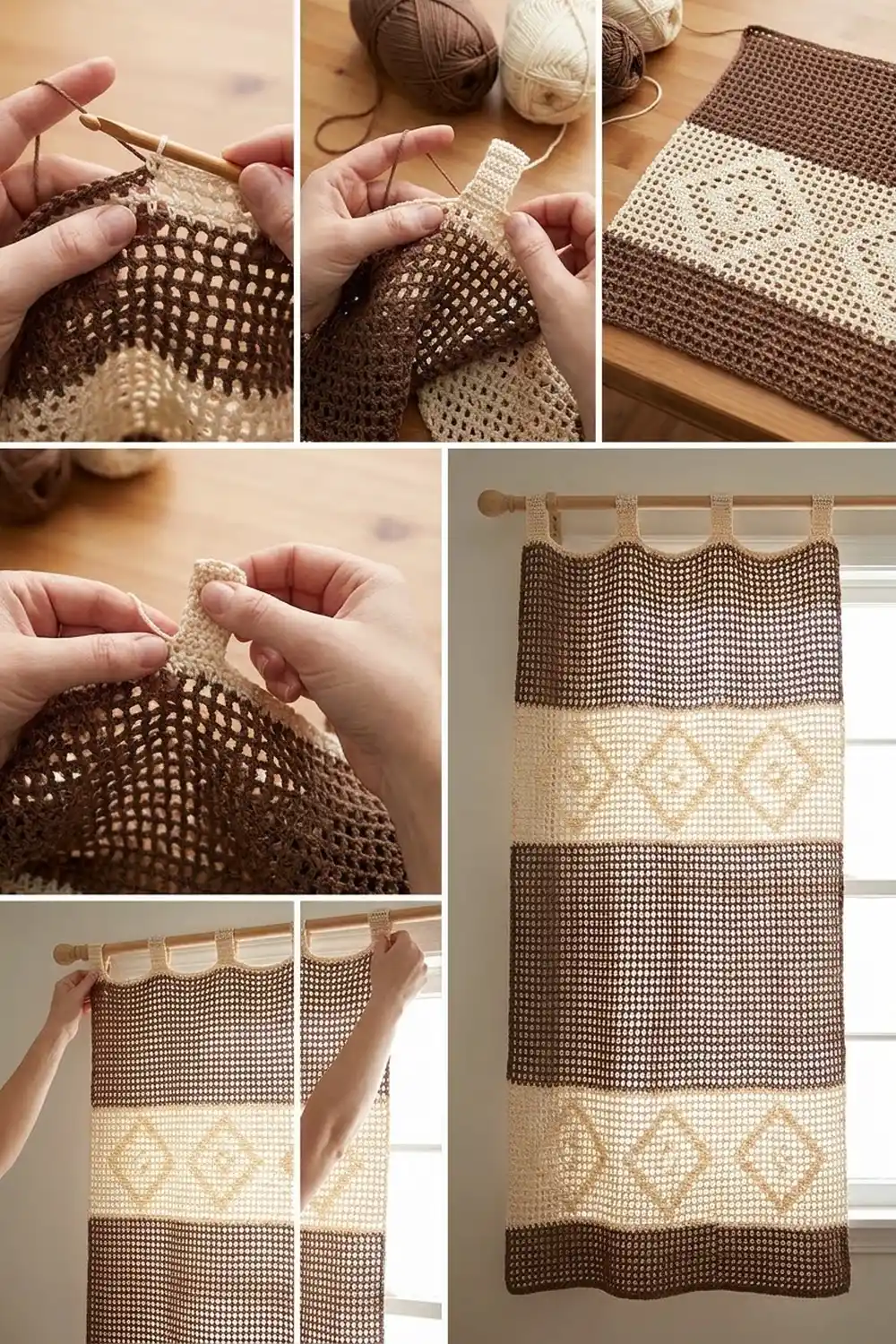
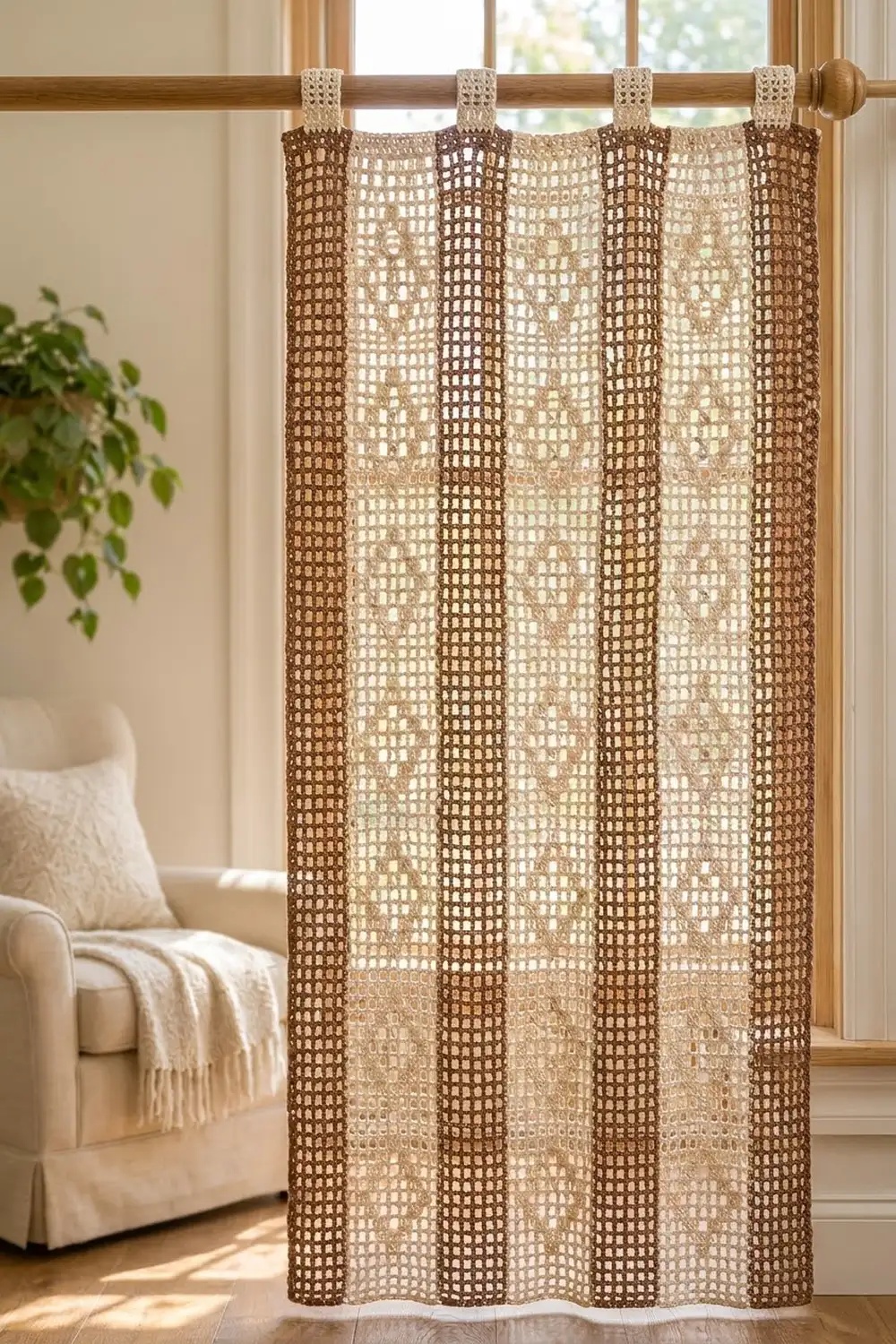
The Cocoa Lattice panel is a light, airy curtain worked in classic filet mesh. Chocolate-brown stripes of plain mesh alternate with cream stripes, and each cream stripe holds a column of hollow diamonds. Daylight shines through the open squares while the solid blocks draw clean, graphic shapes.
The palette is two colors: a deep cocoa brown and a soft natural cream. The look is warm, rustic and slightly boho. It suits a farmhouse kitchen, a reading nook or a sunny living-room window.
This pattern uses US crochet terms. The finished panel measures 27 x 59.8 in (68.6 x 151.9 cm) including the border, and four tab loops sit about 2 in (5.1 cm) above the top edge.
You work the panel bottom to top in one piece, in rows of filet mesh. The vertical stripes are made with intarsia, one small ball (bobbin) per stripe. A two-round single crochet border tidies the edges, and four tabs are worked straight off the top border. There is no seaming apart from tacking the tab ends down.
Finished Size and Construction
- Finished size: 27 x 59.8 in (68.6 x 151.9 cm), plus tabs
- Skill level: Intermediate (filet charting plus intarsia color changes)
- Terminology: US
- Yarn weight: DK (#3) cotton
- Hook: 4.0 mm (US G-6)
- Number of pieces: 1 panel, with tabs worked directly onto it
- Layout: 7 vertical stripes: brown, cream, brown, cream, brown, cream, brown
- Stripe widths: brown 8 meshes = 3.2 in (8.1 cm); cream 11 meshes = 4.4 in (11.2 cm)
- Size before border: 65 meshes x 147 rows = 26 x 58.8 in (66.0 x 149.4 cm)
- Border depth: 2 rounds of sc = 0.5 in (1.3 cm) on every side
Materials
Choose a smooth, mercerized or combed DK cotton (about 115 m per 50 g). Cotton gives crisp mesh, blocks well and hangs straight. Avoid fuzzy or very stretchy yarns, because they blur the filet squares.
- Color A, Cocoa Brown: 175 g (approx. 400 m)
- Color B, Cream: 200 g (approx. 460 m), which includes the border and tabs
These quantities include a margin of about 20% for your swatch and for any rows you need to redo.
Tools:
– 4.0 mm (US G-6) crochet hook
– 7 bobbins or small zip bags (4 for brown, 3 for cream)
– Tapestry needle
– Stitch markers (at least 10)
– Tape measure
– Blocking mats or a large towel, rust-proof pins, and a spray bottle
Abbreviations (US Terms)
- ch – chain
- sc – single crochet
- dc – double crochet
- sk – skip
- sp – space
- st(s) – stitch(es)
- RS / WS – right side / wrong side
- A / B – Color A (brown) / Color B (cream)
Special stitches and terms:
– Post: a dc that forms the vertical bar between meshes.
– Open mesh: ch 1, sk the st below, dc in the next post.
– Block: dc in the st below (a ch-1 sp or a dc) instead of ch 1, then dc in the next post. A block fills a mesh solid.
– Stitch count: every row has 66 posts and 65 “space stitches.” Each space stitch is either a ch 1 or a block dc, so every row is 131 sts.
Gauge and Checkpoints
Gauge: 10 meshes and 10 rows of filet mesh = 4 in (10.2 cm), so each mesh is 0.4 in (1.0 cm) square.
Make a test swatch before you start the panel. Ch 28 and work 12 rows of open mesh (12 meshes wide). Measure the center 10 meshes and 10 rows, and block the swatch lightly before you measure.
- Too big (fewer than 10 meshes per 4 in): go down to a 3.75 mm hook.
- Too small (more than 10 meshes): go up to a 4.5 mm hook.
- Rows too short: pull up the first loop of each dc a little higher. Changing hook size alone is not the fix here.
Checkpoints:
– After Row 1: width 26 in (66.0 cm)
– After Row 15: height 6 in (15.2 cm)
– After Row 51: height 20.4 in (51.8 cm)
– After Row 99: height 39.6 in (100.6 cm)
– After Row 147: height 58.8 in (149.4 cm)
Stripe Map and Color Rules
Each row reads as seven color sections:
[A 17 sts] [B 21 sts] [A 17 sts] [B 21 sts] [A 17 sts] [B 21 sts] [A 17 sts]
Check: 4 x 17 + 3 x 21 = 68 + 63 = 131 sts.
- A brown section is 8 meshes: 9 posts + 8 spaces = 17 sts. Brown always works both posts on the border between a brown and a cream stripe.
- A cream section is 11 meshes: 11 spaces + 10 inner posts = 21 sts. It starts and ends with a space. Number its meshes 1 to 11 in the order you reach them.
Changing colors: finish the last stitch of a section completely. Drop that yarn on the WS, then twist it once around the new color and start the next stitch with the new color. The twist locks the two colors together so no gap opens at the stripe line. Each bobbin stays in its own stripe and is never carried across.
Panel
Wind 4 bobbins of A and 3 bobbins of B. Use a separate bobbin of A for the foundation chain.
Foundation: With A, ch 134.
Row 1 (RS): Dc in 6th ch from hook. The skipped 5 ch count as the first post, a ch-1 sp, and a skipped base ch. Following the stripe map, ch 1, sk next ch, dc in next ch, and repeat from * 64 times. Change to B and back to A at the section boundaries. All meshes are open. (65 meshes, 131 sts)
On this row the foundation chain is all brown, so the cream sections start on brown base chains. From Row 2 on, every section is worked in its own color.
Rows 2–3: Ch 4 (counts as post + ch 1), dc in next post, ch 1, sk next st, dc in next post. Repeat across, working the last dc in the 3rd ch of the turning ch-4. Follow the stripe colors. (131 sts per row)
Diamond repeat (12 rows): Work every brown section as open mesh. In each cream section, work the meshes listed as blocks and all other meshes as open mesh.
- Repeat Row 1: block at mesh 6
- Repeat Row 2: blocks at meshes 5 and 7
- Repeat Row 3: blocks at meshes 4 and 8
- Repeat Row 4: blocks at meshes 3 and 9
- Repeat Row 5: blocks at meshes 2 and 10
- Repeat Row 6: blocks at meshes 3 and 9
- Repeat Row 7: blocks at meshes 4 and 8
- Repeat Row 8: blocks at meshes 5 and 7
- Repeat Row 9: block at mesh 6
- Repeat Rows 10–12: all open mesh
(131 sts on every row)
The block positions are symmetrical, so they land in the same place on both RS and WS rows. Each diamond is 9 meshes wide and 9 rows tall, 3.6 x 3.6 in (9.1 x 9.1 cm). It is a hollow outline with an open center. Meshes 1 and 11 always stay open, which leaves a clear lane of cream mesh on each side of the diamond.
Rows 4–147: Work the 12-row diamond repeat 12 times in total. Each repeat is 4.8 in (12.2 cm) tall.
The panel ends with 3 open rows, matching the 3 open rows at the bottom. Fasten off all bobbins and weave in the ends along the posts of their own color.
Panel checkpoint: 26 x 58.8 in (66.0 x 149.4 cm), with 12 diamonds in each cream stripe.
Border
Border gauge: 5 sc = 1 in (2.5 cm) along the edge, and each round of sc adds about 0.25 in (0.6 cm) of depth.
Why the math works:
– Along the top and bottom, 131 sc over 26 in is 5.04 sc per inch.
– Along the sides, 2 sc per dc row end (each row is 0.4 in) is 5 sc per inch.
Both match the border gauge, so the edges stay flat with no rippling or pulling in.
Round 1 (RS): Join B in the last st of Row 147. Work along each edge as follows:
– Top: ch 1, sc in each st across. (131 sc)
– Top-left corner: ch 1 to mark the corner.
– Left side: 2 sc in each row end down the side. (147 rows x 2 = 294 sc)
– Bottom-left corner: ch 1.
– Bottom: working into the foundation, sc at the base of each post and in each skipped-ch space. (131 sc)
– Bottom-right corner: ch 1.
– Right side: 2 sc in each row end. (294 sc)
– Last corner: ch 1, then sl st to the first sc.
(850 sc + 4 corner ch-1 sps)
Round 2: Ch 1. Sc in each sc around, and work (sc, ch 1, sc) in each corner ch-1 sp. Sl st to the first sc. (top 133, sides 296 each, bottom 133 = 858 sc + 4 corner ch-1 sps)
The corner sc are counted in the side totals above. The corner ch-1 sps are not.
Do not fasten off. Sl st along the top to the position of the first tab, or fasten off and rejoin at each tab.
Border checkpoint: 27 x 59.8 in (68.6 x 151.9 cm).
Tabs (make 4, in B)
Number the 133 top-edge sc of Round 2 from right to left with the RS facing. Mark these groups of 7 sc, one centered over each brown stripe:
- Tab 1: sc 7–13
- Tab 2: sc 45–51
- Tab 3: sc 83–89
- Tab 4: sc 121–127
The tabs are spaced 38 sc apart, or 7.6 in (19.3 cm). The layout is symmetrical from either end.
Row 1: Join B in the first marked sc, ch 1, sc in the same st and the next 6 sts. Turn. (7 sc)
Rows 2–18: Ch 1, sc in each sc across. Turn. (7 sc per row)
The tab is 1.4 x 4.5 in (3.6 x 11.4 cm). Fasten off and leave a 12 in (30.5 cm) tail. Fold the tab to the WS and whipstitch Row 18 to the back of border Round 1 directly behind Row 1 of the tab. This leaves a loop that fits a rod up to 1.25 in (3.2 cm) across, with about 2 in (5.1 cm) of tab showing above the panel.
Final Blocking
- Weave in any remaining tails, and check that no stripe-change twists show on the RS.
- Soak the panel in cool water with a little wool wash for 15 minutes.
- Press out the water gently by rolling the panel in towels. Do not wring it.
- Lay it flat on mats RS up and pin it to 27 x 59.8 in (68.6 x 151.9 cm).
- Pin the stripe lines straight using a long ruler or a taut string, and square up any skewed mesh.
- Pin the tabs flat at full length.
- Let it dry completely before you unpin it, usually 24–36 hours.
Final Quality-Control Checklist
- Every row has 131 sts, and every stripe has its correct width: 17 sts for brown, 21 sts for cream.
- All 36 diamonds are complete, symmetrical and centered, with mesh 1 and mesh 11 open.
- The stripe lines are straight, with no gaps or holes at the color changes.
- Round 2 counts are 133 / 296 / 133 / 296 sc.
- The four tabs are evenly spaced, all the same length, and securely stitched.
- After blocking, the size is 27 x 59.8 in (68.6 x 151.9 cm).
Troubleshooting
- Holes along the stripe lines: you skipped the twist at a color change. Weave a tail of matching color through the post on the WS to close the hole.
- Diamond looks lopsided: recount the meshes from the start of the cream section, and remember that it opens with a space, not a post.
- Panel narrows or widens: you have lost or gained a stitch. The most common cause is the last dc going into the wrong turning-ch stitch. Count to 131 every 10 rows.
- Border ripples: your sc are looser than the 5-per-inch gauge. Redo the side edges with a smaller hook rather than skipping row ends.
- Border pulls in: go up a hook size for the border only.
- Bobbins keep tangling: turn your work clockwise on RS rows and counterclockwise on WS rows so the twists unwind.
Care
Hand wash in cool water, or machine wash on a gentle cycle in a mesh bag. Reshape and dry flat, and do not tumble dry, because heat and tumbling stretch filet mesh out of square.
Final Notes
The measurement chain is simple. Each mesh is 0.4 in (1.0 cm), so 65 meshes give 26 in (66.0 cm) of width and 147 rows give 58.8 in (149.4 cm) of length. The two-round border adds 0.5 in (1.3 cm) on every side, for a finished panel of 27 x 59.8 in (68.6 x 151.9 cm). Four tabs then hang it neatly from the rod. Keep your gauge steady, count to 131, and the stripes and diamonds will line up on their own.
Happy crocheting!