
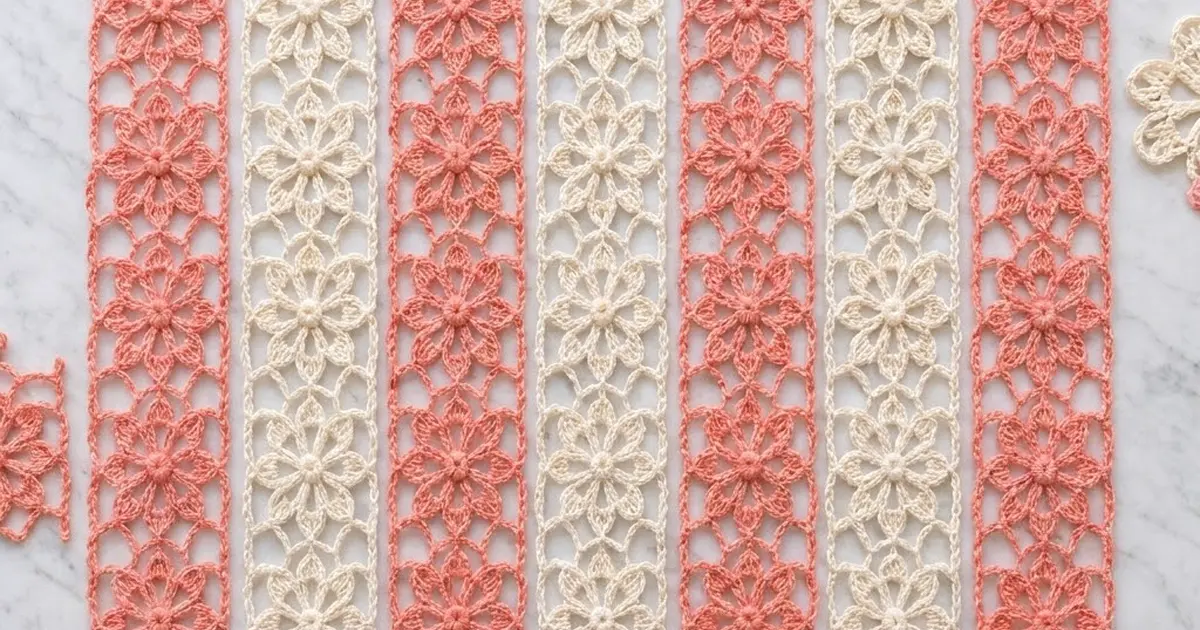
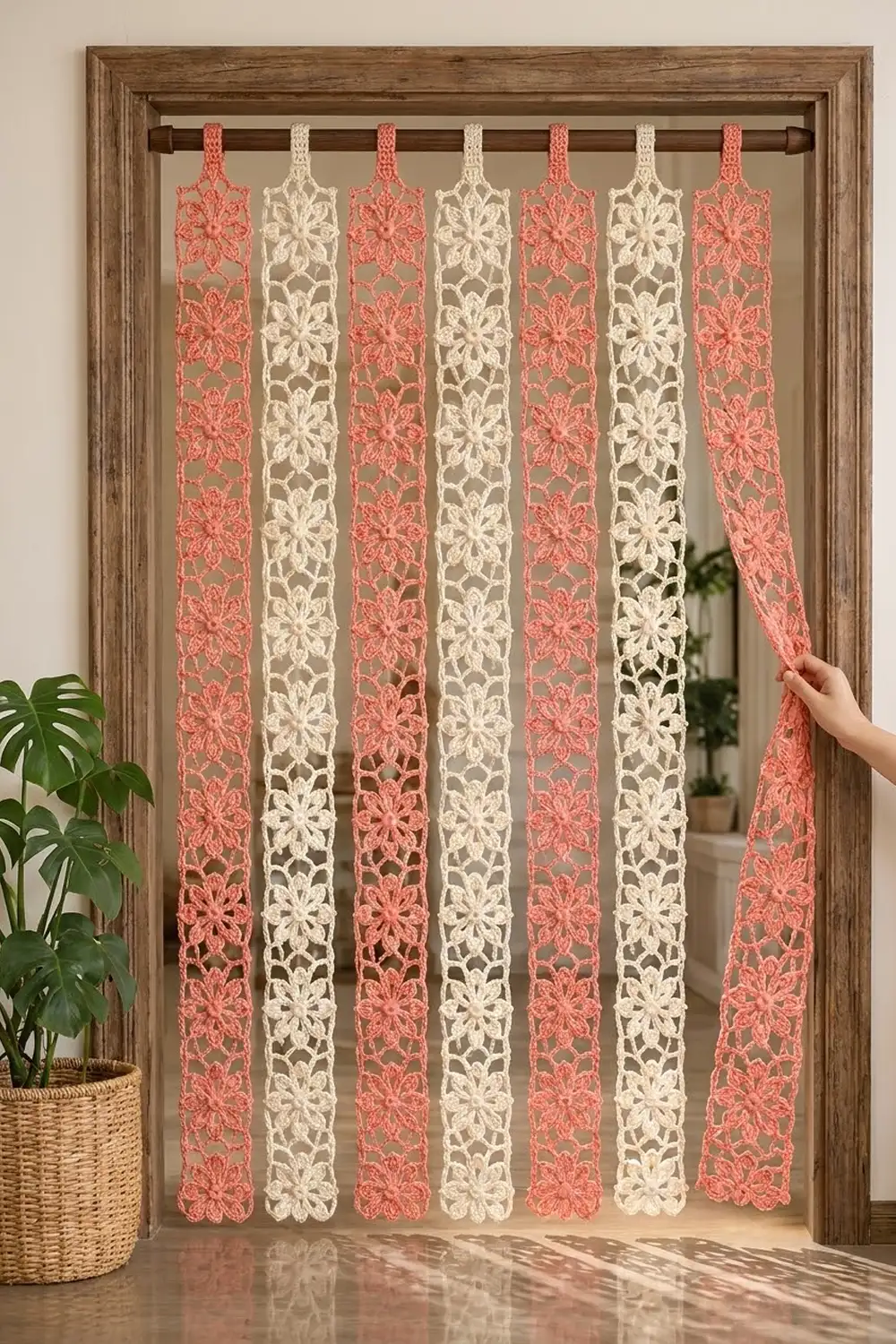
The Coral Bloom curtain is a light, airy doorway curtain made of seven separate lace strips. Each strip is a column of eight-petal flowers set inside small square frames, finished with a chain-loop edge and a hanging tab. The strips alternate between warm coral and soft cream. Light passes through the gaps, and you can push any strip aside without moving the rest.
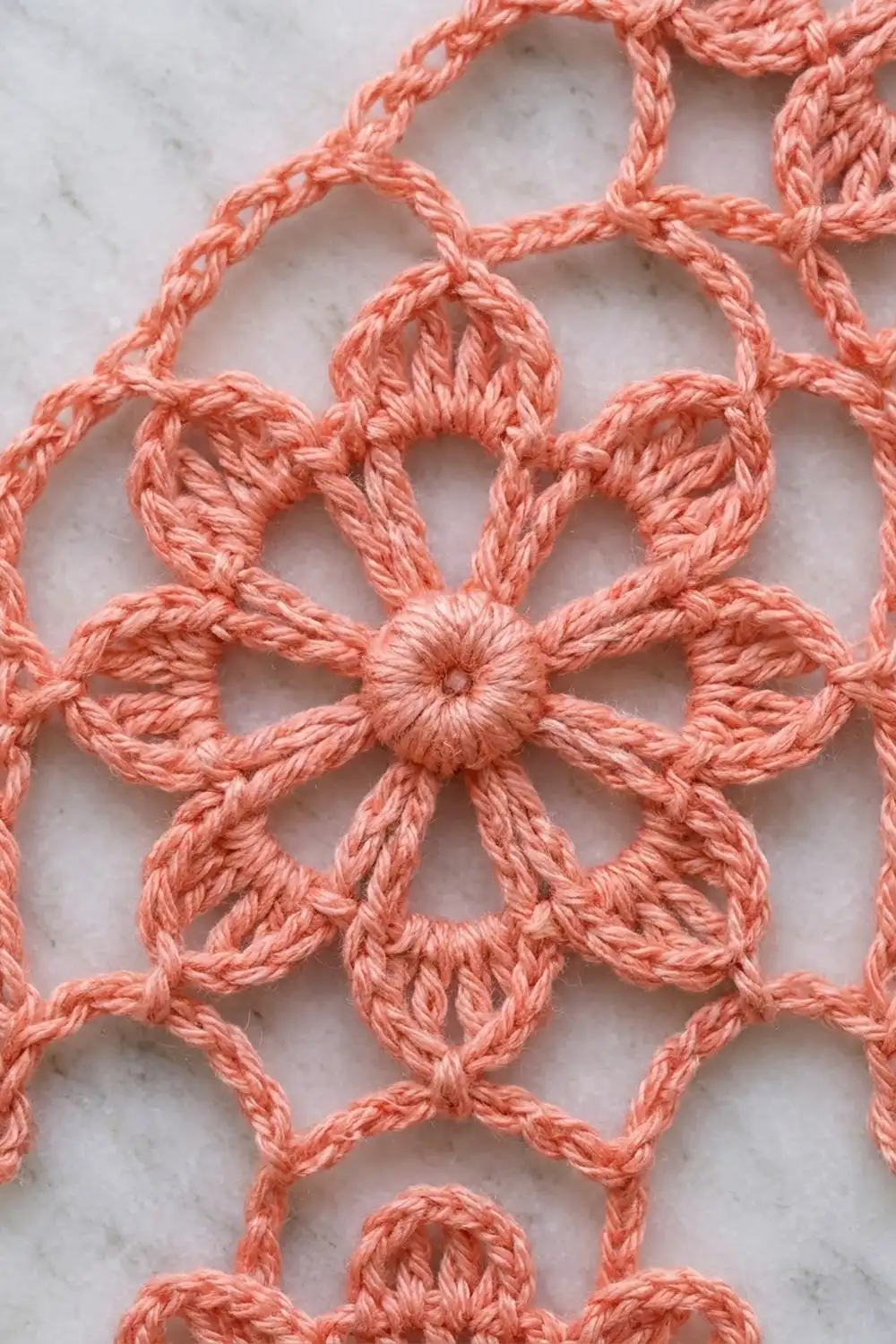
The look is vintage lace with a fresh color scheme. The coral reads as bright and cheerful, and the cream keeps it from feeling heavy. Each flower has a padded round center that catches the light, eight rounded petals and a mesh frame that turns the circle into a crisp square.
This pattern uses US crochet terms. Each finished strip measures 5 in (12.7 cm) wide by 65 in (165.1 cm) long, plus the hanging tab. All seven strips spaced on a rod cover about 39.5 in (100.3 cm).
Construction is simple and modular. You make 112 square flower motifs, join 16 of them into a column for each strip, work a two-round border around each strip, and sew a tab to the top. The strips are never joined to each other.
Finished Size and Construction
- Finished strip size: 5 in × 65 in (12.7 cm × 165.1 cm), not counting the tab
- Curtain width: about 39.5 in (100.3 cm), with seven strips spaced 0.75 in (1.9 cm) apart
- Skill level: Intermediate
- Terminology: US
- Yarn weight: DK / light (#3) cotton
- Hook: 4.0 mm (G-6)
- Number of pieces: 112 motifs, 7 tabs, assembled into 7 separate strips
- Layout: each strip is 1 motif wide × 16 motifs tall
- Motif size: 4 in × 4 in (10.2 cm × 10.2 cm)
- Strip size before border: 4 in × 64 in (10.2 cm × 162.6 cm)
- Border depth: 0.5 in (1.3 cm) on every side
Materials
Use a smooth cotton or cotton blend in DK weight. Mercerized cotton shows the petal shapes best and hangs straight. Avoid fuzzy or very stretchy yarns, because long strips can grow under their own weight.
- Color A, Coral: 400 g, about 920 m (8 balls of 50 g / 115 m), for 4 strips
- Color B, Cream: 300 g, about 690 m (6 balls of 50 g / 115 m), for 3 strips
Each motif uses about 4.5 g. Each strip’s border and tab use about 18 g. The quantities above include a margin of roughly 10%.
Tools:
– 4.0 mm (G-6) crochet hook
– Tapestry needle
– Rust-proof pins and a blocking surface at least 66 in (167.6 cm) long, or a floor with towels
– Measuring tape
– Stitch markers
– Curtain rod, up to 1.25 in (3.2 cm) in diameter
Abbreviations (US Terms)
- ch: chain
- sl st: slip stitch
- sc: single crochet
- hdc: half double crochet
- dc: double crochet
- tr: treble crochet
- sp: space
- st(s): stitch(es)
- RS / WS: right side / wrong side
- sc2tog: single crochet two together (insert hook in next st, pull up a loop, insert hook in following st, pull up a loop, yarn over and draw through all 3 loops)
Special stitch: Petal. Work (sc, hdc, 5 dc, hdc, sc) all in the same ch-5 space. One petal is 9 sts. Its 3rd dc is the “center dc”, the tip of the petal.
Gauge and Checkpoints
Gauge: one motif measures 4 in (10.2 cm) square after Round 6, with 21 sc per side. That works out to 5.25 sc per inch (2.54 cm).
Make one motif and block it lightly before you commit to the full curtain. Check it at each stage:
- After Round 1: the center disc is about 1.25 in (3.2 cm) across.
- After Round 3: the flower is about 3 in (7.6 cm) across, measured petal tip to petal tip.
- After Round 6: the motif is 4 in (10.2 cm) square, within 1/8 in (0.3 cm).
If your motif is too big, go down to a 3.75 mm hook. If it is too small, go up to a 4.5 mm hook. A small error grows quickly: 1/8 in (0.3 cm) per motif adds 2 in (5.1 cm) over a strip of 16.
Flower Motif (make 112)
Every motif is worked in the round with the RS facing. Join each round with a sl st to the first stitch unless stated otherwise.
Round 1: Make a magic ring. Ch 3 (counts as dc), work 15 dc into the ring. Pull the ring tight and join. (16 dc)
The tight ring and dense dc make the raised, padded center.
Round 2: Ch 1, sc in the same st, ch 5, skip next dc, [sc in next dc, ch 5, skip next dc] 7 times. Join to the first sc. (8 sc, 8 ch-5 sps)
Round 3: Work a Petal (sc, hdc, 5 dc, hdc, sc) in each ch-5 sp around. Join to the first sc. (8 petals, 72 sts)
Round 4 (squaring round): Sl st in the next hdc and the next 3 dc, which puts you in the center dc of the first petal.
- Ch 4 (counts as tr), tr in the same st, ch 3, 2 tr in the same st. This is the first corner.
- Ch 5, sc in the center dc of the next petal, ch 5.
- [(2 tr, ch 3, 2 tr) in the center dc of the next petal, ch 5, sc in the center dc of the next petal, ch 5] 3 times.
- Join to the top of the beginning ch-4.
Four petals become corners and four become side anchors. Each side between corner ch-3 sps has 15 sts: 2 tr, 5 ch, 1 sc, 5 ch, 2 tr. Round total: 4 sides × 15 + 4 corners × 3 ch = 72.
Round 5 (mesh frame): Sl st in the next tr and into the corner ch-3 sp. Ch 6 (counts as dc + ch 3), dc in the same sp.
Side:
– Ch 1, skip next tr, dc in next tr, ch 1.
– (Dc, ch 1) twice in the next ch-5 sp.
– Dc in the next sc, ch 1.
– (Dc, ch 1) twice in the next ch-5 sp.
– Dc in the next tr, ch 1, skip the next tr.
Corner: (dc, ch 3, dc) in the corner ch-3 sp.
Repeat the side and corner 3 more times, ending with the 4th side. Join to the 3rd ch of the beginning ch-6.
Each side has 17 sts between corner ch-3 sps: 2 corner dc + 7 dc + 8 ch-1. Round total: 4 × 17 + 4 corners × 3 ch = 80. The ch-1 spaces form the small open windows of the frame.
Round 6 (sc frame): Sl st into the first corner ch-3 sp. Ch 1, 3 sc in the same sp. Then sc in each dc and each ch-1 sp along the side (17 sc) and 3 sc in each corner sp around. The last sc goes in the 3rd ch of the ch-6. Join to the first sc and fasten off, leaving a 6 in (15.2 cm) tail on 2 of every 16 motifs for later sewing if you like.
This round is a conversion round: 17 sc worked one per existing st + 2 extra sc at each corner. Per side, counting both corner sc (the middle sc of each 3-sc group): 1 + 1 + 17 + 1 + 1 = 21 sts. Round total: 4 × 21 − 4 shared corners = 80 sc.
Measure: 4 in (10.2 cm) square.
Make All Pieces
Each strip needs 16 motifs of one color:
- Color A (Coral): 4 strips × 16 = 64 motifs
- Color B (Cream): 3 strips × 16 = 48 motifs
- Total: 112 motifs
Tabs (make 7: 4 in Color A, 3 in Color B):
– Ch 13.
– Row 1: sc in the 2nd ch from the hook and in each ch across. Turn. (12 sc)
– Rows 2–22: Ch 1, sc in each st across. Turn. (12 sc)
– Fasten off, leaving a 12 in (30.5 cm) tail.
Each tab measures about 2.25 in × 4 in (5.7 cm × 10.2 cm).
Curtain layout, viewed from the front (strips are not joined to each other):
 A   B   A   B   A   B   A
[1] [2] [3] [4] [5] [6] [7]
 |   |   |   |   |   |   |
16  16  16  16  16  16  16   motifs per strip
Joining (motifs into strips)
Join motifs top to bottom only. Each strip is one motif wide. Because the motif is square and symmetrical, any side can be the top.
Method: slip stitch seam.
- Hold two motifs with their RS together and Round 6 edges aligned, corner sc to corner sc.
- Insert the hook through both loops of the first corner sc on both motifs and sl st.
- Sl st through each matching pair of sts across, ending at the opposite corner sc. That is 21 sl sts, one for each of the 21 sts per side, stitch to stitch with nothing skipped or added.
- Fasten off and weave in the ends.
- Add the next motif the same way until 16 motifs form a column.
Tension: keep the slip stitches as loose as the motif stitches. A tight seam puckers the strip and shortens it. If needed, use a hook one size larger for the seams only.
Size checkpoint: a joined strip measures 4 in × 64 in (10.2 cm × 162.6 cm). A difference of up to 1 in (2.5 cm) can be corrected in blocking.
Border (each strip)
Border gauge: the same as the motif, 5.25 sc per inch (2.54 cm). Two rounds add 0.5 in (1.3 cm) on every side.
Starting counts:
– Long side: 16 motifs × 21 sts = 336 sts, including the 2 strip corners. The two corner sc that meet at each seam are counted separately, and nothing extra is added per seam.
– Short side: 1 motif × 21 = 21 sts, including the 2 strip corners.
– Total distinct sts around: 2 × 336 + 2 × 21 − 4 shared corners = 710.
Round 1: With RS facing, join the yarn at one strip corner. Work 3 sc in each of the 4 strip corner sts and 1 sc in every other st. At each of the 15 seams per long side, work an sc2tog across the two meeting corner sc.
- Long side: 336 − 15 (sc2tog) + 2 (corner extras) = 323 sts including both corners, so 321 between them.
- Short side: 21 + 2 = 23 sts including both corners, so 21 between them.
- Round total: 710 sts worked 1 per st − 30 (sc2tog) + 8 corner extras = 688 sc.
- Check: 2 × 323 + 2 × 23 − 4 = 688.
The sc2tog at each seam closes the small notch where two motifs meet. It also makes the stitch count between corners odd on every side, which the loop pattern in Round 2 needs.
Round 2 (chain-loop rail): In each corner sc, work (sc, ch 3, sc). Along each side, [ch 3, skip 1 st, sc in next st] to the last st before the corner, then ch 3, skip 1 st.
- Long side: 160 sc + 161 ch-3 loops
- Short side: 10 sc + 11 ch-3 loops
- Round total: 348 sc and 348 ch-3 loops
Why the math works: this pattern needs 2k + 1 sts between corners. 321 = 2 × 160 + 1, and 21 = 2 × 10 + 1. The loops therefore start and end the same way on every side, and the corners look identical.
Fasten off and weave in the ends.
Tab: fold the tab in half crosswise so the two short ends meet. Center both ends on the back of the top edge, overlapping the strip by 0.5 in (1.3 cm), and whipstitch them through the Round 1 sts. The loop takes rods up to 1.25 in (3.2 cm) in diameter and adds about 1.5 in (3.8 cm) above the strip.
Final Blocking
- Wet each strip in cool water with a little wool wash. Squeeze it out gently, without wringing.
- Roll it in a towel to remove most of the water.
- Lay it flat RS up on a long blocking surface.
- Pin the four corners to 5 in × 65 in (12.7 cm × 165.1 cm).
- Pin along each long edge every 2 in (5.1 cm), lining up each seam with the 4 in (10.2 cm) marks.
- Pin each flower’s 8 petals into an even shape and press the centers flat with your fingertips.
- Pin out the Round 2 chain loops so they sit open.
- Let the strip dry completely, usually 24 hours, before unpinning.
Final Quality-Control Checklist
- Each motif is 4 in (10.2 cm) square, with 21 sts per side after Round 6.
- Every petal has 9 sts and every flower has 8 petals.
- Every seam has 21 sl sts and lies flat.
- Each strip has exactly 16 motifs of one color.
- Border Round 1 has 688 sc. Round 2 has 161 loops per long side and 11 per short side.
- Each strip is 5 in × 65 in (12.7 cm × 165.1 cm).
- The tab is centered and secure, and its loop slides freely on the rod.
- All ends are woven in and invisible from the front.
- The colors alternate A-B-A-B-A-B-A.
Troubleshooting
- Petals cup instead of lying flat: Round 2’s chains are too short. Work a ch 6 instead of a ch 5, or relax your tension.
- Motif is square but the corners are rounded: your Round 4 tr are too short. Pull up a full loop on each yarn over.
- Strip curls along the long edge: the seams are too tight. Rework them with a larger hook.
- Loop count is off in Round 2: recount Round 1. Each long side needs 321 sts between corners, so check that you worked all 15 sc2tog.
- Strip grows when hung: your stitches are too loose. Use a smaller hook, or block the strip shorter by 1 in (2.5 cm).
- Strips differ in length: measure every strip after joining and block them all to the same measurement.
Care
Hand-wash cool or machine-wash on a gentle cycle in a mesh bag, then lay flat to dry and re-pin if needed. Do not hang the strips to dry wet, because they will stretch.
Final Notes
Everything depends on the motif. Six rounds give 21 sts per side, and that makes a 4 in (10.2 cm) square. Sixteen squares joined stitch to stitch make a 4 in × 64 in (10.2 cm × 162.6 cm) column. The border starts at 336 sts per long side and 21 per short side, and adds 0.5 in (1.3 cm) all around for a 5 in × 65 in (12.7 cm × 165.1 cm) strip. Seven strips hung 0.75 in (1.9 cm) apart cover about 39.5 in (100.3 cm).
If you check that first motif carefully, the rest of the curtain will fall into place. Happy crocheting!