

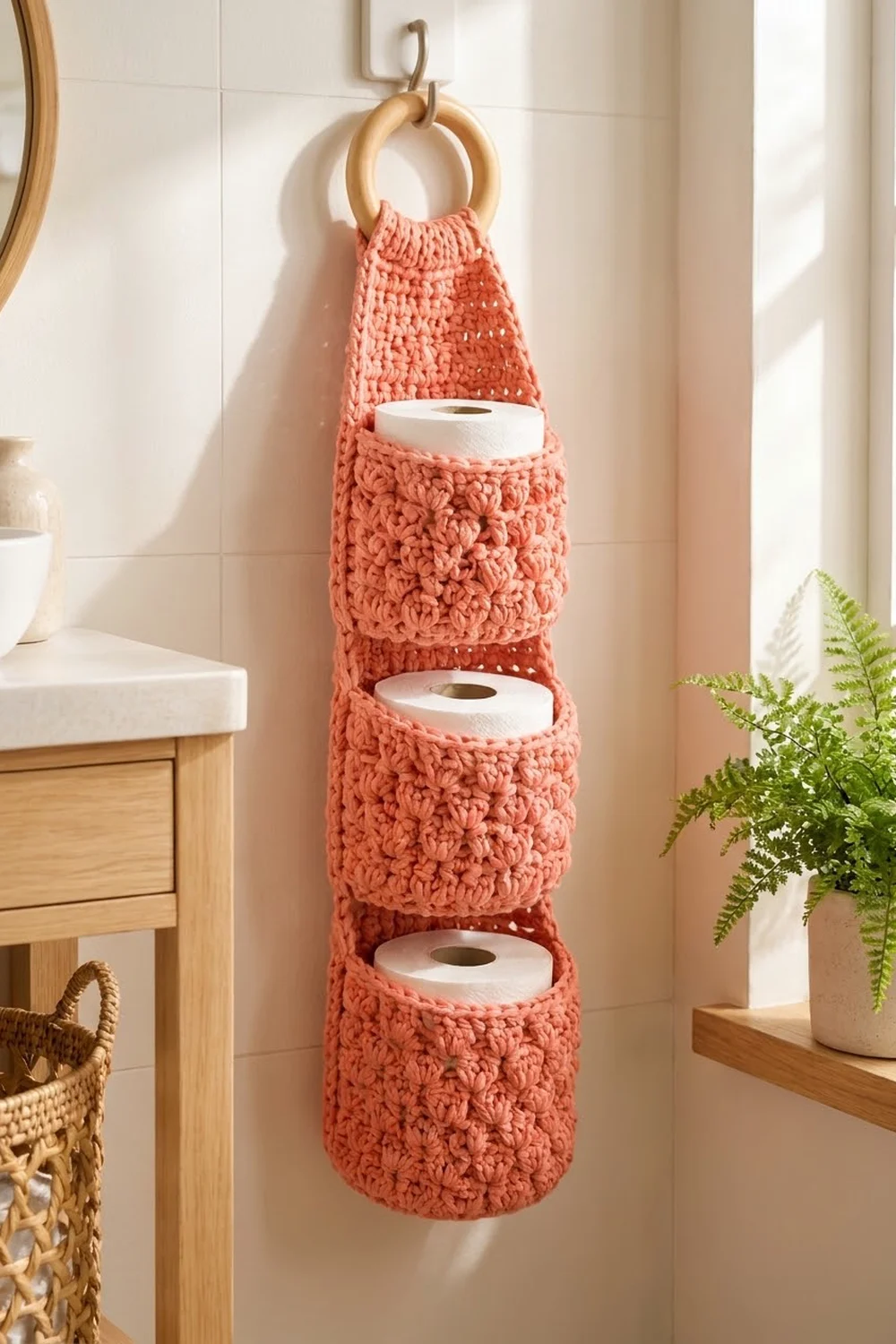
This hanging toilet paper holder is a soft, practical piece for a small bathroom. A long textured back panel hangs from a wooden ring, and three round pockets are stacked down its front, each holding one standard roll.
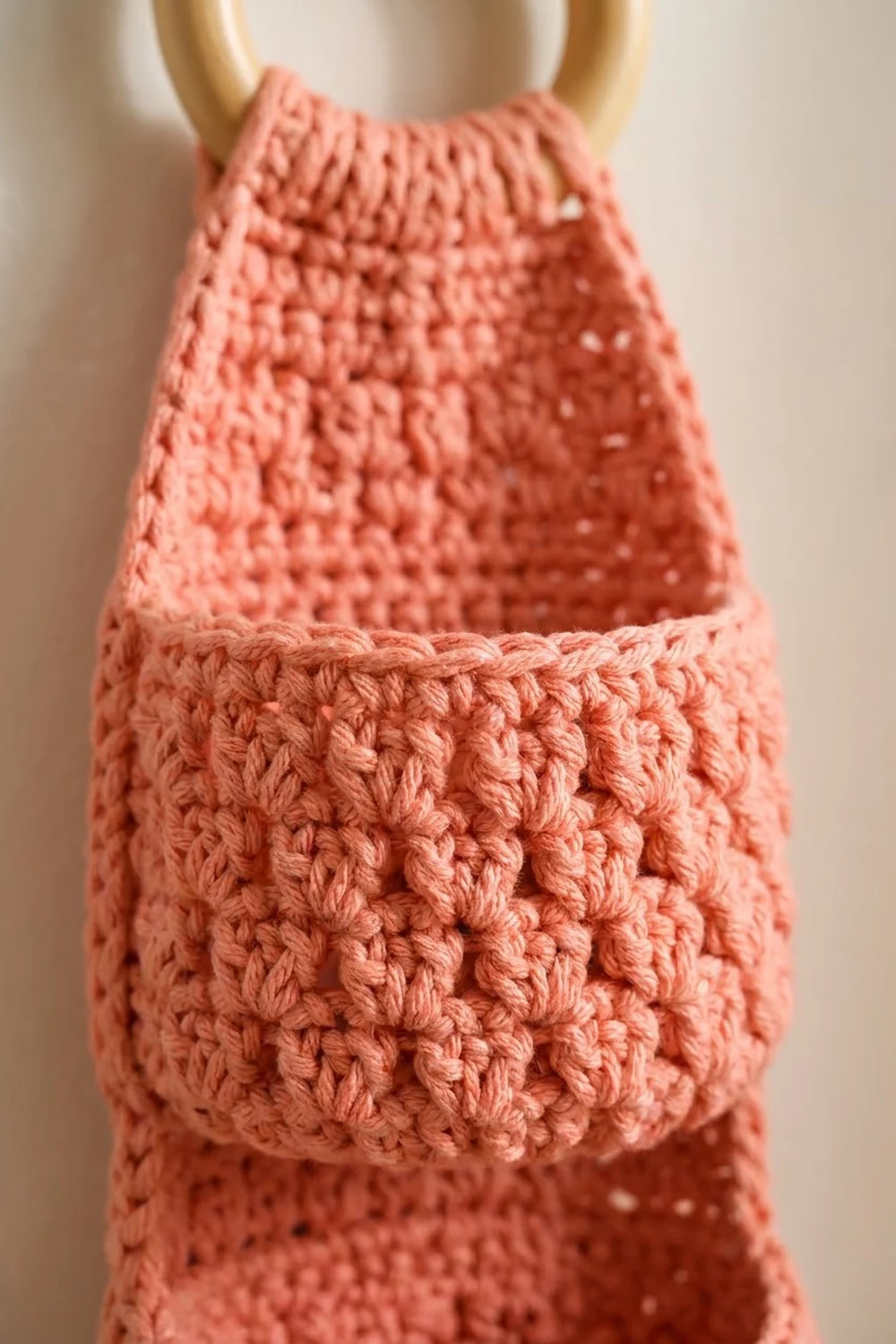
The whole piece is worked in one warm coral cotton. Rows of raised three-loop clusters cover the panel and the pocket walls. Plain single-crochet bases, rims and borders keep the outlines crisp. The top of the panel tapers into a ribbed strap that wraps over the ring.
The pattern uses US crochet terms. The finished panel measures 6.25 in (15.9 cm) wide and 21.75 in (55.2 cm) long before folding. It hangs 19.75 in (50.2 cm) long once the strap is folded over the ring. Each pocket is 4.75 in (12.1 cm) across and 3.25 in (8.3 cm) tall.
You make one flat panel in rows and three pockets in rounds from the bottom up. Then you sew the pockets to the panel, work a two-round border around the panel and fold the strap over the ring.
Finished Size and Construction
- Finished size: 6.25 in x 21.75 in (15.9 cm x 55.2 cm) flat; 19.75 in (50.2 cm) hanging length
- Skill level: Easy-intermediate
- Terminology: US crochet terms
- Yarn weight: Worsted (#4) cotton
- Hook: 5.0 mm (H-8)
- Number of pieces: 4 (1 back panel + 3 pockets)
- Layout: 3 pockets stacked in a single vertical column on the panel
- Piece size: Panel 5.25 in x 20.75 in (13.3 cm x 52.7 cm); each pocket 4.75 in (12.1 cm) across x 3.25 in (8.3 cm) tall
- Size before border: 5.25 in x 20.75 in (13.3 cm x 52.7 cm)
- Border depth: 0.5 in (1.3 cm) on every side
Materials
Use a smooth, firm worsted-weight cotton or cotton blend. Cotton holds the pocket shape better than acrylic and copes with a humid bathroom. The amounts below assume a yarn of about 170 m per 100 g.
- Coral: 240 g total, about 410 m
- Panel: 75 g, about 128 m
- Each pocket: 55 g, about 94 m (165 g, about 282 m, for three)
The quantities include a margin of about 10%, so you won’t run short on the last pocket.
Tools:
- 5.0 mm (H-8) crochet hook
- Wooden ring, 3.5 in (8.9 cm) outer diameter
- Tapestry needle
- 6 locking stitch markers
- Measuring tape
- Blocking mat and rust-proof pins
- Spray bottle
Abbreviations (US Terms)
- ch – chain
- sl st – slip stitch
- sc – single crochet
- dc – double crochet
- sc2tog – single crochet 2 together
- BLO – back loop only
- MR – magic ring
- st(s) – stitch(es)
- RS / WS – right side / wrong side
Special stitch – Cluster (cl): *Yarn over, insert hook in the stitch, yarn over and pull up a loop, yarn over and pull through 2 loops; repeat from * twice more in the same stitch (4 loops on hook), yarn over and pull through all 4 loops. A cluster counts as 1 stitch. Clusters are always worked with the WS facing, so the bump pushes out to the RS.
Gauge and Checkpoints
- Single crochet: 16 sc and 16 rows = 4 in (10.2 cm)
- Cluster pattern: 16 sts = 4 in (10.2 cm); one 4-row repeat = 1.25 in (3.2 cm)
Make one pocket before anything else. It acts as your gauge swatch, and it is the piece that has to fit a roll.
Checkpoints:
- Pocket after Rnd 10: base is 4.75 in (12.1 cm) across and lies flat.
- Pocket after Rnd 21: wall is 3.25 in (8.3 cm) tall and 15 in (38.1 cm) around.
- Panel after Row 5: width is 5.25 in (13.3 cm).
- Panel after Row 41: length is 12.75 in (32.4 cm).
- Panel after Row 57: top of the taper is 2.25 in (5.7 cm) wide.
If your pieces are too big, change to a 4.5 mm hook. If they’re too small, change to a 5.5 mm hook. If only the base ruffles, your sc gauge is loose. Work the base one hook size smaller and the walls on the main hook.
Pocket (Make 3)
The pocket is a flat circle followed by straight walls. The walls are worked in joined rounds that you turn, so every cluster round is worked with the WS facing.
Base (RS facing, no turning):
- Rnd 1: In MR, ch 1, 6 sc; join with sl st to first sc. (6 sts)
- Rnd 2: Ch 1, 2 sc in each st; join. (12 sts)
- Rnd 3: Ch 1, sc in next st, 2 sc in next st 6 times; join. (18 sts)
- Rnd 4: Ch 1, sc in next 2 sts, 2 sc in next st 6 times; join. (24 sts)
- Rnd 5: Ch 1, sc in next 3 sts, 2 sc in next st 6 times; join. (30 sts)
- Rnd 6: Ch 1, sc in next 4 sts, 2 sc in next st 6 times; join. (36 sts)
- Rnd 7: Ch 1, sc in next 5 sts, 2 sc in next st 6 times; join. (42 sts)
- Rnd 8: Ch 1, sc in next 6 sts, 2 sc in next st 6 times; join. (48 sts)
- Rnd 9: Ch 1, sc in next 7 sts, 2 sc in next st 6 times; join. (54 sts)
- Rnd 10: Ch 1, sc in next 8 sts, 2 sc in next st 6 times; join. (60 sts)
Checkpoint: the base is 4.75 in (12.1 cm) across.
Walls:
- Rnd 11 (RS): Ch 1, sc BLO in each st; join. (60 sts) This leaves a ridge that turns the base into a crisp corner.
- Rnd 12 (WS): Turn. Ch 1, cl in next st, sc in next st 30 times; join. (60 sts: 30 cl, 30 sc)
- Rnd 13 (RS): Turn. Ch 1, sc in each st; join. (60 sts)
- Rnd 14 (WS): Turn. Ch 1, sc in next st, cl in next st 30 times; join. (60 sts: 30 cl, 30 sc) Each cluster sits above a sc from Rnd 12, so the rows stagger.
- Rnd 15 (RS): Turn. Ch 1, sc in each st; join. (60 sts)
- Rnds 16–19: Repeat Rnds 12–15.
- Rnds 20–21 (rim, RS): Do not turn. Ch 1, sc in each st; join. (60 sts)
Fasten off, leaving an 18 in (45.7 cm) tail for sewing.
Checkpoint: the wall is 3.25 in (8.3 cm) tall from the ridge to the rim. A roll 4 in (10.2 cm) tall should show about 0.75 in (1.9 cm) above the rim.
Back Panel
The panel is worked flat from the bottom up, starting with the cluster body. Rows 42–57 taper the width and Rows 58–73 form the strap. Clusters are always on WS rows.
Body:
Ch 22.
- Row 1 (RS): Sc in 2nd ch from hook and in each ch across. Turn. (21 sts)
- Row 2 (WS): Ch 1, sc in first st, cl in next st, sc in next st 10 times. Turn. (21 sts: 10 cl, 11 sc)
- Row 3 (RS): Ch 1, sc in each st across. Turn. (21 sts)
- Row 4 (WS): Ch 1, sc in first 2 sts, cl in next st, sc in next st 9 times, sc in last st. Turn. (21 sts: 9 cl, 12 sc)
- Row 5 (RS): Ch 1, sc in each st across. Turn. (21 sts)
Checkpoint: width is 5.25 in (13.3 cm).
- Rows 6–41: Repeat Rows 2–5 nine more times. (21 sts)
Row 1 plus ten repeats gives 41 rows (21 sc rows and 20 cluster rows). Checkpoint: the body measures 12.75 in (32.4 cm).
Taper (sc BLO for a ribbed look):
- Row 42 (WS): Ch 1, sc2tog, sc BLO in each st to last 2 sts, sc2tog. Turn. (19 sts)
- Rows 43–44: Ch 1, sc BLO in each st. Turn. (19 sts)
- Row 45: Repeat Row 42. (17 sts)
- Rows 46–47: Repeat Row 43. (17 sts)
- Row 48: Repeat Row 42. (15 sts)
- Rows 49–50: Repeat Row 43. (15 sts)
- Row 51: Repeat Row 42. (13 sts)
- Rows 52–53: Repeat Row 43. (13 sts)
- Row 54: Repeat Row 42. (11 sts)
- Rows 55–56: Repeat Row 43. (11 sts)
- Row 57: Repeat Row 42. (9 sts)
That makes 16 taper rows, 4 in (10.2 cm) tall. Checkpoint: the top is 2.25 in (5.7 cm) wide.
Strap:
- Rows 58–73: Ch 1, sc BLO in each st. Turn. (9 sts)
That makes 16 rows, 4 in (10.2 cm) tall. Fasten off.
Checkpoint: the panel measures 5.25 in x 20.75 in (13.3 cm x 52.7 cm).
Make All Pieces
- Back panel: 1 in coral
- Pockets: 3 in coral
Layout, from top to bottom (RS of panel facing):
   [ ring ]
   [ strap ]      Rows 58–73
   [ taper ]      Rows 42–57
   [ Pocket 3 ]   base Row 29, rim Row 39
   [ Pocket 2 ]   base Row 15, rim Row 25
   [ Pocket 1 ]   base Row 1,  rim Row 11
Joining
Sew each pocket to the panel with a whipstitch, matching one pocket stitch to one panel stitch. Both pieces work out to 4 sts per inch (2.5 cm), so a 1:1 match lies flat without puckering.
- Mark the pocket back. Flatten the pocket with the Rnd 21 join at the center back. Place markers so that 17 rim sts are centered at the back, and mark the same 17 sts of Rnd 10 on the base edge directly below.
- Mark the panel. With the RS facing, mark sts 3–19 of the row where the rim goes. That is 17 sts, leaving 2 sts free at each side for the border.
- Sew the rim. Whipstitch the 17 marked rim sts to panel sts 3–19 of the rim row (Row 11, 25 or 39).
- Sew the base. Whipstitch the 17 marked base-edge sts to panel sts 3–19 of the base row (Row 1, 15 or 29).
- Tension. Pull each stitch snug so it disappears into the fabric, but don’t let it dimple the panel. Weave in ends inside the pocket.
Checkpoint: the gap between one pocket’s rim and the next pocket’s base is 3 rows, about 0.875 in (2.2 cm). The panel still lies flat and measures 5.25 in (13.3 cm) wide at every pocket.
Border
Border gauge is 16 sc = 4 in (10.2 cm), the same as the body. Each round adds 0.25 in (0.6 cm) to every side.
A corner is 3 sc in one st, and the middle sc of the group is the corner stitch. In this section, side counts are the stitches between corner stitches. The 4 corner stitches are counted separately.
Row-end rule for the long sides: 1 sc in each sc row-end. In the cluster rows, work 1 sc in the first cluster row-end and 2 sc in the next, alternating. The 20 cluster rows give 10 single and 10 double row-ends, for 30 sc.
- Body: 21 + 30 = 51 sc
- Taper: 16 sc
- Strap: 16 sc
- Total per long side: 83 row-end sc
Round 1 (RS): Join at the bottom-right corner (the first ch of the foundation). Work 3 sc in that ch, sc in the next 19 ch, then 3 sc in the last ch. Work 83 sc up the long side, 3 sc in the first st of Row 73, sc in the next 7 sts, then 3 sc in the last st. Work 83 sc down the other long side. Join to the first sc.
- Bottom 21, long sides 85 each, top 9, plus 4 corners: 204 sts
Round 2: Ch 1. Sc in each st, working 3 sc in each corner stitch. Join.
- 204 worked one per stitch + 8 added at the corners = 212 sts
- Bottom 23, long sides 87 each, top 11, plus 4 corners
Fasten off and weave in ends.
Why the math works: The bottom edge goes from 21 sts to 25 sts with corners (23 + 2), and 25 sts ÷ 4 = 6.25 in (15.9 cm). The body side count of 51 sc ÷ 4 = 12.75 in (32.4 cm), which matches the body length, so the edge won’t ruffle or pull. The strap ends at 13 sts with corners, which is 3.25 in (8.3 cm) and gathers slightly through the ring.
Final Blocking
- Lightly mist the panel and pockets until they are damp but not wet.
- Pin the panel flat at 6.25 in x 21.75 in (15.9 cm x 55.2 cm). Keep the side edges straight and the taper symmetrical.
- Put a roll wrapped in a plastic bag inside each pocket so the walls dry round.
- Let everything dry completely, for about 12 hours.
- Remove the pins. Pass the strap through the wooden ring from front to back and fold over the top 2 in (5.1 cm), about 8 strap rows plus the border.
- Whipstitch the strap end to the back of the panel across all 13 sts. Check that the hanging length is 19.75 in (50.2 cm).
Final Quality-Control Checklist
- Panel is 6.25 in (15.9 cm) wide and 19.75 in (50.2 cm) long hanging.
- Every pocket base is 4.75 in (12.1 cm) across and every wall is 3.25 in (8.3 cm) tall.
- All clusters bulge outward and the rows stagger evenly.
- The three pockets are centered and level, with equal gaps.
- Border corners are square and the sides don’t ripple.
- Strap is sewn securely and the ring sits centered.
- All ends are woven in on the WS or inside the pockets.
Troubleshooting
- Clusters sink in instead of popping out: You worked them with the RS facing. Remember to turn before every cluster round or row.
- Pocket base cups or ruffles: Check that you have 60 sts after Rnd 10. If the count is right, work the base with a smaller hook.
- Roll won’t fit: Your gauge is tight. Remake the pocket with a 5.5 mm hook.
- Panel edges wave: You added too many row-end sc. Recount to 83 per long side.
- Pocket sags forward: Re-sew the rim with firmer stitches across all 17 sts.
- Strap twists in the ring: Re-sew it with the RS facing out and the fold centered.
Care
Hand wash in cool water, press out the water in a towel and dry flat. Reshape the pockets around a roll while they are damp.
Final Notes
Everything in this pattern follows from one gauge: 16 sts = 4 in (10.2 cm). That gives 60-st pockets 4.75 in (12.1 cm) across and 3.25 in (8.3 cm) tall. It also gives a 21-st panel 5.25 in (13.3 cm) wide and 20.75 in (52.7 cm) long. The 0.5 in (1.3 cm) border brings the panel to 6.25 in x 21.75 in (15.9 cm x 55.2 cm), and folding 2 in (5.1 cm) over the ring leaves a hanging length of 19.75 in (50.2 cm). Check each stage as you go and the finished holder will hang straight and hold all three rolls.
Happy crocheting!