

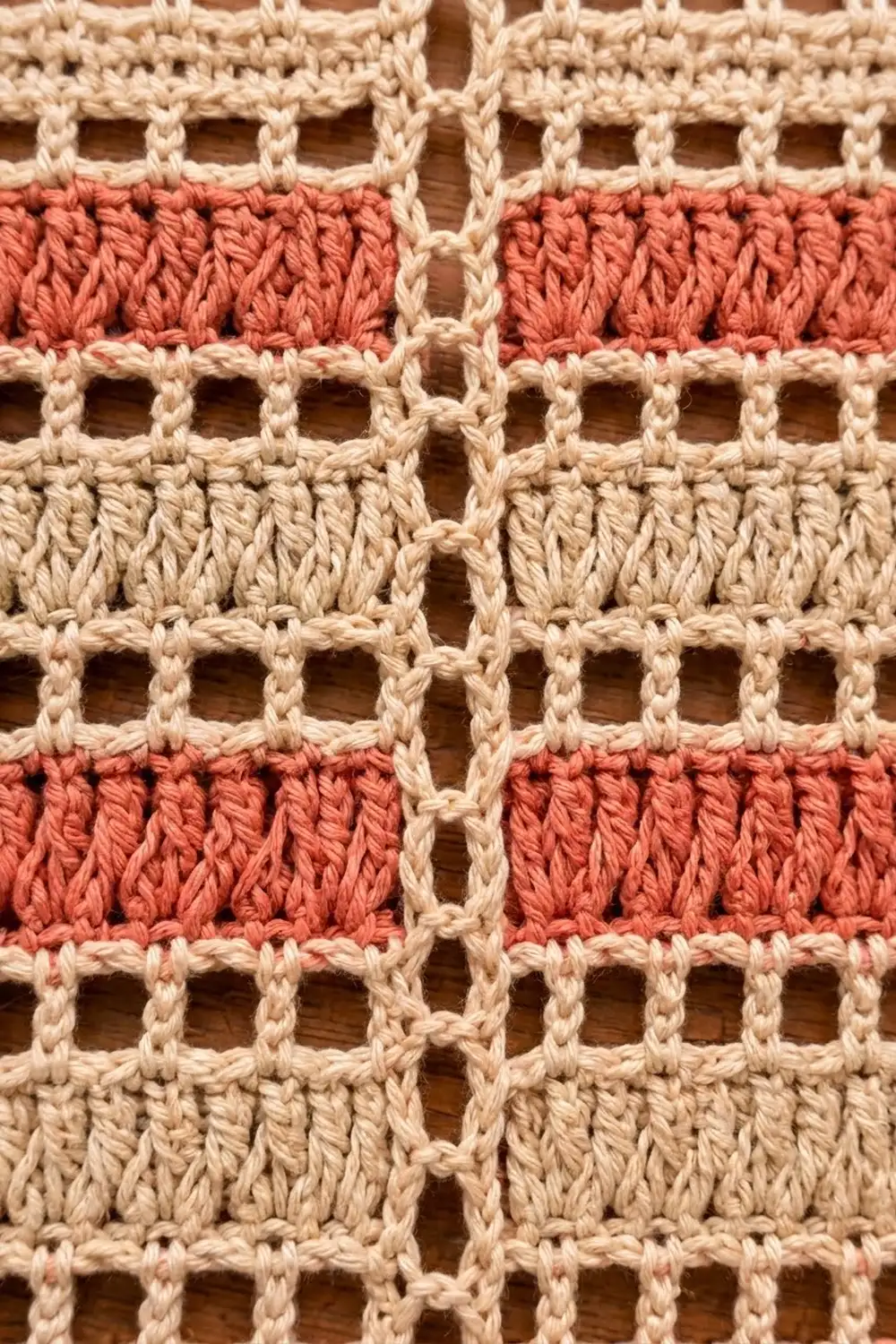
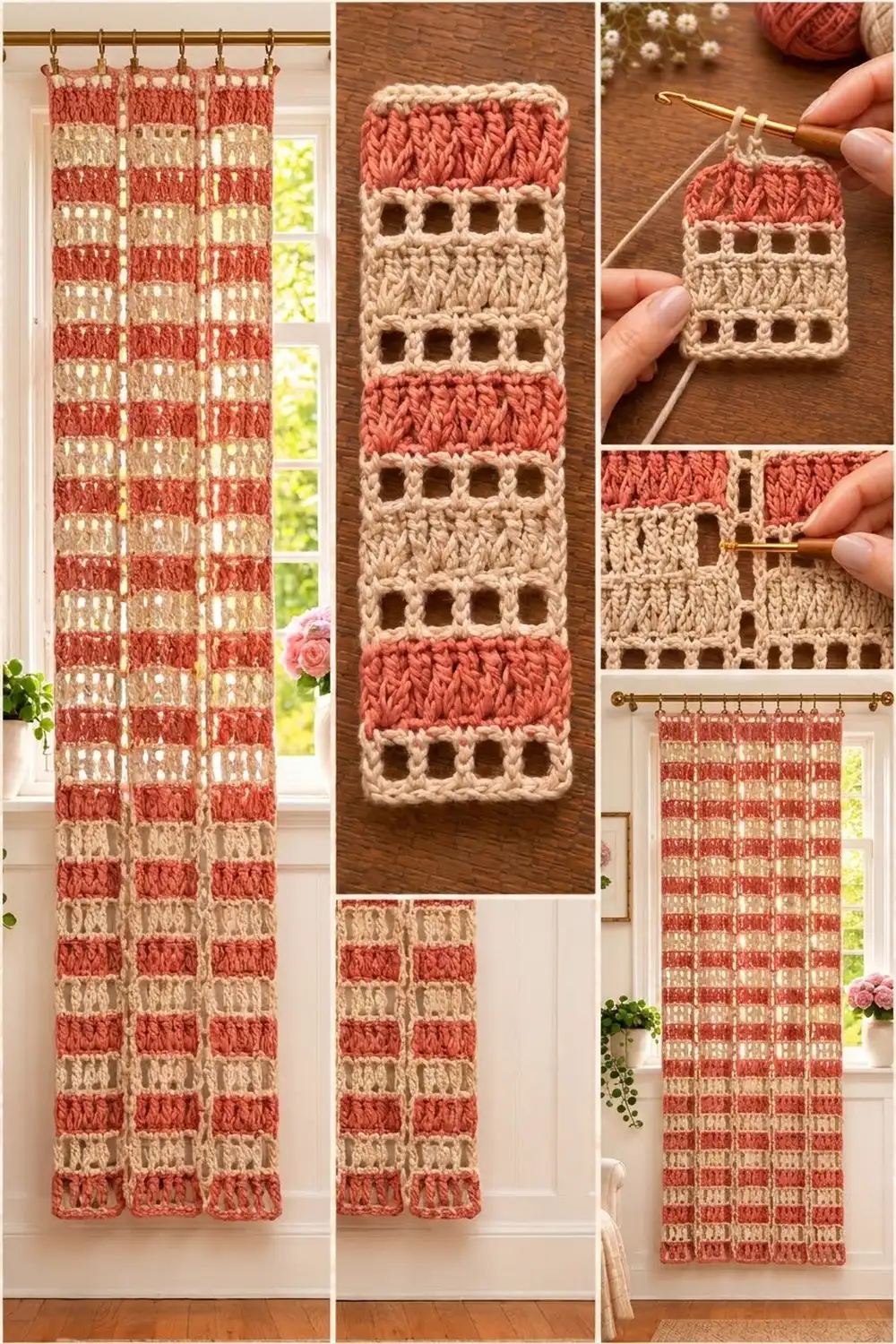
The Coral Ladder Strip Curtain is a light, open curtain built from six narrow vertical strips. Each strip has stacked bands of plump cluster texture and crisp filet mesh windows. Open cream ladder seams join the strips, so light passes through both the mesh and the gaps between strips.
The palette is coral and natural cream. Coral fills every other cluster band. Cream handles the mesh rows, the alternate cluster bands, the edging, the joins, and the border. Because the coral bands line up across all six strips, the finished curtain reads as soft horizontal stripes.
This pattern uses US crochet terms. The finished curtain measures 26 in × 72 in (66.0 cm × 182.9 cm) after blocking. That fits a narrow window, a door panel, or a closet opening.
Construction is simple and modular. You crochet six identical strips in rows, edge each one with single crochet, join them with a zigzag ladder seam, and work a two-round border around the whole curtain.
Finished Size and Construction
- Finished size: 26 in × 72 in (66.0 cm × 182.9 cm)
- Skill level: Easy–Intermediate
- Terminology: US crochet terms
- Yarn weight: Worsted (#4) cotton
- Hook: 5.0 mm (H-8)
- Number of pieces: 6 strips
- Layout: 6 strips side by side (1 row of 6)
- Strip size (edged): 3.75 in × 71 in (9.5 cm × 180.3 cm)
- Joined size before border: 25 in × 71 in (63.5 cm × 180.3 cm)
- Border depth: 0.5 in (1.3 cm) on every side
Materials
Choose a smooth, mercerized or combed worsted cotton. Cotton holds the square mesh shape, defines the clusters clearly, and hangs straight without stretching too much. Avoid fuzzy acrylic, because it blurs the open windows.
- Cream: 750 g (about 1,425 m)
- Coral: 450 g (about 855 m)
These quantities include a margin of roughly 10% for your swatch, tension differences, and weaving in ends.
Tools:
– 5.0 mm (H-8) crochet hook
– Tapestry needle
– Stitch markers (at least 12)
– Measuring tape
– Rust-proof pins and a large blocking surface
– Spray bottle
– Curtain rod and 12–14 clip rings for hanging
Abbreviations (US Terms)
- ch – chain
- sl st – slip stitch
- sc – single crochet
- dc – double crochet
- cl – cluster (see below)
- sk – skip
- st(s) – stitch(es)
- sp – space
- RS / WS – right side / wrong side
- rep – repeat
Special stitch – Cluster (cl): In the same st, yarn over, insert hook, pull up a loop, yarn over, draw through 2 loops. Rep from * twice more (4 loops on hook), then yarn over and draw through all 4 loops. Each cluster counts as 1 st.
Gauge and Checkpoints
Gauge: 16 dc and 8 rows = 4 in (10.2 cm) square. One dc row is 0.5 in (1.3 cm) tall, and 13 sts measure 3.25 in (8.3 cm) across.
Test one piece first. Make the first 13 rows of one strip (Row 1 plus two full repeats). Then check:
- Width: 3.25 in (8.3 cm)
- Height after Row 7: 3.5 in (8.9 cm)
- Height after Row 13: 6.5 in (16.5 cm)
If your strip is too wide or too tall, go down a hook size. If it is too narrow or too short, go up a hook size. Width matters most: a strip that is 0.25 in (0.6 cm) too wide makes the curtain 1.5 in (3.8 cm) too wide across six strips.
Later checkpoints:
– After Row 25: 12.5 in (31.8 cm) tall
– After Row 141: 3.25 in × 70.5 in (8.3 cm × 179.1 cm)
– After edging: 3.75 in × 71 in (9.5 cm × 180.3 cm)
Strip Pattern (Make 6)
Each strip is 13 sts wide throughout. Mesh rows are cream. Cluster bands alternate coral and cream.
Color changes: Change colors in the last yarn-over of the final st of a row. Every color block has an even number of rows, so both yarns always wait at the same side edge. Carry the unused color loosely up that edge instead of cutting it. The edging will cover the carried strands.
Foundation: With cream, ch 17.
Row 1 (Mesh, cream, RS): Dc in 8th ch from hook. Ch 2, sk 2 ch, dc in next ch. Rep from * twice more. Turn.
(5 dc and 4 ch-2 sps = 13 sts, 4 mesh squares)
The 7 skipped chains count as the first dc, the first ch-2 space, and 2 skipped base chains.
Repeat Unit (Rows 2–7)
Row 2 (Cluster, coral): Change to coral. Ch 3 (counts as dc). Working into each ch and each dc, cl in next st, dc in next st. Rep from * 5 more times, placing the last dc in the 3rd ch of the turning ch. Turn.
(6 cl and 7 dc = 13 sts)
Row 3 (Cluster, coral): Ch 3 (counts as dc). Cl in next cl, dc in next dc. Rep from * 5 more times. Turn.
(13 sts)
Stacking clusters on clusters makes the raised vertical ribs in each band.
Row 4 (Mesh, cream): Change to cream. Ch 5 (counts as dc and ch 2). Sk 2 sts, dc in next st. Ch 2, sk 2 sts, dc in next st. Rep from * twice more, placing the last dc in the top of the turning ch. Turn.
(5 dc and 4 ch-2 sps = 13 sts)
Row 5 (Cluster, cream): Work as Row 2 in cream, working into each ch and each dc.
(13 sts)
Row 6 (Cluster, cream): Work as Row 3.
(13 sts)
Row 7 (Mesh, cream): Work as Row 4.
(13 sts)
Rows 8–139: Rep Rows 2–7 twenty-two more times, for 23 repeat units in total.
Rows 140–141 (Final coral band): Work Rows 2–3 once more in coral. Fasten off both colors.
The strip has 141 rows: Row 1, plus 23 × 6 rows, plus 2 final rows. It starts with a mesh row at the bottom and ends with a coral band at the top. It should measure 3.25 in × 70.5 in (8.3 cm × 179.1 cm).
Strip Edging (cream)
Mark the first and last sts of Row 141 and the bases of the first and last dc of Row 1. These are the corner sts.
Round 1: With RS facing, join cream in the first st of Row 141. Ch 1.
- Top edge: 3 sc in the first st (corner). Sc in each of the next 11 sts. 3 sc in the last st (corner).
- Long side: Work 2 sc in each row end down the side, 141 rows × 2 = 282 sc.
- Bottom edge: 3 sc at the base of the first dc of Row 1 (corner). Working into the foundation, place 2 sc under each ch-2 sp and 1 sc at the base of each middle dc, for 11 sc. 3 sc at the base of the last dc (corner).
- Second long side: Work 282 sc up the other side.
- Sl st to the first sc and fasten off.
Edging count: 598 sc.
Per-side counts (each count runs from one corner center sc to the next and includes both corner center sc):
– Short sides: 1 + 1 + 11 + 1 + 1 = 15 sts
– Long sides: 1 + 1 + 282 + 1 + 1 = 286 sts
Check the total: 4 corner centers + (2 × 13) + (2 × 284) = 4 + 26 + 568 = 598. ✓
The edged strip measures 3.75 in × 71 in (9.5 cm × 180.3 cm).
Make All Pieces
Make 6 identical strips. Each strip uses about 75 g (143 m) of coral and about 95 g (181 m) of cream for the body and edging. The rest of the cream goes to the joins, the border, and the margin.
Lay the strips RS up, all with the coral top band at the top:
TOP (rod)
[S1] : [S2] : [S3] : [S4] : [S5] : [S6]
BOTTOM
( : = cream ladder seam )
Every strip has the same row count, so the coral bands line up across the whole curtain.
Joining
Method: A zigzag ladder join in cream. You work single crochets alternately into the facing edges of two strips, with ch-2 bridges between them. This makes the open chain lattice between the strips.
Stitch-to-stitch logic: Number the long-side sts of each strip 1–286, from the bottom corner center to the top corner center. On strip A, work only into the odd-numbered sts. On strip B, work only into the even-numbered sts. Each seam therefore uses 143 sts on each strip, and the bands stay level.
Seam (rep for each of 5 seams):
1. Lay strip A (left) and strip B (right) side by side, RS up and bottoms aligned.
2. Join cream with sc in st 1 of A’s right edge.
3. Ch 2, sc in the next even st of B, ch 2, sc in the next odd st of A. Rep from * until you have worked sc in st 286 of B.
4. Fasten off.
Seam count: 286 sc (143 on each strip) and 285 ch-2 bridges.
Tension advice: Keep the ch-2 bridges relaxed but even. The gap between strips should measure 0.5 in (1.3 cm). If the seam puckers, your chains are too tight. If it sags, use a smaller hook for the joins only. Place a marker every 50 sts on both strips to check that the strips stay aligned.
Size checkpoints:
– Two strips joined: 8 in (20.3 cm) wide
– Six strips joined: 6 × 3.75 in + 5 × 0.5 in = 25 in (63.5 cm) wide, by 71 in (180.3 cm) long
Border
Border gauge: One sc round adds 0.25 in (0.6 cm) on each side. Two rounds add 0.5 in (1.3 cm) on each side, which makes 1 in (2.5 cm) total in each direction.
Round 1 (cream): With RS facing, join cream in the top-left corner center sc of S1. Ch 1, 3 sc in the same st.
- Top edge:
- S1: sc in each of the next 13 sts, then sc in the strip corner center.
- Seam gaps: ch 2 across each seam gap.
- S2–S5: sc in each of 15 sts.
- S6: sc in the first 14 sts, then 3 sc in the outer corner center.
- Right long side: Sc in each of the 284 sts of S6, then 3 sc in the corner.
- Bottom edge: Work as the top edge, in reverse.
- Left long side: Sc in each of the 284 sts of S1. Sl st to the first sc.
Round 1 counts:
– Top and bottom: (6 × 15 = 90, worked one per existing st) + 2 corner extras = 92 sc, plus 5 ch-2 sps
– Long sides: (286, worked one per existing st) + 2 corner extras = 288 sc
– Total: 756 sc and 10 ch-2 sps
The ch-2 spaces count as bridges, not stitches. They are shown exactly here and are not part of any strip’s count.
Round 2 (cream): Ch 1. Sc in each sc, 2 sc in each ch-2 sp, and 3 sc in each corner center sc. Sl st to join and fasten off.
Round 2 counts:
– Top and bottom: (92 + 10, worked into existing sc and spaces) + 2 corner extras = 104 sc
– Long sides: 288 + 2 = 290 sc
– Total: 784 sc
Why the math works: At 4 sc per inch, the 90 strip sc cover 22.5 in (57.2 cm). The 10 sc worked into the seam spaces cover the 2.5 in (6.4 cm) of gaps. Together they cover 25 in (63.5 cm), exactly the joined width, so the top edge stays flat with no flaring or pulling.
Final Blocking
- Weave in all ends, running them along cream mesh posts or into the cluster bands of matching color.
- Soak the curtain in cool water for 15 minutes, then press out the water gently. Do not wring it.
- Roll it in towels to remove excess moisture.
- Lay it flat on a blocking surface and pin it to 26 in × 72 in (66.0 cm × 182.9 cm).
- Pin along each ladder seam so every gap stays 0.5 in (1.3 cm) wide and straight.
- Square up the mesh windows with your fingers, and check that the coral bands run level across the curtain.
- Let it dry completely, which takes 24–48 hours, before unpinning.
Final Quality-Control Checklist
- [ ] Each strip has 141 rows and 13 sts per row
- [ ] Each strip has 23 repeat units plus a final coral band
- [ ] Every strip edging has 598 sc (15 sts on each short side, 286 on each long side)
- [ ] All 5 seams have 286 sc and 285 ch-2 bridges
- [ ] The coral bands line up across all 6 strips
- [ ] Border Round 2 totals 784 sc
- [ ] The blocked size is 26 in × 72 in (66.0 cm × 182.9 cm)
- [ ] Carried yarn is hidden under the edging, and all ends are secure
Troubleshooting
Mesh squares look like rectangles: Your ch-2 chains are too tight or too loose compared with your dc height. Adjust your chain tension, not the hook.
The strip leans or narrows: You missed the turning-ch stitch. Check that you have 13 sts at the end of every row.
The clusters look flat: Pull up each loop to full dc height before you close the cluster.
The side edge puckers where the yarn is carried: Leave slack in the carried yarn when you change colors.
The bands don’t line up after joining: Your edging row-end counts are uneven. Each long side needs exactly 282 row-end sc.
The seam gaps vary: Re-work the seam with markers every 50 sts, and keep your ch-2 tension steady.
The border ruffles at the top: You put more than 2 sc in a seam space. Rework it with exactly 2.
Care
Hand wash in cool water with a mild detergent, or machine wash on a gentle cycle inside a mesh laundry bag. Reshape it and dry it flat, out of direct sun, to protect the coral from fading.
Final Notes
The measurement chain is straightforward. Thirteen sts make a 3.25 in (8.3 cm) strip, and 141 rows make 70.5 in (179.1 cm). Edging brings each strip to 3.75 in × 71 in (9.5 cm × 180.3 cm). Six strips with five 0.5 in (1.3 cm) ladder seams make 25 in × 71 in (63.5 cm × 180.3 cm). The two-round border finishes the curtain at 26 in × 72 in (66.0 cm × 182.9 cm). If your first test section matches the gauge, every later checkpoint will follow. Clip it to your rod and enjoy the light coming through.
Happy crocheting!