

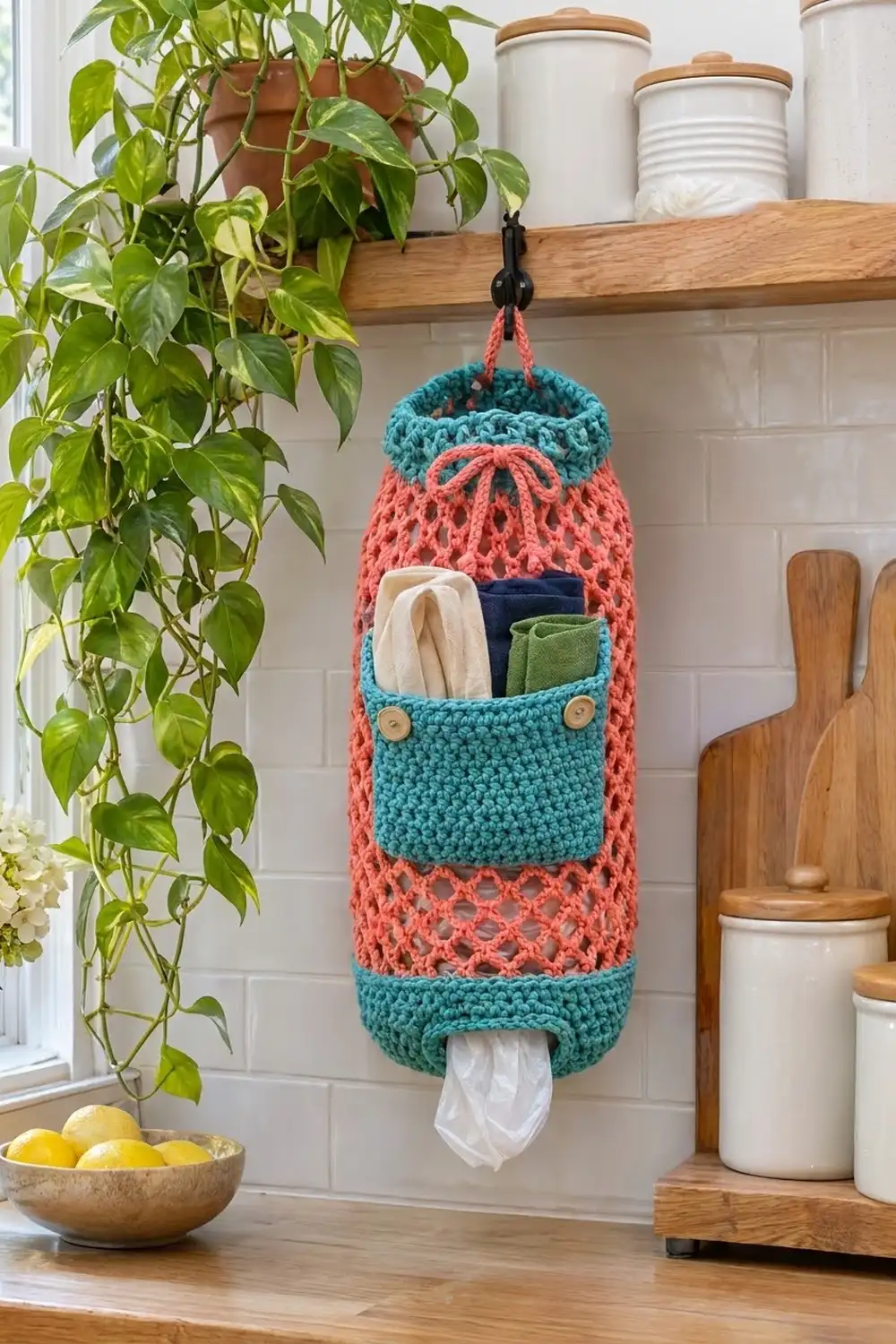
This hanging dispenser keeps plastic shopping bags in one tidy place. You push bags in at the top and pull them out one at a time through a slot near the bottom. The open coral mesh lets you see how many bags are left, and the solid teal bands keep the shape firm at both ends.
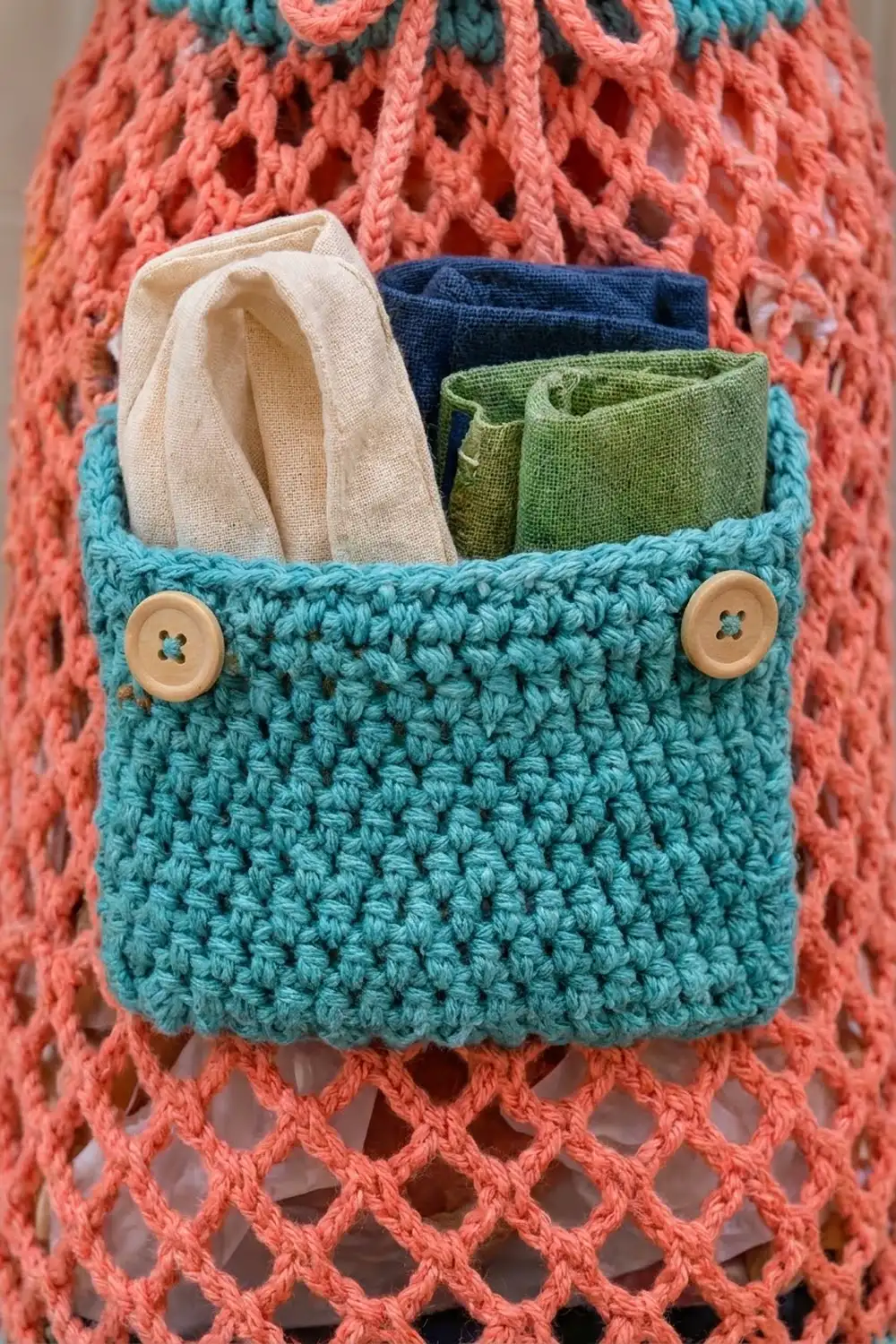
The color scheme is bright coral with deep teal, and two wooden buttons add a natural touch. A teal patch pocket on the front holds folded reusable bags. A coral drawstring closes the top with a bow at center front.
The pattern uses US crochet terms. The finished body measures 7.5 in (19.1 cm) wide laid flat and 18 in (45.7 cm) tall, with a circumference of 15 in (38.1 cm). The hanging loop adds about 2.5 in (6.4 cm).
You start with a flat oval base. From there you work upward in joined rounds: a solid bottom band with the dispensing slot, a chain-loop mesh body, and a solid top band with eyelets. Last, you make the pocket, strap, and drawstring and attach them.
Finished Size and Construction
- Finished size: 7.5 in (19.1 cm) wide flat × 18 in (45.7 cm) tall; about 20.5 in (52.1 cm) including the loop
- Skill level: Easy+
- Terminology: US
- Yarn weight: Worsted (#4) cotton
- Hook: 5.0 mm (US H-8)
- Number of pieces: 1 main body plus 3 small attached parts (pocket, strap, drawstring)
- Layout: Vertical tube; pocket centered on the front
- Base size: about 6 × 3.25 in (15.2 × 8.3 cm)
- Body size before the top band: 15.5 in (39.4 cm) tall
- Top band (border) depth: about 2.5 in (6.4 cm)
Materials
Use a smooth cotton or cotton-blend worsted yarn. Cotton holds its shape and does not stretch out when the dispenser is full. Acrylic also works, but the mesh will be springier.
- Teal (Color A): 140 g / 215 m, for the base, bands, and pocket
- Coral (Color B): 85 g / 130 m, for the mesh, strap, and drawstring
These amounts include about a 25% margin.
Tools:
– 5.0 mm (US H-8) crochet hook
– Tapestry needle
– 4 locking stitch markers
– 2 wooden buttons, 3/4 in (1.9 cm)
– Sewing thread and needle to match the teal
– Scissors and measuring tape
– A 2-liter bottle or rolled towel to use as a form
Abbreviations (US Terms)
- ch – chain
- sl st – slip stitch
- sc – single crochet
- BLO – back loop only
- sk – skip
- sp – space
- st(s) – stitch(es)
- rnd(s) – round(s)
Special stitch – crab stitch (reverse sc): With the right side facing, work single crochet from left to right (right to left if you are left-handed). Insert the hook into the next stitch to the right, yarn over, pull up a loop, then yarn over and pull through both loops. This makes a corded rim.
Gauge and Checkpoints
Gauge: 16 sc and 18 rnds = 4 in (10.2 cm) in sc.
Mesh gauge: 4 mesh rnds = 3 in (7.6 cm), measured hanging and lightly stretched.
Before you start, crochet the base (Rnds 1–6) as your test piece. It is part of the dispenser, so the time is not wasted.
Checkpoints:
– After Rnd 6: oval about 6 × 3.25 in (15.2 × 8.3 cm); 60 sts; edge length 15 in (38.1 cm)
– After Rnd 15: tube 7.5 in (19.1 cm) wide flat; band 2 in (5.1 cm) tall
– After Rnd 23: mesh about 6 in (15.2 cm) tall
– After Rnd 33: mesh 13.5 in (34.3 cm) tall
– After Rnd 44: total body 18 in (45.7 cm)
If the base is too big, go down to a 4.5 mm hook. If it is too small, go up to a 5.5 mm hook. Do not change the stitch counts. Everything else is built on 60 stitches.
Pattern
Join every round with a sl st to the first sc. Ch 1 at the start of each round does not count as a stitch.
Base (Color A)
Ch 15.
Rnd 1: 3 sc in 2nd ch from hook, sc in next 12 ch, 3 sc in last ch. Rotate and work along the underside of the chain: sc in next 12 ch. Join. (30 sts)
The rounds below repeat this order: end A, long side, end B, long side.
Rnd 2: Ch 1, 2 sc in each of next 3 sts, sc in next 12, 2 sc in each of next 3 sts, sc in next 12. Join. (36 sts: 6 + 12 + 6 + 12)
Rnd 3: Ch 1, (sc, 2 sc in next) 3 times, sc in next 12, (sc, 2 sc in next) 3 times, sc in next 12. Join. (42 sts: 9 + 12 + 9 + 12)
Rnd 4: Ch 1, (sc in next 2, 2 sc in next) 3 times, sc in next 12, repeat end group, sc in next 12. Join. (48 sts: 12 + 12 + 12 + 12)
Rnd 5: Ch 1, (sc in next 3, 2 sc in next) 3 times, sc in next 12, repeat end group, sc in next 12. Join. (54 sts: 15 + 12 + 15 + 12)
Rnd 6: Ch 1, (sc in next 4, 2 sc in next) 3 times, sc in next 12, repeat end group, sc in next 12. Join. (60 sts: 18 + 12 + 18 + 12)
Stitches 19–30 form the first long side, which is the front. Place a marker between sts 24 and 25 to mark front center.
Bottom Band (Color A)
Rnd 7: Ch 1, sc in BLO of each st around. Join. (60 sts) This makes a crisp fold between the base and the wall.
Rnd 8: Ch 1, sc in each st around. Join. (60 sts)
Rnd 9 (slot): Ch 1, sc in next 18 sts, ch 12, sk 12 sts, sc in next 30 sts. Join. (48 sc + 12 ch = 60)
Rnd 10: Ch 1, sc in each sc and in each ch. Join. (48 worked into sc + 12 worked into ch = 60 sts)
Rnds 11–15: Ch 1, sc in each st around. Join. (60 sts) Fasten off Color A.
Checkpoint: the band measures 2 in (5.1 cm) and the slot is 3 in (7.6 cm) wide, centered on the front marker.
Mesh Body (Color B)
Rnd 16 (set-up): Join Color B in the first st. Ch 1, sc in the same st, ch 5, sk 2, sc in next st; repeat from * 18 more times, ch 5, sk 2, join to first sc. (20 sc + 100 ch = 20 ch-5 loops)*
Rnd 17: Sl st in next 3 ch to reach the center of the first loop. Ch 1, sc in the same loop, ch 5, sc in next ch-5 loop; repeat from * 18 more times, ch 5, join to first sc. (20 loops)*
Rnds 18–33: Repeat Rnd 17. (20 loops each round) Do not fasten off.
That makes 18 mesh rounds in total, about 13.5 in (34.3 cm). The sl st start moves half a loop each round. This is normal and does not show in the diamond pattern.
Pocket (Color A)
Ch 23.
Row 1: Sc in 2nd ch from hook and in each ch across. Turn. (22 sts)
Rows 2–16: Ch 1, sc in each st across. Turn. (22 sts)
Edging: Ch 1. Along the top: 3 sc in first st, sc in next 20, 3 sc in last st (26). Down the side: 1 sc in each row end (16). Along the bottom, working into the foundation chain: 3 sc in first ch, sc in next 20, 3 sc in last ch (26). Up the side: 1 sc in each row end (16). Join. (84 sts) Fasten off. Leave a 24 in (61.0 cm) tail.
The pocket measures 6 × 4 in (15.2 × 10.2 cm).
Hanging Strap (Color B)
Ch 31.
Row 1: Sc in 2nd ch from hook and in each ch across. Turn. (30 sts)
Rows 2–3: Ch 1, sc in each st across. Turn. (30 sts)
Fasten off and leave a 12 in (30.5 cm) tail. The strap is 7.5 in (19.1 cm) long and about 0.75 in (1.9 cm) wide.
Drawstring (Color B)
Ch 121. Sl st in 2nd ch from hook and in each ch across. (120 sl sts) Fasten off. The cord should be about 30 in (76.2 cm) long. Tie an overhand knot at each end and trim.
Border: Top Band (Color A)
The top band is the border of this piece. It uses the same gauge as the base: 16 sc = 4 in (10.2 cm). Think of the tube as two halves of 30 sts each: front and back.
Rnd 34 (conversion): Join Color A in any loop. Ch 1, work 3 sc in each ch-5 loop around. Join. (20 loops × 3 sc = 60 sts: 30 front, 30 back)
Before you go on, rotate the work so the front marker from the base is at center. Move a marker up to the stitch directly above it.
Rnd 35: Ch 1, sc in each st around. Join. (60 sts)
Rnd 36 (eyelets): Ch 1, sc in next 3 sts, ch 2, sk 2; repeat from * 11 more times. Join. (36 sc + 24 ch = 12 eyelets; 6 per half)* Adjust your starting point so that one eyelet sits right at front center.
Rnd 37: Ch 1, sc in each sc and 2 sc in each ch-2 sp. Join. (36 worked into sc + 24 worked into spaces = 60 sts)
Rnds 38–43: Ch 1, sc in each st around. Join. (60 sts)
Rnd 44: Ch 1, crab stitch in each st around. Join. (60 sts) Fasten off.
Why the math works: The base ends at 60 sts. The mesh uses 1 sc + sk 2 for each loop, so 60 ÷ 3 = 20 loops. Three sc into each loop returns the count to exactly 60. The eyelet repeat uses 5 sts, and 60 ÷ 5 = 12, so there are 6 eyelets on each 30-stitch half. Because the top and bottom both have 60 sts, they match the 15 in (38.1 cm) circumference. That keeps the tube straight instead of flared.
Assembly
- Slot rim: Join Color A at one end of the slot. Work 12 sc along the top edge into the chains, 1 sc at the end, 12 sc along the bottom edge into the skipped stitches, and 1 sc at the other end. Join. (26 sts) Fasten off.
- Pocket: Slide the bottle or towel into the tube. Center the pocket on the front marker, with its top edge 1.5 in (3.8 cm) below the top band. Pin the pocket. Whipstitch the sides and bottom to the mesh, catching a mesh strand every 0.5 in (1.3 cm). Leave the top edge open.
- Buttons: Sew one button to each top corner of the pocket. Go through the pocket and the mesh so the corners are anchored.
- Strap: On the inside of the back top band, overlap each strap end 1 in (2.5 cm) and sew it down. Place the ends 1.5 in (3.8 cm) apart. The loop stands about 2.5 in (6.4 cm) above the rim.
- Drawstring: Starting at the front-center eyelet, weave the cord in and out through all 12 eyelets so both ends come out at the front. Tie a bow.
Final Blocking
- Weave in all ends along solid sc rows, not through the mesh.
- Lightly spray the whole piece with water until it is damp.
- Slide the bottle or rolled towel into the tube.
- Gently pull the mesh lengthwise until it reaches 13.5 in (34.3 cm). Check that the diamonds are even all the way around.
- Flatten the base and pocket with your palms. Pat the top band straight.
- Check that the total height is 18 in (45.7 cm) and the flat width is 7.5 in (19.1 cm).
- Let it dry completely on the form, then remove the form.
Final Quality-Control Checklist
- Base has 60 sts and lies flat
- Slot is centered on the front and measures 3 in (7.6 cm)
- Bottom band is 2 in (5.1 cm) tall
- Mesh has 20 loops in every round with no twisted loops
- Top band has 60 sts and 12 evenly spaced eyelets
- Crab-stitch rim is even with no gaps
- Pocket is 6 × 4 in (15.2 × 10.2 cm), centered, with the top open
- Buttons are firm and the strap holds weight
- Drawstring bow sits at front center
- All ends are woven in securely
Troubleshooting
Base cups or ruffles: Count the end groups. The long sides should always have exactly 12 sts.
Tube flares at the top: Rnd 34 probably has more than 3 sc in some loops. Recount to 60.
Mesh too short: Your chains are tight. Use a 5.5 mm hook for the mesh only, or add 2 mesh rounds.
Bags fall out of the slot: Tighten the slot rim. You can also work the rim with 1 fewer sc at each end.
Pocket puckers the mesh: Sew with the form inside so the mesh is held at its full width.
Drawstring slips out: Make the end knots larger, or add a wooden bead to each end.
Care
Hand wash in cool water and lay flat to dry, reshaping the mesh while damp. Remove the buttons before machine washing on a gentle cycle.
Final Notes
The measurements build on each other. A 6 × 3.25 in (15.2 × 8.3 cm) base gives 60 sts and a 15 in (38.1 cm) circumference. Next comes a 2 in (5.1 cm) bottom band, then 13.5 in (34.3 cm) of 20-loop mesh, then a 2.5 in (6.4 cm) top band. Together they make an 18 in (45.7 cm) dispenser. Check each checkpoint as you go and the finished piece will hang straight and dispense smoothly.
Happy crocheting!