

This fish-shaped plastic bag holder hangs from a hook and dispenses bags from its tail. The body is a teal tube covered in overlapping crocodile-stitch scales. Coral trims the mouth and the bottom band, and coral fins and tail lobes are sewn on. Two black safety eyes and a slim hanging loop finish it.
The style is playful but practical. Push clean bags in through the mouth, then pull them out one at a time between the two tail lobes. The scales add structure, so the holder keeps its shape even when it is nearly empty.
All instructions use US crochet terms. The finished body measures 13.25 in (33.7 cm) long and 6.9 in (17.5 cm) wide laid flat. With the tail, the holder is about 16.75 in (42.5 cm) long, plus the loop.
You work the body in one piece from the bottom up: a coral bottom band, twelve tiers of crocodile scales, then a teal head that narrows to a coral mouth. Next you make two fins, two tail lobes and a loop, sew them on, and finish both openings with a slip-stitch border.
Finished Size and Construction
- Finished size: 13.25 in (33.7 cm) body length x 6.9 in (17.5 cm) flat width; about 16.75 in (42.5 cm) including tail
- Skill level: Intermediate (crocodile stitch in the round)
- Terminology: US
- Yarn weight: Worsted (#4)
- Hook: 5 mm (H-8)
- Number of pieces: 1 finished holder, built from 1 body tube + 2 fins + 2 tail lobes + 1 hanging loop
- Layout: Single vertical tube, mouth at top, tail at bottom
- Body circumference: 13.7 in (34.8 cm), 48 sts
- Size before border: 13 in (33.0 cm) long x 6.9 in (17.5 cm) flat
- Border depth: about 1/8 in (0.3 cm) at each opening
Materials
Choose a smooth worsted cotton or cotton blend. Cotton holds the scales crisp and stands up to frequent handling. Acrylic also works but gives softer scales.
- Teal (main color): 150 g / 300 m
- Coral (contrast): 45 g / 90 m
- 5 mm (H-8) crochet hook
- Two 12 mm black safety eyes
- Tapestry needle
- 4 stitch markers
- Pins, scissors, tape measure
These quantities include a margin of about 15 percent. Crocodile stitch uses a lot of yarn, so don’t cut back on the teal.
Abbreviations (US Terms)
- ch – chain
- sl st – slip stitch
- sc – single crochet
- hdc – half double crochet
- dc – double crochet
- sc2tog – single crochet 2 together
- BLO – back loop only
- sk – skip
- st(s) – stitch(es)
- sp – space
- rnd – round
Scale (special stitch): Turn the work so the first dc of the pair lies horizontally. Work 5 dc around the post of the first dc of the pair, moving from the top of the post down to the bottom. Ch 1, then work 5 dc around the post of the second dc, moving up from bottom to top. Every scale has 10 dc, with the ch-1 at its tip.
Gauge and Checkpoints
Gauge: 14 sc and 16 rnds = 4 in (10.2 cm). In the scale section, 1 tier (one base rnd plus one scale rnd) adds 0.75 in (1.9 cm) of height.
Make Rnds 1–7 first as your test. Lay the tube flat and measure before you go further.
- After Rnd 5: Circumference 13.7 in (34.8 cm), flat width 6.9 in (17.5 cm), height 1.25 in (3.2 cm).
- After Rnd 13 (4 tiers): Total height 4.25 in (10.8 cm).
- After Rnd 29 (12 tiers): Total height 10.25 in (26.0 cm).
- After Rnd 40: Total height 13 in (33.0 cm).
If the tube is too wide, go down to a 4.5 mm hook. If it is too narrow, go up to a 5.5 mm hook. If the scales curl outward, your dc are too tight, so relax the yarn over the post. Change the hook rather than the stitch counts, because the scale repeat depends on 48 sts.
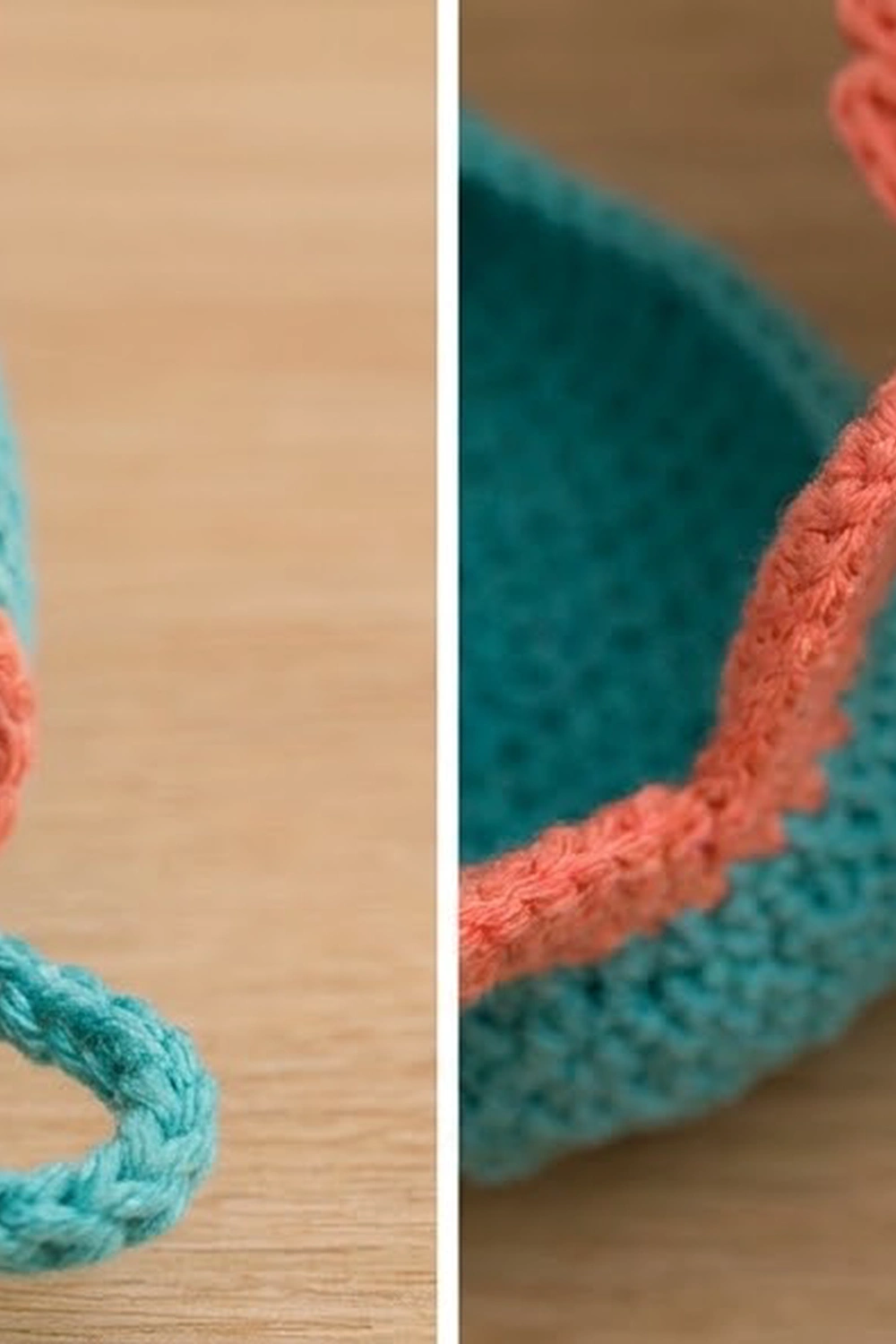
Body
Work in joined rnds with the right side facing. Place the joins at the center back.
Bottom Band (Coral)
Ch 32 and join with a sl st to form a ring, taking care not to twist the chain.
Rnd 1: Ch 1, sc in each ch around, join. (32 sc)
Rnds 2–3: Ch 1, sc in each st around, join. (32 sc)
Rnd 4: Ch 1, sc in next 3 sts, 2 sc in next st 8 times, join. (40 sc)
Rnd 5: Ch 1, sc in next 4 sts, 2 sc in next st 8 times, join. Fasten off coral. (48 sc)
Scale Section (Teal)
Rnd 6 (Base 1): Join teal. Ch 3 (counts as dc), dc in same st, sk 1 st, 2 dc in next st, sk 1 st 23 times, then join to top of ch-3. This is a conversion rnd: 24 dc pairs worked into every other st of the 48. (24 pairs = 48 dc)
Rnd 7 (Scale 1): Work a Scale on the 1st pair. Sl st between the 2 dc of the next pair. Scale on next pair, sl st between the 2 dc of next pair 11 times. (12 scales, 12 sl sts)
The scales should hang down over the coral band, with their rounded tips pointing toward the bottom opening.
Rnd 8 (Base 2): Sl st across to the top center of the first scale, between its 1st and 10th dc. Ch 3 (counts as dc), dc in same sp. 2 dc in next sl st, 2 dc in top center of next scale 11 times, 2 dc in last sl st, join. (24 pairs = 48 dc)
Each scale and each sl st now carries one pair, so the count stays at 24 pairs.
Rnd 9 (Scale 2): Sl st to the space before the 2nd pair. Scale on the 2nd pair, then sl st between the dc of the 3rd pair. Scale on next pair, sl st between the dc of next pair 11 times. The last sl st lands in the 1st pair. (12 scales)
The new scales sit between the scales of the rnd below, which gives the staggered fish-scale look.
Rnds 10–29: Repeat Rnds 8–9 ten more times. Every base rnd has 24 pairs (48 dc), and every scale rnd has 12 scales worked on the even-numbered pairs. That makes 12 base rnds and 12 scale rnds in total. (12 tiers)
Checkpoint: The scale section measures 9 in (22.9 cm), and the total height is 10.25 in (26.0 cm).
Head (Teal)
Rnd 30 (conversion): Sl st to the top center of the first scale. Ch 1, 2 sc there. 2 sc in next sl st, 2 sc in top center of next scale 11 times, 2 sc in last sl st, join. This rnd works 2 sc into each of the 24 pair positions. (24 x 2 = 48 sc)
Rnds 31–35: Ch 1, sc in each st around, join. (48 sc)
Rnd 36: Ch 1, sc in next 6 sts, sc2tog 6 times, join. (42 sc)
Rnd 37: Ch 1, sc in next 5 sts, sc2tog 6 times, join. (36 sc)
Rnd 38: Ch 1, sc in next 4 sts, sc2tog 6 times, join. Fasten off teal. (30 sc)
Mouth Rim (Coral)
Rnds 39–40: Join coral. Ch 1, sc in each st around, join. (30 sc)
Fasten off. The mouth opening is 8.6 in (21.8 cm) around and about 2.7 in (6.9 cm) across.
Eyes
Insert the safety eyes between Rnds 33 and 34 on the front, with 14 sts between them and centered opposite the join. Snap the washers on from inside. If the holder will be used around small children, embroider the eyes with black yarn instead.
Fins (Make 2, Coral)
Ch 10.
Row 1: Sl st in 2nd ch from hook, sc in next 2 ch, hdc in next 3 ch, dc in next 3 ch. (9 sts)
Row 2: Ch 3 (counts as dc), turn. Working in BLO, dc in next 2 sts, hdc in next 3 sts, sc in next 2 sts, sl st in last st. (9 sts)
Row 3: Ch 1 (does not count), turn. Working in BLO, sl st in first st, sc in next 2 sts, hdc in next 3 sts, dc in last 3 sts. (9 sts)
Rows 4–7: Repeat Rows 2–3 twice. (9 sts per row)
Edge: Ch 1, rotate the fin, and work 2 sc in each of the 7 row-ends along the dc edge. (14 sc)
Fasten off and leave a long tail for sewing. The BLO ridges fan out from the narrow sl st base to the wide outer edge. Each fin is about 2.75 in (7.0 cm) long and 3.5 in (8.9 cm) across the outer edge.
Tail Lobes (Make 2, Coral)
Ch 15.
Rnd 1: Work along the chain. Sc in 2nd ch from hook and next ch, hdc in next 3 ch, dc in next 6 ch, 2 dc in each of next 2 ch, 5 dc in last ch. Now work in the other side of the chain: 2 dc in each of next 2 ch, dc in next 6 ch, hdc in next 3 ch, sc in last 2 ch. Ch 2 for the tip and join to the first sc. (35 sts + ch-2 tip)
Side counts: 15 sts on the first side, 5 at the top and 15 on the second side.
Rnd 2 (trim): Ch 1, sc in each st around, working 2 sc in each of the 5 top dc, and work (sc, ch 2, sc) in the ch-2 tip. The count is 35 sc worked one per st, plus 5 extra at the top and 2 in the tip. (42 sc + ch-2 tip)
Fasten off and leave a long tail. Each lobe is about 4.5 in (11.4 cm) long and 1.75 in (4.4 cm) wide at the top, tapering to a point.
Hanging Loop (Teal)
Ch 36, or until the chain measures 10 in (25.4 cm). Sl st in the 2nd ch from hook and in each ch across. (35 sl sts) Fasten off and leave a long tail.
Assembly
- Flatten the body with the eyes centered on the front.
- Pin a fin to each side, with its base over Rnds 30–31 just below the head. Angle the wide edge downward and outward. Whipstitch the base in place.
- Pin a tail lobe to each side of the bottom band. Overlap the wide top of each lobe 1 in (2.5 cm) onto Rnds 1–4, with the points angled outward. Sew through the band only, so the bottom opening stays clear.
- Fold the loop in half and sew both ends side by side to the inside back of Rnds 39–40. The loop stands about 4.5 in (11.4 cm) above the mouth.
- Weave in all ends inside the tube.
Border
The border is one sl st rnd at each opening. It firms up the edge so pulling bags out doesn’t stretch the rim.
Border gauge: Work 1 sl st per st at the same 14 sts per 4 in (10.2 cm). Keep the sl sts loose so the edge doesn’t pucker.
Mouth border: Join coral in any st of Rnd 40. Sl st in each st around, join. (30 sl sts)
Bottom border: Turn the body upside down. Join coral in a free loop of the foundation chain and sl st in each free loop around, join. (32 sl sts)
Why the math works: Each border matches its rnd one to one, with 30 at the mouth and 32 at the bottom. Because no sts are added or removed, the openings keep their sizes of 8.6 in (21.8 cm) and 9.1 in (23.1 cm). The 48-st body divides evenly into 24 pairs and 12 scales. The decreases (6 x 3 rnds = 18 sts, from 48 to 30) and increases (8 x 2 rnds = 16 sts, from 32 to 48) close exactly. Each border adds about 1/8 in (0.3 cm), so the body goes from 13 in (33.0 cm) to 13.25 in (33.7 cm).
Final Blocking
- Stuff the body firmly with a rolled towel so it holds a round shape.
- Smooth each row of scales down with your fingers so the tips point toward the tail.
- Lay the fins and tail lobes flat on a towel and pin them to shape.
- Mist lightly with water, or steam from 1 in (2.5 cm) away. Never press acrylic.
- Let it dry completely, then remove the towel and pins.
- Check that the flat width is 6.9 in (17.5 cm) and the body length is 13.25 in (33.7 cm).
Final Quality-Control Checklist
- 12 scale tiers of 12 scales each, alternating cleanly
- Mouth rim 30 sts, bottom opening 32 sts
- Eyes level, 14 sts apart, washers locked
- Fins symmetrical and at the same height
- Tail lobes mirror each other, bottom opening clear
- Loop sewn securely through both rim rnds
- No loose ends visible outside
Troubleshooting
Scales flip up: You may have worked up the first post. Always start at the top of the first post and work down.
Scales line up in columns: In Rnds 9–29, work the scales on the even pairs, not the odd ones.
Tube twists: Keep the joins at center back and don’t turn between rnds.
Head puckers at Rnd 30: Make sure you work exactly 2 sc in each pair position, for 48 sc.
Bags fall out too easily: Work the bottom border with a smaller hook.
Fins flop: Sew along the full base and partway up the back edge.
Care
Hand wash in cool water with mild soap, reshape the scales and lay flat to dry. Avoid tumble drying.
Final Notes
The measurements build in a short chain you can check at each stage. A gauge of 14 sc = 4 in (10.2 cm) gives a 48-st body that is 13.7 in (34.8 cm) around, or 6.9 in (17.5 cm) flat. The coral band adds 1.25 in (3.2 cm), the 12 tiers add 9 in (22.9 cm), and the head brings the body to 13 in (33.0 cm). The borders finish it at 13.25 in (33.7 cm), and the tail extends the holder to about 16.75 in (42.5 cm). Measure at each checkpoint and your fish will come out true to size.
Happy crocheting!