

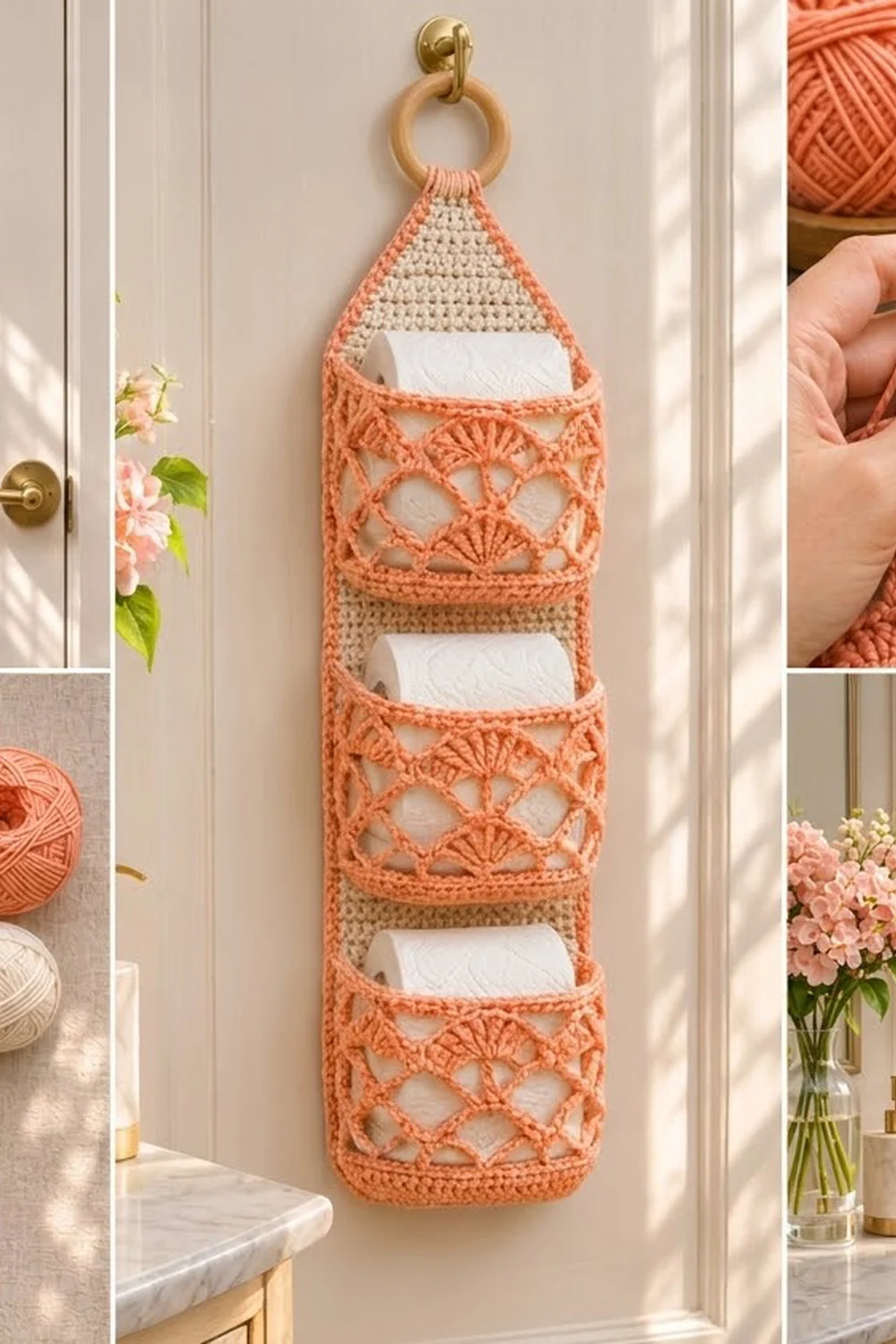
The Coral Shell Cascade holder is a tall wall organizer for the bathroom. It stores three spare toilet rolls in lacy coral pockets on a solid cream back panel. Bright coral fans against soft cream make it look fresh and a little vintage, and it hangs from a simple wooden ring on any door hook.
Each pocket has a solid oval base, then walls of offset fan shells and chain arches, and a firm single crochet rim. The panel behind is dense single crochet, so it keeps its shape and the lace stands out against it.
This pattern uses US crochet terms. The finished panel measures 6.5 in (16.5 cm) wide and 28.5 in (72.4 cm) long, not counting the ring and tab. Each pocket is about 6 in (15.2 cm) wide across the back and stands out about 3 in (7.6 cm) from the panel.
You make four pieces: one cream panel worked in rows, with a tapered top, and three coral pockets worked in the round from an oval base. You sew the pockets to the panel stitch to stitch, then add a coral border, the hanging tab and the ring.
Finished Size and Construction
- Finished size: 6.5 × 28.5 in (16.5 × 72.4 cm), plus the ring at the top
- Skill level: Intermediate
- Terminology: US crochet terms
- Yarn weight: Worsted (#4) cotton
- Hook: 5.0 mm (H-8)
- Number of pieces: 4 (1 back panel, 3 pockets)
- Layout: 3 pockets stacked vertically on 1 panel
- Pocket size: about 6 in (15.2 cm) wide at the back, 4 in (10.2 cm) wall height
- Panel size before border: 6 × 28 in (15.2 × 71.1 cm)
- Border depth: 0.25 in (0.6 cm) on each edge
Materials
Use a smooth worsted-weight cotton or cotton blend. Cotton holds its shape in a damp bathroom, and it shows the fan shells clearly. Avoid fuzzy yarns, because they blur the lace.
- Cream (panel): 70 g / about 120 m
- Coral (pockets, border, tab): 120 g / about 210 m
Tools:
- 5.0 mm (H-8) crochet hook
- 1 wooden ring, 3 in (7.6 cm) outer diameter
- Tapestry needle
- 6 locking stitch markers
- Scissors
- Rustproof pins and a blocking mat
Quantities include a margin of about 15 percent for your gauge swatch and tension differences.
Abbreviations (US Terms)
- ch – chain
- sl st – slip stitch
- sc – single crochet
- dc – double crochet
- sc2tog – single crochet 2 together
- BLO – back loop only
- sp – space
- st(s) – stitch(es)
Special stitch – Shell: 5 dc in the same stitch.
Special stitch – Fan: 7 dc in the same chain space. The 4th dc of a fan is its center dc.
Gauge and Checkpoints
Gauge: 16 sc and 18 rows = 4 in (10.2 cm) in sc rows with cream.
Make one pocket before you start the panel. It shows quickly whether your tension in the round matches your tension in rows.
Checkpoints:
- Pocket base after Round 7: about 5.5 × 3 in (14.0 × 7.6 cm), lying flat
- One shell repeat (6 sts): 1.5 in (3.8 cm)
- Pocket wall after Round 18: about 4 in (10.2 cm) tall, measured from the base fold
- Panel width: 6 in (15.2 cm) across 24 sts
- Panel after Row 108: 24 in (61.0 cm) long
If your pieces come out too big, try a hook one size smaller. If they come out too small, try a hook one size larger. Change hooks rather than stitch counts, because the border and joining math depends on these numbers.
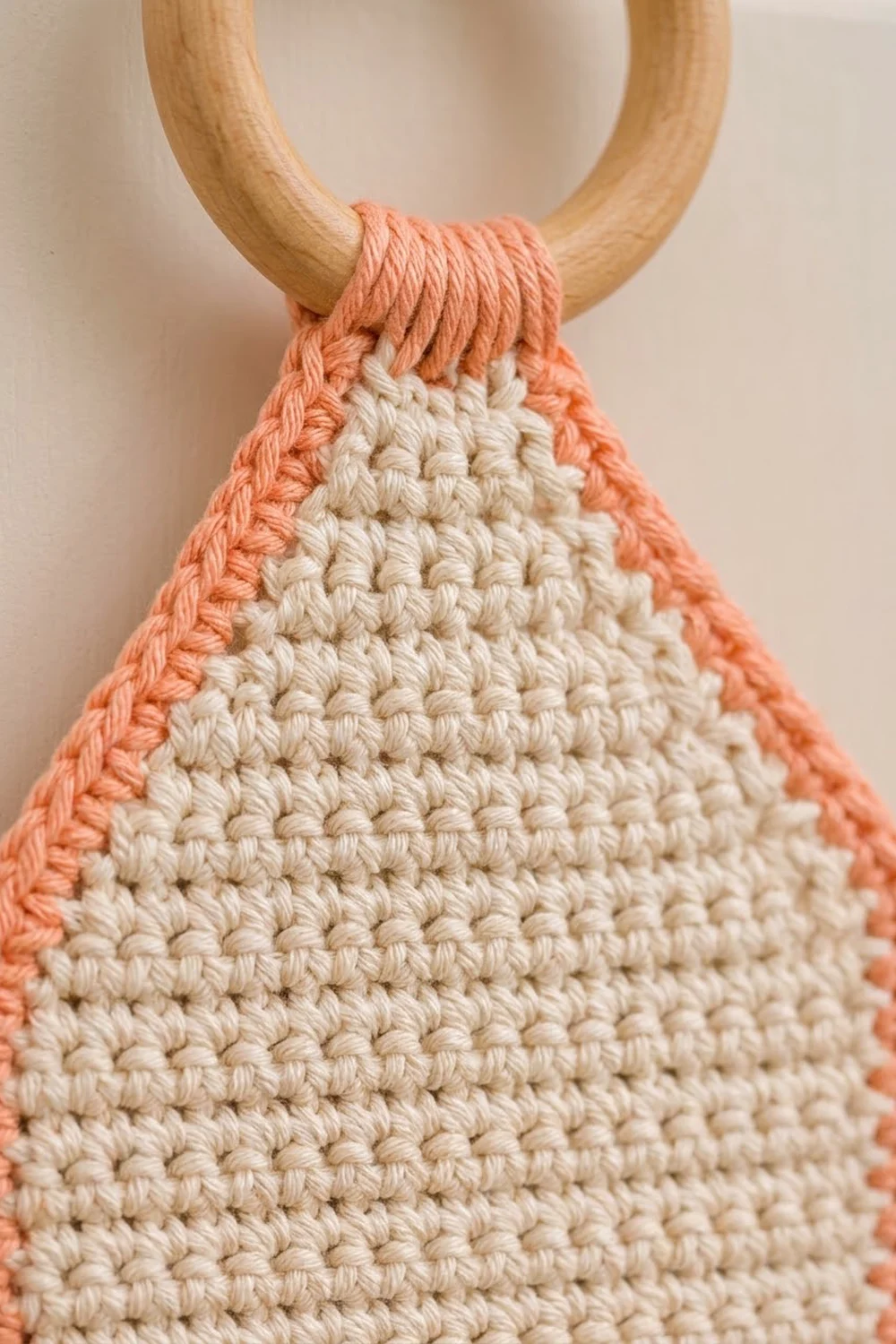
Back Panel (make 1, cream)
Foundation: Ch 25.
Row 1: Sc in the 2nd ch from the hook and in each ch across. Turn. (24 sc)
Rows 2–108: Ch 1, sc in each st across. Turn. (24 sc)
Checkpoint: the panel should be 6 × 24 in (15.2 × 61.0 cm).
Tapered Top
Row 109 (decrease): Ch 1, sc2tog, sc in each st to the last 2 sts, sc2tog. Turn. (22 sc)
Row 110: Ch 1, sc in each st across. Turn. (22 sc)
Rows 111–126: Repeat Rows 109–110 eight more times. Each decrease row ends with 2 fewer sts than the row before: 20, 18, 16, 14, 12, 10, 8, 6.
After Row 126 you have 6 sc. Fasten off.
The taper has 18 rows and loses 9 sts on each side. It adds 4 in (10.2 cm), so the panel before the border is 6 × 28 in (15.2 × 71.1 cm).
Pocket (make 3, coral)
Oval Base
Foundation: Ch 12.
Round 1: Work 3 sc in the 2nd ch from the hook, sc in the next 9 ch, and 3 sc in the last ch. Rotate the work and sc in the next 9 ch along the other side of the chain. Sl st to the first sc. (24 sc)
Round 2: Ch 1, 2 sc in each of the next 3 sts, sc in the next 9, 2 sc in each of the next 3, sc in the next 9. Join. (30 sc)
Round 3: Ch 1, [sc in next, 2 sc in next] 3 times, sc in the next 9, [sc in next, 2 sc in next] 3 times, sc in the next 9. Join. (36 sc)
Round 4: Ch 1, [sc in next 2, 2 sc in next] 3 times, sc in the next 9, repeat the bracket 3 times, sc in the next 9. Join. (42 sc)
Round 5: As Round 4, but with sc in the next 3 inside each bracket. (48 sc)
Round 6: As Round 4, but with sc in the next 4 inside each bracket. (54 sc)
Round 7: As Round 4, but with sc in the next 5 inside each bracket. (60 sc)
The base has two straight sides of 9 sts each and two curved ends of 21 sts each: 9 + 21 + 9 + 21 = 60.
Walls
Round 8: Ch 1, sc in the BLO of each st around. Join. (60 sc) The unworked front loops make a clean fold where the base turns up into the walls.
Round 9: Ch 1, sc in each st around. Join. (60 sc)
Round 10 (shells): Ch 1, sc in the first st, skip 2, shell in the next st, skip 2, sc in the next st. Repeat from * around, but leave out the final sc on the last repeat. Join to the first sc. (10 shells + 10 sc = 60 sts)
Round 11 (arches): Sl st in the next 3 dc to reach the center dc of the first shell. Ch 1, sc in the same st, ch 5, sc in the center dc of the next shell. Repeat from * around and end with ch 5. Join. (10 sc, 10 ch-5 sps)
Round 12 (fans): Sl st into the first ch-5 sp. Ch 3 (counts as dc), 6 dc in the same sp, sc in the next sc, fan in the next ch-5 sp, sc in the next sc. Repeat from * around. Join to the top of the ch-3. (70 dc + 10 sc = 80 sts)
The fans sit between the Round 10 shells, which gives the offset fish-scale pattern.
Round 13 (arches): Sl st in the next 3 dc to reach the center dc. Ch 1, sc in the same st, ch 5, sc in the center dc of the next fan. Repeat around and end with ch 5. Join. (10 sc, 10 ch-5 sps)
Round 14 (fans): Repeat Round 12. (80 sts)
Round 15 (trim): Sl st in the next 3 dc to reach the center dc. Ch 1, sc in the same st, ch 2, sc in the next sc, ch 2, sc in the center dc of the next fan, ch 2, sc in the next sc, ch 2. Repeat around. Join. (20 sc, 20 ch-2 sps)
Round 16 (conversion): Ch 1, sc in each sc and 2 sc in each ch-2 sp. Join. That is 20 sc worked one per existing sc, plus 40 sc worked into the 20 spaces: 20 + 40 = 60 sc.
Rounds 17–18: Ch 1, sc in each st around. Join. (60 sc)
Fasten off and leave a 30 in (76.2 cm) tail for sewing.
Checkpoint: the wall should be about 4 in (10.2 cm) tall, and the rim should have 60 sts, the same as the base.
Make All Pieces
- Cream: 1 back panel
- Coral: 3 pockets
Layout (front view, top to bottom):
      [ring]
       [tab]
      /     \
     / taper \
    |         |
    | POCKET 3|  rim at Row 98
    |         |
    | POCKET 2|  rim at Row 66
    |         |
    | POCKET 1|  rim at Row 34
    |         |
    |_________|
Joining
Lay the panel right side up with Row 1 at the bottom. Place markers on Rows 34, 66 and 98. These rows sit about 7.5 in (19.1 cm), 14.75 in (37.5 cm) and 21.75 in (55.2 cm) above the bottom edge. They are 32 rows apart, which spaces the pockets evenly.
Choose the back 24 rim stitches. On each pocket, find the middle of one straight 9-st side. Count 12 rim sts to the left of that point and 12 to the right, and mark both ends. Those 24 sts are the pocket back. The other 36 sts make the curved front, and that extra length is what lets the pocket bulge out around a roll.
Sew the rim. Line up the 24 back-rim sts with the 24 sts of the marked panel row, one to one. With the coral tail, whipstitch through both loops of each rim st and the matching panel st. Start with Pocket 1 at Row 34.
Tack the base. Let the pocket hang naturally. Its base fold should fall about 18 rows, or 4 in (10.2 cm), below the rim row. Whipstitch the 9 back straight-side sts of the base to the panel along that row.
Tension: Pull each stitch just snug enough to close the gap. If you pull too hard, the cream panel will pucker sideways.
Repeat for Pockets 2 and 3. Checkpoint: the panel should still lie flat and measure 6 in (15.2 cm) wide at every pocket.
Border (coral)
Border gauge: the same as the main gauge, 16 sc = 4 in (10.2 cm). Along the row edges, 8 sc for every 9 rows matches that gauge exactly.
Round 1: With the right side facing, join coral in the first foundation st at the bottom right corner. Work around the panel as follows:
- Bottom edge: 3 sc in the corner st, sc in the next 22 sts, 3 sc in the last st = 28 sc
- Left straight side: 8 sc over every 9 row ends across Rows 1–108 = 96 sc
- Left taper: 1 sc in each row end across Rows 109–126 = 18 sc
- Top edge: 3 sc in the first st, sc in the next 4, 3 sc in the last st = 10 sc
- Right taper: 18 sc
- Right straight side: 96 sc
Sl st to the first sc. Total: 266 sc.
Why the math works: the 108 straight rows divided by 9 give 12 groups, and 12 × 8 = 96 sc. That is the same as 24 in (61.0 cm) at 16 sc per 4 in. Each taper edge runs diagonally for about 4.6 in (11.7 cm), so 18 sc there lies flat. The corners each get 3 sc and are counted once, inside their own side.
Hanging tab: With coral, join in the 3rd sc of the 10-sc top edge. Ch 1, sc in the same st and the next 5 (6 sc). Work 8 rows of 6 sc. The tab is 1.5 × 1.75 in (3.8 × 4.4 cm). Pass it through the ring, fold it to the back, and whipstitch the last row to the back of the panel.
The finished panel is 6.5 × 28.5 in (16.5 × 72.4 cm).
Final Blocking
- Weave in all ends along the stitches of matching color.
- Spray the whole piece lightly with water until it is damp.
- Pin the panel to 6.5 × 28.5 in (16.5 × 72.4 cm), keeping the edges straight.
- Stuff each pocket with a toilet roll or a rolled towel to round it out.
- Pin the fan points slightly upward so the shells open.
- Let it dry completely, then unpin it.
Final Quality-Control Checklist
- The panel has 24 sts across and 126 rows.
- Each pocket rim has 60 sts.
- Each pocket has 24 back-rim sts joined one to one with the panel.
- The border has 266 sc with 3 sc at each of the 4 corners.
- The pockets are 32 rows apart.
- The ring tab is sewn securely.
- No ends show through the lace.
Troubleshooting
- Base is cupping: your tension is tight, so go up one hook size.
- Base is ruffling: check that each increase bracket ends with exactly 21 sts on each curved end.
- Fans lean to one side: you probably missed the center dc. Count 3 sl sts before each arch round.
- Border is waving: you worked 1 sc per row on the straight sides. Go back to 8 sc per 9 rows.
- Pocket is too tight for a roll: block it over a roll while damp. Cotton relaxes a little.
Care
Hand wash in cool water, press out the water in a towel, and dry flat. Don’t put it in the tumble dryer, because it can shrink the cotton panel.
Final Notes
The measurements all build on one another. A 16-sc gauge gives a 6 in (15.2 cm) panel and 28 in (71.1 cm) of rows. The pocket bases grow to 60 sts, and the walls keep that count back to a 60-st rim. The 24 back-rim sts match the panel’s 24 sts exactly, and the 266-sc border brings the panel to 6.5 × 28.5 in (16.5 × 72.4 cm). If you check each stage as you go, the holder will hang straight and hold three rolls neatly.
Happy crocheting!