
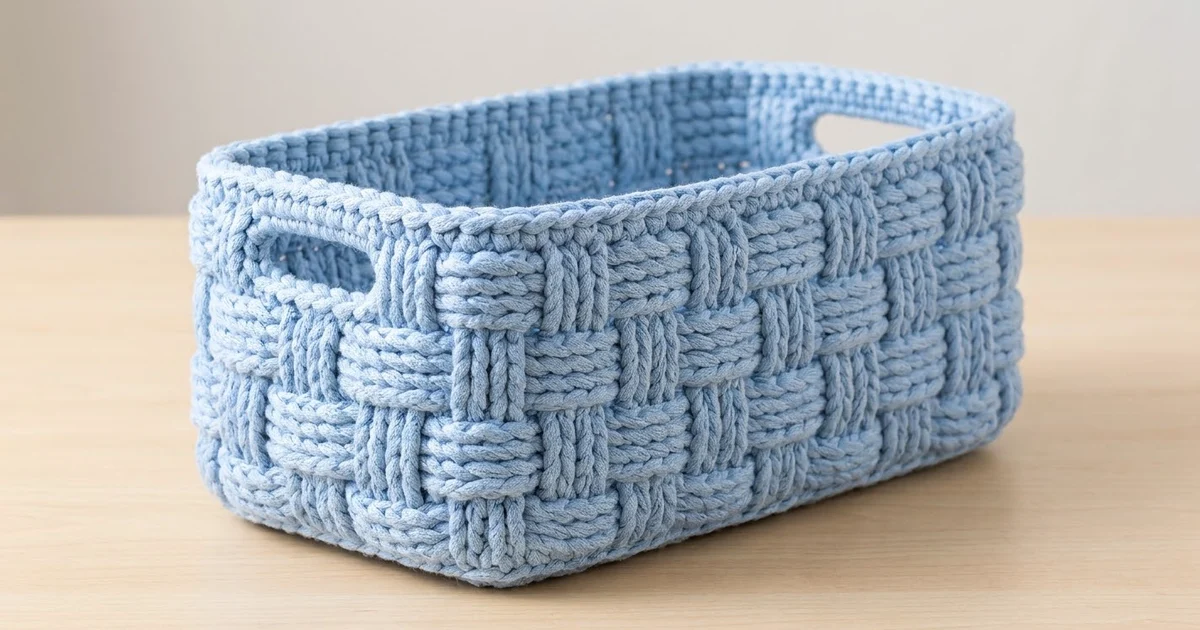
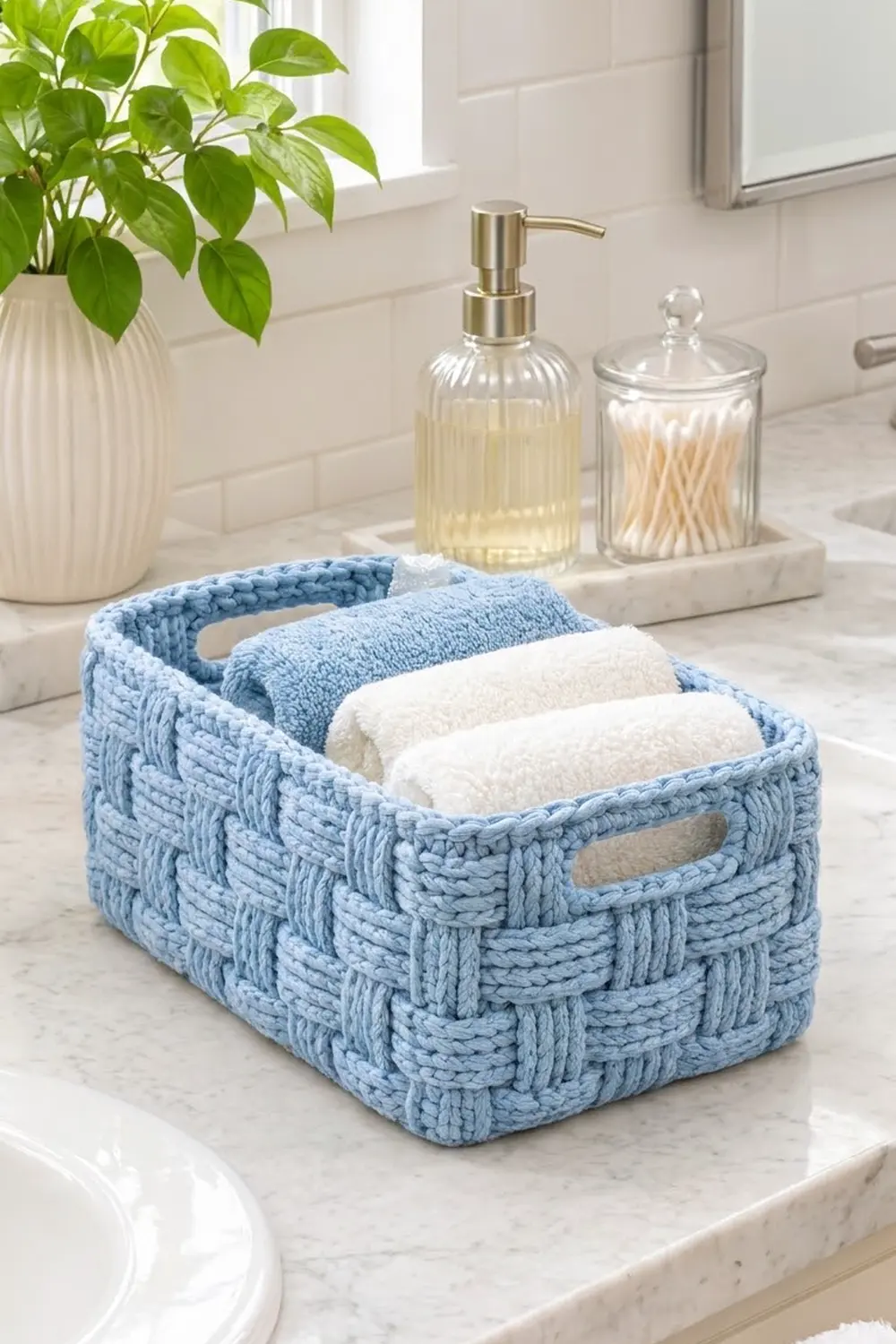
This sturdy rectangular basket brings a calm, tailored look to any shelf or vanity. The walls are a deep basketweave texture of raised vertical columns and horizontal bars, and the solid single crochet base keeps the basket flat and firm. It is the right size for rolled hand towels, washcloths, toiletries or craft supplies.
The sample is worked in one soft light blue, which gives the woven texture a clean, coastal feel. Any solid or lightly heathered color works well. Variegated yarns tend to hide the weave, so save those for another project.
This pattern uses US crochet terms. The finished basket measures about 12.5 in (31.8 cm) long, 6.5 in (16.5 cm) wide and 6 in (15.2 cm) tall.
You make the basket as one piece. You crochet a rectangular base in rows and edge it with one round, then turn the walls up in a back-loop round. The walls are worked in joined rounds of front and back post double crochet. The rim is a short band of single crochet with a handle slot in each short end, finished with reverse single crochet. There is no sewing, apart from weaving in the ends.
Finished Size and Construction
- Finished size: 12.5 in (31.8 cm) long x 6.5 in (16.5 cm) wide x 6 in (15.2 cm) tall
- Skill level: Intermediate (post stitches, working in rounds)
- Terminology: US crochet terms
- Yarn weight: Bulky (#5)
- Hook: 6.0 mm (US J-10)
- Number of pieces: 1
- Layout: Single rectangular basket worked in joined rounds, right side always facing
- Base size: 12 x 6 in (30.5 x 15.2 cm) before the edging round, 12.5 x 6.5 in (31.8 x 16.5 cm) after it
- Size before rim: 12.5 x 6.5 in (31.8 x 16.5 cm) footprint, walls 5.25 in (13.3 cm) tall
- Rim depth: about 1 in (2.5 cm), handle slots included
Materials
Yarn: Use a bulky (#5) cotton or cotton blend with good stitch definition, about 110 m per 100 g. Cotton holds the basket’s shape far better than soft acrylic. A smooth, tightly plied yarn gives the post stitches crisp edges.
- Light blue: about 370 g (about 400 m / 437 yd)
The yarn amount includes a safety margin of roughly 15%, which covers gauge differences and a test swatch. Post stitches use noticeably more yarn than plain stitches, so don’t cut the margin short.
Tools:
- 6.0 mm (US J-10) crochet hook
- 4 locking stitch markers
- Tapestry needle
- Scissors
- Measuring tape
- Spray bottle and a box or stack of books about 12 x 6 in (30.5 x 15.2 cm) for blocking
- Optional: plastic canvas cut to 12 x 6 in (30.5 x 15.2 cm) for a stiffer floor
Abbreviations (US Terms)
- ch – chain
- sl st – slip stitch
- sc – single crochet
- dc – double crochet
- BLO – back loop only
- FPdc – front post double crochet
- BPdc – back post double crochet
- rev sc – reverse single crochet (crab stitch)
- st(s) – stitch(es)
- sp – space
- rep – repeat
Special stitches:
- FPdc: Yarn over and insert the hook from front to back to front around the post of the stitch below. Yarn over, pull up a loop, then (yarn over, pull through 2 loops) twice.
- BPdc: Yarn over and insert the hook from back to front to back around the post of the stitch below. Finish like a regular dc.
- Rev sc: Work single crochet from left to right (right-handed), inserting the hook into the next stitch to the right.
Gauge and Checkpoints
Before you start the basket, make one small test piece. Chain 13 and work 14 rows of sc on 12 sts. If you want to check the post-stitch gauge too, add one dc row and six rows of the basketweave.
- Sc gauge: 12 sc x 14 rows = 4 in (10.2 cm)
- Post-stitch gauge: 12 sts x 8 rounds = 4 in (10.2 cm) in basketweave
- One basketweave block: 4 sts x 3 rounds = about 1.33 in (3.4 cm) wide x 1.5 in (3.8 cm) tall
Checkpoints:
- After base Row 21: 12 x 6 in (30.5 x 15.2 cm)
- After base Rnd 1: 12.5 x 6.5 in (31.8 x 16.5 cm), circumference 112 sts = about 37 1/3 in (94.8 cm)
- After Rnd 3: walls about 0.75 in (1.9 cm) tall
- After Rnd 6: walls about 2.25 in (5.7 cm) tall
- After Rnd 12: walls about 5.25 in (13.3 cm) tall
- After Rnd 16: walls about 6 in (15.2 cm) tall
If your swatch has more than 12 sts per 4 in (10.2 cm), your basket will come out small, so go up half a hook size. If it has fewer, your basket will come out large, so go down half a size. Match the stitch gauge first; the row gauge matters less.
Base
The base is worked in rows. After that, the whole basket is worked in joined rounds with the right side facing out.
Row 1: Ch 37. Sc in the 2nd ch from the hook and in each ch across. (36 sc)
Rows 2–21: Ch 1, turn. Sc in each st across. (36 sc)
Checkpoint: the base measures 12 x 6 in (30.5 x 15.2 cm).
Base Rnd 1 (edging, conversion round): Do not turn. Ch 1 and rotate the piece to work down the short side.
- Short side A: Working into the row ends, sc in the next 6 row ends, skip 1 row end. Rep from * 2 more times. (18 sc across 21 row ends)
- Long side 1: Working into the free loops of the foundation chain, work 2 sc in the first ch for the corner, sc in the next 34 ch, then 2 sc in the last ch for the corner. (38 sc)
- Short side B: Rep the short side A sequence. (18 sc)
- Long side 2: Working across Row 21, work 2 sc in the first st, sc in the next 34 sts, then 2 sc in the last st. (38 sc)
Join with a sl st to the first sc. Count: 108 sc worked 1 per existing stitch or row-end position, + 4 extra sc from the doubled corners = 112 sc.
Each long-side count of 38 already includes its 2 doubled corner stitches at each end. The short sides hold no corner stitches. Place a marker in the first st of short side A. This stitch is st 1, and short side A is sts 1–18. Put the other three markers at sts 19, 57 and 75 to mark the start of each side.
Checkpoint: 12.5 x 6.5 in (31.8 x 16.5 cm), with softly rounded corners.
Walls
All wall rounds start with ch 1 for sc rounds or ch 2 for dc and post rounds. The turning chain does not count as a stitch. Each round ends with a sl st to the first stitch. Do not turn.
Rnd 2 (turning ridge): Ch 1, sc BLO in each st around. (112 sc)
The unused front loops form a neat ridge along the floor edge, and the walls begin to rise from here.
Rnd 3: Ch 2, dc in each st around. (112 dc)
Checkpoint: walls about 0.75 in (1.9 cm) tall.
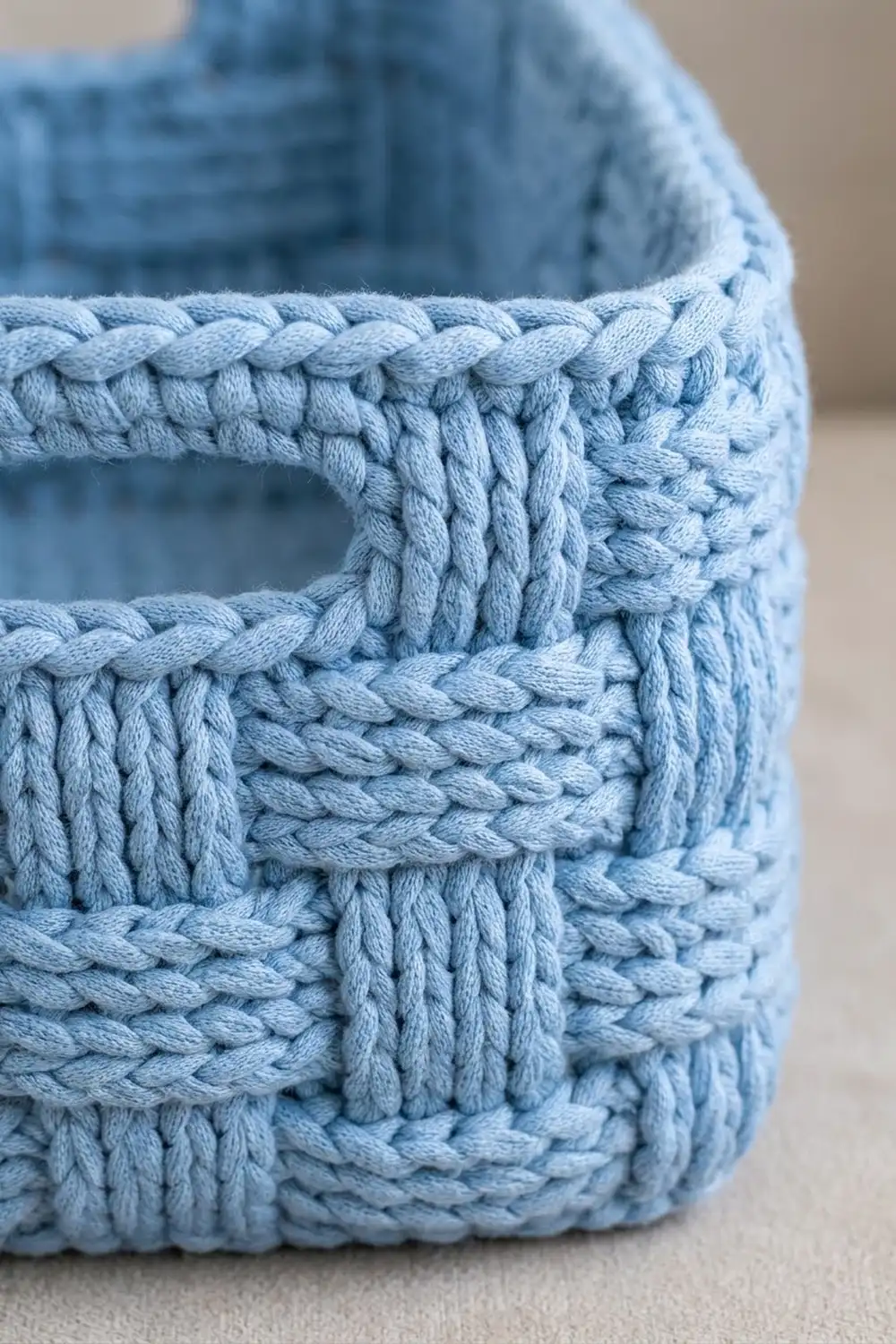
Rnds 4–6: Ch 2, FPdc around each of the next 4 sts, BPdc around each of the next 4 sts. Rep from * around. (112 sts: 56 FPdc + 56 BPdc in 14 repeats)
On the outside, the FPdc blocks show as vertical columns and the BPdc blocks show as horizontal bars.
Checkpoint after Rnd 6: walls about 2.25 in (5.7 cm) tall.
Rnds 7–9: Ch 2, BPdc around each of the next 4 sts, FPdc around each of the next 4 sts. Rep from * around. (112 sts)
The blocks now swap, which creates the woven look.
Rnds 10–12: Rep Rnds 4–6. (112 sts)
Checkpoint: walls about 5.25 in (13.3 cm) tall, with three tiers of blocks.
Post-stitch tip: Pull up each loop to the height of a normal dc before you finish the stitch. If you work the posts short, the walls get shorter and stiffer, and the blocks lose their square shape. Count each round in groups of 8. It is much easier to catch a mistake within one repeat than at the end of the round.
Rim and Handle Slots
The rim works as the border of this basket. It adds about 1 in (2.5 cm) of height and holds the two handle openings.
Rim gauge: 12 sc = 4 in (10.2 cm), with one round about 0.3 in (0.8 cm) tall.
Rnd 13: Ch 1, sc in each st around. (112 sc: short sides 18 each, long sides 38 each)
Rnd 14 (handle round): Ch 1.
- Short side A: Sc in the next 5 sts, ch 8, skip the next 8 sts (sts 6–13), sc in the next 5 sts. (10 sc + ch-8)
- Long side 1: Sc in the next 38 sts. (38 sc)
- Short side B: Sc in the next 5 sts, ch 8, skip the next 8 sts (sts 62–69), sc in the next 5 sts. (10 sc + ch-8)
- Long side 2: Sc in the next 38 sts. (38 sc)
Join. Count: 96 sc + 2 ch-8 sps. That is 112 positions: 5 + 8 + 48 + 8 + 43, counted from st 1.
Each slot is about 2 2/3 in (6.8 cm) wide, centered on its short end.
Rnd 15 (conversion round): Ch 1, sc in each sc around, and work 8 sc into each ch-8 sp. Count: 96 sc worked 1 per existing sc + 16 sc in the spaces = 112 sc.
Working into the space, rather than into the chains, wraps the opening for a rounded, sturdy handle edge.
Rnd 16: Ch 1, rev sc in each st around. (112 rev sc: short sides 18 each, long sides 38 each) Join and fasten off.
Why the math works: 112 is a multiple of 8, so the 4 + 4 basketweave repeat closes perfectly every round, with 14 repeats and no partial blocks at the seam. The count never changes from the base edging to the rim. Because of that, the walls rise straight and the rim fits the base exactly. Each short side keeps its 18 sts: 5 + 8 + 5 for the handle, 5 + 8 + 5 again after Rnd 15, and 18 rev sc to finish.
Final Blocking
- Weave in all ends on the inside, following the post stitches so they stay hidden.
- Mist the whole basket with water until it is damp but not soaked.
- Slip it over a box or stack of books about 12 x 6 in (30.5 x 15.2 cm), upside down.
- Square the corners and press the floor flat with your palms.
- Pull the walls gently downward so the block columns stand vertical.
- Shape each handle slot with your fingers into a smooth oval.
- Let it dry completely, usually 24 hours, before removing the form.
- If you like, place the plastic canvas insert on the floor.
Final Quality-Control Checklist
- The base lies flat and measures 12.5 x 6.5 in (31.8 x 16.5 cm).
- Every round from Base Rnd 1 to Rnd 16 holds 112 sts.
- There are 14 complete blocks per round, and they swap at Rnds 7 and 10.
- The walls stand about 6 in (15.2 cm) tall without slumping.
- Both handle slots are centered and the same size.
- The rev sc rim is even, with no gaps.
- The round-start seam sits at one short-side corner.
- All ends are woven in securely on the inside.
Troubleshooting
The walls flare outward: Your post stitches are too loose. Go down half a hook size for Rnds 4–12.
The walls lean inward: You are pulling post stitches too tight. Relax your tension, or go up half a hook size for the walls only.
The blocks are off by a stitch: Recount 112. A missed stitch at the join is the usual cause.
The base ruffles: You worked too many row-end sc. Keep to 18 per short side.
The base cups: You skipped too many row ends or forgot the corner increases.
The handle is tight on fingers: Work ch 9 and skip 9 instead. Then sc in 4 on one side of the slot and keep the totals at 18 per short side.
The seam jogs: Always join to the first true stitch, never to the turning chain.
The walls feel floppy: Use a cotton yarn, check your gauge, and add the plastic canvas insert to support the floor.
Care
Hand wash in cool water and lay the basket flat or over its blocking form to dry. Avoid the dryer, which can soften the walls and distort the weave.
Final Notes
Here is the measurement chain in one place:
- Gauge: 12 sts = 4 in (10.2 cm)
- Base: 36 sts x 21 rows = 12 x 6 in (30.5 x 15.2 cm)
- Edging: 112 sts gives 12.5 x 6.5 in (31.8 x 16.5 cm)
- Walls: 112 sts in 9 basketweave rounds rise to 5.25 in (13.3 cm)
- Rim: four rounds of 112 sts finish the basket at 6 in (15.2 cm) tall
Check your measurements at each stage and the basket will come out square, firm and ready to fill.
Happy crocheting!