

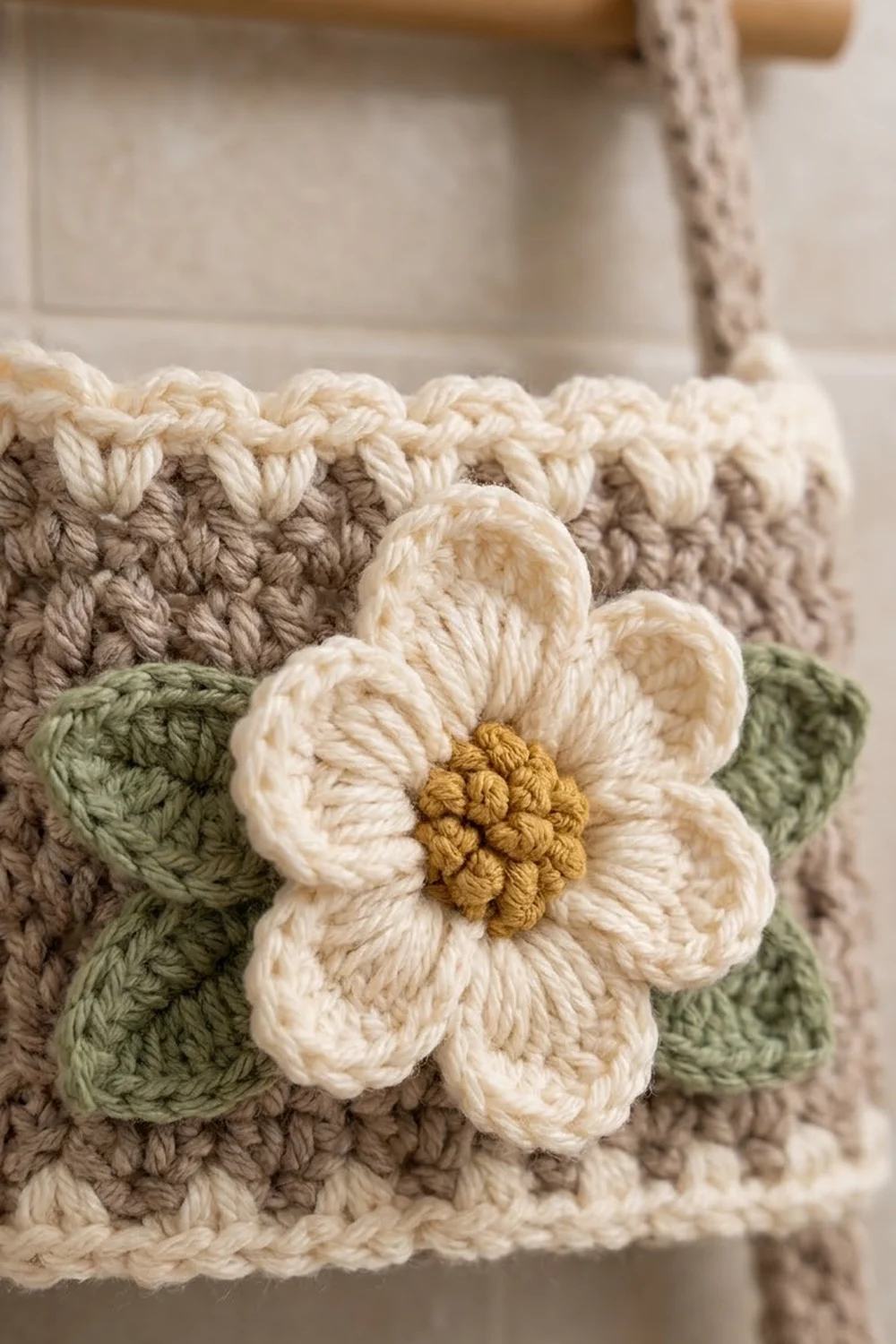
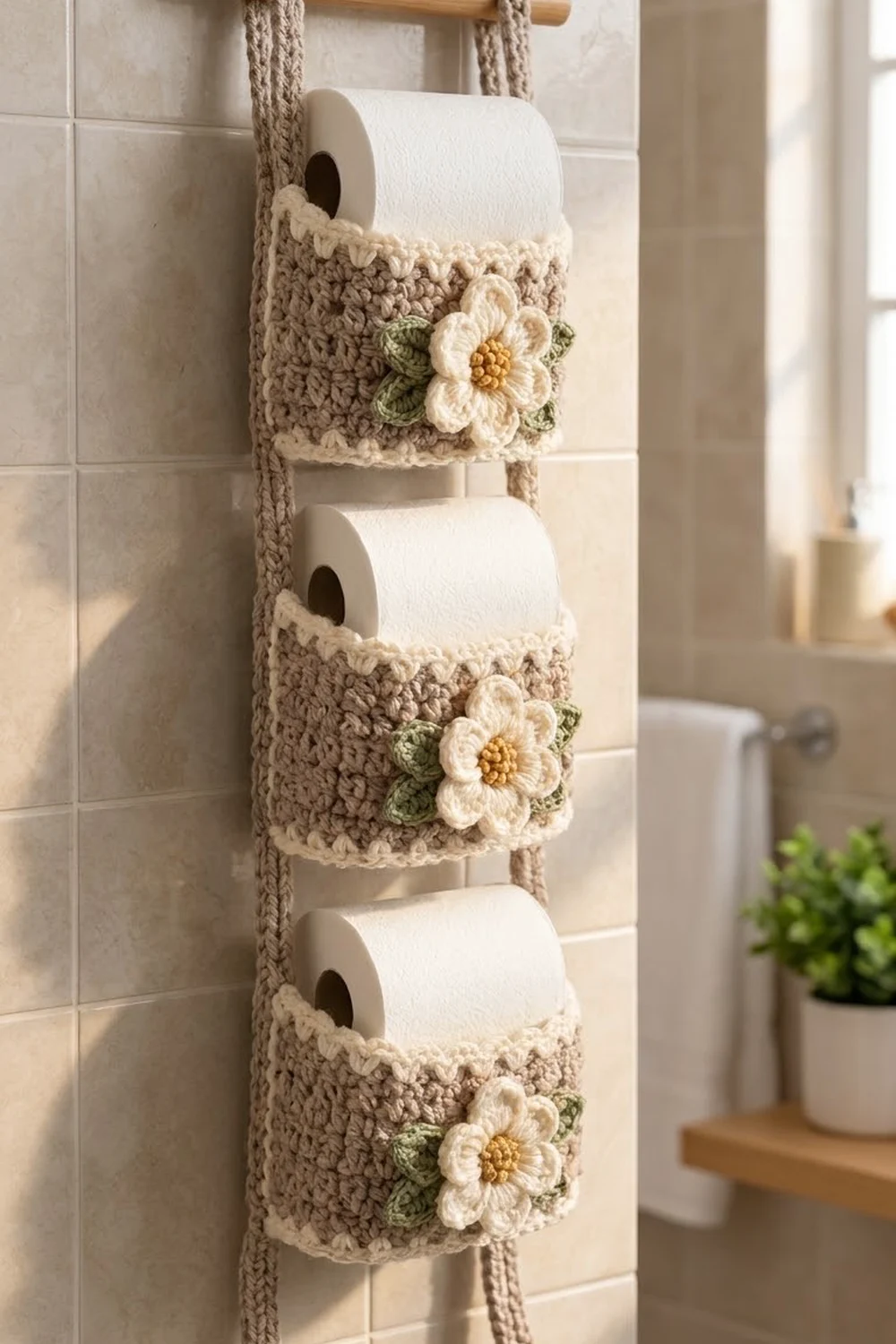
The Cottage Bloom holder keeps three spare rolls within easy reach. Three open-top box pockets hang one above the other on two slim straps. Each pocket has a cream flower with a golden center and two green leaves.
The colors are calm and natural. Warm taupe is used for the pockets and straps, cream for the trim and petals, mustard for the flower centers, and sage green for the leaves. The pockets use a crunchy suzette texture that holds its shape, and a cream spike-stitch trim finishes each top edge.
This pattern uses US crochet terms. The finished holder is about 6 in (15.2 cm) wide and 22.5 in (57.2 cm) long, including the hanging loops. Each pocket is 5 in (12.7 cm) wide, 4.4 in (11.2 cm) deep, and 3.9 in (9.9 cm) tall.
The construction is simple:
1. Crochet a flat base for each pocket.
2. Work the walls in joined rounds to turn the base into a box.
3. Make two separate straps and sew the pockets between them.
4. Add the top trim and the flower appliqués.
Finished Size and Construction
- Finished size: 6 in (15.2 cm) wide x 22.5 in (57.2 cm) long
- Skill level: Easy-intermediate
- Terminology: US terms
- Yarn weight: Worsted (#4), cotton or cotton blend
- Hooks: 4.5 mm (US 7) for pockets and straps; 4.0 mm (US G-6) for flowers and leaves
- Number of pieces: 14 (3 pockets, 2 straps, 3 flowers, 6 leaves)
- Layout: 1 column of 3 pockets, with pocket bases 5.5 in (14.0 cm) apart
- Pocket size: 5 in (12.7 cm) wide x 4.4 in (11.2 cm) deep x 3.9 in (9.9 cm) tall
- Pocket height before border: 3.4 in (8.6 cm)
- Border depth: 0.5 in (1.3 cm)
Materials
Choose a firm worsted cotton or cotton blend. Cotton keeps the pocket walls upright and holds up better in a humid bathroom than soft acrylic.
- Taupe (pockets, straps): 220 g / 375 m
- Cream (trim, petals, corner lines): 55 g / 95 m
- Mustard (flower centers): 10 g / 15 m
- Sage green (leaves): 10 g / 15 m
All quantities include a margin of about 10-15% for swatching and yarn tails.
Tools:
- 4.5 mm (US 7) and 4.0 mm (US G-6) hooks
- Tapestry needle
- 6 locking stitch markers
- Scissors and a tape measure
- Rust-proof pins and a blocking mat
- Wooden dowel, 8 in (20.3 cm) long and 0.75 in (1.9 cm) thick
Abbreviations (US Terms)
- ch – chain
- sl st – slip stitch
- sc – single crochet
- hdc – half double crochet
- dc – double crochet
- tr – treble crochet
- rev sc – reverse single crochet (crab stitch)
- BLO / FLO – back loop only / front loop only
- MR – magic ring
- sk – skip
- sp – space
- st(s) – stitch(es)
- rnd – round
Suzette pair: (sc, dc) worked in the same stitch. One pair counts as 2 sts.
Spike sc: Insert the hook into the stitch one round below the next stitch. Pull up a long loop to the height of the current round, yarn over, and pull through both loops. Skip the stitch hidden behind the spike.
Gauge and Checkpoints
Gauge with the 4.5 mm hook:
- Sc: 16 sts and 18 rows = 4 in (10.2 cm)
- Suzette pattern: 16 sts and 14 rnds = 4 in (10.2 cm)
Make one complete pocket first. Slide a roll inside and measure it before you start the other two.
Checkpoints:
- Base after Row 20: 5 in (12.7 cm) x 4.4 in (11.2 cm)
- After Rnd 2: wall circumference about 19 in (48.3 cm)
- After Rnd 8: wall height about 2 in (5.1 cm) above the cream base ridge
- After Rnd 13: wall height 3.4 in (8.6 cm)
- After the border: wall height 3.9 in (9.9 cm)
If the pocket is too big, go down 0.5 mm. If it is too small or the roll won’t fit, go up 0.5 mm. Always change hooks for the whole pocket, never partway through.
Pocket (Make 3)
Use the 4.5 mm hook. Start every joined round at the back-left corner so the seam is hidden against the wall.
Base
With taupe, ch 21.
Row 1: Sc in 2nd ch from hook and in each ch across, turn. (20 sc)
Rows 2-20: Ch 1, sc in each st across, turn. (20 sc)
Fasten off. The base measures 5 in (12.7 cm) x 4.4 in (11.2 cm).
Base Edge
Rnd 1 (cream): Join cream in the first st of Row 20.
– Ch 1, then sc in each of the 20 sts across Row 20.
– Work 18 sc evenly down the row ends, skipping 2 row ends spaced well apart.
– Sc in each of the 20 foundation chains.
– Work 18 sc evenly up the other row ends.
– Join with a sl st to the first sc. (76 sc: 20 + 18 + 20 + 18)
This pattern has no separate corner stitches. Each corner falls between the last stitch of one side and the first stitch of the next. This keeps the corners square and lets the walls rise straight up.
Walls
Rnd 2 (cream): Ch 1, sc in BLO of each st around, join. (76 sc)
This round folds the walls upward and leaves a crisp cream ridge along the bottom edge. Fasten off cream.
Rnd 3 (taupe): Join taupe in the first st. Ch 1, suzette pair in the same st, sk next st, suzette pair in next st, sk next st; repeat from * around, join with a sl st to the first sc. (38 pairs = 76 sts)
Rnds 4-13: Ch 1, suzette pair in the first sc, sk the dc, suzette pair in the next sc, sk the dc; repeat around, join. (38 pairs = 76 sts each round)
Each side holds a whole number of pairs: 10 on the front, 9 on each side, and 10 on the back. This lines the texture up neatly at every corner. Fasten off taupe.
Flower (Make 3)
Use the 4.0 mm hook.
Rnd 1 (mustard): MR, ch 1, 10 sc in ring, join. (10 sc)
Rnd 2 (mustard, FLO): Sl st in FLO of next st, ch 3, sl st in same st; repeat around. (10 picot nubs) Fasten off.
These nubs form the knobbly golden center.
Rnd 3 (cream, BLO of Rnd 1): Join cream in any back loop of Rnd 1. Sc in BLO of next st, ch 4, sk next st; repeat 5 times, join. (5 sc, 5 ch-4 sps)
Rnd 4 (cream): In each ch-4 sp work (sc, hdc, 2 dc, 2 tr, 2 dc, hdc, sc), then sl st in the next sc. (5 petals of 10 sts = 50 sts)
Fasten off, leaving a 12 in (30.5 cm) tail for sewing. The flower is about 2.75 in (7.0 cm) across, with a 1 in (2.5 cm) center.
Leaf (Make 6)
With sage green and the 4.0 mm hook, ch 8.
Rnd 1: Work into the 7 chains as follows: sc in 2nd ch from hook, hdc in next ch, dc in next 2 ch, hdc in next ch, sc in next ch, (sc, ch 2, sc) in last ch. Turn the leaf and work along the other side of the chain: sc in next ch, hdc in next ch, dc in next 2 ch, hdc in next ch, sc in next ch, sl st in first sc. (14 sts plus a ch-2 tip)
Fasten off, leaving a sewing tail. Each leaf is about 1.75 in (4.4 cm) long.
Strap (Make 2)
With taupe and the 4.5 mm hook, ch 97.
Row 1: Sc in 2nd ch from hook and in each ch across, turn. (96 sc)
Row 2: Ch 1, sl st in each st across. (96 sl st)
Fasten off. Each strap is 24 in (61.0 cm) long and about 0.5 in (1.3 cm) wide. At 4 sts per inch, each stitch is 0.25 in (0.6 cm), which makes counting the placement easy.
Make All Pieces
- Taupe: 3 pocket bases and walls, 2 straps
- Cream: 3 base edges, 3 sets of corner lines and border rounds, 3 petal rounds
- Mustard: 3 flower centers
- Sage green: 6 leaves
Layout (front view, top to bottom):
 [loop]                       [loop]
 strap |  Pocket 1 + flower  | strap
 strap |        gap          | strap
 strap |  Pocket 2 + flower  | strap
 strap |        gap          | strap
 strap |  Pocket 3 + flower  | strap
 [tail]                       [tail]
Joining
Step 1: Mark the Straps
Count from the bottom end of each strap and place markers at:
– stitch 12, 3 in (7.6 cm)
– stitch 34, 8.5 in (21.6 cm)
– stitch 56, 14 in (35.6 cm)
Each marker shows where a pocket base sits. Each pocket base is 22 sts, or 5.5 in (14.0 cm), above the one below it.
Step 2: Sew the Pockets
Lay a strap beside the back-left corner of Pocket 3, with the strap’s flat face level with the back wall. Line up the cream base ridge with the marker at stitch 12.
Whipstitch the strap’s inner edge to the corner, making about 4 stitches per inch. Sew from the base ridge to the top of Rnd 13 only. This covers 3.4 in (8.6 cm), about 14 strap sts, and leaves the top 0.5 in (1.3 cm) free for the border.
Repeat on the back-right corner with the second strap. Then join Pocket 2 at stitch 34 and Pocket 1 at stitch 56.
Tension: Pull each whipstitch just snug. Sewing too tightly puckers and shortens the strap, which moves the pockets closer together.
Each gap between pockets is 1.6 in (4.1 cm). The top of Pocket 1 sits 17.9 in (45.5 cm) above the strap ends, which leaves 3.1 in (7.9 cm) of strap below the loop.
Step 3: Form the Loops
Fold the top 3 in (7.6 cm) of each strap toward the back. Sew the end down to make a loop about 1.5 in (3.8 cm) deep. Thread the dowel through both loops.
Size checkpoint: The holder should measure 6 in (15.2 cm) wide and 22.5 in (57.2 cm) from the top of the loops to the strap ends.
Border
Border gauge: 16 sc = 4 in (10.2 cm) in cream.
Border each pocket separately. The pockets are not joined side by side, so each border starts with that pocket’s own 76 sts: 20 on the front, 18 on the left side, 20 on the back, and 18 on the right side. Don’t add stitches at the corners or at the strap seams.
Border Rnd 1 (cream): Join cream at the back-left corner. Ch 1, sc in next st, spike sc into the next st one round below; repeat around, join. (76 sts = 38 sc + 38 spike sc; 0 added)
Per side, that is 20 on the front (10 + 10), 18 on each side (9 + 9), and 20 on the back (10 + 10). The cream spikes dip over the taupe to make the toothed band.
Border Rnd 2 (cream): Ch 1, rev sc in each st around, join. (76 sts = 76 rev sc; 0 added)
Fasten off and weave in the ends. The border adds 0.5 in (1.3 cm), so the pocket grows from 3.4 in (8.6 cm) to 3.9 in (9.9 cm) tall.
Why the math works: Every side has an even stitch count, so the sc and spike repeat starts and ends cleanly at each corner. The border keeps the same 76 sts as the walls, so the top edge doesn’t ruffle or pull in.
Front corner lines: With cream, work a surface sl st up each front corner, from the base ridge to the border. This sharpens the box shape.
Attach the Flowers
Center a flower on each pocket front, 0.25 in (0.6 cm) below the border. Tuck one leaf behind the left petals and one behind the right petals, angled slightly downward. Sew the leaves on first, then the flower. Stitch through the petal bases only so the petal edges stay lifted.
Final Blocking
- Lightly mist each pocket with water.
- Slide a roll, or a box of the same size, into each pocket.
- Square the corners with your fingers.
- Pin the straps flat and straight on the mat.
- Press each flower’s petals outward and pin the leaf tips.
- Let everything dry completely, about 12 hours, before hanging.
Final Quality-Control Checklist
- Every wall round of each pocket has 76 sts.
- Each base measures 5 in (12.7 cm) x 4.4 in (11.2 cm).
- Each pocket is 3.9 in (9.9 cm) tall after the border.
- All round seams sit at the back-left corner.
- The pocket bases are 5.5 in (14.0 cm) apart.
- Both straps are the same length, and the loops match.
- The flowers are centered, and the leaves are level.
- All ends are woven in securely.
Troubleshooting
- Walls lean outward: Rnd 2 wasn’t worked in BLO, or the tension was loose. Redo Rnd 2 firmly.
- The roll is too tight: Go up 0.5 mm, or add 1 row to the base and 2 sts to each side edge so the counts stay even.
- Corners look rounded: Add the cream corner lines and block the pocket over a roll.
- Stitch count drifts in suzette rounds: Make sure every pair goes into a sc, never into a dc.
- A pocket tilts forward: Sew the strap along the full wall height, from the base ridge to Rnd 13.
- The border ruffles: You added stitches. Keep exactly 76.
Care
Remove the dowel, then hand wash in cool water. Gently press out the excess water and dry flat, with the pockets shaped over rolls.
Final Notes
Here is the full measurement chain. A 5 in x 4.4 in (12.7 cm x 11.2 cm) base gives 76 wall sts. Thirteen rounds bring the wall to 3.4 in (8.6 cm), and the border adds 0.5 in (1.3 cm) for a 3.9 in (9.9 cm) pocket. Three pockets, with their bases 5.5 in (14.0 cm) apart on 24 in (61.0 cm) straps, give a 6 in x 22.5 in (15.2 cm x 57.2 cm) holder. Check each stage as you go, and the finished size will come out right.
Happy crocheting!