

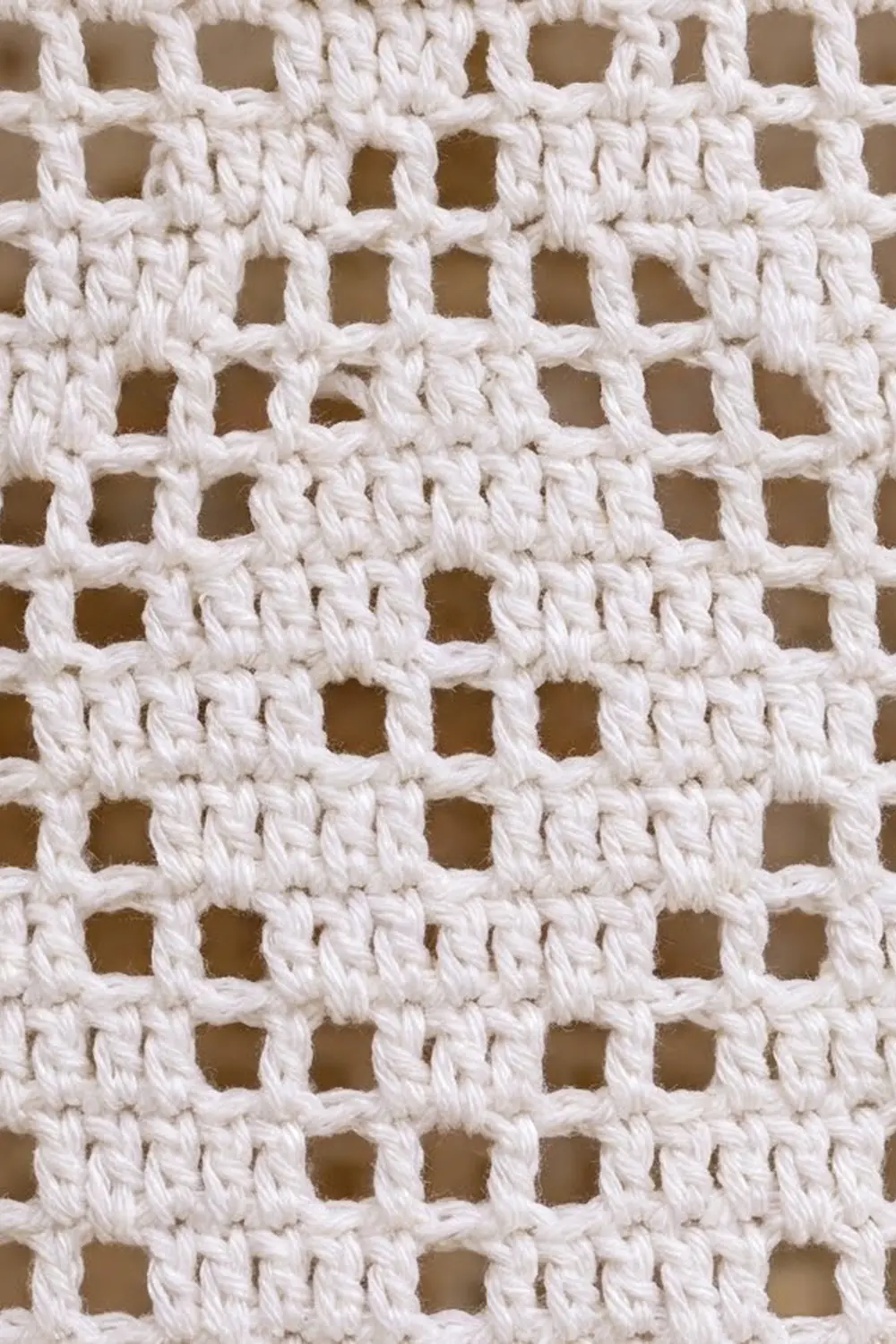
This tall, airy bag holder adds a bit of farmhouse lace to a kitchen wall. It is a single tube in crisp white cotton, worked in filet crochet with a column of stacked diamonds up the front and the back. Each diamond has a small cross of solid blocks in its center. The open mesh around it lets the bags show through.
Plastic bags go in through the open top and pull out through a rounded opening just above the flat base. A sturdy single crochet strap arches across the top, so the holder hangs neatly from a hook or cabinet knob. White suits a cottage kitchen, but a soft pastel such as light blue works just as well.
The pattern uses US crochet terms. The finished holder is 5.5 in (14.0 cm) across and 18 in (45.7 cm) tall without the strap. With the strap, it hangs about 21 in (53.3 cm) long.
Construction is continuous. You start with a flat circle for the base, turn the edge up to begin the tube, and work a few turned rows to leave the dispensing opening. Then you go back to joined rounds for the filet diamonds and finish with a solid rim. The opening gets one round of edging, and the strap is worked straight off the rim.
Finished Size and Construction
- Finished size: 5.5 in (14.0 cm) diameter x 18 in (45.7 cm) tall; 21 in (53.3 cm) including the strap
- Skill level: Intermediate (filet mesh, rounds and turned rows)
- Terminology: US crochet terms
- Yarn weight: Worsted (#4) cotton
- Hook: 4.0 mm (G-6)
- Number of pieces: 1 (base, body and strap worked continuously)
- Layout: Single cylinder, no joining
- Circumference: 78 sts = 17.3 in (43.9 cm)
- Size before rim: 17.3 in (43.9 cm) tall after Round 39
- Rim depth: about 0.7 in (1.8 cm), made of 1 dc round + 1 sc round
Materials
Yarn: Use a smooth worsted-weight cotton, mercerized or plain. Cotton holds the tube shape and shows the filet pattern clearly. Avoid stretchy acrylic blends, because the holder carries weight.
- White: 200 g / about 340 m (372 yd)
For a pastel version, use the same amount of light blue.
Tools:
- 4.0 mm (G-6) crochet hook
- 4 locking stitch markers
- Tapestry needle
- Scissors
- Measuring tape
- Spray bottle, plus a 5.5 in (14.0 cm) diameter tube, canister or rolled towel for blocking
The yarn amounts include a margin of about 20 percent for your gauge check and normal differences in tension.
Abbreviations (US Terms)
- ch: chain
- sl st: slip stitch
- sc: single crochet
- dc: double crochet
- BLO: back loop only
- sk: skip
- sp: space
- st(s): stitch(es)
Special stitches (filet mesh): Each mesh is 3 sts wide and ends with a dc “post.”
- Space (S): ch 2, sk the next 2 sts (or the next ch-2 sp), dc in next dc.
- Block (B): 2 dc in the next ch-2 sp (or dc in the next 2 dc), dc in next dc.
- Last mesh of a round: work it the same way, but replace the final dc with a sl st to the top of the beginning ch-3.
Each round starts with ch 3, which counts as the first post. 26 meshes x 3 sts = 78 sts per round.
Gauge and Checkpoints
Gauge: 18 dc and 9 rounds = 4 in (10.2 cm). In filet, 6 meshes = 4 in (10.2 cm).
Make the base first and use it as your test piece. Its diameter tells you whether the tube will come out the right size.
Checkpoints:
- After Base Round 3: about 2.6 in (6.6 cm) across
- After Base Round 6: about 5 in (12.7 cm) across
- After Base Round 7: 5.5 in (14.0 cm) across
- After Body Round 7: about 3 in (7.6 cm) of wall height
- After Body Round 17: about 7.6 in (19.3 cm)
- After Body Round 37: about 16.5 in (41.9 cm)
- After Round 41: 18 in (45.7 cm)
If the base is bigger than 5.5 in (14.0 cm), go down half a millimeter in hook size. If it is smaller, go up half a millimeter. Do not add or remove stitches, because the diamond layout depends on exactly 78 sts.
If the width is right but the tube comes out short, add one all-space round between diamonds. If it runs long, leave out Round 38.
Base
Work in joined rounds and do not turn. The ch 3 counts as the first dc in every round.
Base Round 1: Magic ring, ch 3, 11 dc in ring, sl st to the top of the ch-3. (12 sts)
Base Round 2: Ch 3, dc in the same st, 2 dc in each st around, sl st to join. (24 sts)
Base Round 3: Ch 3, 2 dc in next st, dc in next st, 2 dc in next st; repeat from * around, join. (36 sts)
Base Round 4: Ch 3, dc in next st, 2 dc in next st, dc in next 2 sts, 2 dc in next st; repeat around, join. (48 sts)
Base Round 5: Ch 3, dc in next 2 sts, 2 dc in next st, dc in next 3 sts, 2 dc in next st; repeat around, join. (60 sts)
Base Round 6: Ch 3, dc in next 3 sts, 2 dc in next st, dc in next 4 sts, 2 dc in next st; repeat around, join. (72 sts)
Base Round 7: Ch 3, dc in next 10 sts, 2 dc in next st, dc in next 11 sts, 2 dc in next st; repeat around, join. (78 sts)
The base should lie flat and measure 5.5 in (14.0 cm). If it ruffles, your tension is loose. If it cups, your tension is tight.
Body
For counting, the joining stitch of each round is position 0, and the stitches run up to position 77.
Body Round 1: Ch 3, dc in BLO of each st around, sl st to join. (78 sts)
Working in the back loop leaves a clean ridge at the edge of the base and turns the wall upward.
Dispensing Opening (Rows 2–6)
Now work turned rows over the first 61 sts and leave the last 17 sts unworked. This leaves a gap 17 sts wide.
Row 2: Ch 3 (counts as dc), ch 2, sk 2 sts, dc in next st; repeat from * 20 times, turn. (20 spaces, 61 sts; the last dc is at position 60)
Rows 3–6: Ch 3 (counts as dc), ch 2, dc in next dc; repeat from * 20 times, working the last dc into the top of the turning ch-3, turn. (20 spaces, 61 sts each)
Row 6 ends at position 60, at the edge of the gap. Do not turn.
Close the gap: Ch 17, then sl st to the top of the turning ch-3 of Row 6. 61 worked sts + 17 ch = 78 sts, so the full round is back.
Body Round 7: Ch 3, ch 2, dc in next dc; repeat from * 20 times to reach position 60. Over the ch-17: ch 2, sk 2 ch, dc in the 3rd ch; [ch 2, sk 2 ch, dc in next ch] 4 times, placing the dc’s in chains 6, 9, 12 and 15. Ch 2, sl st to the top of the ch-3. (26 spaces, 78 sts)
Before edging, the opening is about 3.8 in (9.7 cm) wide and 2.2 in (5.6 cm) tall. It spans meshes 21–26.
Diamond Section (Rounds 8–37)
Each round is written out as all 26 meshes. The diamonds are centered on mesh 10 (back) and mesh 23 (front), so the front diamond sits directly over the opening.
- Round 8: S9, B1, S12, B1, S3
- Round 9: S8, B1, S1, B1, S10, B1, S1, B1, S2
- Round 10: S7, B1, S3, B1, S8, B1, S3, B1, S1
- Round 11: S6, B1, S2, B1, S2, B1, S6, B1, S2, B1, S2, B1
- Round 12: B1, S4, B1, S2, B3, S2, B1, S4, B1, S2, B3, S2
- Round 13: Repeat Round 11.
- Round 14: Repeat Round 10.
- Round 15: Repeat Round 9.
- Round 16: Repeat Round 8.
- Round 17: S26
Every round adds up to 26 meshes (78 sts). For example, in Round 12: 1 + 4 + 1 + 2 + 3 + 2 + 1 + 4 + 1 + 2 + 3 + 2 = 26.
The blocks make a diamond outline 9 meshes wide. The blocks in Rounds 11–13 form the small cross in the center. In Round 12, the first block (mesh 1) is the outer point of the front diamond, which wraps around past the joining post.
Rounds 18–37: Repeat Rounds 8–17 twice more. (3 diamonds stacked in each column; 78 sts per round)
Each diamond repeat adds about 4.4 in (11.2 cm) of height.
Upper Mesh (Rounds 38–39)
Rounds 38–39: Ch 3, S 26 times, joining the last one with a sl st. (78 sts)
The tube should now be about 17.3 in (43.9 cm) tall.
Rim and Opening Edging
This section takes the place of a border. Both parts use the same gauge of 4.5 sts per inch.
Round 40: Ch 3, 2 dc in each ch-2 sp and dc in each dc around, sl st to join. (26 posts + 26 x 2 = 78 sts)
Round 41: Ch 1, sc in each st around, sl st to the first sc. (78 sts) Fasten off.
The count stays at 78 because each mesh is exactly 3 sts: 1 post plus 2 sts in its space. With 78 sts, the rim neither ruffles nor pulls in.
Opening edging (1 round): Join yarn at the lower right corner of the opening and sc evenly around:
- Lower edge: 17 sc, one in each unworked st of Body Round 1
- Left side: 10 sc, 2 around each row-end post of Rows 2–6
- Top edge: 17 sc, one in the underside of each ch of the ch-17
- Right side: 10 sc, 2 around each row-end post
- Total: 54 sc
Sl st to the first sc and fasten off. The top and bottom edges match the 17-st gap exactly. The sides get 2 sc per dc row because one dc is about as tall as 2 sc. The finished opening is a soft oval about 3.5 in (8.9 cm) wide and 2 in (5.1 cm) tall.
Hanging Strap
Place a marker in the Round 41 sc directly above the center of the opening. Count 39 sts around and mark the sc on the opposite side.
Row 1: Join yarn 2 sts before the back marker. Ch 1, sc in the same st and in each of the next 4 sts, turn. (5 sc)
Rows 2–36: Ch 1, sc in each st across, turn. (5 sc)
The strap should be about 8 in (20.3 cm) long and 1 in (2.5 cm) wide. Center the free end over 5 front sts, with the marker in the middle, and sl st through both layers to attach it. Fasten off. The strap rises about 3 in (7.6 cm) above the rim.
Final Blocking
- Weave in all ends along the dc posts so they don’t show in the spaces.
- Spray the holder until it is evenly damp. Don’t soak it.
- Slide it over a 5.5 in (14.0 cm) tube or canister, or fill it with a rolled towel.
- Line up the posts so the diamond columns run straight up and down.
- Gently shape the opening into an oval with your fingers.
- Straighten the strap and press it flat.
- Let it dry completely on the form before you hang it.
Final Quality-Control Checklist
- Base is flat and 5.5 in (14.0 cm) across
- Every body round has 78 sts (26 meshes)
- Front diamond column is centered over the opening, with the back column directly opposite
- Each column has three complete diamonds
- Opening edging has 54 sc and lies flat
- Rim has 78 sc and no ruffling
- Strap is 5 sc wide and firmly attached at both ends
- Height is 18 in (45.7 cm) without the strap
Troubleshooting
Tube twists: Joined rounds tend to drift. Start every round with ch 3 at the same joining post. Blocking on a form fixes a slight spiral.
Diamonds look lopsided: Count meshes, not stitches. Every round must add up to 26.
Diamond isn’t over the opening: Check that Body Round 7 starts at the turning chain of Row 6, so mesh 1 begins at position 0.
Opening has a step at one corner: Make sure you closed the gap with exactly 17 ch.
Base cups or ruffles: Change hook size for the base only, then go back to the 4.0 mm (G-6) hook for the body.
Strap stretches: Use a smaller hook for the strap, or add a row of sl sts along each long edge.
Care
Hand wash in cool water with mild soap, press the water out in a towel, and dry the holder on a form so it keeps its tube shape. Don’t use the dryer, because it can shrink cotton unevenly.

Final Notes
The measurements build on each other. A 5.5 in (14.0 cm) base of 78 sts sets the circumference. 26 meshes of 3 sts keep every round at 78. Seven lower rounds, thirty diamond rounds and two mesh rounds bring the wall to 17.3 in (43.9 cm). The 0.7 in (1.8 cm) rim then finishes the holder at 18 in (45.7 cm). If your base measures correctly and you keep the count at 78, the rest of the holder will come out right.
Happy crocheting!