

This cottage-style curtain is one airy panel of cream filet mesh. It has a soft scalloped border and climbing vines of pink and lilac flowers. Each flower has a cluster of small pearl beads at its center, and pointed green leaves sit along chain-stitch vines that wander down the edges of the panel.
The look is light, romantic, and a little vintage. Sunlight passes straight through the open grid, so the flowers seem to float against the window. The palette is simple: cream for the curtain, rose pink and soft lilac for the flowers, and a fresh leaf green for the vines and leaves.
This pattern uses US crochet terms. The finished curtain measures 31 in wide x 43 in long (78.7 x 109.2 cm), including the border.
Construction is straightforward. You work the panel flat in rows of classic filet mesh and add a three-round scalloped border all the way around. Then you crochet the flowers, leaves, and vines separately and sew them on. A matching braided tieback with a tassel finishes the set.
Finished Size and Construction
- Finished size: 31 x 43 in (78.7 x 109.2 cm)
- Skill level: Easy-intermediate
- Terminology: US crochet terms
- Yarn weight: DK / light worsted (#3) cotton
- Hook: 4.0 mm (G-6)
- Number of pieces: 1 mesh panel worked as one piece with no joining, plus 12 flowers, 30 leaves, 2 vines, and 1 tieback
- Layout: Vine A runs down the left edge; Vine B climbs the lower right edge
- Panel size before border: 28 x 40 in (71.1 x 101.6 cm), 42 meshes wide x 60 rows tall
- Border depth: 1.5 in (3.8 cm) on every side
Materials
Choose a smooth mercerized or combed cotton in DK weight. In a sunny window, cotton keeps the mesh square, washes well, and resists fading and stretching better than acrylic. The amounts below assume a cotton with about 105 m per 50 g.
- Cream (panel, border, tieback): 500 g, about 1,050 m
- Rose pink (flowers): 25 g, about 53 m
- Lilac (flowers): 25 g, about 53 m
- Leaf green (leaves and vines): 50 g, about 105 m
These amounts include a margin of about 10 to 15 percent for your gauge swatch and small differences in tension.
Tools and notions:
- 4.0 mm (G-6) crochet hook
- Tapestry needle
- Sewing needle and cream sewing thread
- 90 pearl beads, 6 mm (7 per flower, plus spares)
- Rust-proof pins and a blocking surface
- Measuring tape
- Stitch markers
- 8 curtain rings with clips, or plain rings
- Piece of cardboard 4 in (10.2 cm) tall for the tassel
Abbreviations (US Terms)
- ch – chain
- sl st – slip stitch
- sc – single crochet
- hdc – half double crochet
- dc – double crochet
- tr – treble crochet
- sk – skip
- sp – space
- st(s) – stitch(es)
- RS – right side
Special stitches:
- Mesh: dc, ch 2, sk 2 sts (or the next ch-2 sp), dc in next dc. Neighboring meshes share their dc.
- Shell: 7 dc in the same st.
- Picot: ch 3, worked between two sc in the same st.
Gauge and Checkpoints
Gauge: 6 meshes and 6 rows = 4 in (10.2 cm) in filet mesh, after blocking. Each mesh is a true square.
Border gauge: 9 sc = 2 in (5.1 cm) along every edge, which is 4.5 sc per inch.
Test one piece first. Ch 23 and work Rows 1–8 of the panel over 6 meshes instead of 42. Block the swatch, let it dry, and measure it. It should be 4 in (10.2 cm) wide.
If your swatch is too big, go down 0.5 mm in hook size. If it is too small, go up 0.5 mm. Width matters most, because the border math depends on 42 meshes measuring 28 in (71.1 cm).
Checkpoints:
- After Row 6: width 28 in (71.1 cm), height 4 in (10.2 cm)
- After Row 30: height 20 in (50.8 cm)
- After Row 60: 28 x 40 in (71.1 x 101.6 cm)
- After border: 31 x 43 in (78.7 x 109.2 cm)
- Each flower: 2.25 in (5.7 cm) across
- Each leaf: 1.5 in (3.8 cm) long
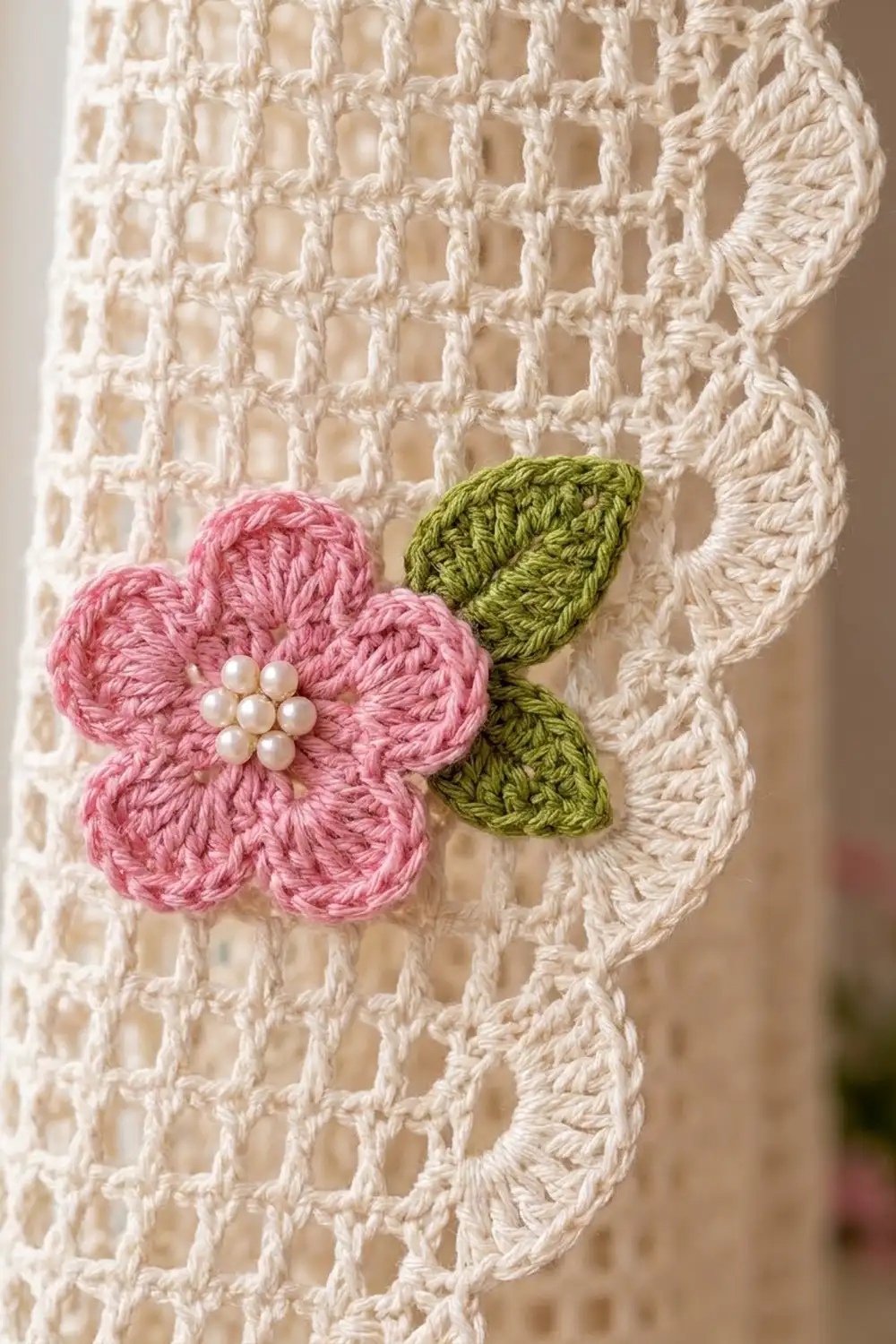
Curtain Panel
With cream, ch 131 (a multiple of 3, plus 5).
Row 1 (RS): Dc in 8th ch from hook. The skipped chs count as a dc, a ch-2 sp, and the 2 skipped base chs of the first mesh. Ch 2, sk 2 ch, dc in next ch; repeat from * across. Turn. (42 meshes: 43 dc, 42 ch-2 sps)*
Check: the first mesh uses 8 chains and the other 41 meshes use 3 chains each, so 8 + 123 = 131.
Row 2: Ch 5 (counts as dc and ch 2), sk first ch-2 sp, dc in next dc. Ch 2, dc in next dc; repeat from * across, working the last dc in the 3rd ch of the turning ch. Turn. (42 meshes)*
Rows 3–60: Repeat Row 2. (42 meshes in every row)
Keep your turning ch-5 snug so the side edges stay straight. Don’t fasten off; the border starts from here. Measure: the panel should be 28 x 40 in (71.1 x 101.6 cm).
Flowers (Make 12)
Make 6 in rose pink and 6 in lilac.
Round 1: Make a magic ring, ch 1, 10 sc in ring, sl st to first sc. Pull the ring closed. (10 sc)
Round 2: Ch 1. Sc in next sc, ch 3, sk next sc; repeat from * 4 more times, sl st to first sc. (5 sc, 5 ch-3 sps)*
Round 3: In each ch-3 sp, work (sc, hdc, 2 dc, tr, 2 dc, hdc, sc), then sl st in the next sc of Round 2. (5 petals of 9 sts each, 45 sts)
Fasten off, leaving a 12 in (30.5 cm) tail for sewing. The tr at the top of each petal makes it full and rounded. The sl st between petals pinches them apart into five clear lobes.
Pearl center: With sewing thread, stitch 7 pearl beads to the center: 1 in the middle and 6 in a ring around it. Pass the thread through each bead twice so it sits firmly.
Leaves (Make 30)
With green, ch 9.
Round 1: Work in the back bumps of the chain. Sl st in 2nd ch from hook, sc in next ch, hdc in next ch, dc in next 2 ch, hdc in next ch, sc in next ch. Work (sc, ch 2, sc) in the last ch for the tip. Rotate and work along the other side of the foundation ch: sc in next ch, hdc in next ch, dc in next 2 ch, hdc in next ch, sc in next ch, sl st in last ch. (7 sts per side, plus 2 tip sc and a ch-2 point: 16 sts)
Fasten off, leaving a 10 in (25.4 cm) tail. Thread the tail onto a needle and work one line of backstitch from the stem to the tip to make the center vein.
Vines (Make 2)
With green, ch loosely until the chain reaches the length below (about 5 ch per inch). Sl st in the back bump of each ch back to the start. Slip-stitching back along the chain makes a firm, round cord that won’t stretch.
- Vine A: 150 ch, 30 in (76.2 cm)
- Vine B: 100 ch, 20 in (50.8 cm)
Fasten off, leaving 12 in (30.5 cm) tails.
Tieback
With cream, make 3 cords the same way as the vines, each 120 ch and 24 in (61.0 cm) long. Knot the three cords together at one end, braid them firmly, and knot the other end.
Tassel: Wrap cream yarn 40 times around the 4 in (10.2 cm) card. Tie the loops at the top and cut them at the bottom. Wrap the neck 0.5 in (1.3 cm) below the top and trim the ends evenly. Sew the tassel to one end of the braid. At the other end, ch a 2 in (5.1 cm) loop to slip over a wall hook.
Border
Work with the RS facing. The border is worked directly onto the panel’s own edges. Between the corner ch-2 sps, each side must have a multiple of 6 sts, plus 1, so the scallops fit exactly.
Round 1: Ch 1.
- Top (Row 60): (sc, ch 2, sc) in the corner dc. Sc in each of the 41 interior dc and 2 sc in each of the 42 ch-2 sps. (sc, ch 2, sc) in the next corner dc.
- First side: 3 sc around each row-end, except 2 sc in the Row 1 row-end.
- Bottom: Work the same as the top, into the foundation ch.
- Second side: Work the same as the first side.
Sl st to first sc.
Counts per side between corner ch-2 sps, including that side’s own 2 corner sc:
- Top and bottom: 1 + 41 + 84 + 1 = 127 sc
- Each side: 1 + (59 x 3) + 2 + 1 = 181 sc
- Total: 616 sc, plus 4 corner ch-2 sps
Round 2 (scallops): Sl st into the corner ch-2 sp. Ch 3 (counts as dc), 4 dc in same sp. *Sc in first sc of the side. [Sk 2, shell in next sc, sk 2, sc in next sc] across the side. 5 dc in corner ch-2 sp. Repeat from * around, leaving out the last corner fan. Sl st to top of ch-3.
Counts:
- Top and bottom: 21 shells and 22 sc, 169 sts per side (127 = 1 + 21 x 6)
- Each side: 30 shells and 31 sc, 241 sts per side (181 = 1 + 30 x 6)
- Corners: 4 fans of 5 dc
- Total: 102 shells, 840 sts
Round 3 (picot edge): Ch 1.
- Each corner fan: sc in next 2 dc, (sc, picot, sc) in center dc, sc in next 2 dc.
- Along each side: sl st in each sc. In each shell, sc in next 3 dc, (sc, picot, sc) in 4th dc, sc in next 3 dc.
Sl st to first sc and fasten off.
Counts: 102 shells x 8 sc = 816 sc, plus 4 corners x 6 sc = 24 sc, plus 106 sl sts and 106 picots.
Why the math works: The top edge has 42 meshes, an even number, so 3 x 42 + 1 = 127 sc. That makes 21 scallops, with an anchoring sc at each end. The sides have 60 rows, also even, so 3 x 60 + 1 = 181 sc makes 30 scallops. Both edges carry 4.5 sc per inch, so the border lies flat without ruffling or cupping. Rounds 1–3 add 1.5 in (3.8 cm) to each edge, so the curtain grows from 28 to 31 in wide and from 40 to 43 in long.
Placing the Appliqués
Block the panel (see Final Blocking below) before sewing anything on. Lay it flat with the RS up and the top edge at the top.
Vine A: Pin it 1 in (2.5 cm) inside the left border. Start at the top corner and run it downward in gentle S-curves for 30 in (76.2 cm). Space 7 flowers along it about 4 in (10.2 cm) apart, in this order from the top: pink, lilac, pink, lilac, pink, lilac, pink. Add 18 leaves in pairs and singles between the flowers.
Vine B: Pin it 1 in (2.5 cm) inside the right border. Start 20 in (50.8 cm) above the bottom corner and run it down to the bottom border. Space 5 flowers along it: lilac, pink, lilac, pink, lilac. Add the remaining 12 leaves.
Sew the vines first with small whip stitches through the mesh bars. Then sew each leaf at its stem and tip, and each flower around its Round 2 sc. Catch only the mesh bars so your stitches don’t show through the holes.
Final Blocking
- Weave in all ends on the panel before blocking.
- Soak the curtain in cool water for 15 minutes, then press the water out in a towel. Don’t wring it.
- Lay it flat on a blocking surface and pin the corners to 31 x 43 in (78.7 x 109.2 cm).
- Pin along each edge so the mesh lines run straight and every square is even.
- Pin each scallop at its center picot to open the shells.
- Let it dry completely, then unpin it and sew on the appliqués.
- Lightly steam the flowers from above without pressing on the pearls.
Final Quality-Control Checklist
- Panel is 42 meshes wide and 60 rows tall
- Every mesh is square, with no missing or doubled dc
- Border Round 1 has 127 sc on the top and bottom and 181 sc on each side
- Top and bottom have 21 scallops each; each side has 30
- Finished size is 31 x 43 in (78.7 x 109.2 cm)
- Each flower has 5 even petals and 7 secure pearls
- Vines are smooth and sewn flat, with no puckering
- All ends are woven in, hidden behind appliqués where possible
Troubleshooting
Mesh leans to one side: Your turning ch-5 is too loose or too tight. Match it to the height of your dc.
Side edges wave: You have too many sc in Round 1. Recount the 3 sc per row-end.
Border cups: Round 1 has too few sc, or your tension is tight. Go up a hook size for the border only.
Scallops don’t fit evenly: Recount Round 1. Each side must be a multiple of 6, plus 1.
Petals curl: Loosen your tr, or block the flower flat under a damp cloth.
Panel puckers behind a vine: The vine was stretched while you sewed it. Remove it and re-sew it with the cord relaxed.
Care
Hand wash in cool water with mild soap and dry flat. Don’t tumble dry, because heat can loosen the pearls and distort the mesh.

Final Notes
Here is the full measurement chain. At 6 meshes per 4 in, 42 meshes and 60 rows make a 28 x 40 in (71.1 x 101.6 cm) panel. Round 1 puts 127 sc on the top and bottom and 181 sc on each side, at 4.5 sc per inch. Those counts divide evenly into 21 and 30 scallops. The three border rounds add 1.5 in (3.8 cm) per edge, for a finished curtain of 31 x 43 in (78.7 x 109.2 cm).
Hang it from clip rings spaced about 4 in (10.2 cm) apart, gather it with the braided tieback, and let the vines catch the light.
Happy crocheting!