

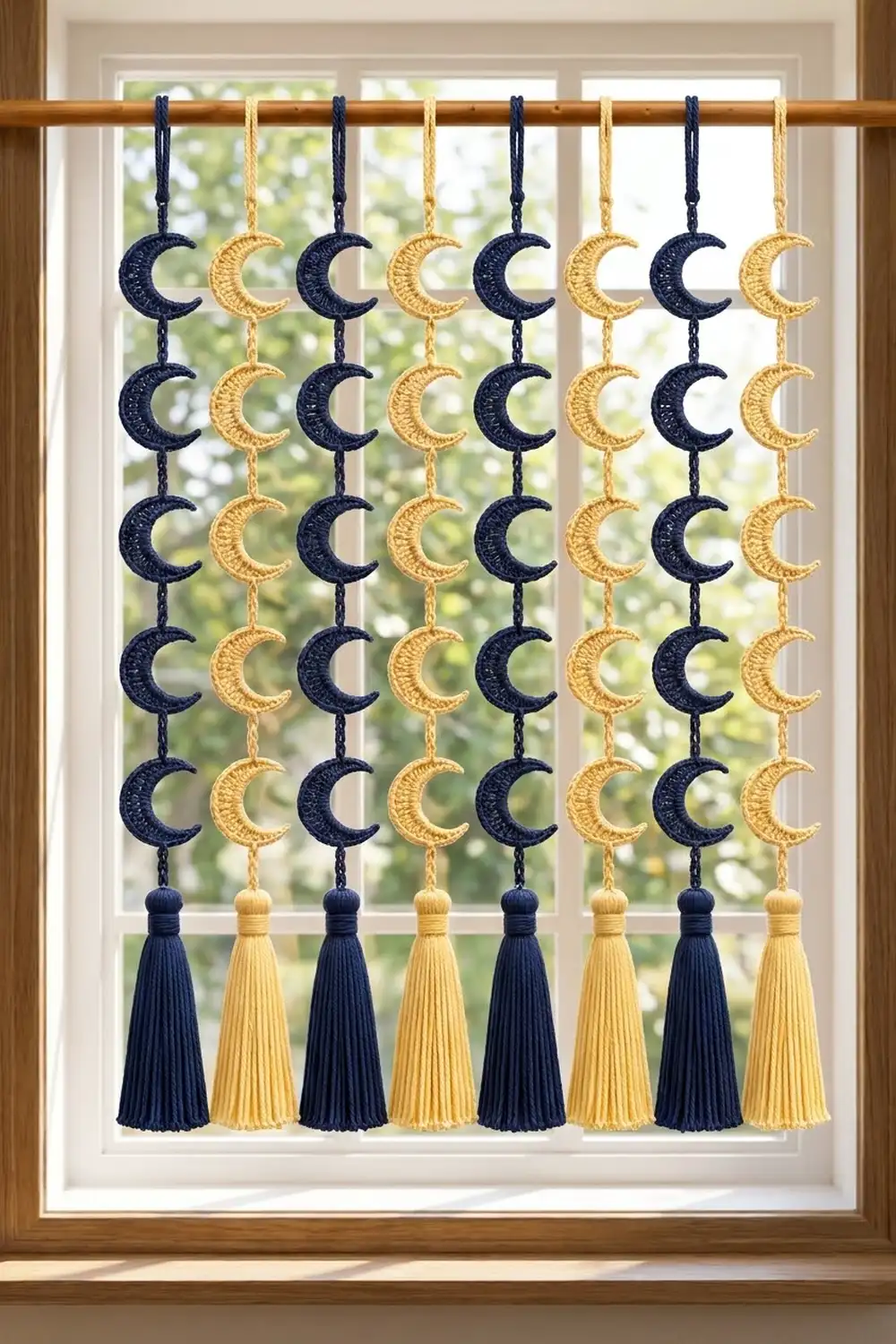
This hanging curtain is made of little crescent moons strung in vertical strands, and each strand ends in a soft, full tassel. Navy strands alternate with butter-yellow strands, so the curtain looks like a night sky crossed with moonlight. It works well in a window, a doorway, a nursery, or a reading nook.
Each moon is a small, flat crescent. The inner curve is smooth, the middle shows short radiating double crochet posts, and a neat single crochet edge outlines the outer curve and both points. Short doubled chain cords link the moons, so every strand hangs straight and stays tidy.
The pattern uses US crochet terms. The finished curtain measures about 26.5 in (67.3 cm) wide and 25.25 in (64.1 cm) long, including the hanging loops and tassels. Each moon is 2.75 in (7.0 cm) tall and 2 in (5.1 cm) wide.
Construction is simple. You crochet each moon in two rows along a foundation chain, then add one edging round. On every moon after the first, that edging round also makes the connector to the moon above, so the strand grows as you go. You add the tassels last.
Finished Size and Construction
- Finished curtain: 26.5 in (67.3 cm) wide x 25.25 in (64.1 cm) long
- Skill level: Easy
- Terminology: US crochet terms
- Yarn weight: #4 worsted, cotton
- Hook: 4.0 mm (G-6)
- Number of pieces: 40 moons and 8 tassels
- Layout: 8 strands of 5 moons each, alternating navy and yellow
- Piece size (one moon): 2.75 in (7.0 cm) tall x 2 in (5.1 cm) wide
- Moon size before edging: 2.5 in (6.4 cm) tall x 1.75 in (4.4 cm) wide
- Edging (border) depth: 0.125 in (0.3 cm) all around
- Strand spacing on rod: 3.5 in (8.9 cm) center to center
Materials
Use a smooth worsted-weight cotton with about 186 yd (170 m) per 100 g. Cotton shows each stitch clearly, holds the crescent shape, and lets the tassels hang heavy and straight. Avoid fuzzy or loosely plied yarns, which hide the stitches and make the tassels frizz. Mercerized cotton gives a soft sheen. Matte cotton looks more rustic.
- Navy: 150 g, about 279 yd (255 m), for 20 moons and 4 tassels
- Butter yellow: 150 g, about 279 yd (255 m), for 20 moons and 4 tassels
Each strand uses about 28 g:
- five moons at about 4 g each
- about 2 g for the loop and connectors
- about 6 g for the tassel
Four strands per color use about 112 g. The amounts above include a margin for your test moon and for trimming.
Tools:
– 4.0 mm (G-6) crochet hook
– Tapestry needle
– Scissors
– Stitch markers (at least 2)
– Stiff card, 5 in (12.7 cm) tall, for tassels
– Wooden dowel or curtain rod, at least 30 in (76.2 cm) long
– Ruler or measuring tape
– Blocking mat and rust-proof pins
Abbreviations (US Terms)
- ch – chain
- sl st – slip stitch
- sc – single crochet
- hdc – half double crochet
- dc – double crochet
- st(s) – stitch(es)
- FLO – free loop of the foundation chain (the loop left unused after Row 1)
Special technique – doubled cord connector: Chain the stated number, sl st into the target stitch, then sl st back into each chain until you reach your starting point. This turns a thin chain into a firm, cord-like link that won’t stretch.
Gauge and Checkpoints
Gauge: 18 sc = 4 in (10.2 cm). 5 ch = 1 in (2.5 cm).
Instead of a square swatch, make one complete moon first and measure it at each stage:
- After Row 1: The strip curls into a shallow arch about 2.25 in (5.7 cm) from tip to tip.
- After Row 2: The piece closes into a C about 2.5 in (6.4 cm) tall and 1.75 in (4.4 cm) wide.
- After Round 3 (edging): The moon is 2.75 in (7.0 cm) tall and 2 in (5.1 cm) wide.
If your moon is too big, go down to a 3.75 mm (F-5) hook. If it’s too small, go up to a 4.5 mm (7) hook. A difference of 0.25 in (0.6 cm) per moon adds up to 1.25 in (3.2 cm) over a strand, so it’s worth checking. Keep your test moon if it measures correctly. It can be the first moon of your first strand.
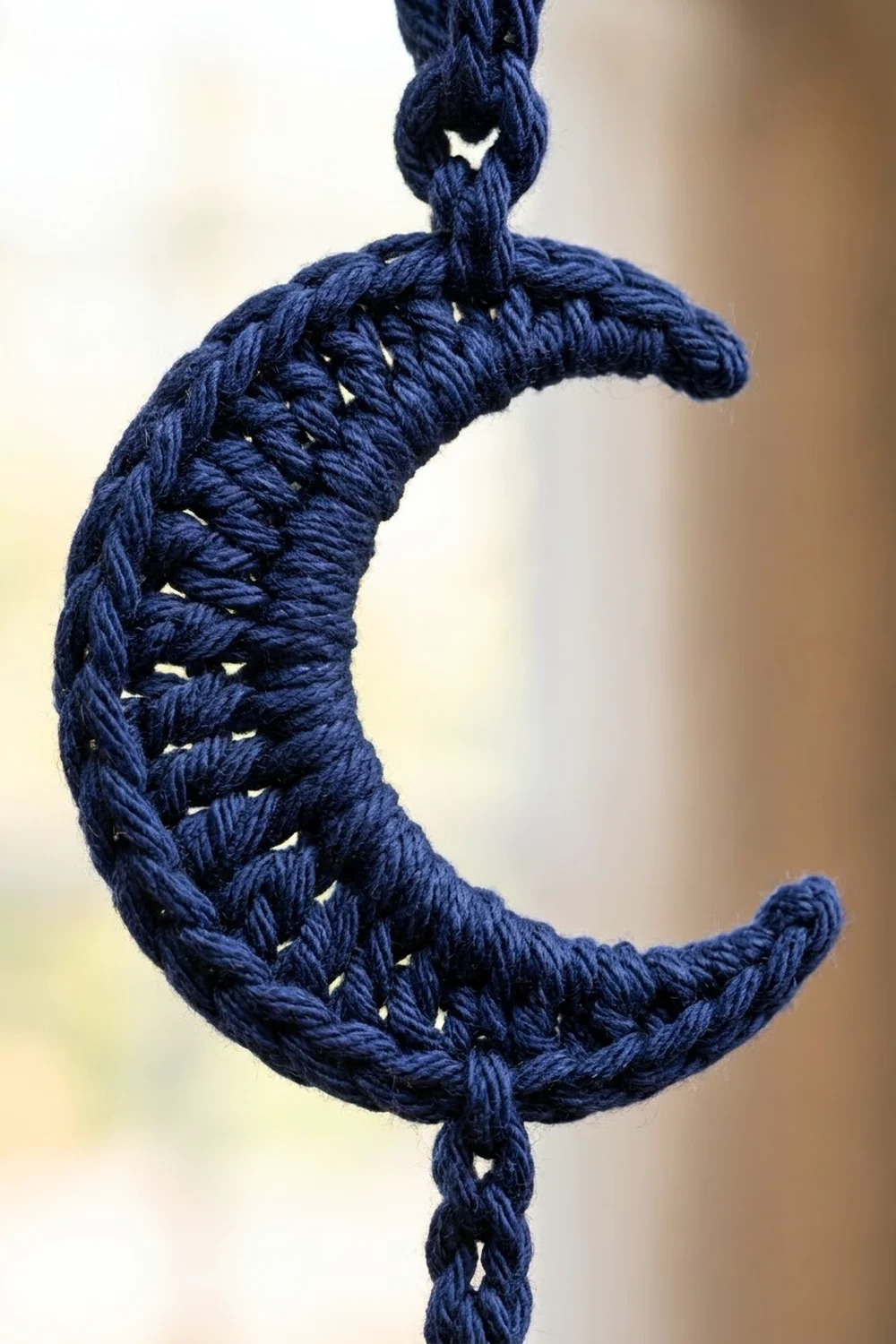
Crescent Moon (make 40: 20 navy, 20 yellow)
The foundation chain becomes the smooth inner arc. Row 1 increases only in the middle, so the outer edge grows longer than the inner edge and the strip bends into a crescent. Row 2 lengthens the outer edge further and closes the C.
Foundation: Ch 18.
Row 1: Sl st in 2nd ch from hook, sc in next ch, hdc in next ch, dc in next ch, 2 dc in each of next 9 ch, dc in next ch, hdc in next ch, sc in next ch, sl st in last ch. Turn. (26 sts)
Check: This row uses all 17 working chains (4 + 9 + 4). The count is 4 stitches before the middle, 18 dc in the middle, and 4 stitches after it. The stitches step up in height (sl st, sc, hdc, dc) toward the middle, which shapes the pointed tips. The 18 middle dc form the radiating posts.
Row 2: Ch 1 (doesn’t count as a st). Sc in each of first 4 sts, [2 sc in next st, sc in next st] 9 times, sc in each of last 4 sts. Don’t turn. (35 sts)
Check: 4 + 27 + 4 = 35. The 18 middle dc become 27 sc, and the 4 stitches at each end get 1 sc each. This row forms the outer curve.
Don’t fasten off. The edging round in the Border section finishes the moon and also joins it to its strand. Read the Joining section before you work Round 3 on any moon.
Make All Pieces
- Navy: 20 moons and 4 tassels (4 strands)
- Yellow: 20 moons and 4 tassels (4 strands)
Work moons 1–5 of each strand in order, joining as you go, then add that strand’s tassel.
Layout grid (front view, N = navy, Y = yellow):
Rod:   ===================================
Loop:    o   o   o   o   o   o   o   o
1:       N   Y   N   Y   N   Y   N   Y
2:       N   Y   N   Y   N   Y   N   Y
3:       N   Y   N   Y   N   Y   N   Y
4:       N   Y   N   Y   N   Y   N   Y
5:       N   Y   N   Y   N   Y   N   Y
Tassel:  T   T   T   T   T   T   T   T
Each strand is one solid color, and every moon opens to the right.
Joining
You join the moons while working each moon’s edging round, so there’s no separate seaming.
Attachment points: In Round 3 you’ll work 35 sc along the outer arc. The 9th of these sc is the top of the moon, and the 27th is the bottom. Each sits 9 stitches in from its end of the outer arc, so the moon hangs level with the C opening to the right.
Moon 1 (hanging loop): At outer-arc stitch 9, work: sc, ch 15, sl st in the same sc. Then continue the round. The loop is about 1.5 in (3.8 cm) tall.
Moons 2–5 (connectors): At outer-arc stitch 9, work: sc, ch 5, sl st through both loops of stitch 27 on the moon above, sl st in each of the 5 ch back down, sl st in the same sc. Then continue the round. The connector is 1 in (2.5 cm) long.
Moon 5 (tassel ring): At outer-arc stitch 27, work: sc, ch 7, sl st in 3rd ch from hook to form a small ring, sl st in each of the remaining 4 ch, sl st in the same sc. Then continue the round.
The connector chains and their returning sl sts are extras. They aren’t part of the 56-stitch edging count.
Tension: Keep the connector chains as tight as your foundation chain. Loose chains make the strands hang at different lengths.
Strand checkpoint: Measure from the top of the loop to the bottom of moon 5. It should be 19.25 in (48.9 cm): a 1.5 in loop, plus 5 moons x 2.75 in, plus 4 connectors x 1 in.
Border (Moon Edging Round)
Border gauge: 18 sc = 4 in (10.2 cm), worked firmly.
Round 3: Starting from the end of Row 2, turn the piece so you can work around its outside edge:
- Tip A: Work 2 sc: 1 sc into the end of Row 2 and 1 sc into the end of Row 1. (2 sts)
- Inner arc: Sl st in each of the 17 FLO of the foundation chain. (17 sts)
- Tip B: Work 2 sc: 1 sc into the end of Row 1 and 1 sc into the end of Row 2. (2 sts)
- Outer arc: Sc in each of the 35 sts of Row 2. Work the loop, connector, or tassel ring at stitch 9 or 27, as given in Joining. (35 sts)
Sl st to the first sc to join. Fasten off and weave in the ends. (56 sts: 2 + 17 + 2 + 35)
Why the math works:
- Tips: Each tip has exactly two row ends, so 2 sc covers it without flaring.
- Inner arc: One sl st per foundation chain keeps the inner arc snug, which keeps the crescent crisp.
- Outer arc: The increases for the outer arc already happened in Row 2, so 1 sc per stitch keeps it flat.
- Size: The edge adds 0.125 in (0.3 cm) all around. That takes the moon from 2.5 x 1.75 in (6.4 x 4.4 cm) to 2.75 x 2 in (7.0 x 5.1 cm).
Tassels (make 8: 4 navy, 4 yellow)
- Wrap yarn 40 times around the 5 in (12.7 cm) card.
- Slide a 10 in (25.4 cm) strand under the wraps at the top and tie it tightly.
- Cut through all the wraps along the bottom edge.
- Wrap a separate strand 6 times around the tassel, 0.75 in (1.9 cm) below the top. Tie it off and bury the ends inside the tassel.
- Thread the top tie through the tassel ring on moon 5. Knot it twice and hide the tails inside the tassel head.
- Trim the tassel to 5 in (12.7 cm) from the head to the tips.
Full strand length: 19.25 in + 1 in for the tassel-ring connector + 5 in for the tassel = 25.25 in (64.1 cm).
Final Blocking
- Lay each strand flat on a blocking mat with every moon opening to the right.
- Mist the moons and connectors with water until they’re evenly damp.
- Pin each moon to 2.75 in (7.0 cm) tall and 2 in (5.1 cm) wide. Put one pin in each tip and one in the middle of the outer arc.
- Straighten the connectors so the moons line up vertically.
- Steam the tassels lightly and comb them straight.
- Let everything dry completely before unpinning.
- Hang the strands on the rod 3.5 in (8.9 cm) apart, center to center. Seven gaps of 3.5 in plus one moon width of 2 in gives 26.5 in (67.3 cm).
Final Quality-Control Checklist
- Every moon has 26 sts in Row 1, 35 in Row 2, and 56 in Round 3.
- Every moon measures 2.75 x 2 in (7.0 x 5.1 cm).
- All moons open to the right.
- Every connector is doubled and 1 in (2.5 cm) long.
- Each strand measures 25.25 in (64.1 cm) from the top of the loop to the tassel tips.
- All tassels are an even 5 in (12.7 cm).
- Colors alternate navy and yellow across the rod.
- All ends are woven in securely.
Troubleshooting
The moon is too open, like a shallow bowl. Your middle increases may be short. Recount for 18 dc in Row 1 and 27 sc across the middle of Row 2.
The moon ruffles. Either your tension is loose or you’ve added extra increases. Go down a hook size and recount.
The inner arc puckers. Loosen your sl sts slightly, but keep exactly 1 per chain.
The strand twists. Check that every connector joins outer-arc stitch 9 to stitch 27, with all moons facing the same way.
The strands are different lengths. Compare your chain tension, and remake any connector longer than 1 in (2.5 cm).
The tassels frizz. Steam them, then trim the ends again with sharp scissors.
Care
Dust the curtain gently or shake it out. If it needs washing, hand wash it in cool water, press the water out in a towel, and block it flat again.
Final Notes
Every measurement builds on the one before. Rows 1 and 2 make a 2.5 x 1.75 in (6.4 x 4.4 cm) crescent. The 56-stitch edging brings it to 2.75 x 2 in (7.0 x 5.1 cm). Five moons with the loop and connectors make 19.25 in (48.9 cm), and the tassel brings each strand to 25.25 in (64.1 cm). Eight strands spaced 3.5 in (8.9 cm) apart give a curtain 26.5 in (67.3 cm) wide. If your first moon measures correctly, the whole curtain will too.
Happy crocheting!