

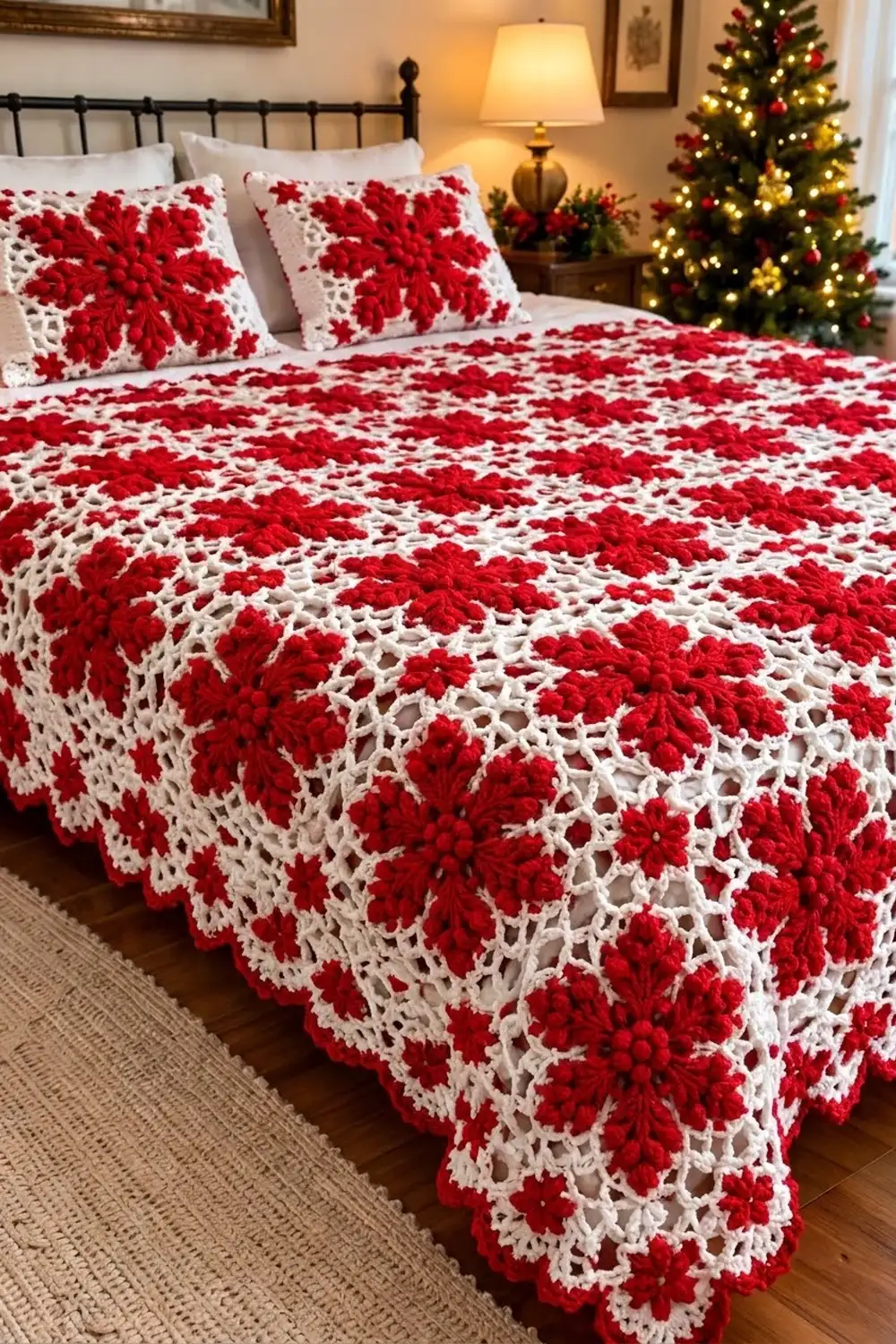
The Crimson Frost Hexagon Bedspread is a bold red-and-white holiday bedspread made from joined lace hexagons. Each hexagon has a raised red snowflake in the center, set in an open white mesh. Small red popcorn flowers are sewn on wherever three hexagons meet, and a red shell edging runs around the scalloped outer edge.
You need just two colors: a deep Christmas red and a clean bright white. The style is classic winter cottage. Heavy, textured popcorns sit against light chain lace, so the snowflakes look almost carved.
This pattern uses US crochet terms. The finished bedspread measures 76.2 x 83.1 in (193.5 x 211.1 cm) at its widest points, including the border.
You make 94 hexagon motifs and join them as you go in 11 offset rows. Then you make 150 small junction flowers and sew them on. Last, you work a two-round border around the zigzag edge.
Finished Size and Construction
- Finished size: 76.2 x 83.1 in (193.5 x 211.1 cm)
- Skill level: Intermediate
- Terminology: US
- Yarn weight: DK (#3)
- Hook: 4.0 mm (G-6)
- Number of pieces: 94 hexagon motifs + 150 junction flowers
- Layout: 11 offset rows, alternating 9 and 8 motifs (6 rows of 9, 5 rows of 8)
- Motif size: 8.3 in (21.1 cm) flat-to-flat, 9.6 in (24.4 cm) point-to-point, 4.8 in (12.2 cm) per side
- Size before border: 74.7 x 81.6 in (189.7 x 207.3 cm)
- Border depth: 0.75 in (1.9 cm)
Materials
Use a smooth DK yarn so the popcorns and lace show clearly. Mercerized cotton or a cotton-acrylic blend gives crisp texture and survives washing. Choose a red that won’t bleed onto the white. The amounts below assume about 230 m per 100 g.
- Red: 1,400 g (approx. 3,220 m)
- White: 1,000 g (approx. 2,300 m)
One motif uses about 10 g (23 m) of red and 9 g (21 m) of white. One junction flower uses about 1.5 g (3.5 m) of red. The totals above include a margin of about 10%.
Tools:
– 4.0 mm (G-6) crochet hook
– Tapestry needle
– Stitch markers
– Rust-proof pins and a foam blocking mat
– Cardboard hexagon template, 8.3 in (21.1 cm) flat-to-flat
– Measuring tape and spray bottle
Abbreviations (US Terms)
- ch – chain
- sl st – slip stitch
- sc – single crochet
- sc2tog – single crochet 2 together
- hdc – half double crochet
- dc – double crochet
- sp – space
- st(s) – stitch(es)
- MR – magic ring
Special stitches:
– Popcorn (pc): 5 dc in the same st or ch, drop the loop from the hook, insert the hook from front to back through the top of the first dc, pick up the dropped loop and pull it through. Popcorns bulge toward you, so keep the right side facing.
– Beginning popcorn (beg pc): ch 3 (counts as the first dc), 4 dc in the same st, then close as for pc.
– Picot popcorn (ppc): ch 3, pc in the 3rd ch from hook. It makes a knob on a short stalk and uses no stitch from the round below.
– Picot: ch 3, sl st in the 3rd ch from hook.
Gauge and Checkpoints
Gauge: 20 sc and 22 rows = 4 in (10.2 cm) with a 4.0 mm hook.
Make one complete motif and block it before you start the rest. Measure at each stage:
- After Round 4 (red snowflake): 6 in (15.2 cm) from arm tip to arm tip.
- After Round 7 (white mesh): 8.8 in (22.4 cm) point-to-point, unblocked.
- After Round 9 (blocked): 8.3 in (21.1 cm) flat-to-flat, 9.6 in (24.4 cm) point-to-point, 4.8 in (12.2 cm) per side.
If the motif is more than 0.2 in (0.5 cm) too big, go down to a 3.5 mm hook. If it is too small, go up to a 4.5 mm hook. A 0.2 in (0.5 cm) error per motif adds up to 1.8 in (4.6 cm) over the 9-motif width.
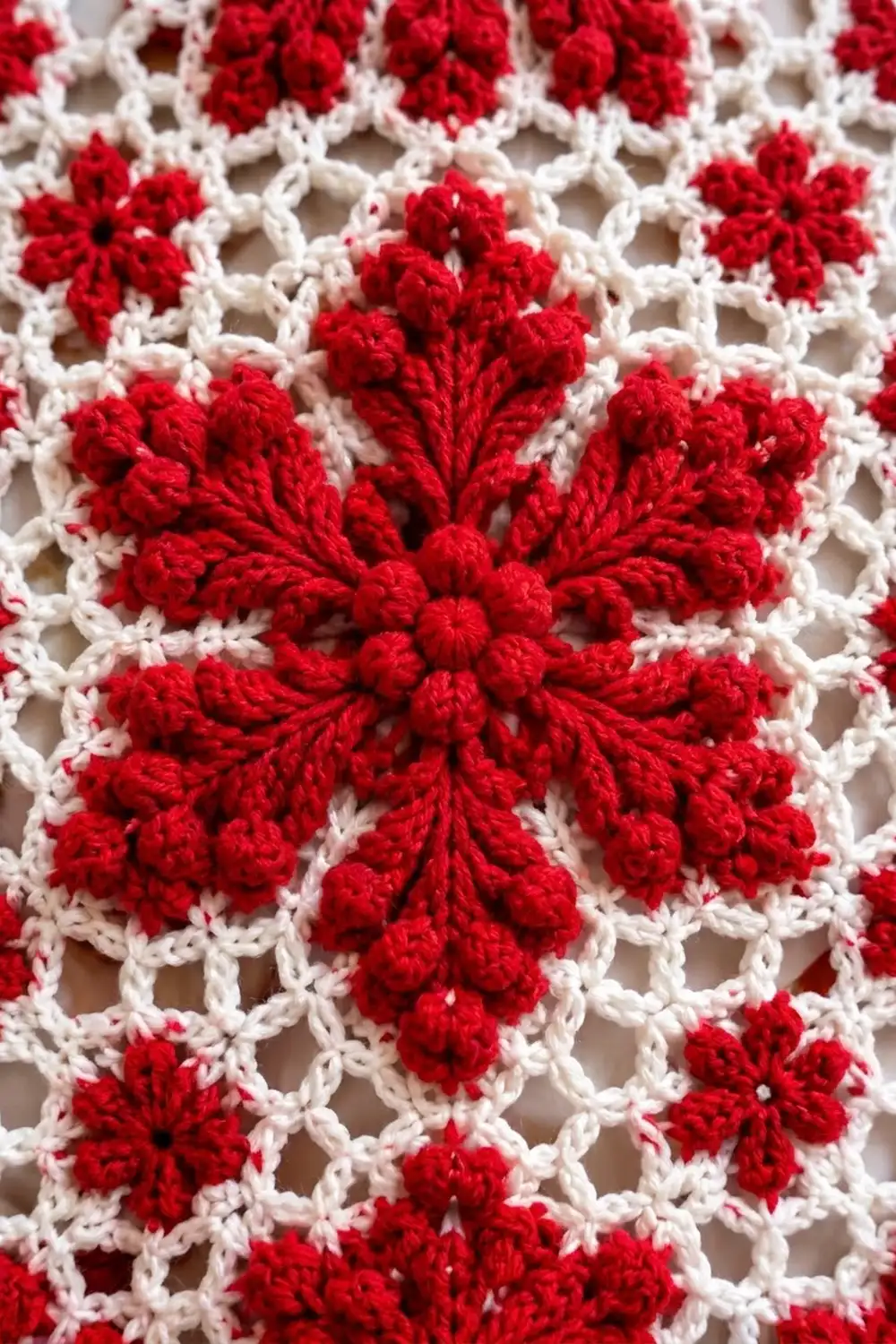
Hexagon Motif
Work Rounds 1–4 in red and Rounds 5–9 in white. Keep the right side facing throughout. Do not turn.
Red Snowflake
Round 1: With red, MR, ch 1, 12 sc in ring, sl st to first sc. (12 sc)
Round 2: Beg pc in first sc, ch 2, skip next sc, pc in next sc, ch 2, skip next sc; repeat from * 4 more times, sl st to top of beg pc. (6 pc, 6 ch-2 sps)
Round 3 (spokes): Ch 1. Sc in top of pc. To make a spoke, ch 10, pc in 4th ch from hook (tip pc), then sl st in each of the remaining 6 ch, back to the base. Sc in the same pc top, 3 sc in next ch-2 sp. Repeat from * 5 more times, sl st to first sc. (30 sc, 6 spokes)
Round 4 (feathered arms): Ch 1. Work every arm as follows:
- Side A: Working up the spoke into the back bumps of the 6 spoke ch: sc, hdc, dc, ppc, dc, dc, ppc, hdc.
- Tip: (sc, ch 3, sc) in top of tip pc.
- Side B: Working down the spoke into the 6 sl sts: hdc, ppc, dc, dc, ppc, dc, hdc, sc.
- Between arms: Skip the sc at the base of the spoke, sc in next sc, pc in next sc, sc in next sc, then skip the sc before the next spoke.
Repeat for all 6 arms and sl st to the first sc. Fasten off red.
Round 4 totals: 6 arms, each with 12 side sts, 4 ppc and 1 tip ch-3 sp; 6 small pc and 12 sc between the arms.
Each arm now has a raised center spine, a popcorn at the tip and two popcorn knobs on each side. One shorter popcorn sits between each pair of arms.
White Lace Mesh
Round 5: Join white with sc in any tip ch-3 sp. Ch 3, sc in same sp. Ch 5, sc in top of the outer ppc on Side B, ch 5, sc in top of the between-arm pc, ch 5, sc in top of the outer ppc on Side A of the next arm, ch 5, (sc, ch 3, sc) in next tip ch-3 sp. Repeat from * around, ending with ch 5 and sl st to first sc. (6 corner ch-3 sps, 24 ch-5 sps; 4 per side)
Round 6: Sl st into corner sp, ch 1. (Sc, ch 4, sc) in corner sp, [ch 4, sc in next ch-5 sp] 4 times, ch 4. Repeat from * 5 more times, sl st to first sc. (6 corner sps, 30 ch-4 sps; 5 per side)
Round 7: Sl st into corner sp, ch 1. (Sc, ch 4, sc) in corner sp, [ch 4, sc in next ch-4 sp] 5 times, ch 4. Repeat from * around, sl st to first sc. (6 corner sps, 36 ch-4 sps; 6 per side)
Round 8: Sl st into corner sp, ch 1. (2 sc, ch 2, 2 sc) in corner sp, 3 sc in each of next 6 ch-4 sps. Repeat from * around, sl st to first sc. (132 sc, 6 corner ch-2 sps; 22 sc per side)
Round 9 (edge, joining round): Ch 1. (Sc, ch 3, sc) in corner ch-2 sp, sc in next 3 sc, [picot, sc in next 4 sc] 4 times, picot, sc in next 3 sc. Repeat from * around, sl st to first sc. Fasten off. (144 sc, 30 picots, 6 corner ch-3 sps)
Each side now has 24 sc: 22 worked into Round 8, plus the corner sc at each end. Each side also has 5 picots. The 24 already includes both corner sc, so don’t count them again later.
Junction Flower
Round 1: With red, MR, ch 1, 6 sc in ring, sl st to first sc. (6 sc)
Round 2: Beg pc in first sc, ch 1, pc in next sc, ch 1; repeat from * 4 more times, sl st to top of beg pc. (6 pc, 6 ch-1 sps)
Fasten off and leave a 10 in (25.4 cm) tail. The flower measures about 1.75 in (4.4 cm) across.
Make All Pieces
- Hexagon motifs: 94, all made the same way (red Rounds 1–4, white Rounds 5–9). The first one is complete; the other 93 are joined on Round 9.
- Junction flowers: 150, all red.
Layout (M = motif; even rows are shifted half a motif to the right):
ROW 1:  M M M M M M M M M   (9)
ROW 2:   M M M M M M M M    (8)
ROW 3:  M M M M M M M M M   (9)
ROW 4:   M M M M M M M M    (8)
ROW 5:  M M M M M M M M M   (9)
ROW 6:   M M M M M M M M    (8)
ROW 7:  M M M M M M M M M   (9)
ROW 8:   M M M M M M M M    (8)
ROW 9:  M M M M M M M M M   (9)
ROW 10:  M M M M M M M M    (8)
ROW 11: M M M M M M M M M   (9)
6 x 9 + 5 x 8 = 94 motifs. The hexagons stand point-up. Every 8-motif row fits into the notches of the rows above and below.
Joining
Use join-as-you-go on Round 9. Work Round 9 as usual along the free sides. On a side that meets a finished neighbor, replace the corners and picots like this:
- Joined corner: sc in corner sp, ch 1, sl st in neighbor’s corner ch-3 sp, ch 1, sc in same corner sp.
- Joined picot: ch 1, sl st in the matching picot of the neighbor, ch 1, sl st in the first ch made.
A shared side has 2 corners and 5 picots, so it joins at 7 points. The 24 sc on each motif are not joined to each other. They lie side by side, which keeps the lace open.
When a corner already joins two motifs, sl st into the existing join sl st. Then all three motifs meet at a single point.
Order: Join along each row from left to right. A Row 1 motif joins 1 side to its left neighbor. A motif in a later row joins its upper-left and upper-right sides to the row above, plus its left side if there’s a neighbor.
Tension: Work the joining ch 1 at the same height as a normal picot ch. If you pull it tight, the seams pucker. If you leave it loose, gaps open up.
Size checkpoint: Row 1 should measure 74.7 in (189.7 cm) across. Rows 1–2 together should measure 16.8 in (42.7 cm) tall, since each new row adds 7.2 in (18.3 cm). At the end, the bedspread measures 74.7 x 81.6 in (189.7 x 207.3 cm).
Flowers: Sew one junction flower over each point where three motifs meet. There are 15 such points between each pair of rows, so 10 x 15 = 150. Sew through the flower’s ring and around the Round 2 chains so it lies flat.
Border
Border gauge: 20 sc = 4 in (10.2 cm), the same as the motif edge. A 24-sc side stays 4.8 in (12.2 cm) long.
The edge zigzags. It has 78 free motif sides, 42 outer points and 36 inner notches. Along the top and bottom edges, each motif shows 2 free sides (9 x 2 = 18 per edge). Each long side has 21 free sides.
Round 1 (white): Join with sc in the first sc of any free side. Work sc in each of the 24 sc on every free side, skipping the picots and folding them forward. At each outer point, work (sc, ch 2, sc) in the corner ch-3 sp. At each inner notch, sc2tog over the last sc of one side and the first sc of the next. Skip the joined corner sps. Sl st to first sc.
- Base count: 78 sides x 24 sc = 1,872 sc
- Plus 42 points x 2 extra sc = 84
- Minus 36 notches x 1 (sc2tog) = 36
- Total: 1,920 sts + 42 ch-2 sps
Round 2 (red): Join red in any first middle sc. Every side has 22 middle sc between its corner sc.
- Each side’s 22 middle sc: sc in first sc, [skip 1, 5 dc in next, skip 1, sc in next] 5 times, sc in next sc. (5 shells, 7 sc)
- Each outer point: sc in corner sc, skip extra sc, 7 dc in ch-2 sp, skip extra sc, sc in next corner sc.
- Each inner notch: sc in the sc2tog.
Sl st to first sc and fasten off. (390 side shells + 42 point shells; 2,910 sts)
Why the math works: Round 1 matches the motif edge 1:1, so the sides keep their length. The extra sc at the points turn the edge outward, and the sc2tog at the notches stop the edge from ruffling. In Round 2, 22 = 1 + (4 x 5) + 1, so every side ends cleanly with no leftover stitches. Each round adds about 0.25–0.5 in (0.6–1.3 cm), for 0.75 in (1.9 cm) total.
Final Blocking
- Weave in all ends and secure them in the white mesh.
- Soak the bedspread in cool water, then gently press out the water. Don’t wring it.
- Lay it flat on blocking mats or a clean sheet over carpet.
- Pin the width to 76.2 in (193.5 cm) and the length to 83.1 in (211.1 cm).
- Pin each outer point and each red point shell.
- Shape the arms and popcorns with your fingers, but don’t flatten them.
- Let it dry completely, at least 24 hours.
Final Quality-Control Checklist
- 94 motifs, each 8.3 in (21.1 cm) flat-to-flat
- Every snowflake has 6 arms with 1 tip pc and 4 ppc
- 6 short popcorns between the arms on each motif
- Every shared side joined at 7 points
- 150 flowers, one on every three-motif junction
- Border Round 1: 1,920 sts; Round 2: 432 shells
- Size 76.2 x 83.1 in (193.5 x 211.1 cm)
- No red dye bleeding onto white
Troubleshooting
- Popcorns pop to the back: Close each one from front to back, with the right side facing you.
- Motif cups: Use ch 5 instead of ch 4 in Rounds 6–7, or go up a hook size for the mesh.
- Motif ruffles: Check that Round 8 has 3 sc per sp, not 4.
- Seam doesn’t line up: Count the picots. Each side must have exactly 5.
- Border waves: Make sure every inner notch has an sc2tog.
- Border pulls in: Loosen Round 2 or use a 4.5 mm hook for the shells.
Care
Hand wash or machine wash on a cold, gentle cycle with a color-catcher sheet. Dry flat and re-pin the points if needed.
Final Notes
Everything depends on the motif gauge. If 20 sc measure 4 in (10.2 cm), each 24-sc side is 4.8 in (12.2 cm), and each motif is 8.3 in (21.1 cm) flat-to-flat and 9.6 in (24.4 cm) point-to-point. Nine motifs give a width of 74.7 in (189.7 cm). Eleven rows spaced 7.2 in (18.3 cm) apart give a length of 81.6 in (207.3 cm). The 0.75 in (1.9 cm) border brings the finished size to 76.2 x 83.1 in (193.5 x 211.1 cm).
Happy crocheting!