

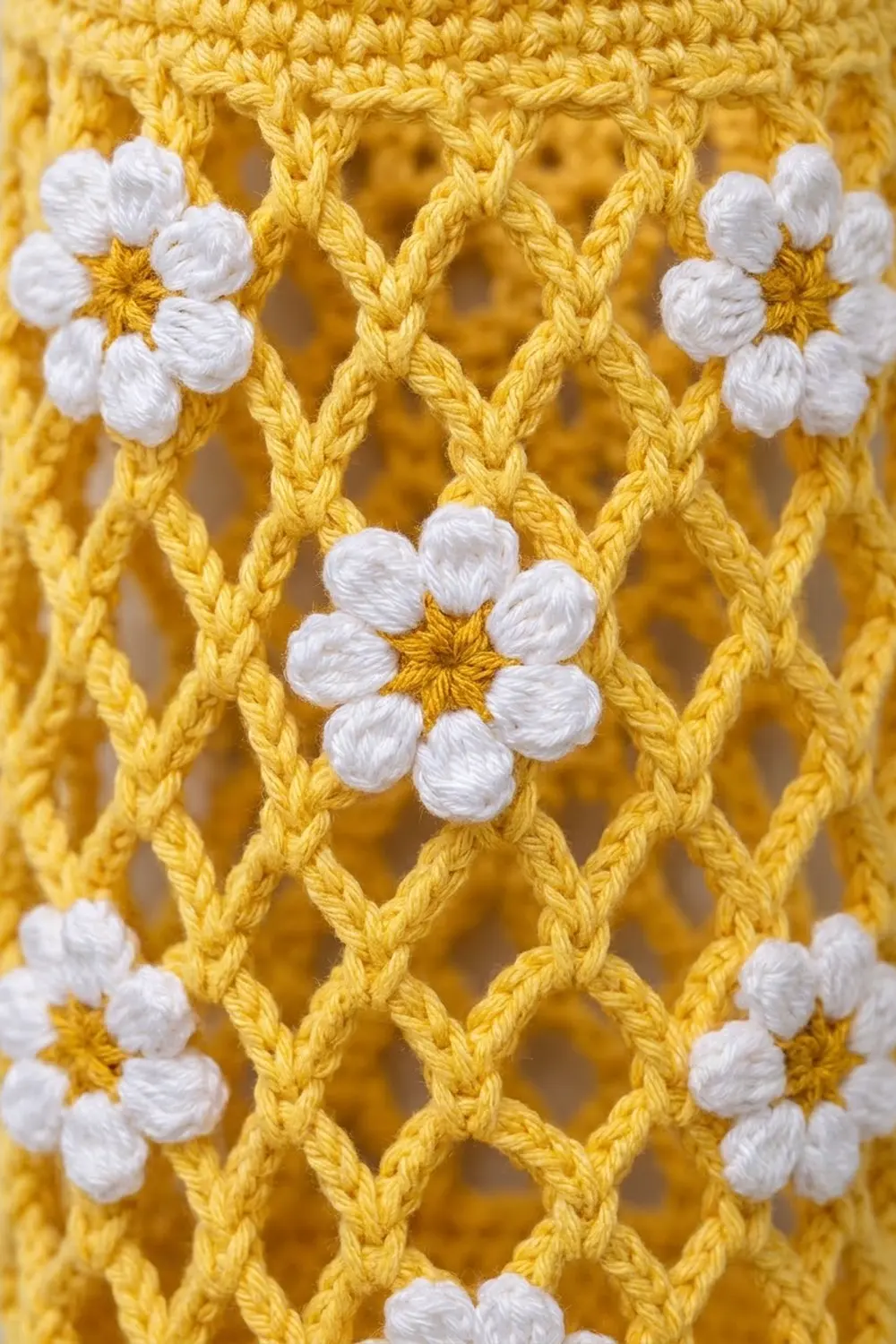
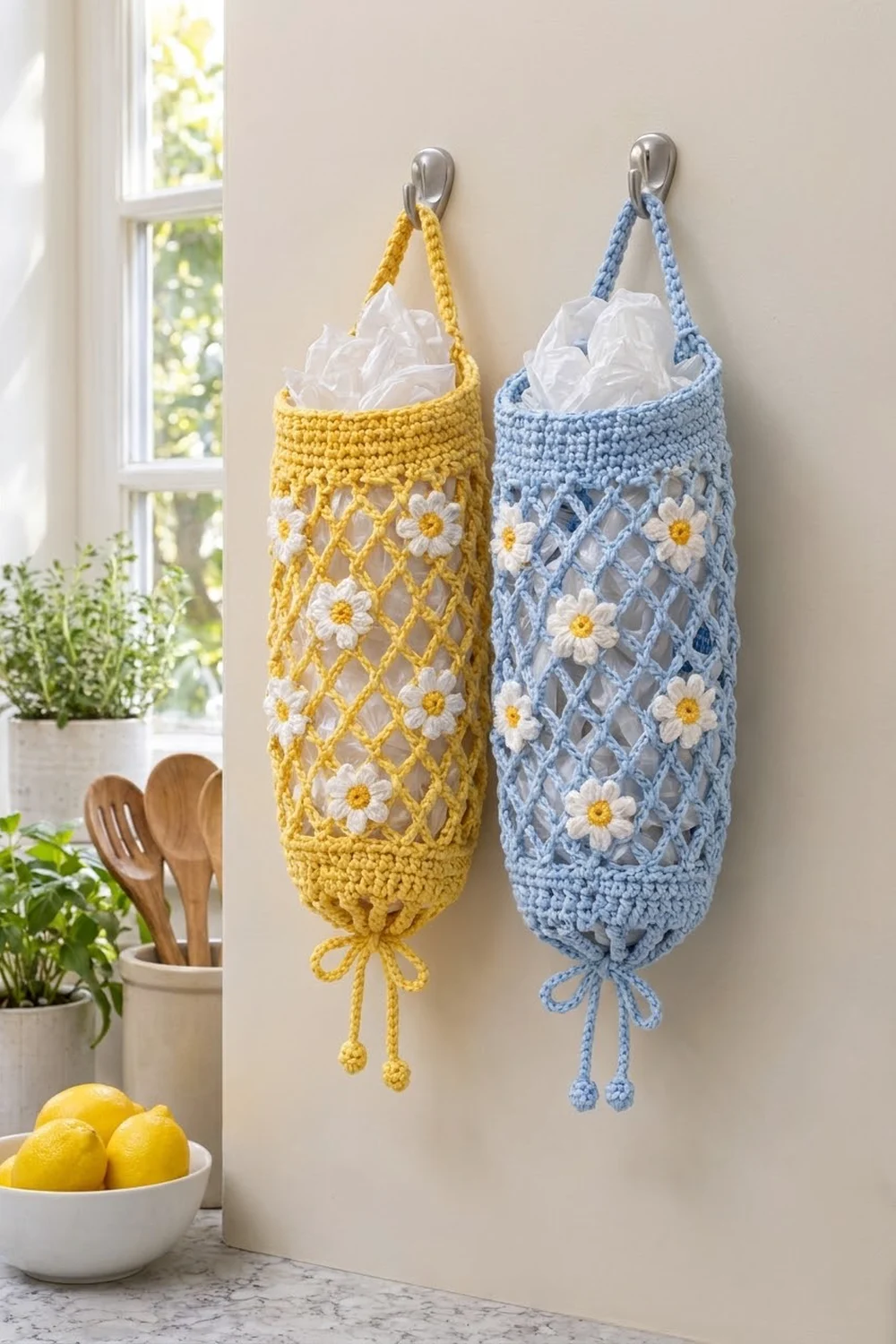
This hanging bag holder is a cheerful way to keep loose grocery bags tidy. It is a long, open tube of diamond chain mesh between two solid bands, with small white daisies sewn over the mesh. A strap handle arches across the top. At the bottom, a drawstring with bobble ends gathers the opening so you can pull out one bag at a time.
The sample is shown in two colors: sunny yellow and soft light blue. Both versions use daisies with white petals and golden yellow centers. The style is fresh farmhouse kitchen: practical, washable, and bright. Make one in each color for the kitchen and the laundry room, or match the holder to your dish towels.
This pattern uses US crochet terms. The finished holder is 15.5 in (39.4 cm) long without the handle and 7.5 in (19.1 cm) wide when laid flat, which is a 15 in (38.1 cm) circumference. The handle rises about 4 in (10.2 cm) above the rim, so the holder hangs about 19.5 in (49.5 cm) tall in total.
You work the holder in one seamless piece from the bottom up. First comes a solid bottom band with a row of eyelets, then the chain-loop mesh, then a solid top band, and the handle last. The daisies and drawstring are made separately and added at the end. The body has no seams at all.
Finished Size and Construction
- Finished size: 15.5 in (39.4 cm) long × 7.5 in (19.1 cm) wide flat; 15 in (38.1 cm) around
- Skill level: Easy / Advanced Beginner
- Terminology: US
- Yarn weight: Worsted (#4) cotton
- Hook: 5 mm (H-8) for the body; 4 mm (G-6) for the daisies
- Number of pieces: 1 tube body, plus 20 daisy appliqués and 1 drawstring
- Layout: bottom band → mesh → top band → handle
- Piece size: 60 stitches around at 16 sts = 4 in (10.2 cm)
- Size before border: 13 in (33.0 cm) long (bottom band plus mesh)
- Border depth: top band 2.5 in (6.4 cm)
Materials
Choose a smooth worsted-weight cotton or cotton blend. Cotton holds its shape, stretches less under the weight of the bags, and washes well. A yarn of about 170 m per 100 g is a good match. Avoid fuzzy or splitty yarns, because the mesh looks best with crisp stitches. If you use acrylic instead, the holder will be a little softer and stretchier.
- Main color (Sunny Yellow or Light Blue): 120 g, about 204 m
- White (petals): 20 g, about 34 m
- Golden Yellow (daisy centers): 8 g, about 14 m
Tools:
- 5 mm (H-8) crochet hook
- 4 mm (G-6) crochet hook
- Tapestry needle
- 2 stitch markers
- Scissors
- Measuring tape
- Rust-proof pins and a blocking mat
All quantities include about 15 percent extra for your gauge test and sewing tails.
Abbreviations (US Terms)
- ch – chain
- sl st – slip stitch
- sc – single crochet
- dc – double crochet
- sk – skip
- sp – space
- st(s) – stitch(es)
- MR – magic ring
- bob – bobble (see below)
Special stitch – Bobble (bob): *Yarn over, insert hook in the stitch, yarn over and pull up a loop, yarn over and pull through 2 loops; repeat from * 4 more times in the same stitch (6 loops on hook), yarn over and pull through all 6 loops.
Turning chains: In this pattern, the ch 3 at the start of a dc round counts as the first dc. The ch 1 at the start of a sc round does not count as a stitch. Every round is joined, and you never turn the work.
Gauge and Checkpoints
Gauge: 16 dc and 8 dc rounds = 4 in (10.2 cm) with the 5 mm hook. Each sc round adds about 0.25 in (0.6 cm) of height, and each dc round adds about 0.5 in (1.3 cm). Each mesh round adds about 0.75 in (1.9 cm) when the piece hangs lightly.
Use the bottom band as your test piece. It is only 6 rounds, so it’s quick to redo, and it shows you whether your tension is right.
Checkpoints:
- After Round 1: the ring lies flat at 15 in (38.1 cm) around, or 7.5 in (19.1 cm) folded flat.
- After Round 6: the band is 2.5 in (6.4 cm) tall and still 7.5 in (19.1 cm) wide flat.
- After Round 20: the body is about 13 in (33.0 cm) long when hung.
- After Round 26: the body is 15.5 in (39.4 cm) long.
If your band is too big, go down one hook size and start again. If it is too small, go up one hook size. Don’t change the stitch count, because the mesh and the top band both need exactly 60 stitches.
Bottom Band
With the main color and the 5 mm hook, ch 60. Join with a sl st to the first ch to form a ring, taking care not to twist the chain.
Round 1: Ch 1, sc in each ch around, join with a sl st to the first sc. (60 sc)
Round 2 (eyelet round): Ch 4 (counts as dc and ch-1), sk next st, dc in next st, ch 1, sk next st; repeat from * 28 more times, join with a sl st to the 3rd ch of beginning ch-4. (30 dc and 30 ch-1 sps = 60 sts)
Round 3: Ch 3, dc in next ch-1 sp, dc in next dc; repeat from * around, ending with dc in last ch-1 sp, join to top of ch-3. (60 dc)
Rounds 4–5: Ch 3, dc in each st around, join to top of ch-3. (60 dc)
Round 6: Ch 1, sc in each st around, join to first sc. (60 sc)
Checkpoint: The band is 2.5 in (6.4 cm) tall and 7.5 in (19.1 cm) wide flat. Round 2 makes a row of 30 evenly spaced holes for the drawstring.
Diamond Mesh
The mesh is a net of chain loops. Every round has 15 sc and 15 ch-5 loops. Each new sc goes into the center of a loop from the round below, which makes the diamond pattern.
Round 7 (setup): Ch 1, sc in first st, ch 5, sk 3 sts, sc in next st; repeat from * 13 more times, ch 5, sk last 3 sts, join with a sl st to first sc. (15 sc, 15 ch-5 loops)
The math: 15 repeats × (1 sc + 3 skipped sts) = 60 stitches, so the loops are evenly spaced.
Round 8: Sl st in each of the next 2 ch, sl st into the ch-5 loop, ch 1, sc in the same loop, ch 5, sc in next ch-5 loop; repeat from * 13 more times, ch 5, join with a sl st to first sc. (15 sc, 15 ch-5 loops)
Rounds 9–20: Repeat Round 8. (15 sc, 15 ch-5 loops in each round)
You now have 14 mesh rounds (Rounds 7–20). Keep your chains even. Tight chains make the mesh shorter, and loose chains make it sag.
Checkpoint: Let the piece hang from your fingers. The mesh should be about 10.5 in (26.7 cm) long, and the whole body about 13 in (33.0 cm). The mesh stretches, so measure it without pulling.
Border: Top Band
The top band is this piece’s border. It finishes the mesh with a solid rim and holds the handle.
Border gauge: same as the bottom band, 16 sts = 4 in (10.2 cm), so 60 sts = 15 in (38.1 cm). Each half of the tube (front and back) has 30 sts, which measures 7.5 in (19.1 cm) across when flat.
Round 21 (conversion round): Ch 1, sc in next sc, 3 sc in next ch-5 loop; repeat from * around, join to first sc. (15 sc worked 1-per-sc + 45 sc worked into loops = 60 sc; 30 sts per half)
Rounds 22–25: Ch 3, dc in each st around, join to top of ch-3. (60 dc; 30 per half)
Round 26: Ch 1, sc in each st around, join to first sc. (60 sc; 30 per half) Do not fasten off.
Why the math works: Each mesh loop stands for 4 stitches of the bottom band (1 sc + 3 skipped). The conversion round puts those 4 stitches back (1 + 3 per repeat), so 15 × 4 = 60. The top band has exactly as many stitches as the bottom band, so the tube hangs straight instead of flaring out or pulling in.
Checkpoint: The top band is 2.5 in (6.4 cm) tall, and the body is 15.5 in (39.4 cm) long.
Handle
Place a marker in the first sc of Round 26 (st 1). Count around and place a second marker in st 31. That stitch is directly opposite, with 30 sts on each side.
Ch 40. Sl st into st 31. Turn and work 1 sc in each ch back along the chain (40 sc). Sl st into st 1. Fasten off and weave in the end.
The 40-stitch handle is 10 in (25.4 cm) long. On a hook, it arches about 4 in (10.2 cm) above the rim.
Daisies (Make 20)
With the 4 mm hook and Golden Yellow, make a MR.
Round 1: Ch 1, 6 sc in ring, pull the ring closed, join with a sl st to first sc. (6 sc) Fasten off.
Round 2: Join White with a sl st in any sc. Ch 2, 2 dc in same st, ch 2, sl st in same st (first petal). Sl st in next sc, ch 2, 2 dc in same st, ch 2, sl st in same st; repeat from * 4 more times. (6 petals) Fasten off, leaving an 8 in (20.3 cm) tail.
Each daisy is about 1.5 in (3.8 cm) across, with rounded white petals around a raised golden center. Weave in the golden tail on the back. Keep the white tail for sewing.
Drawstring
With the main color and the 5 mm hook, ch 3, bob in 3rd ch from hook (first bead end). Ch 100. Ch 3, bob in 3rd ch from hook, ch 1 (second bead end). Fasten off tightly and hide the ends inside the bobble.
The chain between the bobbles is 25 in (63.5 cm) long. That goes once around the 15 in (38.1 cm) eyelet round and leaves about 5 in (12.7 cm) on each side for the bow.
Final Assembly
- Daisies: Place the daisies in 4 tiers on mesh Rounds 9, 12, 15, and 18, with 5 daisies per tier (20 total). On Rounds 9 and 15, number the sc 1 to 15 starting from the join, and place daisies on sc 1, 4, 7, 10, and 13. On Rounds 12 and 18, use sc 2, 5, 8, 11, and 14. This shifts each tier so the flowers look scattered. Center each daisy over its sc and use the white tail to sew through the daisy center and the sc. Then tack down the tip of every other petal to the nearest chain.
- Drawstring: Start at the front center and weave the drawstring in and out through the 30 eyelet holes of Round 2. Bring both bead ends out through 2 neighboring holes. Pull the drawstring until the bottom opening is about 1.5 in (3.8 cm) across, and tie a bow.
Final Blocking
- Untie the drawstring so the bottom is fully open.
- Spray the whole piece lightly with water until it is damp, or soak it briefly and roll it in a towel.
- Slide a rolled towel or a tall bottle inside the tube to keep it round.
- Pat the bands to 7.5 in (19.1 cm) wide flat and the body to 15.5 in (39.4 cm) long.
- Gently open each diamond in the mesh with your fingers so the pattern looks even.
- Pin each daisy flat with the petals spread open.
- Let the holder dry completely, then tie the drawstring again.
Final Quality-Control Checklist
- Both bands have exactly 60 stitches.
- Every mesh round has 15 sc and 15 ch-5 loops.
- The body is 15.5 in (39.4 cm) long and 7.5 in (19.1 cm) wide flat.
- The handle is attached at sts 1 and 31, exactly opposite each other.
- All 20 daisies are sewn on firmly, with no loose petals.
- The drawstring goes through all 30 eyelets, and both bobbles are firm.
- All ends are woven in on the inside.
Troubleshooting
The mesh slants in a spiral. You may be skipping the slip stitches at the start of a round. Always sl st to the center of the loop before working the first sc.
The top band flares. Round 21 probably has extra stitches. Recount for exactly 60 sc.
The top band pulls in. You may have worked fewer than 3 sc into some loops. Redo Round 21.
The holder stretches too long. Cotton relaxes under weight. Take out one mesh round, or use a hook one size smaller for the mesh only.
The handle twists. Make sure you work every sc into the same side of the chain, then steam the handle flat.
Daisies curl. Wet-block them flat and tack down one more petal tip.
Bags won’t come out of the bottom. Loosen the drawstring until the opening is 1.5 in (3.8 cm) wide.
Care
Hand wash, or machine wash on a gentle cycle in cool water. Reshape and lay flat to dry.
Final Notes
Everything in this pattern comes back to one number: 60 stitches. At 16 sts = 4 in (10.2 cm), 60 sts makes a 15 in (38.1 cm) circumference and a 7.5 in (19.1 cm) flat width. Each of the 15 mesh loops stands for 4 stitches, so the top band comes back to exactly 60. The bottom band adds 2.5 in (6.4 cm), the mesh adds 10.5 in (26.7 cm), and the top band adds 2.5 in (6.4 cm), for a total length of 15.5 in (39.4 cm). Check each stage as you go, and your holder will hang straight and neat.
Happy crocheting!