
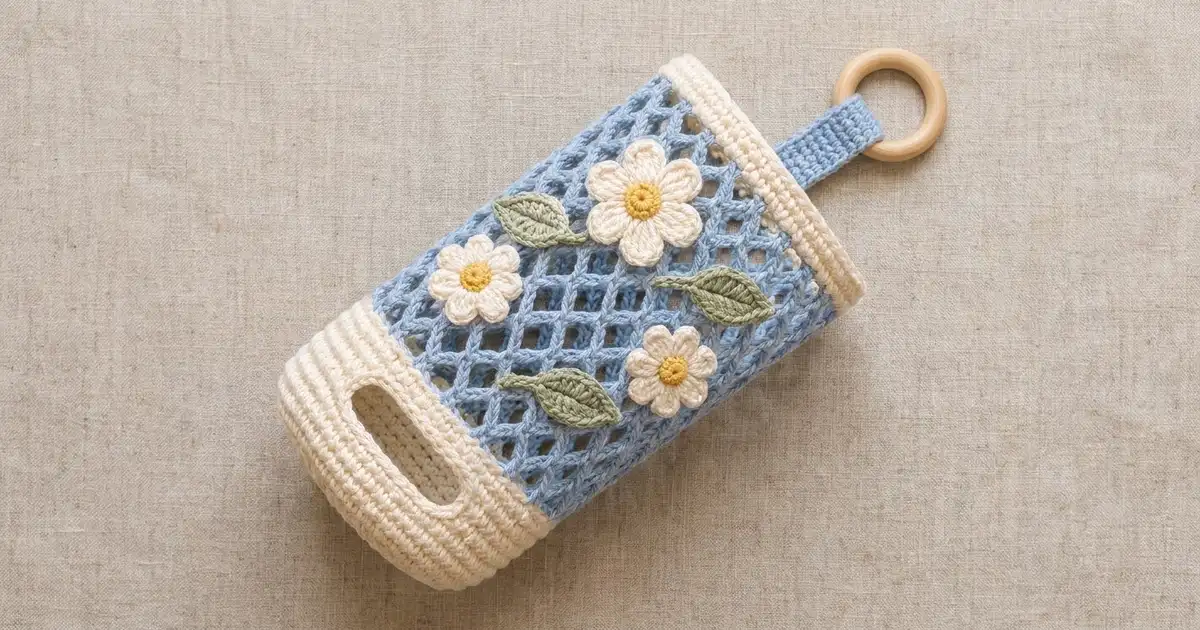
This hanging bag holder has a soft blue diamond-mesh body between a solid cream base and a solid cream top rim. Three cream daisies with golden centers and three sage-green leaves are sewn to the front. A blue strap loops over a natural wooden ring so it hangs neatly on a hook.
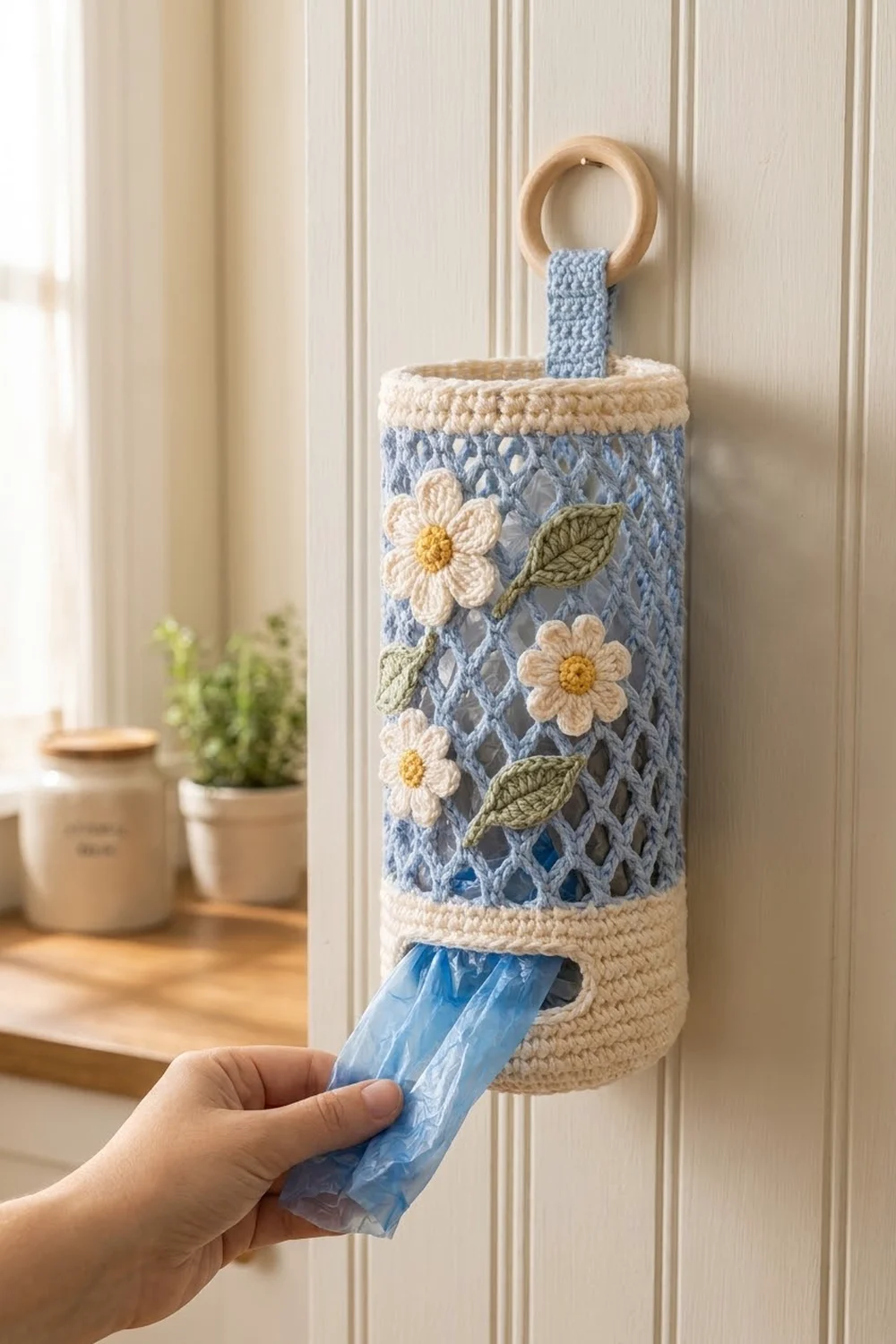
The colors are powder blue, cream, golden yellow, and sage green. The look is fresh and cottage-style. The mesh lets you see how many bags are left, and the solid base keeps them from slipping out. You stuff bags in at the top and pull them out through an oval slot in the cream base.
The pattern uses US crochet terms. The finished body is 4.75 in (12.1 cm) across, 15 in (38.1 cm) around, and 11.6 in (29.5 cm) tall, not counting the strap.
You crochet the body as one seamless tube from the bottom up: a flat circle base, solid single crochet walls with a built-in slot, 14 rounds of chain mesh, and a solid rim. Then you make a short strap, three daisies, and three leaves, and sew them on.
Finished Size and Construction
- Finished size: 4.75 in (12.1 cm) diameter x 11.6 in (29.5 cm) tall, plus strap
- Skill level: Easy-Intermediate
- Terminology: US
- Yarn weight: Worsted (#4) cotton
- Hook: 4.0 mm (US G-6)
- Number of pieces: 1 seamless body + 1 strap + 3 daisies (1 large, 2 small) + 3 leaves
- Layout: Appliqués on the front, upper half of the mesh; slot on the same side as the appliqués, in the base
- Body circumference: 60 stitches = 15 in (38.1 cm)
- Size before rim: 15 in (38.1 cm) around x 10.5 in (26.7 cm) tall
- Rim depth: 5 rounds = 1.1 in (2.8 cm)
Materials
Use a smooth worsted-weight cotton or cotton blend, about 175 m per 100 g. Cotton holds its shape and stands up to plastic bags being stuffed in and pulled out every day. Don’t use acrylic for the base, because it stretches and the slot will sag.
- Cream (A): 70 g, about 125 m (137 yd) for the base, rim, and petals
- Powder blue (B): 45 g, about 80 m (88 yd) for the mesh and strap
- Golden yellow (C): 5 g, about 9 m (10 yd) for the daisy centers
- Sage green (D): 8 g, about 14 m (15 yd) for the leaves
All quantities include a margin of about 15 percent.
Tools:
- 4.0 mm (US G-6) crochet hook
- Tapestry needle
- Stitch markers
- Wooden ring, 2 in (5.1 cm) outer diameter
- Rust-proof pins
- Measuring tape
- A cylinder about 4.5 in (11.4 cm) across for blocking (a large can or a rolled towel)
Abbreviations (US Terms)
- ch – chain
- sl st – slip stitch
- sc – single crochet
- hdc – half double crochet
- dc – double crochet
- sk – skip
- sp – space
- st(s) – stitch(es)
- BLO – back loop only
- MR – magic ring
- rnd(s) – round(s)
Special stitch – Mesh loop: Ch 5, then sc in the next ch-5 sp. One mesh loop is 1 in (2.5 cm) wide, measured sc to sc.
Gauge and Checkpoints
Solid gauge: 16 sc and 18 rnds = 4 in (10.2 cm).
Mesh gauge: 1 mesh loop = 1 in (2.5 cm) wide; 2 mesh rnds = 1 in (2.5 cm) tall.
Make the base circle (Rnds 1–10) first and use it as your gauge test. Its 60 stitches must measure 15 in (38.1 cm) around, which is about 4.75 in (12.1 cm) across.
Checkpoints:
- After Rnd 5 (30 sts): about 2.4 in (6.1 cm) across
- After Rnd 10 (60 sts): about 4.75 in (12.1 cm) across
- After Rnd 18 (slot round): wall is about 1.8 in (4.6 cm) tall above the ridge
- After Rnd 26: wall is about 3.5 in (8.9 cm) tall
- After 6 mesh rnds: mesh is about 3 in (7.6 cm) tall, with the tube relaxed
- After Rnd 40: body is about 10.5 in (26.7 cm) tall
- After Rnd 45: body is about 11.6 in (29.5 cm) tall
If your base is too big, go down to a 3.75 mm hook. If it’s too small, go up to a 4.5 mm hook. Don’t change the stitch counts: everything above the base depends on 60 stitches. If your mesh is too tall, pull each ch-5 a little tighter rather than changing the number of chains.
Body
Work in joined rounds. Join each round with a sl st to the first st, then ch 1. The ch 1 does not count as a stitch. Put a marker in the first st of every round.
Base Circle (Color A)
Rnd 1: 6 sc in MR. (6 sts)
Rnd 2: 2 sc in each st around. (12 sts)
Rnd 3: Sc in next st, 2 sc in next st; rep from * around. (18 sts)
Rnd 4: Sc in next 2 sts, 2 sc in next st; rep from * around. (24 sts)
Rnd 5: Sc in next 3 sts, 2 sc in next st; rep from * around. (30 sts)
Rnd 6: Sc in next 4 sts, 2 sc in next st; rep from * around. (36 sts)
Rnd 7: Sc in next 5 sts, 2 sc in next st; rep from * around. (42 sts)
Rnd 8: Sc in next 6 sts, 2 sc in next st; rep from * around. (48 sts)
Rnd 9: Sc in next 7 sts, 2 sc in next st; rep from * around. (54 sts)
Rnd 10: Sc in next 8 sts, 2 sc in next st; rep from * around. (60 sts)
Check: the base lies flat and measures 4.75 in (12.1 cm) across.
Base Wall with Slot (Color A)
Rnd 11: Sc in BLO of each st around. (60 sts) This makes a crisp ridge where the base turns up into the wall.
Rnds 12–17: Sc in each st around. (60 sts)
Rnd 18 (slot opening): Sc in next 23 sts, ch 14, sk next 14 sts, sc in next 23 sts. (23 sc + 14 ch + 23 sc = 60 sts)
Rnd 19: Sc in next 23 sts, sc in each of the 14 ch, sc in next 23 sts. (60 sts)
Rnds 20–26: Sc in each st around. (60 sts)
The slot is 14 sts wide, which is 3.5 in (8.9 cm). The bags push it open into an oval about 1 in (2.5 cm) tall. Mark the center of the slot (between the 7th and 8th skipped sts). That’s the front of the holder.
Fasten off Color A.
Slot edging: Join A with a sl st at the right end of the slot. Work 14 sc along the bottom edge, one in each of the Rnd 17 sts. Work 1 sc in the left corner. Work 14 sc along the top edge, into the underside of the Rnd 19 sts. Work 1 sc in the right corner. Join. (14 + 1 + 14 + 1 = 30 sts) Fasten off. This firm edge keeps the slot neat and makes the oval shape.
Diamond Mesh (Color B)
Rnd 27 (set-up): Join B with sc in the st above the slot center. *Ch 5, sk next 3 sts, sc in next st; rep from * 13 more times, ch 5, sk last 3 sts, sl st to first sc. (15 sc, 15 ch-5 sps)
Each loop covers 1 sc + 3 skipped sts, so 15 loops x 4 sts = 60 sts. The tube stays the same width.
Rnd 28: Sl st in next 2 ch, sc in same ch-5 sp, ch 5, sc in next ch-5 sp; rep from * 13 more times, ch 5, sl st to first sc. (15 ch-5 sps)
Rnds 29–40:* Rep Rnd 28. (15 ch-5 sps each round)
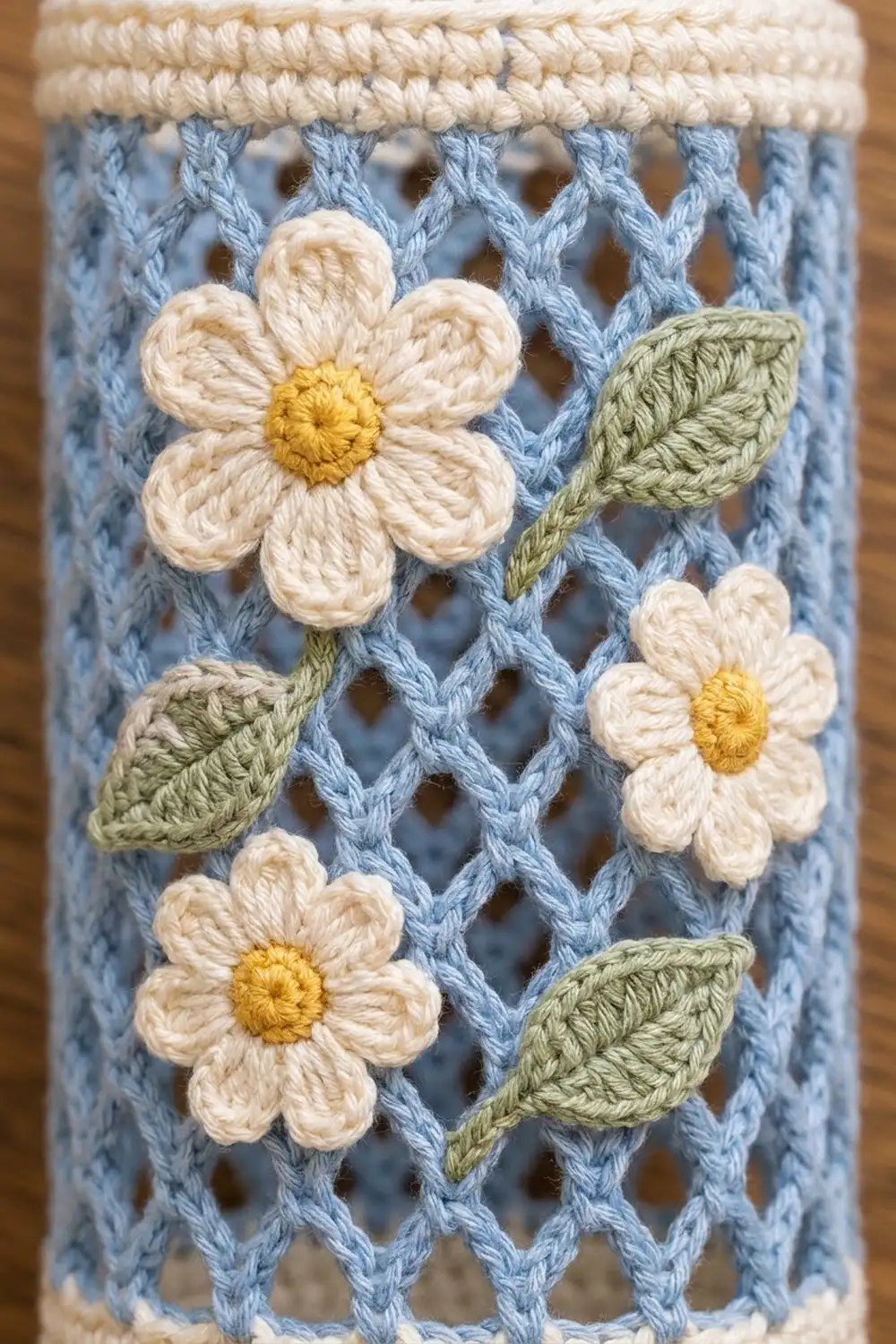
Because each sc lands in the center of the loop below, the loops stagger into diamonds. With 14 mesh rounds (Rnds 27–40), the mesh is 7 in (17.8 cm) tall. Fasten off B.
Strap (Color B)
Ch 7.
Row 1: Sc in 2nd ch from hook and in each ch across. (6 sts)
Rows 2–22: Ch 1, turn, sc in each st across. (6 sts)
The strap is 1.5 in (3.8 cm) wide and 4.9 in (12.4 cm) long. Fasten off and leave a 12 in (30.5 cm) tail.
Daisies
Large daisy (make 1):
Rnd 1: With C, 8 sc in MR. (8 sts)
Rnd 2: 2 sc in each st around. (16 sts) Join, fasten off C.
Rnd 3: Join A in any st. *(Hdc, 3 dc, hdc) in next st, sl st in next st; rep from * 7 more times. (8 petals, 6 sts per petal, 48 sts)
Fasten off and leave an 8 in (20.3 cm) tail. Finished size: 2.25 in (5.7 cm) across.
Small daisy (make 2):
Rnd 1: With C, 8 sc in MR. (8 sts) Join, fasten off C.
Rnd 2: Join A. *(Sc, hdc, 2 dc, hdc, sc) in next st; rep from * 7 more times. (8 petals, 6 sts per petal, 48 sts)
Fasten off and leave an 8 in (20.3 cm) tail. Finished size: 1.6 in (4.1 cm) across.
Leaves (Color D, make 3)
Ch 9.
Rnd 1: Starting in 2nd ch from hook, sl st, sc, hdc, dc, dc, hdc, sc (7 sts). Work 3 sc in the last ch (the leaf base). Rotate and work along the other side of the chain: sc, hdc, dc, dc, hdc, sc, sl st (7 sts). Sl st into the turning ch to make the pointed tip. (7 + 3 + 7 = 17 sts)
Each leaf is 1.75 in (4.4 cm) long. For the center vein, work a line of surface sl sts from the base to the tip with D. Leave an 8 in (20.3 cm) tail.
Assembly
- Strap: Fold 1 in (2.5 cm) of the strap over the wooden ring and whipstitch it to itself. Center the other end over the back of the rim, directly opposite the slot. Sew 1 in (2.5 cm) of it flat to the inside of the rim, through all 5 rim rounds. That leaves 2.9 in (7.4 cm) of strap showing between the rim and the ring.
- Appliqués: Lay the holder flat with the slot facing you. Pin the large daisy in the upper left of the mesh with a leaf to its upper right. Pin a leaf at mid-left with a small daisy to its right. Pin the second small daisy at lower left with the last leaf to its right. Keep everything within the mesh area, about 0.5 in (1.3 cm) below the rim and above the cream base.
- Sew each appliqué around its outer edge, catching the mesh bars behind it. Tack each petal tip down so it doesn’t snag on bags. Weave in all ends on the inside.
Top Rim (Border)
The rim is the border. It closes off the mesh and gives the opening a firm, rounded edge.
Border gauge: Same as the solid gauge: 16 sc and 18 rnds = 4 in (10.2 cm). The rim has 60 sts, or 15 sts per quarter of the circle. Each quarter is 3.75 in (9.5 cm).
Rnd 41 (conversion round): Join A in any sc of Rnd 40. Sc in sc, 3 sc in next ch-5 sp; rep from * around. Join. (15 sc worked into the existing sc + 45 sc added in the loops = 60 sts; 15 sts per quarter)
Rnds 42–45:* Sc in each st around. Join. (60 sts; 15 sts per quarter)
Fasten off and weave in the end.
Why the math works: The base wall has 60 sts. Rnd 27 turns those 60 into 15 loops of 4 sts each. Rnd 41 puts exactly 4 sts back into each loop (1 in the sc + 3 in the space), so you’re back to 60. The base and rim match stitch for stitch, so the tube is straight with no flare or pinch at either end. The 5 rim rounds measure 1.1 in (2.8 cm), which brings the body from 10.5 in (26.7 cm) to 11.6 in (29.5 cm).
Attach the strap (Assembly step 1) after the rim is finished.
Final Blocking
- Spritz the body with water until it’s damp but not soaking.
- Slide it over your 4.5 in (11.4 cm) cylinder or rolled towel. It should fill the tube without stretching it.
- Gently pull the mesh lengthwise until it measures 7 in (17.8 cm) and the diamonds are even.
- Press the base flat and shape the slot into a smooth oval.
- Pin the daisies and leaves flat on a towel before you sew them on. Open each petal and point each leaf tip.
- Let everything dry completely, usually 24 hours.
- Check the final measurements: 15 in (38.1 cm) around and 11.6 in (29.5 cm) tall.
Final Quality-Control Checklist
- Base Rnd 10 and rim Rnd 45 both have 60 sts.
- Every mesh round has 15 loops.
- The slot is 14 sts wide with a 30-st edging.
- The ridge from Rnd 11 runs evenly around the bottom.
- The strap is centered opposite the slot and sewn through all rim rounds.
- The large daisy has 8 petals; each small daisy has 8 petals.
- All petal tips and leaf tips are tacked down.
- All ends are woven in on the inside.
Troubleshooting
Base cups or ruffles: Your tension is off between rounds. Cupping means you’re crocheting too tightly; ruffling means you’re crocheting too loosely. Recheck your gauge.
Mesh leans in a spiral: You started a round in the wrong place. Always sl st across exactly 2 ch so the round starts in the center of a loop.
Tube narrows at the mesh: Your chains are too tight. Work the ch-5s more loosely, or use a hook one size larger for the mesh only.
Slot gapes or sags: Work the slot edging firmly, or add a second round of edging.
Rim flares: You worked more than 3 sc into some loops. Count to make sure you have 60 sts.
Holder tilts when hanging: Move the strap so it’s exactly opposite the slot center.
Care
Hand wash in cool water, reshape over a cylinder, and lay flat to dry. Don’t wring or tumble dry, because that will distort the mesh and slot.
Final Notes
The measurement chain is simple: 60 sts = 15 in (38.1 cm) around. That gives a 4.75 in (12.1 cm) base, a 3.5 in (8.9 cm) slotted wall, 7 in (17.8 cm) of 15-loop mesh, and a 1.1 in (2.8 cm) rim, for a total height of 11.6 in (29.5 cm). Check your base gauge first, and the rest follows. Add the strap, daisies, and leaves, and the holder is ready to hang.
Happy crocheting!