

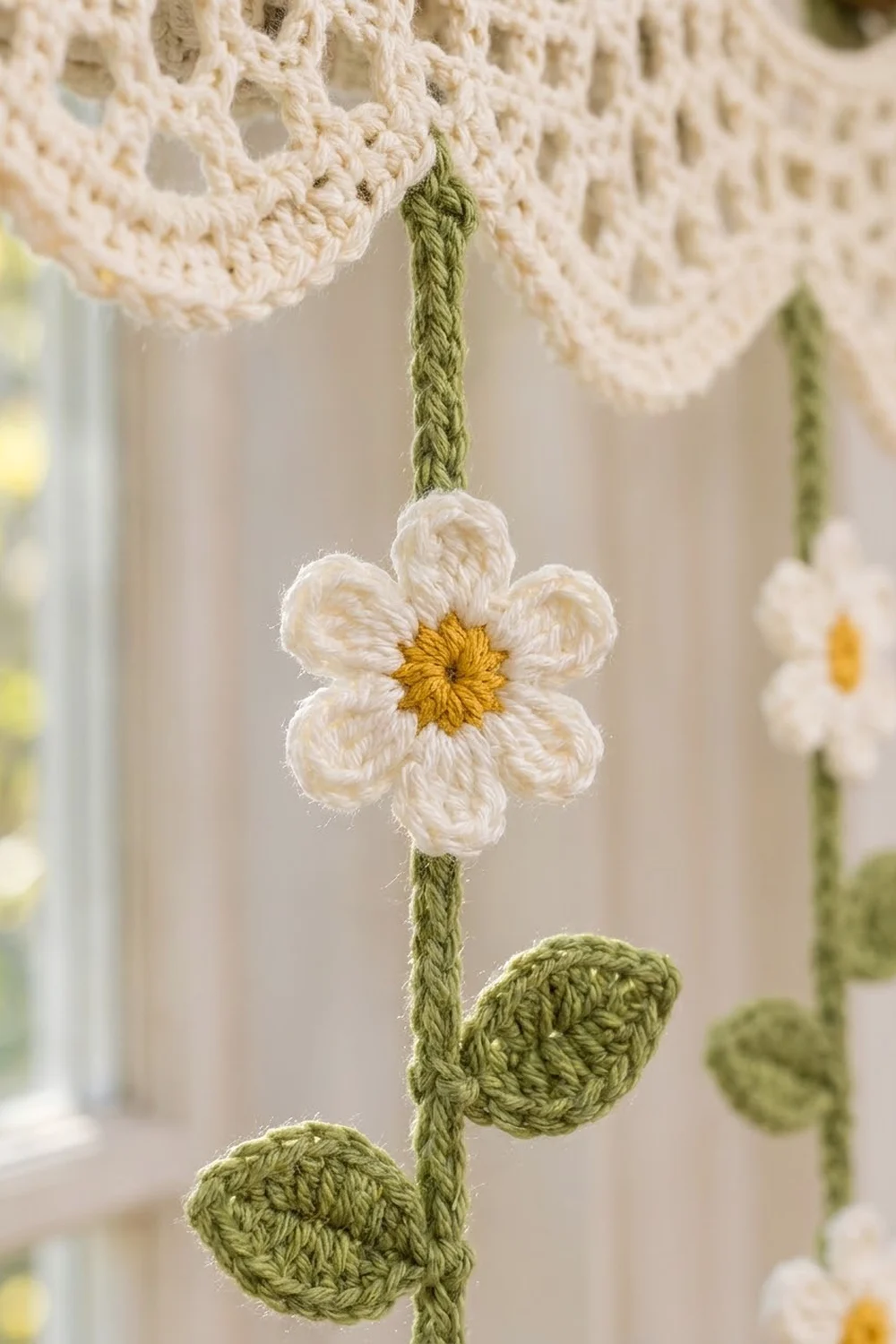
The Daisy Meadow Curtain is a light, airy window treatment. A cream lace valance with five soft scallops hangs from sage-green tabs. Below it hang five green vines, each with white daisies with sunny yellow centers, leaves on alternating sides, and a little green teardrop at the end.
The colors are calm and cottage-style: cream, sage, white and mustard. Light passes through the mesh and between the vines, so the window stays bright.
This pattern uses US crochet terms. The finished curtain is 30.75 in (78.1 cm) wide and 48 in (121.9 cm) long from the top of the valance to the teardrop tips, not counting the tab loops.
You crochet the valance flat from the top down, then work the scallops, border and tabs directly onto it. Each vine starts at its teardrop: you chain up, join to a scallop tip, and slip stitch back down. The daisies and leaves are made separately and sewn on.
Finished Size and Construction
- Finished size: 30.75 in (78.1 cm) wide x 48 in (121.9 cm) long
- Skill level: Intermediate
- Terminology: US
- Yarn weight: Worsted (#4) cotton
- Hook: 5.0 mm (H-8)
- Number of pieces: 1 valance (6 tabs worked on), 5 vines with teardrops, 25 daisies, 25 leaves
- Layout: 5 scallops across, 1 vine centered under each scallop, 6 tabs on top
- Valance size before border: 30.25 in (76.8 cm) wide x 6 in (15.2 cm) deep at the scallop tips
- Border depth: 0.5 in (1.3 cm) on the bottom, 0.25 in (0.6 cm) on the top and sides
- Valance size after border: 30.75 in (78.1 cm) x 6.75 in (17.1 cm)
- Vine length: 40 in (101.6 cm), plus a 1.25 in (3.2 cm) teardrop
Materials
Use a smooth worsted cotton, either mercerized or matte. Cotton keeps the scallops crisp, blocks well and won’t fuzz in a sunny window. The amounts below assume about 85 m per 50 g.
- Cream (valance): 200 g / 340 m
- Sage green (tabs, vines, leaves, teardrops): 100 g / 170 m
- White (petals): 50 g / 85 m
- Mustard yellow (centers): 25 g / 43 m
Tools:
- 5.0 mm (H-8) crochet hook
- Tapestry needle
- 10 locking stitch markers
- Rust-proof pins and a blocking mat or towel
- Measuring tape
- Spray bottle
All quantities include about 15 percent extra for your gauge swatch and sewing tails.
Abbreviations (US Terms)
- ch – chain
- sl st – slip stitch
- sc – single crochet
- hdc – half double crochet
- dc – double crochet
- st(s) – stitch(es)
- sp – space
- sk – skip
- MR – magic ring
- rep – repeat
- WS – wrong side
Mesh: dc, ch 1, sk 1 st. Each open square is 2 sts wide. In mesh rows, every dc and every ch-1 sp counts as 1 st.
Petal: (hdc, 3 dc, hdc) all in the same st.
Gauge and Checkpoints
- Valance gauge: 16 sts and 8 rows = 4 in (10.2 cm) in dc or mesh. That’s 4 sts and 2 rows per inch.
- Tab gauge: 16 sc and 18 rows = 4 in (10.2 cm).
- Chain gauge: 4 ch = 1 in (2.5 cm).
Make one daisy and one leaf before you start the valance to test your tension. Then measure the valance as you go:
- After Row 1: 30.25 in (76.8 cm) wide
- After Row 8: 4 in (10.2 cm) deep
- Row S1 of each scallop (25 sts): 6.25 in (15.9 cm) wide
- Row S4 of each scallop (13 sts): 3.25 in (8.3 cm) wide, 2 in (5.1 cm) below Row 8
- Daisy: yellow center 1 in (2.5 cm) across, whole flower 2.25 in (5.7 cm) across
- Leaf: 2 in (5.1 cm) long, 1 in (2.5 cm) wide
If your work is too big, go down 0.5 mm in hook size. If it’s too small, go up 0.5 mm. Never change the stitch counts, because the scallop and tab positions depend on them.
Valance Body
Use cream. A ch 3 at the start of a row counts as 1 dc. A ch 4 at the start of a mesh row counts as 1 dc + ch 1.
Foundation: Ch 123.
Row 1: Dc in 4th ch from hook and in each ch across. (121 sts)
Row 2 (mesh): Ch 4, turn, sk next st, dc in next st. *Ch 1, sk 1, dc in next st; rep from * across, ending with a dc in the top of the turning ch. (61 dc + 60 ch-1 sps = 121 sts)
Rows 3–7: Ch 4, turn, dc in next dc. *Ch 1, dc in next dc; rep from * across, ending with a dc in the 3rd ch of the turning ch. (121 sts in each row)
Row 8: Ch 3, turn, dc in each ch-1 sp and each dc across. (121 sts)
Fasten off. Checkpoint: 30.25 x 4 in (76.8 x 10.2 cm).
Place markers in Row 8 at sts 25, 49, 73 and 97. These are where the scallops meet. Each scallop uses 25 sts, and neighboring scallops share their end stitch: 5 x 24 + 1 = 121.
Scallops
Work each scallop separately, top to bottom, on these Row 8 stitches:
- Scallop 1: sts 1–25
- Scallop 2: sts 25–49
- Scallop 3: sts 49–73
- Scallop 4: sts 73–97
- Scallop 5: sts 97–121
Row S1: Join cream in the scallop’s first st. Ch 4, sk 1, dc in next st. *Ch 1, sk 1, dc in next st; rep from * to the scallop’s last st. (13 dc + 12 ch-1 sps = 25 sts)
Row S2: Turn, sl st in the first ch-1 sp and the next dc. Ch 4, dc in next dc. *Ch 1, dc in next dc; rep from * until 1 dc remains, then stop. Leave the last ch-1 sp and dc unworked. (11 dc + 10 sps = 21 sts)
Row S3: Work the same as Row S2. (9 dc + 8 sps = 17 sts)
Row S4 (solid): Turn, sl st in the first ch-1 sp and the next dc. Ch 3, then dc in each ch-1 sp and dc until 1 dc remains. Leave the last ch-1 sp and dc unworked. (13 sts)
Fasten off. Repeat for all 5 scallops. Each row starts 2 sts in from each end of the row before, which leaves a 2-st “step” at each end of Rows S1–S3. These steps make the scallop rounded.
Checkpoint: 30.25 in (76.8 cm) wide and 6 in (15.2 cm) deep at each scallop tip.
Make All Pieces
Daisies (make 25):
Rnd 1: With yellow, MR, ch 1, 6 sc in ring, sl st to first sc. (6 sts)
Rnd 2: Ch 1, 2 sc in each st, sl st to first sc. (12 sts) Fasten off yellow.
Rnd 3: Join white in any st. *Sl st in next st, petal in next st; rep from * 5 more times, then sl st in the first sl st. (6 petals: 30 petal sts + 6 sl sts) Fasten off, leaving a 12 in (30.5 cm) tail.
Leaves (make 25): With green, ch 8. Sc in 2nd ch from hook, hdc in next ch, dc in each of next 3 ch, hdc in next ch, then (sc, ch 2, sc) in the last ch for the tip. Turn the leaf and work along the other side of the chain: hdc in next ch, dc in each of next 3 ch, hdc in next ch, sc in last ch, sl st to first sc. (14 sts + ch-2 tip) Fasten off, leaving a 10 in (25.4 cm) tail.
Teardrop vines (make 5, don’t fasten off): With green, ch 5. Sc in 2nd ch from hook, hdc in next ch, dc in next ch, then 7 dc in the last ch for the round end. Turn the piece and work along the other side: dc in next ch, hdc in next ch, sc in next ch, sl st in the skipped ch at the point. (13 sts) Continue with ch 160 for the stem. Put the loop on a stitch marker to hold it.
Pieces per color: yellow for 25 centers; white for 25 petal rounds; green for 25 leaves, 5 teardrop vines and 6 tabs; cream for the valance and border.
Layout (front view):
T=tab  S=scallop  D=daisy  L=leaf  V=teardrop

T     T     T     T     T     T
[ S1 ][ S2 ][ S3 ][ S4 ][ S5 ]
   |     |     |     |     |
   D     D     D     D     D    ch 16
  L     L     L     L     L     ch 30
   D     D     D     D     D    ch 44
    L     L     L     L     L   ch 58
   D     D     D     D     D    ch 72
  L     L     L     L     L     ch 86
   D     D     D     D     D    ch 100
    L     L     L     L     L   ch 114
   D     D     D     D     D    ch 128
  L     L     L     L     L     ch 142
   V     V     V     V     V    ch 160
Border
Border gauge: 2 sc in each dc row end, and 1 sc in each stitch, including the 2 sts of each step.
Round 1 (cream): Join in a top corner. Sc in each of the 121 foundation ch across the top (121 sc). Work down the first side with 2 sc in each row end of Rows 1–8 (16 sc). Along the bottom, work each scallop like this:
- Down the side (14 sc): 2 sc in the S1 row end, 1 sc in each of the 2 step sts, 2 sc in the S2 row end, 1 sc in each of the 2 step sts, 2 sc in the S3 row end, 1 sc in each of the 2 step sts, then 2 sc in the S4 row end.
- Across the tip (13 sc): 1 sc in each st of S4.
- Up the other side (14 sc): Work the same as the first side, in reverse order.
That’s 41 sc per scallop, so 5 x 41 = 205 sc along the bottom. Work up the last side with 16 sc, then sl st to the first sc. The corners need no extra stitches, because each corner sc is already counted in its side.
Round 1 total: 121 + 16 + 205 + 16 = 358 sc.
Row 2 (bottom only): Sl st down the side to the first bottom sc. Hdc in each of the 205 bottom sc. (205 hdc) Fasten off.
Why the math works:
- The top has one sc for each foundation st, so it lies flat at 30.25 in (76.8 cm).
- A dc row is about as tall as 2 sc, so 2 sc per row end keeps the sides flat.
- Each scallop side has 7 short segments (4 row ends and 3 steps) with 2 sc each, which makes 14 sc. That’s enough to round the steps without making them ruffle.
- The 21st hdc of each scallop’s 41 (14 + 7) sits at the exact center of S4.
Mark that center hdc on each scallop. Counting from the first bottom hdc, they are hdc 21, 62, 103, 144 and 185.
Tabs
Use green. Work the tabs into the 121 top sc of Round 1, on sts 1–7, 22–28, 46–52, 70–76, 94–100 and 115–121. The positions are symmetrical, so you can count from either end. The four middle tabs are centered over the points where the scallops meet.
Row 1: Join in the tab’s first st, ch 1, sc in the same st and in the next 6 sts. (7 sts)
Rows 2–24: Ch 1, turn, sc in each st. (7 sts)
Fasten off, leaving a 12 in (30.5 cm) tail. Checkpoint: 1.75 in (4.4 cm) wide x 5.3 in (13.5 cm) long. Fold each tab to the WS and whipstitch Row 24 to the back of valance Row 2. The loops fit rods up to 1.25 in (3.2 cm) across.
Joining
Vines to valance: Insert the hook front to back through a marked center hdc and pull the vine’s held loop through. Sl st to secure it. Then sl st in the back bump of each of the 160 ch, working back down the vine. Sl st into the teardrop’s point and fasten off. The 5 vines hang 24 sts, or 6 in (15.2 cm), apart.
Keep your slip stitches loose. If you pull them tight, the vine gets shorter and twists.
Checkpoint: Let each vine hang. It should measure 40 in (101.6 cm) from the scallop tip to the teardrop, and all 5 should match within 0.5 in (1.3 cm).
Daisies and leaves: Count chains down from the scallop tip. Pin a daisy center at ch 16, 44, 72, 100 and 128. That’s every 28 ch, or 7 in (17.8 cm), starting 4 in (10.2 cm) below the tip. Pin a leaf base at ch 30, 58, 86, 114 and 142. Alternate the leaves left, right, left, right, left, with each tip angled downward. Use the tails to sew through the back of each daisy center and leaf base, catching only the back half of the vine.
Final Blocking
- Lay the valance face down.
- Pin the top edge straight to 30.75 in (78.1 cm).
- Pin each scallop tip 6.75 in (17.1 cm) below the top edge.
- Pin the points where the scallops meet so the V-dips match.
- Mist everything until it’s damp, but not soaked.
- Pin the daisies flat, with the petals open.
- Hang the vines straight, with a light clip on each teardrop.
- Let everything dry completely before you unpin it.
Final Quality-Control Checklist
- Rows 1–8 each have 121 sts
- All 5 scallops end with 13 sts in Row S4
- Round 1 has 358 sc and Row 2 has 205 hdc
- There are 6 tabs, each 7 sts wide, in the listed positions
- The vines are 40 in (101.6 cm) long and hang from the exact scallop centers
- Each vine has 5 daisies and 5 leaves at the listed chain counts
- All tails are woven in and hidden from the front
Troubleshooting
- Scallops ruffle: There are too many sc on the sides. Recount to 14 per side.
- Scallops cup: The border is too tight. Redo Round 1 with a hook 0.5 mm larger.
- Vines twist: Steam them and hang them with clips to dry. Keep your slip stitches looser next time.
- Petals curl: Pin them flat while they’re damp.
- Valance slants: You’ve lost a stitch. Recount each row to 121.
- Tabs too tight on the rod: Add 2 rows to each tab.
Care
Hand wash in cool water with mild soap. Press out the water in a towel and dry flat with the vines laid straight, and never machine dry.

Final Notes
Here’s how the measurements build on each other. At 4 sts per inch, 121 sts make 30.25 in (76.8 cm). The 8 body rows and 4 scallop rows make 6 in (15.2 cm). The border brings the valance to 30.75 x 6.75 in (78.1 x 17.1 cm). Add the 40 in (101.6 cm) vines and 1.25 in (3.2 cm) teardrops, and the full length is 48 in (121.9 cm). Check each measurement as you go, and the curtain will hang straight and even.
Happy crocheting!