

This curtain panel is all sunshine. A pale butter-yellow filet mesh lets the light pour through, sage-green vines climb the panel, and white daisies with golden centers bloom along the vines and across the hem. Soft scallops finish the bottom, and simple tabs slide straight onto a curtain rod.
The palette uses four colors: butter yellow for the panel, white for the petals, golden yellow for the daisy centers, and sage green for the vines and leaves. The look is cottage garden, but the construction is simple: open mesh, a few solid rows, and appliqués sewn on top.
This pattern uses US crochet terms. One finished panel measures 30 in (76.2 cm) wide and about 61 in (154.9 cm) long, from the top of the tab loops to the scallop points.
You work the panel in one piece from the top down. Then you add the scalloped hem and the tabs, surface crochet the vines, and sew on the daisies and leaves. The pattern makes one panel. For a matching pair like the one in the photo, make a second panel the same way.
Finished Size and Construction
- Finished size: 30 in (76.2 cm) x about 61 in (154.9 cm), tabs included
- Skill level: Intermediate
- Terminology: US crochet terms
- Yarn weight: DK / light (#3) cotton
- Hook: 4.0 mm (G-6)
- Number of pieces: 1 main panel (single piece), plus sewn appliqués: 22 daisies and 44 leaves
- Layout: 75 mesh squares wide, with 9 tabs, 5 vertical vines, and 7 hem daisies
- Size before border: 30 in (76.2 cm) x 56 in (142.2 cm)
- Border depth: 2 in (5.1 cm), scalloped, bottom edge only
- Tab loops: about 3 in (7.6 cm) tall
Materials
Use a smooth mercerized cotton or cotton blend in DK weight, about 115 m per 50 g. Cotton keeps the mesh crisp, blocks well, and holds up in a sunny window. Avoid fuzzy yarns because they blur the open squares.
- Color A, butter yellow (panel, hem, tabs): 750 g / 1725 m
- Color B, white (petals): 100 g / 230 m
- Color C, golden yellow (centers): 25 g / 58 m
- Color D, sage green (vines, leaves, tendrils): 125 g / 288 m
These quantities include about a 10% margin for swatching and differences in tension.
Tools: 4.0 mm (G-6) hook, tapestry needle, 10 stitch markers, rust-proof pins, a large padded blocking surface, a tape measure, a spray bottle, and scissors.
Abbreviations (US Terms)
- ch – chain
- sl st – slip stitch
- sc – single crochet
- hdc – half double crochet
- dc – double crochet
- st(s) – stitch(es)
- sp – space
- sk – skip
- RS / WS – right side / wrong side
Surface slip stitch: Hold the yarn behind the work. Insert the hook from front to back through a mesh space, then pull a loop to the front. Insert the hook into the next space and pull a loop through the fabric and the loop on the hook. This makes a chain-like line on the RS.
Turning chains: Ch 3 counts as 1 dc. Ch 5 on mesh rows counts as 1 dc plus ch 2.
Gauge and Checkpoints
Gauge: 10 mesh squares (30 sts) and 8 rows = 4 in (10.2 cm), lightly blocked. One square is 0.4 in (1.0 cm) wide, and one row is 0.5 in (1.3 cm) tall.
Make a test piece before you start the 226-stitch foundation. Ch 39, then work Row 1 as written below (37 sts). Work 8 rows of mesh for 12 squares. Block the swatch, let it dry, and measure the 10 center squares.
- Too big: go down a hook size.
- Too small: go up a hook size.
- Rows the wrong height: change how high you pull up the first loop of each dc. Row height controls where the vines and daisies land.
Checkpoints:
- After Row 3: 30 in (76.2 cm) wide, header 1.5 in (3.8 cm) deep
- After Row 16: 8 in (20.3 cm) long
- After Row 56: 28 in (71.1 cm) long (the halfway point)
- After Row 112: 30 in (76.2 cm) x 56 in (142.2 cm)
Measure flat, without stretching.
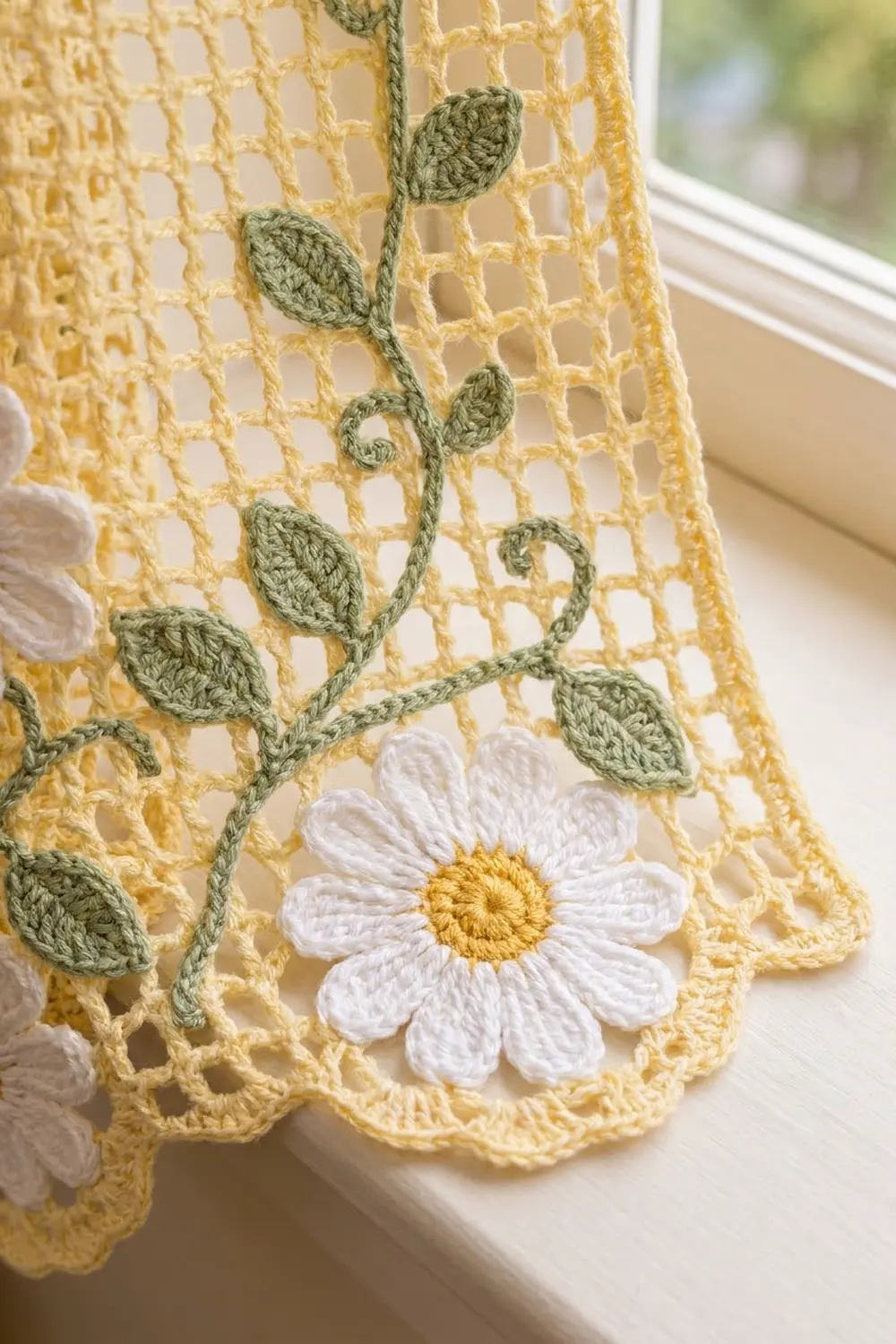
Main Panel
Use Color A and work from the top edge down.
Foundation: Ch 228.
Row 1: Dc in 4th ch from hook (the skipped ch count as 1 dc) and in each ch across. Turn. (226 sts)
Rows 2–3: Ch 3, dc in each st across, working the last dc in the top of the turning ch. Turn. (226 sts)
Row 4 (first mesh row): Ch 5, sk next 2 sts, dc in next st. Ch 2, sk next 2 sts, dc in next st; rep from * across, working the last dc in the top of the turning ch. Turn. (75 squares: 76 dc + 75 ch-2 sps = 226 sts)*
Rows 5–109: Ch 5, sk ch-2 sp, dc in next dc. Ch 2, sk ch-2 sp, dc in next dc; rep from * across, working the last dc in the 3rd ch of the turning ch. Turn. (75 squares, 226 sts)*
Mark Row 56 at the halfway checkpoint.
Row 110 (conversion row): Ch 3. 2 dc in next ch-2 sp, dc in next dc; rep from * across, working the last dc in the 3rd ch of the turning ch. Turn. (76 dc worked 1-per-existing-dc + 150 dc added in the 75 sps = 226 sts)*
Rows 111–112: Ch 3, dc in each st across. Turn. (226 sts)
Don’t fasten off. Go straight on to the Border section.
Tabs
Work the tabs into the free loops of the foundation chain. There are 9 tabs of 10 sts each, with 17 sts between tabs: 9 x 10 + 8 x 17 = 90 + 136 = 226. The tabs start on sts 1, 28, 55, 82, 109, 136, 163, 190, and 217, and the last tab ends exactly on st 226.
Row 1: Join Color A, ch 3, dc in next 9 loops. Turn. (10 sts)
Rows 2–12: Ch 3, dc in each st across. Turn. (10 sts)
Fasten off and leave a 12 in (30.5 cm) tail. Fold the tab to the WS and whipstitch its last row to the back of header Row 1. The 6 in (15.2 cm) strip makes a loop about 3 in (7.6 cm) tall that fits rods up to 1.5 in (3.8 cm) across. Each tab is about 1.3 in (3.3 cm) wide, and the gaps are about 2.3 in (5.8 cm).
Daisies (Make 22)
With Color C: Make a magic ring.
Rnd 1: Ch 1, 6 sc in ring, then join with a sl st. (6 sc)
Rnd 2: Ch 1, 2 sc in each st around, then join. (12 sc) Fasten off.
Rnd 3: Join Color B in any sc. Ch 7, sc in 2nd ch from hook, hdc in next ch, dc in next 3 ch, hdc in last ch, sl st in next sc; rep from * 11 more times. (12 petals, 6 sts each)*
Fasten off with a long tail. The center is about 1 in (2.5 cm) across, and the finished daisy is about 3.5 in (8.9 cm) across.
Leaves (Make 44)
With Color D: Ch 8. Sc in 2nd ch from hook, hdc in next ch, dc in next 3 ch, hdc in next ch, 3 sc in last ch. Working along the other side of the chain: hdc in next ch, dc in next 3 ch, hdc in next ch, sc in last ch, sl st in first sc. (9 + 6 = 15 sts)
Fasten off with a long tail. Each leaf is about 1.75 in (4.4 cm) long.
Vines and Placement
Counting from the right edge, the vines run up squares 8, 23, 38, 53, and 68. That places them 3 in (7.6 cm), 9 in (22.9 cm), 15 in (38.1 cm), 21 in (53.3 cm), and 27 in (68.6 cm) from the edge, 6 in (15.2 cm) apart.
Vines: With Color D, work surface slip stitch from Row 6 to Row 99, one st per square. Move one square sideways every 4 rows, alternating direction, to make a soft S-curve. Each vine is about 47 in (119.4 cm) long.
Tendrils (make 10): Ch 12, then work 2 sc in 2nd ch from hook and in each ch across. (22 sc) Each tendril twists into a curl about 2 in (5.1 cm) long. Sew 2 per vine at the curves.
Pin everything before you start sewing:
- Vine daisies (15): On vines 1, 3, and 5, center daisies on Rows 20, 50, and 80. On vines 2 and 4, center them on Rows 30, 60, and 90.
- Vine leaves (30): Sew 6 per vine on the outer edges of the curves.
- Hem daisies (7): Center these on Row 110, with the lower petals overlapping the scallops. Place them 2.1 in (5.3 cm), 6.4 in (16.3 cm), 10.7 in (27.2 cm), 15.0 in (38.1 cm), 19.3 in (49.0 cm), 23.6 in (59.9 cm), and 27.9 in (70.9 cm) from the right edge.
- Hem leaves (14): Tuck 2 behind each hem daisy.
Sew each daisy through Rnd 2 and the base of each petal, leaving the petal tips free. Catch only the dc posts and chains so no stitches show across the open squares.
Border
Border gauge: One scallop uses 15 sts of Row 112, which is 2 in (5.1 cm). The 3 border rows add 2 in (5.1 cm) of depth.
Row 1: Ch 1, turn, sc in first st. Ch 5, sk next 4 sts, sc in next st; rep from * across. Turn. (46 sc + 45 ch-5 loops)*
Row 2: Ch 1, sc in first sc. Ch 2, sc in next loop, 11 dc in next loop, sc in next loop, ch 2, sc in next sc; rep from * across. Turn. (1 + 15 x 18 = 271 sts)*
Row 3: Ch 1, sc in first sc. 2 sc in ch-2 sp, sk sc, (dc in next dc, ch 1) 10 times, dc in next dc, sk sc, 2 sc in ch-2 sp, sc in next sc; rep from * across. (1 + 15 x 26 = 391 sts)* Fasten off.
Why the math works: Each Row 1 repeat uses 5 sts, and 1 + 45 x 5 = 226, so Row 1 ends on the last st. Each scallop uses 3 loops, and 45 / 3 = 15 scallops. The scallops cover 15 x 15 = 225 sts plus the first st, so the hem stays 30 in (76.2 cm) wide without ruffling.
Final Blocking
- Weave in all ends, hiding them in solid rows or vine stitches.
- Soak the panel in cool water with a mild wash, then roll it in a towel to press out the water.
- Lay it RS down on a padded surface.
- Pin the top edge straight at 30 in (76.2 cm).
- Pin the sides to 56 in (142.2 cm), placing a pin every 4 in (10.2 cm).
- Pin out each of the 15 scallop points. The total from the top edge to the points should be 58 in (147.3 cm).
- Straighten the mesh columns against a ruler.
- Mist the petals and leaves and shape them.
- Let the panel dry completely before you unpin it.
Final Quality-Control Checklist
- Each mesh row has 75 squares and 226 sts.
- The panel is 30 in (76.2 cm) x 56 in (142.2 cm) before the border.
- There are 15 even scallops.
- All 9 tabs are level and the same length.
- The 5 vines are 6 in (15.2 cm) apart.
- All 22 daisies have 12 petals, and all 44 leaves are secure.
- No yarn ends show through the mesh.
Troubleshooting
- Edges slant: You skipped the last dc. Count 76 dc on each mesh row.
- Squares are tall: Use a smaller hook or shorter dc.
- Hem ruffles or pulls in: Recount to 45 loops in Border Row 1, and adjust how loosely you chain.
- Vine puckers: Your surface stitches are too tight. Rework them more loosely.
- Petals curl: Mist them and pin them flat.
Care
Hand wash in cool water and dry flat, reshaping the scallops while the panel is damp. Avoid the dryer.

Final Notes
The measurements work as a chain: 10 squares and 8 rows = 4 in (10.2 cm), 75 squares = 30 in (76.2 cm), and 112 rows = 56 in (142.2 cm). Add a 2 in (5.1 cm) hem and 3 in (7.6 cm) tabs, and you get a panel 30 in (76.2 cm) x about 61 in (154.9 cm). If your gauge matches, the vines and daisies will fall into place.
Happy crocheting!