

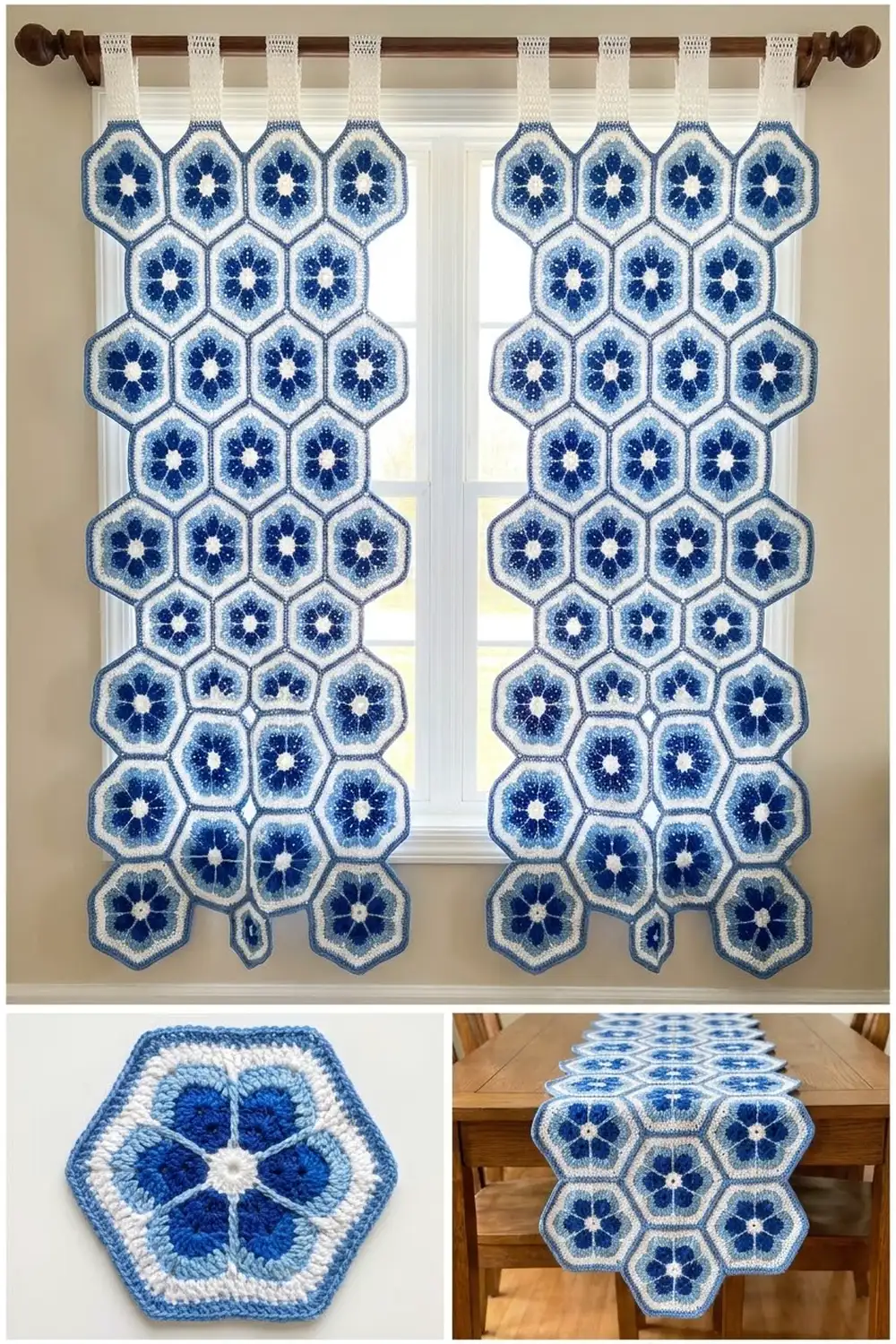
The Delft Bloom curtain brings a blue-and-white tile look to a sunny window. Each hexagon opens from a crisp white center into small dark-blue petals and wide light-blue wedges. A white round frames them, and a slim medium-blue outline finishes each motif. Joined in offset columns, the motifs form a honeycomb lace that glows when light comes through it.
The palette is four shades: white, dark blue, light blue and medium blue. The style is cottage-classic and a little coastal, and it reads clearly from across the room. This pattern uses US crochet terms throughout.
One finished panel measures about 32.7 in (83.1 cm) wide, point to point, by 80.8 in (205.2 cm) long, plus tabs. Make two panels for a pair.
Construction is simple and well ordered. You make 109 hexagons in rounds and 6 white half-hexagon fillers in rows. You whipstitch the pieces into 7 columns and add a two-round border. Last, you sew on 6 lacy tabs.
Finished Size and Construction
- Finished panel: 32.7 in (83.1 cm) wide x 80.8 in (205.2 cm) long, without tabs
- Skill level: Intermediate
- Terminology: US
- Yarn weight: Worsted (#4) cotton
- Hook: 5.0 mm (H-8)
- Pieces per panel: 109 hexagons, 6 half-hexagons, 6 tabs
- Layout: 7 offset columns. Columns 1, 3, 5 and 7 have 16 hexagons each. Columns 2, 4 and 6 have 15 hexagons each, plus a half-hexagon at the top and bottom.
- Hexagon size: 5 in (12.7 cm) flat to flat, 5.8 in (14.7 cm) point to point, sides 2.9 in (7.4 cm)
- Size before border: 31.9 in (81.0 cm) x 80 in (203.2 cm)
- Border depth: 0.4 in (1.0 cm)
- Tabs: 2.9 in (7.4 cm) wide, and each loop stands about 2.5 in (6.4 cm) above the top edge
Materials
Choose a smooth, mercerized or combed worsted cotton with about 155 m per 100 g. Cotton drapes well, holds its shape when blocked, and resists sun fading better than most acrylics. Quantities below are for one panel, so double them for a pair.
- Color A, White: 600 g / 930 m
- Color B, Dark Blue: 150 g / 233 m
- Color C, Light Blue: 325 g / 504 m
- Color D, Medium Blue: 500 g / 775 m
These quantities include a margin of about 20% for swatching, tails and tension differences.
Tools:
– 5.0 mm (H-8) crochet hook
– Tapestry needle
– Locking stitch markers
– Blocking mats, rust-proof pins and a spray bottle
– Measuring tape
– A 5 in (12.7 cm) hexagon template cut from card (optional, but very helpful)
Abbreviations (US Terms)
- ch – chain
- sl st – slip stitch
- sc – single crochet
- dc – double crochet
- sc2tog – single crochet 2 together
- rsc – reverse single crochet (crab stitch)
- MR – magic ring
- sp(s) – space(s)
- st(s) – stitch(es)
- beg – beginning
- rep – repeat
- RS – right side
Special stitches
- Cluster (cl): Yarn over, insert hook in the indicated sp, pull up a loop, yarn over, pull through 2 loops. Rep from * once more in the same sp, then yarn over and pull through all 3 loops.
- Beg cl: Ch 2, then work 1 dc in the same sp. Together these count as 1 cl.
- rsc: Work left to right. Insert the hook in the next st to the right, pull up a loop, then yarn over and pull through both loops.
Gauge and Checkpoints
Make one complete hexagon and block it before you start the full set. Gauge matters here, because every hexagon error is multiplied 16 times down the length of the panel.
Hexagon checkpoints (after blocking):
- After Round 1: 1.5 in (3.8 cm) diameter
- After Round 2: 2.5 in (6.4 cm) across
- After Round 3: 3.5 in (8.9 cm) flat to flat
- After Round 4: 4.5 in (11.4 cm) flat to flat
- After Round 5: 5 in (12.7 cm) flat to flat, with each side 2.9 in (7.4 cm)
Half-hexagon checkpoint: Row 1 measures 5.8 in (14.7 cm), and the finished height is 2.5 in (6.4 cm).
If your hexagon is too big, switch to a 4.5 mm hook. If it is too small, switch to a 5.5 mm hook. Aim for a tolerance of 1/8 in (0.3 cm). If each hexagon is off by just 1/4 in (0.6 cm), the panel length changes by 4 in (10.2 cm).
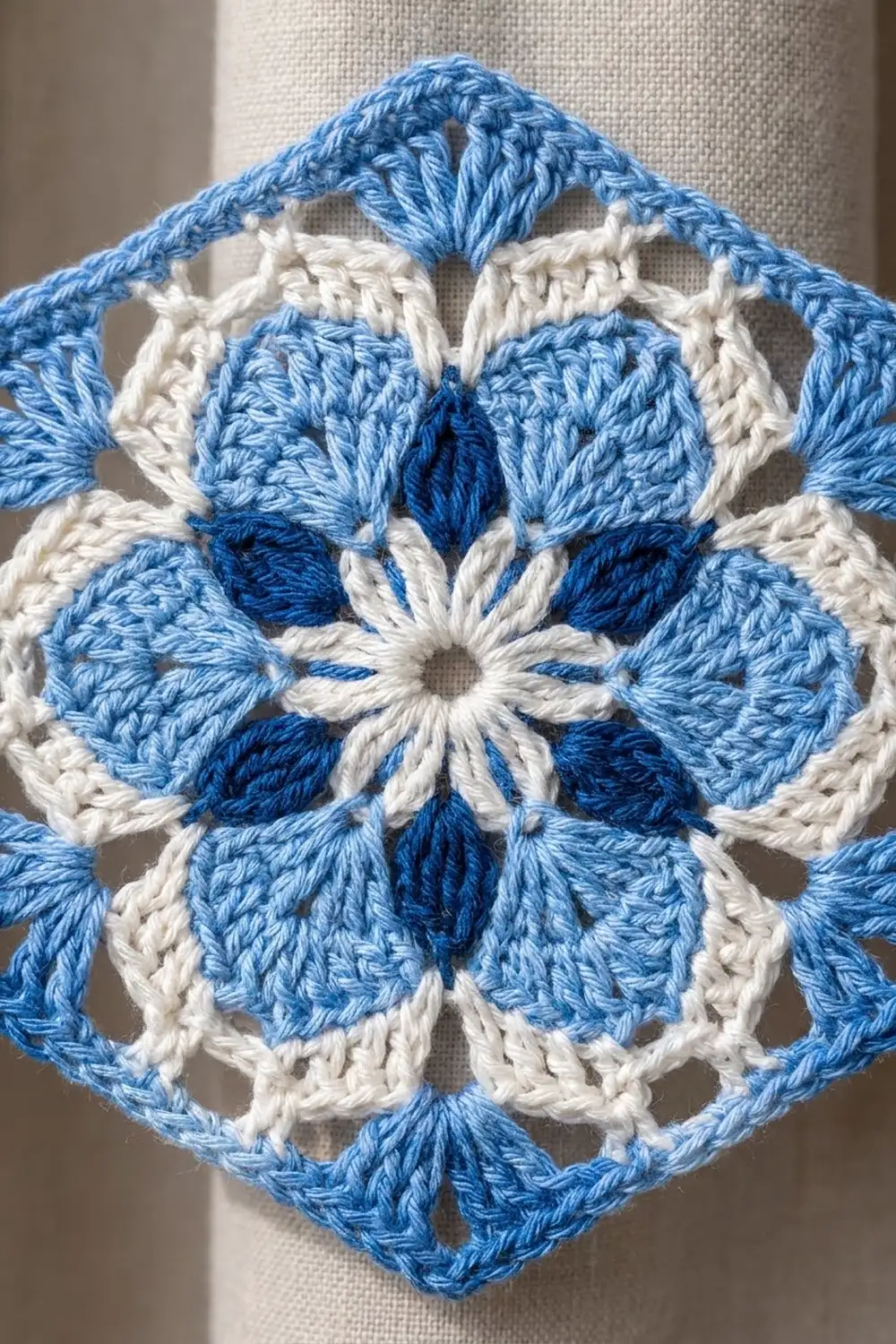
Hexagon Motif (Make 109)
Fasten off at the end of each round and join the next color with a standing stitch or a sl st.
Round 1 (A, white): MR, ch 3 (counts as dc), 11 dc in ring, sl st to top of ch-3. [12 dc] Pull the ring tight and fasten off.
Round 2 (B, dark blue): Join in any sp between 2 dc. Work beg cl in the same sp, then ch 3 and skip the next sp. Cl in the next sp, ch 3, skip the next sp. Rep from * 4 more times. Sl st to top of beg cl. [6 cl, 6 ch-3 sps] These are the small dark petals.
Round 3 (C, light blue): Join in any ch-3 sp. Ch 3 (counts as dc), then work (2 dc, ch 2, 3 dc) in the same sp. (3 dc, ch 2, 3 dc) in the next ch-3 sp. Rep from * 4 more times. Sl st to top of ch-3. [36 dc, 6 ch-2 corner sps] Each group forms a wide light-blue wedge, and its ch-2 tip becomes a hexagon corner.
Round 4 (A, white): Join in any ch-2 corner sp. Ch 3 (counts as dc), then work (ch 2, dc) in the same sp. Dc in each of the next 6 dc, then (dc, ch 2, dc) in the next ch-2 sp. Rep from * 4 more times. Dc in each of the last 6 dc, then sl st to top of ch-3.
[48 dc = 36 worked 1-per-st + 12 added in corners; 8 dc per side; 6 ch-2 sps]
Round 5 (D, medium blue): Join in any ch-2 corner sp. Ch 1, then work (sc, ch 1, sc) in the same sp. Sc in each of the next 8 dc, then (sc, ch 1, sc) in the next ch-2 sp. Rep from * 4 more times. Sc in each of the last 8 dc, then sl st to the first sc.
[60 sc = 48 worked 1-per-st + 12 added in corners; 6 ch-1 corner sps]
Stitches per side: 10 sc, which includes the 2 corner sc of that side. The ch-1 corner sps sit between sides.
Weave in all tails on the wrong side. Do this as you go, not at the end.
Half-Hexagon Filler (Make 6)
This is the lower half of a hexagon, cut through its points. It is worked in rows with A (white).
Ch 21.
- Row 1: Sc in 2nd ch from hook and in each ch across, turn. [20 sc]
- Row 2: Ch 1, sc2tog, sc in each st to the last 2 sts, sc2tog, turn. [18 sc]
- Row 3: Ch 1, sc in each st across, turn. [18 sc]
- Rows 4–9: Rep Rows 2–3 three more times. [Row 4: 16 sc, Row 5: 16 sc, Row 6: 14 sc, Row 7: 14 sc, Row 8: 12 sc, Row 9: 12 sc]
- Row 10: Rep Row 2. [10 sc]
Fasten off.
Edge counts:
– Long edge (Row 1): 20 sts, the length of 2 hexagon sides
– Short edge (Row 10): 10 sc
– Each slanted edge: 10 row-ends
Tabs (Make 6)
Work with A (white).
Ch 11.
- Row 1: Sc in 2nd ch from hook and in each ch across, turn. [10 sc]
- Row 2: Ch 3 (counts as dc), dc in the next 2 sts, ch 1, skip 1, dc in the next 2 sts, ch 1, skip 1, dc in the last 3 sts, turn. [8 dc + 2 ch-1 sps = 10 sts]
- Row 3: Ch 1, sc in each dc and each ch-1 sp across, turn. [10 sc]
- Rows 4–15: Rep Rows 2–3 six more times.
Fasten off. The tab measures 2.9 in (7.4 cm) x about 6.25 in (15.9 cm).
Make All Pieces
| Piece | Quantity | Colors |
|---|---|---|
| Hexagon | 109 | A, B, C, A, D (Rounds 1–5) |
| Half-hexagon | 6 | A |
| Tab | 6 | A |
The 109 hexagons are 4 columns of 16 plus 3 columns of 15 (64 + 45 = 109).
Layout grid (H = full hexagon, h = half-hexagon). Even columns sit half a hexagon lower than odd columns:
Col:   1     2     3     4     5     6     7
       H1    h     H1    h     H1    h     H1
       H2    H1    H2    H1    H2    H1    H2
       H3    H2    H3    H2    H3    H2    H3
       ...   ...   ...   ...   ...   ...   ...
       H16   H15   H16   H15   H16   H15   H16
             h           h           h
In each even column, the top half-hexagon has its long edge facing up. The bottom one is flipped, with its long edge facing down.
Joining
Method: Flat whipstitch with D, RS facing up. Go through the back loops of the facing sc on both pieces, 1 stitch per pair. At each 3-way meeting point, pass the needle through the meeting ch-1 corner sps together, so no holes form.
Step 1: Join each column.
– Odd columns: Join the bottom side of each hexagon to the top side of the next one, 10 sc to 10 sc. That makes 15 seams per column.
– Even columns: Join the short edge (Row 10) of a half-hexagon to the top side of H1, 10 sc to 10 sc. Join H1 through H15 the same way. Then add the second half-hexagon below H15, with its long edge facing down. That makes 16 seams per column.
Step 2: Join the columns together. Work along the zigzag edge between each pair of columns.
– Each slanted side of an odd-column hexagon meets a slanted side of the even-column hexagon beside it, 10 sc to 10 sc.
– Where an odd-column hexagon meets a half-hexagon, work 1 whipstitch per row-end, 10 row-ends to 10 sc.
– Each column boundary takes 32 slanted seams. The odd side offers 16 x 2 = 32 sides, and the even side offers 15 x 2 + 2 = 32.
Tension: Keep the stitches snug but not tight. Lay the joined section flat every few seams; it should not pucker or wave. Use the same tension on every seam so the hexagon points stay sharp.
Size checkpoint: The joined panel measures 31.9 in (81.0 cm) point to point and 80 in (203.2 cm) long. The straight top edge measures 29 in (73.7 cm).
Border
Border gauge: Round 1 adds 0.25 in (0.6 cm) and Round 2 adds 0.15 in (0.4 cm), for 0.4 in (1.0 cm) total. Work both rounds with D.
Edge landmarks:
– Top and bottom edges: 4 hexagon sides plus 3 half-hexagon long edges.
– Long sides: The 16 hexagons of column 1 (or column 7) show 2 slanted sides each. Each hexagon also has a point that sticks out (its ch-1 sp), and there are 15 notches where neighboring hexagons meet.
– Panel corners: The outer top and bottom corners of the first and last hexagons. There are 4.
Round 1 (sc): Join at the top edge. Work 1 sc in each sc and each foundation stitch, and follow these rules:
- Top straight seams: Skip the hexagon ch-1 corner sp where a hexagon meets a half-hexagon.
- Panel corners and side points: Work (sc, ch 1, sc) in the ch-1 sp.
- Notches: Sc2tog, working the first leg in the ch-1 sp of one hexagon and the second leg in the ch-1 sp of the next.
Round 1 counts:
– Top edge: (4 x 10) + (3 x 20) = 100 sc worked 1-per-st, plus 0 added = 100
– Each long side: 16 x 20 = 320 sc worked 1-per-st, plus 32 sc in the 16 points and 15 sc2tog = 367 sts and 16 ch-1 sps
– Bottom edge: 100
– 4 corners: 2 sc + 1 ch-1 sp each = 8 sc
– Round total: 840 worked 1-per-st + 8 + 32 + 32 + 30 = 942 sts, plus 36 ch-1 sps
Sl st to the first sc. Do not turn.
Round 2 (crab stitch): Ch 1. Work 1 rsc in each st and 1 rsc in each ch-1 sp all the way around, then sl st to the first rsc.
Round 2 counts:
– Top and bottom: 100 each
– Each long side: 367 + 16 = 383
– Corners: 3 each
– Round total: 942 + 36 = 978 rsc
Why the math works: Working 1 sc per edge stitch keeps the border the same length as the pieces, so the edges cannot ruffle or draw in. The extra sc at points and corners give the outer turns room to spread. The sc2tog removes fullness at the notches, where the edge curves inward. Round 2 adds only 1 rsc per space and no other increases, so it stays flat and corded.
Attach tabs: Space the 6 tabs across the 100 top stitches as 10-8-10-8-10-8-10-8-10-8-10 (6 x 10 + 5 x 8 = 100). There is a tab at each end. Fold each tab in half. Sew 0.5 in (1.3 cm) of one end to the front of the top edge and the other end to the back. Each loop fits a rod up to 1.5 in (3.8 cm) in diameter.
Final Blocking
- Soak the panel in cool water for 15 minutes, then press the water out gently. Do not wring it.
- Roll the panel in towels to remove excess water.
- Lay it flat on blocking mats and work in sections. Use your template to set each hexagon at 5 in (12.7 cm) flat to flat.
- Pin every hexagon point along both long sides.
- Pin the top and bottom edges straight with a measuring tape, at 29 in (73.7 cm) plus the border.
- Check that the total length is 80.8 in (205.2 cm).
- Let the panel dry completely, which takes 24 to 48 hours, then unpin.
Final Quality-Control Checklist
- All 109 hexagons measure 5 in (12.7 cm), within 1/8 in (0.3 cm).
- Every hexagon has 60 sc and 6 ch-1 sps in Round 5.
- Every half-hexagon tapers from 20 to 10 sts over 10 rows.
- No holes show at the 3-way meeting points.
- Border Round 1 has 942 sts and Round 2 has 978 rsc.
- The top and bottom edges are straight and the side points are sharp.
- All 6 tabs are evenly spaced and sewn front and back.
- The panel measures 32.7 in (83.1 cm) x 80.8 in (205.2 cm).
- All tails are woven in securely.
Troubleshooting
- The hexagon cups: Round 3 or 4 is too tight. Loosen your dc tension or go up a hook size.
- The hexagon ruffles: You may have worked 2 dc on each side of a corner in Round 4. Each corner takes just (dc, ch 2, dc).
- The half-hexagon slants unevenly: Decrease only on even rows, and at both ends of the row.
- The seams pucker: Whipstitch more loosely, and use exactly 1 stitch per matching pair.
- The border ruffles at the points: Work exactly 2 sc per point. Do not add an extra stitch there.
- The border cups at the notches: Check that each notch has a sc2tog, not 2 separate sc.
- The panel is too long: Re-block the hexagons slightly shorter, or remove a row of hexagons before you add the border.
Care
Hand wash in cool water with mild soap, roll in a towel and dry flat. Re-block if needed. To limit sun fading, rotate the panels occasionally.
Final Notes
The measurement chain for this curtain is short and reliable:
- One 5 in (12.7 cm) hexagon, with 10 sc per side at 2.9 in (7.4 cm)
- 16 hexagons per column, giving 80 in (203.2 cm) of length
- 7 offset columns, giving 31.9 in (81.0 cm) of width from point to point
- A 0.4 in (1.0 cm) border, bringing the panel to 32.7 in (83.1 cm) x 80.8 in (205.2 cm)
Check the first hexagon carefully and the rest will follow. Happy crocheting!