

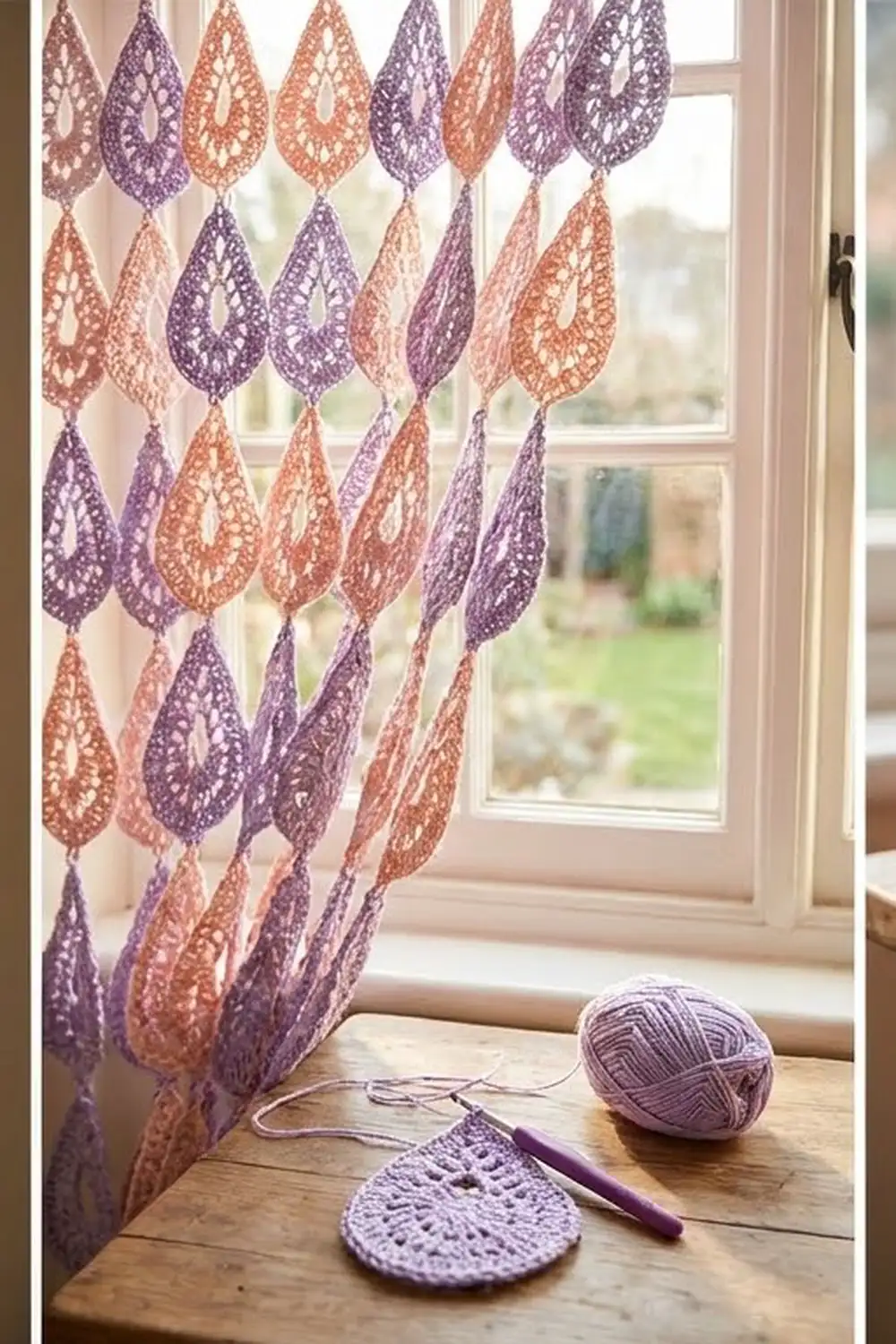
The Dewdrop Garden Curtain is a light, airy window hanging made from chains of open teardrop motifs. Every teardrop points upward, with a rounded, weighted bottom and a crisp point that links straight into the drop above. When sunlight passes through the open centers, it casts a row of little drop-shaped shadows on the floor.
The sample alternates lavender and soft peach strands across the rod: lavender, peach, lavender, peach, and so on, for 8 strands in total. The look is soft, modern, and a little retro. It works in a nursery, a sunroom, a doorway, or as a room divider.
This pattern uses US crochet terms. The finished curtain is 27.25 in (69.2 cm) wide on the rod and 59 in (149.9 cm) long from the top of the rod to the bottom tip of the last motif.
Construction is simple. Each teardrop is worked in three rounds around a chain ring. Motifs are joined as you go, top to bottom, with a short chain link at each point. The top motif of each strand gets a covered hanging loop. You don’t sew anything and there are no seams to hide.
Finished Size and Construction
- Finished size: 27.25 in (69.2 cm) wide x 59 in (149.9 cm) long
- Skill level: Easy
- Terminology: US crochet terms
- Yarn weight: Worsted (#4), cotton or cotton blend
- Hook: US H-8 (5 mm)
- Number of pieces: 96 teardrop motifs (48 lavender, 48 peach)
- Layout: 8 strands x 12 motifs, colors alternating strand by strand
- Piece size: 2.75 in (7.0 cm) wide x 4.25 in (10.8 cm) tall per motif
- Strand length: 56.5 in (143.5 cm) of motifs, plus a 2.5 in (6.4 cm) loop drop
- Size before border: the curtain has no edge border, so the strand length is the final length
- Border depth: none. The only finishing is the hanging loop on the top motif of each strand.
Materials
Yarn advice: Use a smooth, firmly plied worsted cotton or cotton blend, about 170 m per 100 g. Cotton keeps the teardrop point sharp and hangs straight without stretching. Avoid fuzzy or very stretchy acrylics, because the long strands will slowly grow.
- Lavender: approx. 190 g (320 m / 350 yd)
- Peach: approx. 190 g (320 m / 350 yd)
Each motif uses about 5.5 m (6 yd), about 3 g. Each hanging loop uses about 1.5 m (1.6 yd). The quantities above include a margin of about 15% for gauge swatches, tails, and small tension differences.
Tools:
- US H-8 (5 mm) crochet hook
- Tapestry needle
- Locking stitch markers (at least 2)
- Scissors
- Measuring tape
- Blocking mat, rust-proof pins, and a spray bottle
- Wooden curtain rod, at least 30 in (76.2 cm) long and about 1.25 in (3.2 cm) in diameter, with brackets
- Optional: a cardboard teardrop template, 2.75 x 4.25 in (7.0 x 10.8 cm)
Abbreviations (US Terms)
- ch – chain
- sl st – slip stitch
- sc – single crochet
- hdc – half double crochet
- dc – double crochet
- st(s) – stitch(es)
- rnd – round
- [ ] x times – repeat the bracketed steps the stated number of times
Special technique: Point connector. Ch 2, sl st in the marked gap at the bottom center of the motif above, ch 2, sl st in the first sc of the current round. The connector joins two motifs and is not counted in the stitch total.
Gauge and Checkpoints
Gauge: 14 dc = 4 in (10.2 cm) worked flat with a 5 mm hook. Gauge matters more than usual here, because any error is multiplied by 12 motifs in every strand.
Test one motif first. Work Rounds 1–3 and measure before starting a full strand.
- After Rnd 1: the chain ring should lie as a loose circle, not twisted.
- After Rnd 2: about 2 in (5.1 cm) wide x 3 in (7.6 cm) tall. The open center is about 1.25 in (3.2 cm) wide.
- After Rnd 3: 2.75 in (7.0 cm) wide x 4.25 in (10.8 cm) tall, measured from point to bottom.
If your motif is too big (more than 0.25 in / 0.6 cm over in either direction), go down half a hook size. Twelve oversized motifs can add 3 in (7.6 cm) or more to each strand.
If your motif is too small, go up half a hook size. Also check that you are not pulling the ch 24 ring too tight. A tight ring closes up the open center.
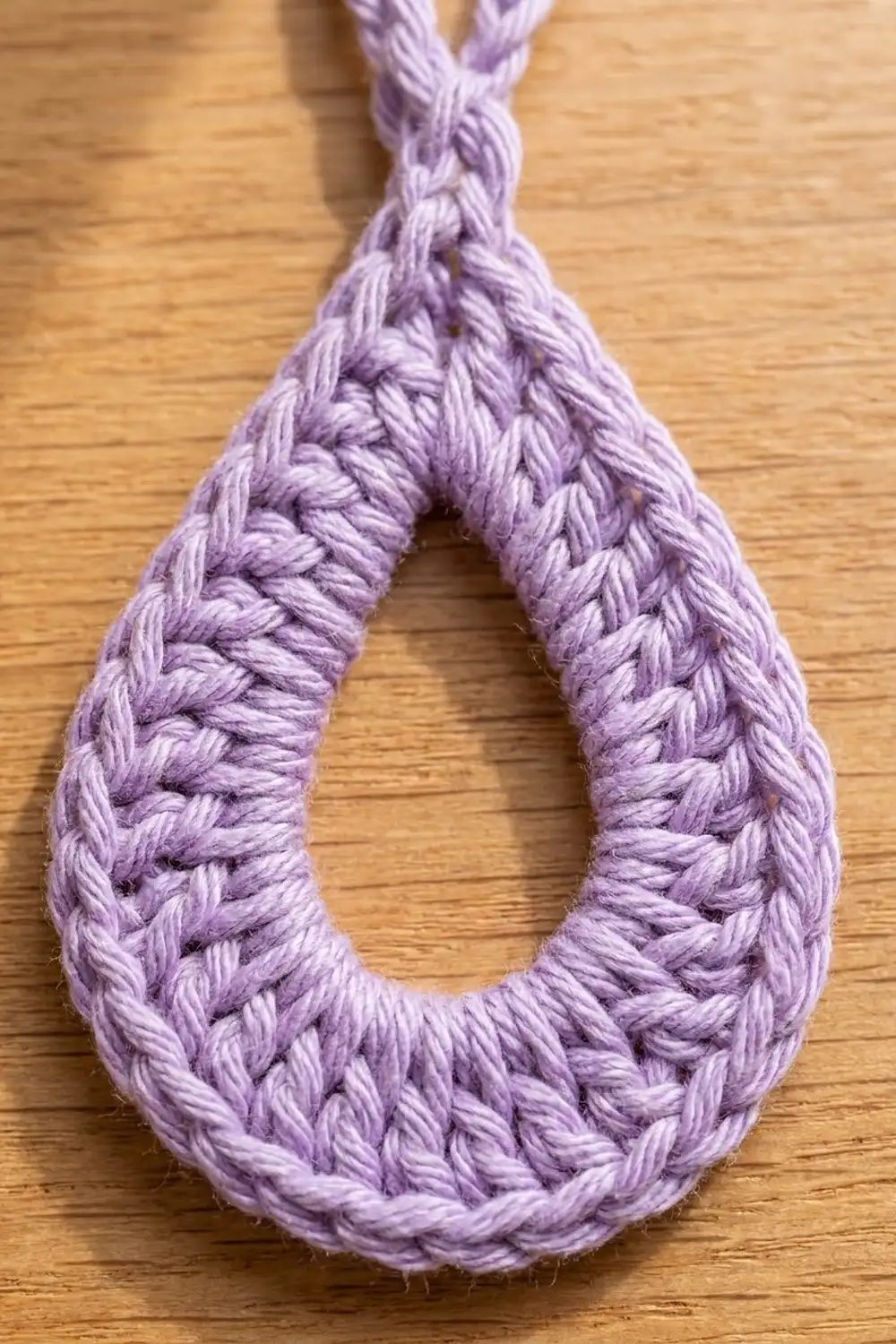
Teardrop Motif (Make 96)
Each motif is worked in joined rounds without turning. Rnd 2 and Rnd 3 both start at the point of the teardrop.
Rnd 1 (foundation ring): Ch 24, sl st in the first ch to form a ring. Check that the chain is not twisted. (24 ch)
Rnd 2: Ch 1 (does not count as a st). Work into the chains of the ring:
- sc in the same ch as the join (this is the point, St 1)
- hdc in each of the next 2 ch
- dc in each of the next 5 ch
- [2 dc in next ch, dc in next ch] 4 times (12 dc across the bottom)
- dc in each of the next 5 ch
- hdc in each of the next 2 ch
- sc in the last ch
Sl st in the first sc to join.
Stitch count: 24 sts worked one per chain + 4 increases = 28 sts (2 sc, 4 hdc, 22 dc).
The increases sit only along the bottom curve. That gives the rounded base, while the short sc and hdc stitches keep the top narrow and pointed.
Rnd 3: Ch 1 (does not count as a st).
- sc in the same st as the join (St 1)
- hdc in each of the next 2 hdc
- dc in each of the next 5 dc
- [2 dc in next st, dc in next st] 6 times (18 dc across the bottom)
- dc in each of the next 5 dc
- hdc in each of the next 2 hdc
- sc in the last sc
Stitch count: 28 sts worked one per stitch + 6 increases = 34 sts (2 sc, 4 hdc, 28 dc).
Mark the bottom center: Count from the first sc. The bottom-center gap is between St 17 and St 18, which are the 9th and 10th dc of the 18-dc bottom group. Place a marker in that gap. The next motif hangs from this point.
Finishing the round depends on the motif’s position:
- Motif 1 (top of a strand): sl st in the first sc. Go on to “Hanging Loop” below.
- Motifs 2–12: do not sl st yet. Work the Point connector into the marked gap of the motif above (see Joining). Fasten off.
Weave in tails along the inside of the dc band so they don’t show through the open center.
Make All Pieces
- Lavender: 48 motifs (4 strands x 12). Four of these are top motifs with loops.
- Peach: 48 motifs (4 strands x 12). Four of these are top motifs with loops.
Layout grid (L = lavender, P = peach; each column is one strand, read left to right on the rod):
Rod:     L  P  L  P  L  P  L  P
Row 1:   L  P  L  P  L  P  L  P   <- top motifs with loops
Row 2:   L  P  L  P  L  P  L  P
Row 3:   L  P  L  P  L  P  L  P
 ...
Row 12:  L  P  L  P  L  P  L  P   <- bottom motifs
Each strand is a single color from top to bottom. The colors alternate only between strands.
Joining
Method: Join as you go, using the Point connector at the end of Rnd 3 of each new motif.
Stitch-to-stitch logic: The point of the new motif (its St 1 sc) connects to the bottom-center gap (between St 17 and St 18) of the motif above. Since the gap sits exactly on the bottom’s axis of symmetry, both motifs hang straight. Each joint uses exactly 4 ch + 2 sl sts and adds no stitches to either motif.
How to work it: After the last sc of Rnd 3, ch 2, then remove the hook from the loop. Insert the hook from front to back through the marked gap of the motif above, pick up the dropped loop, and pull it through (sl st). Ch 2, then sl st in the first sc of the current motif. Fasten off.
Tension advice: Keep the connector chains snug but not tight. A finished connector should be about 0.5 in (1.3 cm) long. If the chains are loose, the strand sags and the motifs twist. If they are tight, the points pucker.
Size checkpoint: Each motif plus its connector adds 4.75 in (12.1 cm) to the strand.
- After 4 motifs, the strand is 18.5 in (47.0 cm) long: 4 x 4.25 in + 3 x 0.5 in.
- After 8 motifs, it is 37.5 in (95.3 cm).
- After 12 motifs, it is 56.5 in (143.5 cm).
Measure while the strand hangs freely, not stretched.
Border: Hanging Loops (No Edge Border)
This curtain has no perimeter border. The 34-stitch Rnd 3 of each motif is already the finished edge. The only finishing is one covered hanging loop at the top of each of the 8 strands.
Loop gauge: about 4 sc per 1 in (2.5 cm) when worked over a chain.
Hanging Loop (top motif only): After the joining sl st of Rnd 3, keep the loop on the hook.
- Step 1: Ch 20. Give the chain one half twist, then sl st in the first sc (St 1) of Rnd 3. The two legs now cross at the base, as shown in the photos. (20-ch loop)
- Step 2: Ch 1. Work 26 sc over the chain loop, working around it rather than into the chains. Sl st in St 1. Fasten off and weave in the tail. (26 sc)
Why the math works: Working 26 sc over 20 ch gives 1.3 sc per chain. That is enough to cover the chain fully and keep the loop firm and round, without the ruffling you get at 1.5 or more. The finished loop is about 6.5 in (16.5 cm) around. On a 1.25 in (3.2 cm) rod, that leaves a 2.5 in (6.4 cm) drop from the top of the rod to the motif point.
Spacing on the rod: Hang the strands 3.5 in (8.9 cm) apart, center to center. That leaves a 0.75 in (1.9 cm) gap between neighboring strands. The width works out as 7 gaps x 3.5 in + 2.75 in for the last strand = 27.25 in (69.2 cm).
Final Blocking
- Lay each strand flat on the blocking mat, motif by motif. Work in sections if your mat is shorter than the strand.
- Spray each motif until it is evenly damp but not dripping.
- Shape every teardrop to 2.75 in (7.0 cm) wide x 4.25 in (10.8 cm) tall. Use the cardboard template if you made one.
- Pin the point first, then the bottom center, then the widest part of the curve. Keep each point sharp and centered.
- Line up the connectors in a straight vertical line, each 0.5 in (1.3 cm) long.
- Leave the strands to dry completely, which takes about 6–12 hours.
- Hang each strand and check the total length of 59 in (149.9 cm) from the top of the rod. Small differences between strands can be evened out by re-blocking the longest one a little tighter.
Final Quality-Control Checklist
- Every motif has 34 sts in Rnd 3, with 18 dc across the bottom.
- Every motif measures 2.75 x 4.25 in (7.0 x 10.8 cm), give or take 0.125 in (0.3 cm).
- Every point is joined to the exact bottom-center gap of the motif above.
- All teardrops point upward, and none are flipped or twisted.
- Each strand has 12 motifs and is a single color.
- The strand colors alternate L, P, L, P, L, P, L, P.
- Each loop has 26 sc and a half twist at its base.
- All tails are woven in invisibly inside the dc band.
- All strands hang at the same length, within 0.5 in (1.3 cm).
Troubleshooting
- The point is rounded, not sharp: you probably used dc instead of sc at St 1 of Rnd 2 or Rnd 3. Re-work the round and keep the sc at the point.
- The bottom ruffles: your increases are too tight together. Check that you are working the [2 dc, dc] repeat exactly, 4 times in Rnd 2 and 6 times in Rnd 3.
- The bottom cups: your tension is too tight on the dc. Go up half a hook size.
- The motif hangs crooked: the connector is off-center. Count to the gap between St 17 and St 18 again.
- The strand keeps growing: the yarn is too stretchy, or the connectors are loose. Shorten the connectors to ch 1 on each side, or switch to firmer cotton.
- The loop is too tight for the rod: add 2 ch to Step 1 and 3 sc to Step 2.
Care
Hand wash in cool water with mild soap and press out the water in a towel. Lay the strands flat to dry and re-block lightly if needed.
Final Notes
The measurement chain is short and reliable. Each round adds a fixed number of stitches: 24 ch become 28 sts, and 28 sts become 34 sts. That gives one 2.75 x 4.25 in (7.0 x 10.8 cm) motif.
Twelve motifs with 0.5 in (1.3 cm) connectors make a 56.5 in (143.5 cm) strand. A 2.5 in (6.4 cm) loop drop brings each strand to 59 in (149.9 cm). Eight strands spaced 3.5 in (8.9 cm) apart fill 27.25 in (69.2 cm) of rod.
If your first motif matches gauge, the rest of the curtain will too. Happy crocheting!