

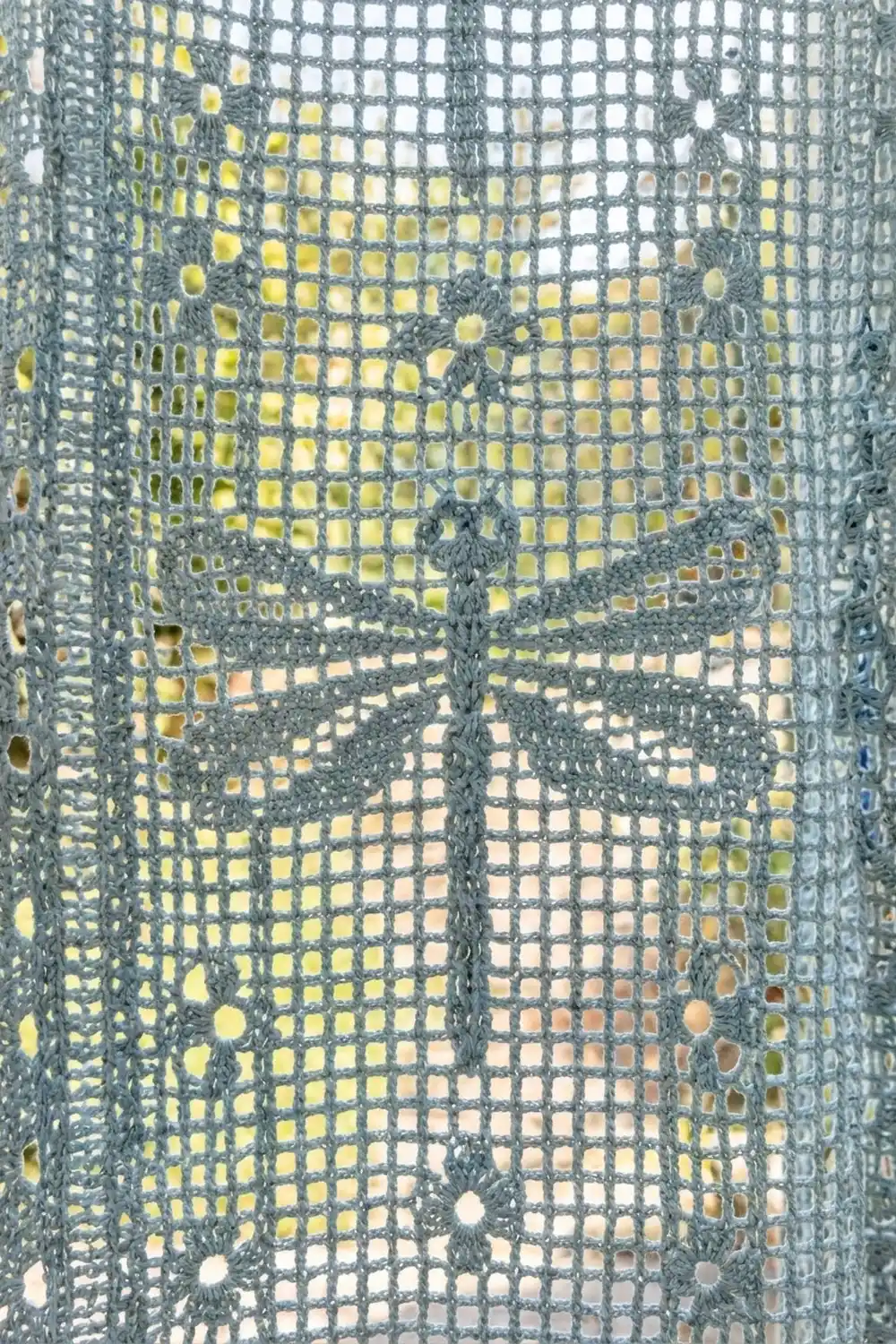
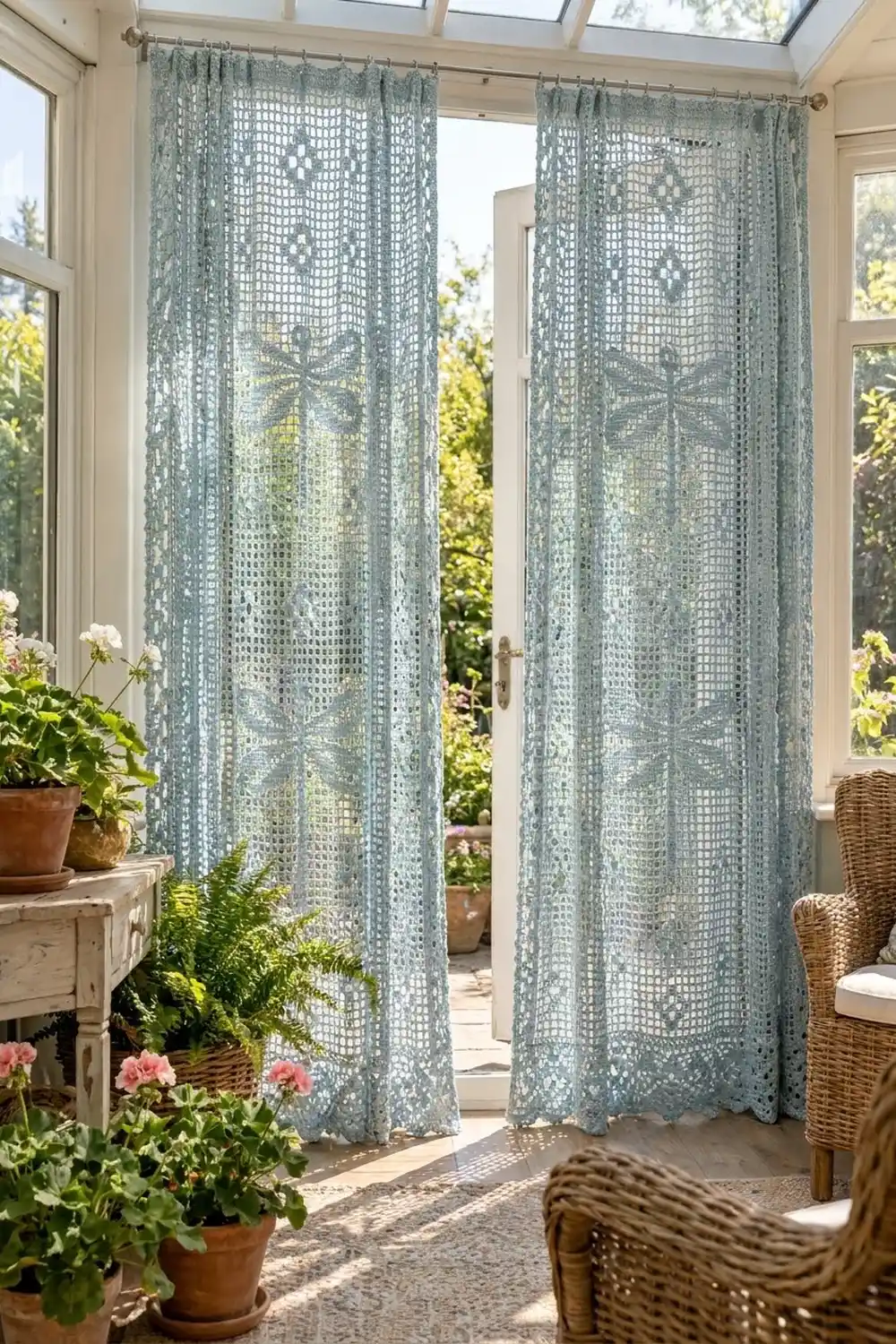
This curtain panel looks best with sunlight behind it. The open filet mesh lets the light through, and the solid-block motifs show up as soft silhouettes: two large dragonflies down the center, small open-centered diamond flowers between them, and narrow side bands with little plus-shaped blossoms.
The panel is worked in one color, a pale dusty duck-egg blue, so the design comes from light and shadow rather than color changes. It suits a cottage, coastal or garden-room setting. The pattern uses US crochet terms throughout.
The finished panel measures 37 in (94.0 cm) wide and 83.25 in (211.5 cm) long, including the border. It’s one single piece. For a pair like the one shown, make a second identical panel. The two panels are hung side by side and are not joined.
You work the panel from the top down in filet rows of blocks and spaces. A single round of single crochet then neatens all four edges, and four lace rows add the scalloped fan border along the bottom edge only.
Finished Size and Construction
- Finished size: 37 in x 83.25 in (94.0 cm x 211.5 cm)
- Skill level: Intermediate (easy stitches, careful counting)
- Terminology: US crochet terms
- Yarn weight: DK / light (#3) mercerized cotton
- Hook: 3.5 mm (E-4), or the size needed for gauge
- Number of pieces: 1 per panel (make 2 for a pair, not joined)
- Layout: 73 meshes wide x 160 rows long
- Piece size before border: 36.5 in x 80 in (92.7 cm x 203.2 cm)
- Border depth: 0.25 in (0.6 cm) on the top and sides; 3 in (7.6 cm) on the bottom
Materials
Yarn: Use a smooth mercerized cotton in DK weight. It gives crisp, square meshes and holds its shape when hanging. Avoid fuzzy or very stretchy blends, because they blur the motifs and sag over time.
- Pale dusty blue: 900 g, about 1,890 m (at 105 m per 50 g) per panel; 1,800 g, about 3,780 m, for a pair
These quantities include a margin of roughly 12% for your gauge swatch and small tension differences.
Tools:
– 3.5 mm (E-4) crochet hook
– Tapestry needle
– 4 locking stitch markers
– Tape measure
– Rust-proof pins and a large blocking surface (a clean floor covered with sheets works well)
– Spray bottle
– 10 curtain clip rings per panel
Abbreviations (US Terms)
- ch: chain
- sc: single crochet
- dc: double crochet
- sk: skip
- sp(s): space(s)
- st(s): stitch(es)
- RS / WS: right side / wrong side
Special filet terms:
– Mesh: one square of the grid. A row of 73 meshes always contains 220 stitches: 73 x 3 + 1 shared closing dc.
– sp (space): ch 2, sk 2 sts, dc in next st.
– bl (block): dc in each of next 3 sts. Over a ch-2 space, work 2 dc in the space, then dc in the next dc.
– Row start: ch 3 counts as the first dc. Because every row begins with an edge block, start each row with ch 3, then dc in each of the next 3 sts.
– Row end: the last dc of each row goes into the top of the turning ch.
Gauge and Checkpoints
Gauge: 8 meshes and 8 rows = 4 in (10.2 cm) in filet mesh. Each mesh is 0.5 in (1.3 cm) square.
Test swatch: Ch 51. Dc in the 4th ch from the hook and in each ch across (49 sts = 16 bl). For Rows 2–15, work 1 bl, 14 sp, 1 bl. For Row 16, work 16 bl. The swatch should measure 8 in x 8 in (20.3 cm x 20.3 cm).
- If the swatch is too big, go down a hook size.
- If it’s too small, go up a hook size.
- If the width is right but the rows are short, pull up the dc loops slightly taller.
Small errors add up over a long panel. A swatch that is just 0.4 in (1.0 cm) too long becomes 4 in (10.2 cm) of extra length over 80 in (203.2 cm).
Checkpoints:
– After Row 3: 36.5 in (92.7 cm) wide; solid top band 1.5 in (3.8 cm) deep
– After Row 56 (end of first dragonfly): 28 in (71.1 cm) long
– After Row 117 (end of second dragonfly): 58.5 in (148.6 cm) long
– After Row 160: 36.5 in x 80 in (92.7 cm x 203.2 cm)
The Panel
Foundation and Top Band
Row 1: Ch 222. Dc in the 4th ch from the hook and in each ch across. The skipped ch-3 counts as a dc. (220 sts = 73 bl)
Rows 2–3: Ch 3, turn, dc in each st across. (220 sts = 73 bl)
How Patterned Rows Are Built
Every row from 4 to 158 follows this sequence across:
Edge bl, Side Band (11 meshes), 1 bl, Center Field (47 meshes), 1 bl, Side Band (11 meshes), Edge bl
That’s 1 + 11 + 1 + 47 + 1 + 11 + 1 = 73 meshes = 220 sts.
Place markers in the divider blocks (meshes 13 and 61) during the first few rows. Every motif is left–right symmetrical, so the instructions read the same on RS and WS rows.
Side Band rows (11 meshes):
– S0: 11 sp
– S1: 5 sp, 1 bl, 5 sp
– S3: 4 sp, 3 bl, 4 sp
Side Band sequence: Starting at Row 4, repeat this 8-row cycle: S1, S3, S1, S0, S0, S0, S0, S0. The final cycle starts on Row 156, so Rows 156–158 are S1, S3, S1. Each side band has 20 plus-flowers, each 1.5 in (3.8 cm) across.
Center Field rows (47 meshes):
– Plain: 47 sp
Diamond Flower (5 rows):
– Row a: 23 sp, 1 bl, 23 sp
– Row b: 22 sp, 3 bl, 22 sp
– Row c: 21 sp, 2 bl, 1 sp, 2 bl, 21 sp (the open center)
– Row d: as Row b
– Row e: as Row a
Dragonfly (34 rows, 41 meshes wide = 20.5 in / 52.1 cm, 17 in / 43.2 cm tall):
– D1–D2 (head): 22 sp, 3 bl, 22 sp
– D3 (neck): 23 sp, 1 bl, 23 sp
– D4: 4 sp, 8 bl, 10 sp, 3 bl, 10 sp, 8 bl, 4 sp (raised wing tips)
– D5: 3 sp, 15 bl, 4 sp, 3 bl, 4 sp, 15 bl, 3 sp
– D6: 3 sp, 41 bl, 3 sp
– D7: 4 sp, 39 bl, 4 sp
– D8: 7 sp, 33 bl, 7 sp
– D9: 12 sp, 9 bl, 1 sp, 3 bl, 1 sp, 9 bl, 12 sp
– D10 (gap between wing pairs): 22 sp, 3 bl, 22 sp
– D11: 13 sp, 21 bl, 13 sp
– D12: 8 sp, 31 bl, 8 sp
– D13: 6 sp, 35 bl, 6 sp
– D14: 6 sp, 15 bl, 1 sp, 3 bl, 1 sp, 15 bl, 6 sp
– D15: 8 sp, 10 bl, 4 sp, 3 bl, 4 sp, 10 bl, 8 sp
– D16 (thorax end): 22 sp, 3 bl, 22 sp
– D17–D34 (tail): 23 sp, 1 bl, 23 sp. The tail is 18 rows, 9 in (22.9 cm) long.
Check that every Center Field row adds up to 47.
Center Field Layout
| Rows | Center Field |
|---|---|
| 4–6 | Plain |
| 7–11 | Diamond |
| 12–14 | Plain |
| 15–19 | Diamond |
| 20–22 | Plain |
| 23–56 | Dragonfly 1 |
| 57–59 | Plain |
| 60–64 | Diamond |
| 65–67 | Plain |
| 68–72 | Diamond |
| 73–75 | Plain |
| 76–80 | Diamond |
| 81–83 | Plain |
| 84–117 | Dragonfly 2 |
| 118–120 | Plain |
| 121–125 | Diamond |
| 126–128 | Plain |
| 129–133 | Diamond |
| 134–136 | Plain |
| 137–141 | Diamond |
| 142–144 | Plain |
| 145–149 | Diamond |
| 150–152 | Plain |
| 153–157 | Diamond |
| 158 | Plain |
The panel has 2 dragonflies and 10 diamond flowers in total.
Every row from 4 to 158: 220 sts = 73 meshes.
Bottom Band
Rows 159–160: Ch 3, turn, dc in each st across. (220 sts = 73 bl)
Don’t fasten off. Turn and continue to the border.
Border
Border gauge: 1 sc per st along the top and bottom edges (about 6 sc per inch); 2 sc per dc row-end along the sides (4 sc per inch). Each corner is 3 sc worked into the corner stitch. The side counts below are between the corners and do not include them.
Round 1 (sc edging): Ch 1. Work 3 sc in the first st (corner).
- Bottom edge: sc in each of the next 218 sts, then 3 sc in the last st (corner).
- Side: 2 sc in each of the 160 row-ends (320 sc), then 3 sc in the corner.
- Top edge: along the foundation ch, sc in each of the 218 ch between the corner sts, then 3 sc in the corner.
- Second side: 320 sc.
Sl st to the first sc. Total: 218 + 218 + 320 + 320 + (4 x 3) = 1,088 sc.
The bottom lace is worked in rows across 222 sts: from the center sc of the first bottom corner to the center sc of the second. That’s 1 + 1 + 218 + 1 + 1 = 222.
Why the math works: 222 = 2 + (22 x 10). Each scallop uses 20 sts plus a 2-sc anchor, and one extra anchor closes the row. That gives exactly 10 scallops, each about 3.7 in (9.4 cm) wide after blocking.
Lace Row 1 (RS): Sl st into the center sc of the corner. Ch 1, sc in the same st and in the next st (anchor).
Repeat 10 times: ch 5, sk 4, sc in next st, ch 5, sk 4, dc in next st, ch 3, dc in next st, ch 5, sk 4, sc in next st, ch 5, sk 4, sc in each of next 2 sts (anchor).
You now have 40 ch-5 loops, 10 ch-3 centers and 11 anchors.
Lace Row 2 (WS): Ch 1, turn, sc in the first 2 sc.
Repeat 10 times: ch 3, sc in next ch-5 loop, ch 5, sc in next ch-5 loop, ch 3, 9 dc in ch-3 center, ch 3, sc in next ch-5 loop, ch 5, sc in next ch-5 loop, ch 3, sc in each of 2 anchor sc.
You now have 10 fans of 9 dc (90 dc) and 20 ch-5 loops.
Lace Row 3 (RS): Ch 1, turn, sc in the first 2 sc.
Repeat 10 times: ch 4, sc in next ch-5 loop, ch 4, (dc in next dc, ch 1) 8 times, dc in next dc, ch 4, sc in next ch-5 loop, ch 4, sc in each of 2 anchor sc.
You now have 90 dc and 80 ch-1 sps.
Lace Row 4 (WS): Ch 1, turn, sc in the first 2 sc.
Repeat 10 times: ch 6, sk next 2 ch-4 sps, sc in first dc of fan, (sc, ch 3, sc) in each of 8 ch-1 sps, sc in last dc of fan, ch 6, sk next 2 ch-4 sps, sc in each of 2 anchor sc.
You now have 80 picots. Fasten off and weave in the ends.
Final Blocking
- Soak the panel in cool water, then press the water out gently. Don’t wring it.
- Roll it in towels to remove excess moisture.
- Lay it flat on sheets and smooth it to 37 in x 83.25 in (94.0 cm x 211.5 cm).
- Pin the long sides straight first, then the top edge.
- Pin out each scallop: one pin at each anchor and three pins along each fan, opening every picot.
- Square up the dragonflies and diamonds by nudging the meshes. Mist with water if needed.
- Let it dry completely, then hang it for a day before trimming the clip-ring spacing.
Final Quality-Control Checklist
- Every row has 220 sts / 73 meshes, and the edges are straight.
- Divider block columns run unbroken from Row 4 to Row 158.
- Each dragonfly is centered, with a gap row (D10) between the wing pairs.
- There are 10 diamonds, each with an open center.
- There are 20 plus-flowers in each side band, level with each other across the panel.
- Round 1 has 1,088 sc, and the corners lie flat.
- There are 10 even scallops, and the anchors line up.
- Before the border, the panel measures 36.5 in x 80 in (92.7 cm x 203.2 cm).
Troubleshooting
- Panel narrows or widens: Check that the ch-3 is counted as the first dc and that the last dc goes into the turning ch.
- Meshes look tall and thin: Your dc are too loose. Go down a hook size, or shorten the pulled-up loop.
- Motif looks off-center: Recount the Center Field sequence. Markers in the divider blocks make errors obvious within one row.
- Bottom border ruffles: Your ch-5 loops are too long. Chain more firmly, or use ch 4.
- Border cups: Your loops are too tight. Go up one hook size for the lace rows only.
- Panel lengthens when hung: This is normal for cotton. Block it flat again and hang it from more clip rings to spread the weight.
Care
Hand wash in cool water with mild soap, roll in a towel, and dry flat. Re-pin the scallops while damp. Avoid tumble drying, which distorts the mesh.
Final Notes
The measurements build on each other step by step:
- 8 meshes = 4 in (10.2 cm)
- 73 meshes = 36.5 in (92.7 cm) wide
- 160 rows = 80 in (203.2 cm) long
- Round 1 adds 0.25 in (0.6 cm) to each edge
- The lace adds 2.75 in (7.0 cm) at the bottom
- Finished panel: 37 in x 83.25 in (94.0 cm x 211.5 cm)
Check gauge, count meshes and keep the markers in place, and the dragonflies will line up. Make a second panel for a matching pair.
Happy crocheting!