

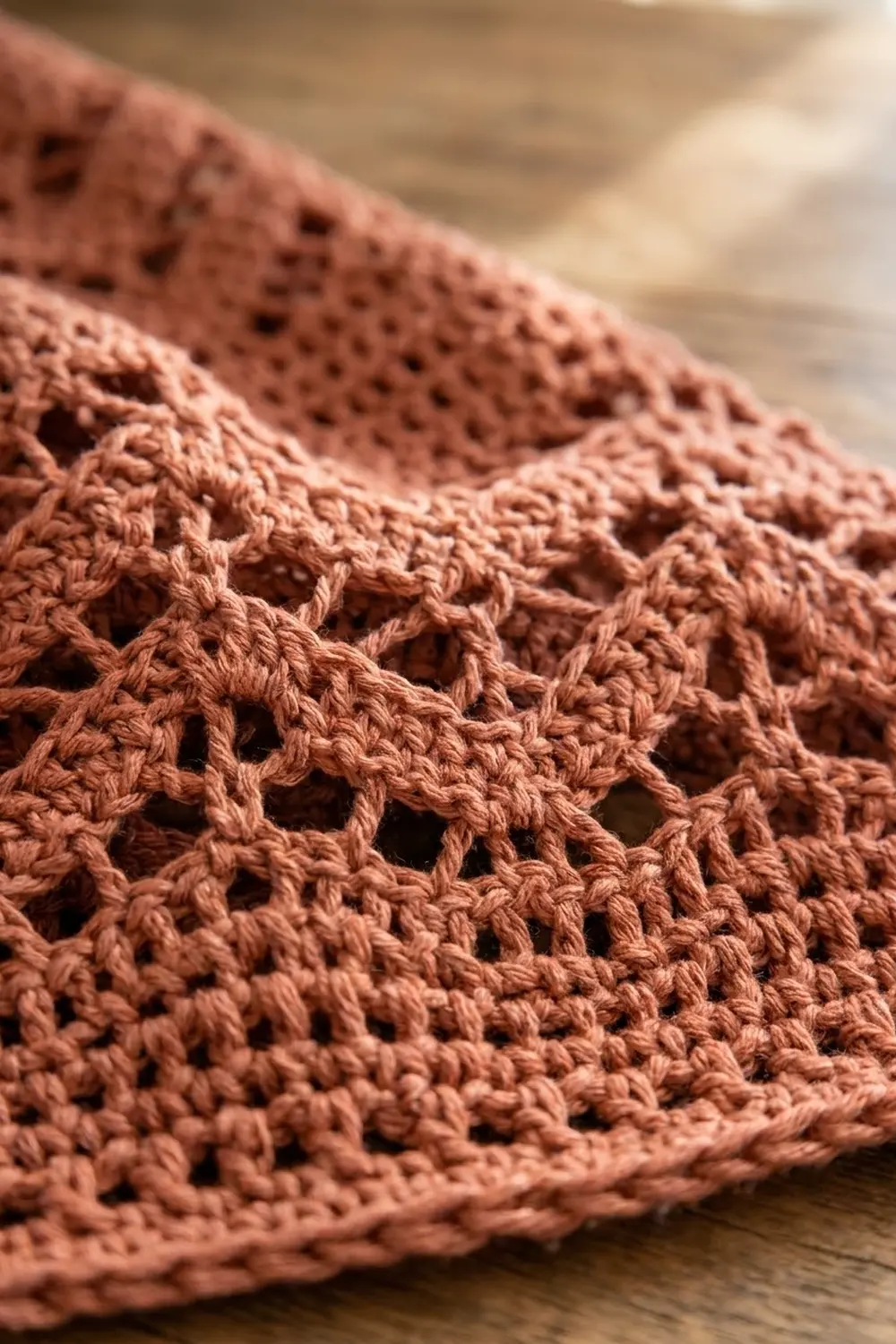
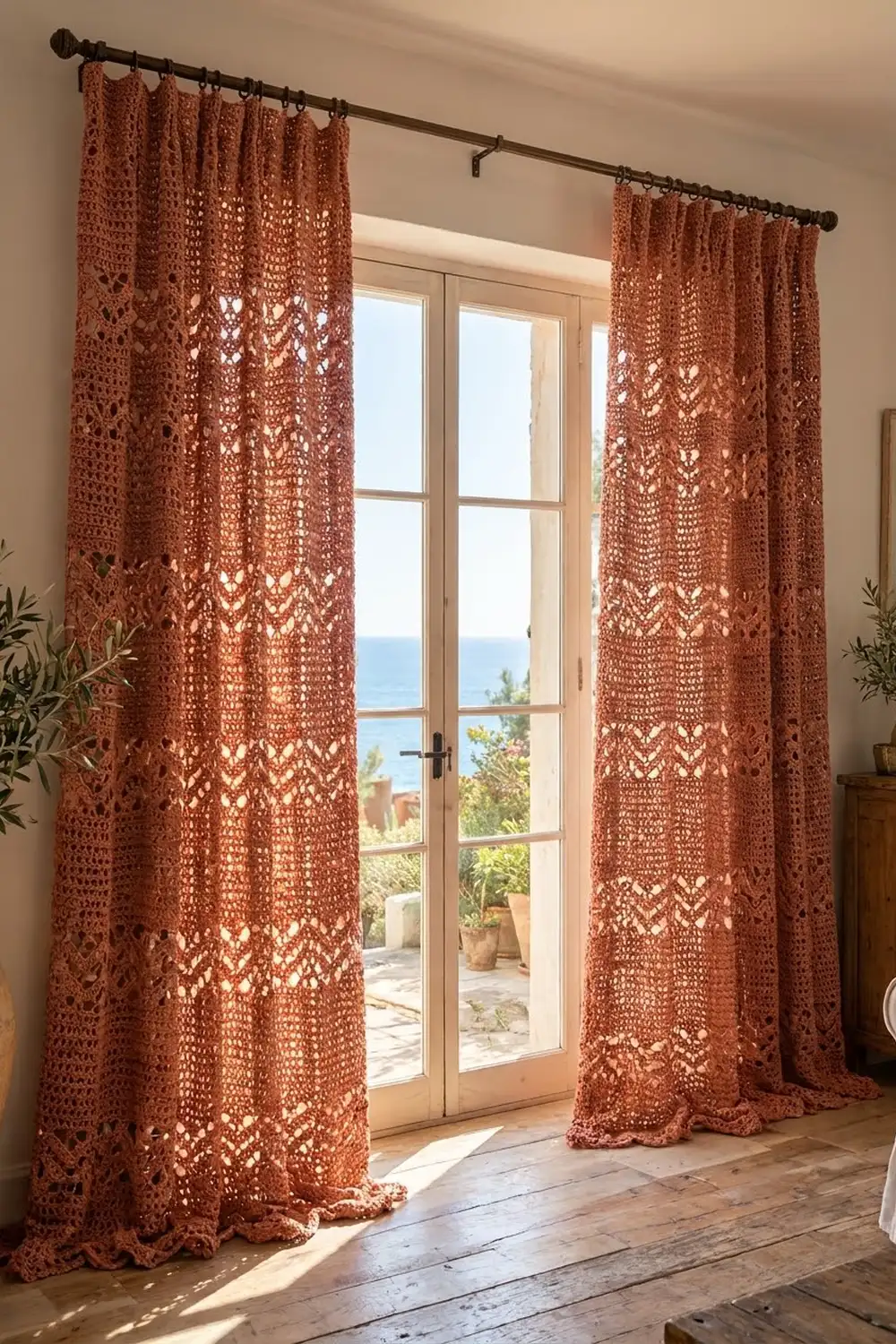
The Terracotta Coast Curtain Panel is a long, textured crochet panel in warm terracotta rust. Solid bands of double crochet alternate with openwork bands. Some of the openwork bands are V-shaped chevrons made from lines of eyelets, and the others are simple filet-style mesh.
In front of a sunny window, the open bands let light through in horizontal stripes. The solid bands keep the panel feeling substantial. The panel uses one color in a worsted-weight cotton, which gives crisp stitch definition and enough weight to hang straight. All instructions use US crochet terms.
The finished panel measures 46.25 in (117.5 cm) wide and 77.75 in (197.5 cm) long, from the top fold of the rod pocket to the tips of the scallops. Each panel is a single piece. For a pair like the one shown, make two identical panels. They are not joined.
You start at the bottom and work straight up in rows. A 24-row band sequence repeats six times, then a top solid band and a rod pocket finish the body. After that you add a single-crochet edge on each side, fold and sew the pocket, and work a scalloped bottom border.
Finished Size and Construction
- Finished size (one panel): 46.25 in x 77.75 in (117.5 cm x 197.5 cm)
- Skill level: Intermediate (lots of stitches, but simple counting)
- Terminology: US crochet terms
- Yarn weight: Worsted (#4) cotton
- Hook: 5.0 mm (H-8)
- Number of pieces: 1 per panel. Make 2 panels for a pair.
- Layout: one vertical rectangle, worked from the bottom up in rows
- Panel size before border: 45.75 in x 77 in (116.2 cm x 195.6 cm), with the pocket folded
- Border depth: 0.25 in (0.6 cm) on each side and 0.75 in (1.9 cm) at the bottom. There is no border along the top fold.
Materials
Yarn: Use a smooth worsted-weight cotton or cotton blend, about 190 m (208 yd) per 100 g. Mercerized or combed cotton shows the eyelets best. Avoid fuzzy or very stretchy yarns, because a long panel grows under its own weight.
- Terracotta (one panel): 1,200 g / 2,280 m (2,493 yd), which is 12 balls of 100 g
- Terracotta (pair): 2,400 g / 4,560 m (4,987 yd), which is 24 balls of 100 g
These quantities include a margin of about 10% for swatching and the border. Buy all of the yarn from one dye lot.
Tools:
- 5.0 mm (H-8) crochet hook
- Locking stitch markers (at least 10)
- Tapestry needle
- Scissors
- Tape measure and a long, flat surface or floor
- Rust-proof pins and a spray bottle
Abbreviations (US Terms)
- ch = chain
- sc = single crochet
- dc = double crochet
- sk = skip
- st(s) = stitch(es)
- sp = space
- RS / WS = right side / wrong side
Special stitch: eyelet. Ch 1, sk next st. One eyelet replaces exactly one stitch, so the row count stays the same.
Counting rule:
- On every row after the foundation, each ch-1 sp counts as 1 st. An instruction like “dc in next 7” can include ch-1 sps; work into the space itself.
- The ch-3 at the start of a row counts as the first dc.
- Always work your last st into the top ch of the previous row’s turning chain.
Gauge and Checkpoints
Gauge: 16 dc and 8 rows = 4 in (10.2 cm) in solid dc, before blocking. Eyelet rows and mesh rows are the same height as dc rows.
Make a test swatch first:
- Ch 29. Dc in the 4th ch from the hook and in each ch across. (27 sts, which is 12 x 2 + 3)
- Work 5 more solid rows.
- Work Chevron Rows C1 to C4 (below). In C1 to C3, work the starred repeat once instead of 14 times. In C4, work it twice instead of 15 times.
- Work 4 mesh rows.
You now have 14 rows. The swatch should measure 6.75 in (17.1 cm) wide and 7 in (17.8 cm) tall.
- If the swatch is too big: go down to a 4.5 mm hook.
- If the swatch is too small: go up to a 5.5 mm hook.
- If the width is right but the height is off by more than 0.25 in (0.6 cm): keep the hook and adjust the height of your dc instead.
Checkpoints:
- After Row 1: 45.75 in (116.2 cm) wide
- After Row 24: 12 in (30.5 cm) tall
- After Row 144: 72 in (182.9 cm) tall
- After Row 158: 79 in (200.7 cm) tall, unfolded
- After folding the pocket: 77 in (195.6 cm)
- After the border: 46.25 in x 77.75 in (117.5 cm x 197.5 cm)
Always measure flat, not hanging, and check the width every 24 rows.
Stitch Patterns Used
Every row has 183 sts.
Solid row: Ch 3 (counts as dc), dc in each st across. (183 dc)
Mesh row: Ch 4 (counts as dc + ch 1), sk next st, dc in next st, ch 1, sk next st; rep from * across to the last st (90 times total), dc in last st. (92 dc + 91 ch-1 sps = 183 sts)
On the next mesh row, each dc lands on a dc and each ch-1 sits over a ch-1 sp.
Chevron Row C1: Ch 3, dc in next 6, ch 1, sk 1, dc in next 11, ch 1, sk 1; rep from * 13 more times (14 times total), dc in last 7.
(1 + 6 + 1 + 168 + 7 = 183 sts; 15 eyelets)
Chevron Row C2: Ch 3, dc in next 4, ch 1, sk 1, dc in next 3, ch 1, sk 1, dc in next 7, ch 1, sk 1, dc in next 3, ch 1, sk 1; rep from * 13 more times (14 times total), dc in last 5.
(1 + 4 + 1 + 3 + 1 + 168 + 5 = 183 sts; 30 eyelets)
Chevron Row C3: Ch 3, dc in next 2, ch 1, sk 1, dc in next 7, ch 1, sk 1, dc in next 3, ch 1, sk 1, dc in next 7, ch 1, sk 1; rep from * 13 more times (14 times total), dc in last 3.
(1 + 2 + 1 + 7 + 1 + 168 + 3 = 183 sts; 30 eyelets)
Chevron Row C4: Ch 4 (counts as dc + ch 1), sk next st, dc in next 11, ch 1, sk 1; rep from * 14 more times (15 times total), dc in last st.
(2 + 180 + 1 = 183 sts; 16 eyelets)
Why this makes a V: In each 12-st repeat, the eyelet starts at the center in C1. It moves 2 sts outward on each side in C2 and again in C3, and reaches the edges of the repeat in C4. The diagonal lines of holes meet at the bottom, so each chevron is a V that points down. The pattern is symmetrical, so it works the same from either direction.
Panel Pattern
Foundation (Row 1, solid): Ch 185. Dc in the 4th ch from the hook (the skipped 3 ch count as the first dc) and in each ch across. (183 dc) Turn.
Check the width: it should be 45.75 in (116.2 cm).
Band Sequence (24 rows)
- Rows 1 to 6, solid band: Work 6 solid rows. In the first sequence, the foundation is Row 1, so work Rows 2 to 6. (183 sts each)
- Rows 7 to 14, chevron band: Work C1, C2, C3 and C4, then work C1, C2, C3 and C4 again. This gives two stacked lines of V chevrons. (183 sts each)
- Rows 15 to 20, solid band: Work 6 solid rows. On Row 15, dc into each ch-1 sp. (183 sts each)
- Rows 21 to 24, mesh band: Work 4 mesh rows. (183 sts each)
Rows 25 to 144: Repeat the Band Sequence 5 more times, for 6 sequences in total. On the first solid row after each mesh band, dc in each dc and in each ch-1 sp. (183 sts) Place a marker at the end of every 24th row. Checkpoint: 72 in (182.9 cm).
Rows 145 to 150, top solid band: Work 6 solid rows. (183 sts each)
Rows 151 to 158, rod pocket: Work 8 solid rows. (183 sts each) Fasten off, leaving a tail 24 in (61.0 cm) long. Checkpoint: 79 in (200.7 cm).
Second panel: Repeat everything above to make an identical second panel.
Border
Border gauge: 16 sc = 4 in (10.2 cm). One sc row adds about 0.25 in (0.6 cm).
Side edging (work on each long side):
- With RS facing, join the yarn at the Row 1 corner.
- Ch 1, then work 2 sc into the end of each row, from Row 1 up to Row 158. That is 158 x 2 = 316 sc. Fasten off.
- Work the other side the same way, from the Row 158 corner down to Row 1. (316 sc)
Each dc row is 0.5 in (1.3 cm) tall, so 2 sc per row gives 4 sc per inch. That matches the border gauge, so the edge lies flat without flaring or puckering. The edging adds 0.25 in (0.6 cm) on each side: 45.75 + 0.5 = 46.25 in (117.5 cm).
Fold the pocket:
- Fold Rows 155 to 158 to the WS, along the line between Rows 154 and 155.
- With the tail, whipstitch the top loops of Row 158 to the back of the top of Row 150, matching stitch to stitch (183 to 183).
- Leave both short ends open for the rod.
The pocket is 2 in (5.1 cm) deep and fits a rod up to 1 in (2.5 cm) in diameter. The visible panel now measures 77 in (195.6 cm).
Bottom Border Row 1: With RS facing, join the yarn in the first foundation ch at the right-hand corner. Do not work into the side edging. Ch 1, then sc in the underside of each foundation ch across. (183 sc) Turn.
Bottom Border Row 2 (scallops): Ch 1, sc in first 2 sc, sk 2, 5 dc in next sc, sk 2, sc in next sc; rep from * 29 more times (30 times total), sc in last sc. Fasten off.
This row uses 2 + (30 x 6) + 1 = 183 sts and makes 30 scallops.
Why the math works:
- The 30 scallops use 6 sts each, which is 180 sts.
- The 3 sts left over become 2 sc at the start and 1 sc at the end, so both ends finish with a pair of sc and the edge is symmetrical.
- At 4 sts per inch, the border stays 45.75 in (116.2 cm) wide, the same as the body.
- It adds 0.75 in (1.9 cm) of depth: 77 + 0.75 = 77.75 in (197.5 cm).
Final Blocking
- Weave in all ends along solid rows, not across eyelets.
- Soak the panel in cool water for 15 minutes, then press the water out gently. Do not wring it.
- Roll the panel in towels to remove most of the water.
- Lay it flat on a clean sheet or blocking mats, RS up.
- Pat it to 46.25 in x 77.75 in (117.5 cm x 197.5 cm). Measure across in three places and along both sides.
- Pin the side edges every 6 in (15.2 cm), and pin each scallop tip.
- Open the eyelets with your fingertips so the chevrons sit evenly.
- Let the panel dry completely flat. Never hang it wet, because wet cotton can stretch 2 in (5.1 cm) or more.
- Block the second panel the same way, then compare the two side by side.
Final Quality-Control Checklist
- [ ] Every row has 183 sts.
- [ ] Each chevron band shows 2 clean lines of 15 V’s.
- [ ] Each mesh row has 91 open squares.
- [ ] The width is 46.25 in (117.5 cm) at the top, middle and bottom.
- [ ] Both side edges measure 77.75 in (197.5 cm).
- [ ] Each side edging has 316 sc.
- [ ] There are 30 scallops along the bottom.
- [ ] The rod pocket is open at both ends.
- [ ] The two panels match to within 0.5 in (1.3 cm).
Troubleshooting
The panel gets narrower. You are missing the last dc into the turning chain. Count rows against 183 sts.
The chevrons look crooked. An eyelet is off by one stitch. Check that you counted each ch-1 sp as a stitch, then rip back to the row where it went wrong.
The side edges wave or pull in. Work exactly 2 sc per row end, with relaxed tension.
The scallops flare. Bottom Border Row 1 must be exactly 183 sc.
The panel is too long. Re-block it flat. Next time, leave out solid rows; each row you remove takes off 0.5 in (1.3 cm).
The rod won’t fit. Add 2 pocket rows and fold at the new midpoint. This adds 1 in (2.5 cm) of circumference and 0.5 in (1.3 cm) of length.
Care
Hand wash, or machine wash cool on a gentle cycle in a large mesh bag. Reshape the panel and dry it flat. Never tumble dry it.
Final Notes
Here is the full measurement chain:
- A gauge of 16 sts and 8 rows = 4 in (10.2 cm) makes 183 sts = 45.75 in (116.2 cm).
- 158 rows = 79 in (200.7 cm), which folds to 77 in (195.6 cm).
- The side edging brings the width to 46.25 in (117.5 cm).
- The scallops bring the length to 77.75 in (197.5 cm).
Keep the 183-stitch count and your gauge steady at every checkpoint, and both panels will hang straight and match.
Happy crocheting!