

This curtain panel is made of airy chain mesh. Three deep green strips each carry a column of dragonflies, and two plain cream strips sit between them. Light comes through the open cells, so the dragonflies look as if they are hovering against the window.
The palette is just emerald green and natural cream, in a cottage-garden lace style. The pattern uses US crochet terms throughout.
The finished panel measures 33.5 in wide x 61 in long (85.1 x 154.9 cm), not counting the tabs and bottom drop loops. Before the border it measures 32.5 x 60 in (82.6 x 152.4 cm).
You work five mesh strips from the bottom up, each ending with a solid trim row. Then you make 18 dragonfly appliqués and sew six onto each green strip. Finally, you join the strips flat with slip stitches, work a two-round green border, and add hanging tabs.
Finished Size and Construction
- Finished size: 33.5 x 61 in (85.1 x 154.9 cm)
- Skill level: Intermediate
- Terminology: US crochet terms
- Yarn weight: DK (#3) mercerized cotton
- Hook: 4.0 mm (G-6)
- Number of pieces: 5 strips + 18 dragonflies (each made of 1 body and 4 wings)
- Layout: 5 strips side by side: G C G C G
- Piece size: green strip 7.5 x 60 in (19.1 x 152.4 cm); cream strip 5 x 60 in (12.7 x 152.4 cm)
- Size before border: 32.5 x 60 in (82.6 x 152.4 cm)
- Border depth: 0.5 in (1.3 cm) on every side
Materials
Use a smooth mercerized cotton or cotton blend in DK weight. It gives the chain mesh crisp definition and holds its shape after blocking. Avoid fuzzy yarns, because they blur the cells.
- Green (A): 300 g / about 650 m. This covers the strips, dragonflies, joining, border and tabs.
- Cream (B): 100 g / about 220 m
These quantities include a margin of roughly 15 percent.
Tools:
– 4.0 mm (G-6) crochet hook
– Tapestry needle
– About 20 locking stitch markers
– Rust-proof pins and a large blocking surface
– Tape measure
– Spray bottle
Abbreviations (US Terms)
- ch – chain
- sl st – slip stitch
- sc – single crochet
- hdc – half double crochet
- dc – double crochet
- sp – space
- st(s) – stitch(es)
- rep – repeat
- RS – right side
Special stitches
- Bobble eye: Sl st into the st, ch 2, then work a 3-dc bobble in the same st. To make the bobble: (yarn over, insert hook, pull up a loop, yarn over, draw through 2 loops) 3 times, then yarn over and draw through all 4 loops. Finish with ch 2, then sl st in the same st.
- Tab: Sc in st, ch 20, then sl st in the top of that sc. Work 26 sc into the ch-20 loop, then sl st in the base sc. Each tab counts as 1 st.
- Drop loop: Sc in st, ch 7, then sl st in the top of that sc. Each drop loop counts as 1 st.
Gauge and Checkpoints
Mesh gauge (blocked): 4 ch-5 loops wide x 8 rows = 5 x 5 in (12.7 x 12.7 cm). One loop repeat is 1.25 in (3.2 cm) wide, and one row is 0.625 in (1.6 cm) tall.
Solid gauge: 20 sc = 4 in (10.2 cm).
Test one piece first: start the first green strip, work Rows 1–16, and pin it out gently.
- Checkpoint 1: After Row 16, the strip measures 7.5 x 10 in (19.1 x 25.4 cm).
- Checkpoint 2: After Row 48, it measures 30 in (76.2 cm) tall.
- Checkpoint 3: After Row 95, it measures 59.4 in (150.9 cm). The trim row brings it to 60 in (152.4 cm) when blocked.
- Checkpoint 4: One dragonfly body is 3.75 in (9.5 cm) long, each wing is 3 x 0.75 in (7.6 x 1.9 cm), and the wingspan is 6.5 in (16.5 cm).
Too big? Go down to a 3.75 mm hook. Too small? Go up to a 4.5 mm hook. Don’t add or remove loops, because the border and tab counts depend on the counts given here. If your 16-row test is off by more than 0.25 in (0.6 cm), change hooks.
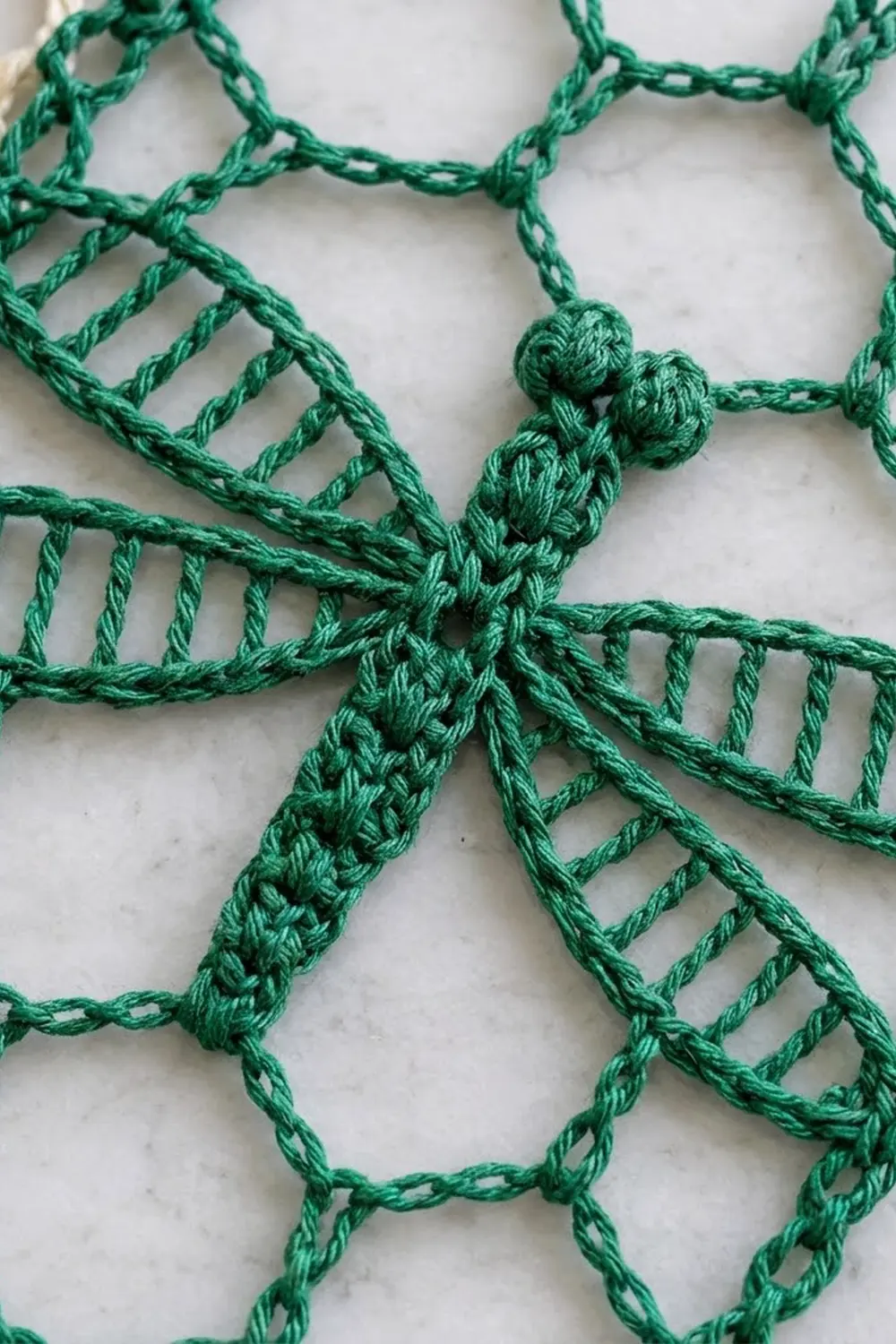
Mesh Strips
The same instructions work for both strip widths. N is the number of loops across:
- Green strips: N = 6
- Cream strips: N = 4
Foundation: Ch 6N + 2. That is ch 38 for green and ch 26 for cream.
Row 1 (RS): Sc in 2nd ch from hook, ch 5, skip 5 ch, sc in next ch; rep from * across. Turn.
(N + 1 sc and N ch-5 loops: 7 sc and 6 loops for green, or 5 sc and 4 loops for cream.)*
Row 2: Ch 5 (counts as dc + ch 2), sc in first ch-5 loop, ch 5, sc in next ch-5 loop; rep from * across, ending ch 2, dc in last sc. Turn.
(N sc, N – 1 full loops, and 2 half loops at the edges.)*
Row 3: Ch 1, sc in first dc, ch 5, sc in next ch-5 loop; rep from * to the turning ch, ch 5, sc in 3rd ch of turning ch. Turn.
(N + 1 sc and N full loops, the same as Row 1.)*
Rows 4–95: Alternate Rows 2 and 3, ending on a Row 3 repeat at Row 95.
Odd rows have N full loops. Even rows have N – 1 full loops plus 2 half loops. These offset rows are what make the honeycomb cells.
Row 96 (trim, conversion row): Ch 1, sc in first sc, *5 sc in next ch-5 loop, sc in next sc; rep from * across. Fasten off.
The trim count is (N + 1 sc worked 1-per-sc) + (5N sc added into loops):
– Green: 7 + 30 = 37 sc
– Cream: 5 + 20 = 25 sc
That matches the 6N + 1 usable foundation chains, so the top and bottom edges are the same width.
Dragonfly Appliqué (make 18, all in A)
Body
Ch 17.
Rnd 1: Sc in 2nd ch from hook and next 14 ch, then 3 sc in last ch (head end). Working along the other side of the chain, sc in next 14 ch, then 2 sc in the first ch. Join with a sl st.
(34 sc)
Rnd 2: Ch 1, sc in first 15 sts, 2 sc in each of next 3 sts, sc in next 14 sts, 2 sc in each of last 2 sts. Join.
(34 sc worked 1-per-st + 5 increases = 39 sc)
These two dense rounds around the chain form the raised, ridged body.
Eyes: The 3 head sts are now 6 sts. Work a Bobble eye in the 2nd and 5th of these 6 sts. Fasten off, leaving a 12 in (30.5 cm) tail.
Wings (make 4 per dragonfly)
Ch 16.
Row 1: Sc in 2nd ch from hook, ch 1, skip 1 ch, hdc in next ch. Ch 1, skip 1 ch, dc in next ch; rep from * 3 more times. Ch 1, skip 1 ch, hdc in next ch, ch 1, skip 1 ch, sc in last ch.
(8 posts — sc, hdc, 4 dc, hdc, sc — and 7 ch-1 sps)*
The posts get shorter toward each end, which shapes a pointed oval, and they form the ladder veins.
Rnd 2 (outline): Do not turn. Ch 1, then work around the wing:
– Top edge: Sc in each post and ch-1 sp from the first hdc to the last hdc (13 sc).
– First tip: 3 sc in the end sc.
– Bottom edge: Sc in each of the 13 foundation chs between the end posts (13 sc).
– Second tip: 3 sc in the first sc.
Join with a sl st.
(13 + 3 + 13 + 3 = 32 sc)
Fasten off, leaving a 10 in (25.4 cm) tail.
Assemble
Lay the body flat with the eyes at the top.
– Upper wings: Sew one on each side just below the head, angled about 20 degrees upward.
– Lower wings: Sew these directly below the upper wings, angled about 20 degrees downward.
Tuck each wing base 0.25 in (0.6 cm) under the body edge and whipstitch it in place. The wingspan should measure 6.5 in (16.5 cm).
Make All Pieces
- Color A: 3 green strips (N = 6) and 18 dragonflies
- Color B: 2 cream strips (N = 4)
Layout (RS facing, top edge up):
| G | C | G | C | G |
 7.5  5  7.5  5  7.5 in
Attach the dragonflies: On each green strip, center six dragonflies at Rows 8, 24, 40, 56, 72 and 88. That puts one dragonfly in each 16-row block, 10 in (25.4 cm) apart.
Line each body up with the center of the strip and tack it down along its length. Then tack each wing tip to the nearest mesh chain. The dragonflies are 6.5 in (16.5 cm) wide on a 7.5 in (19.1 cm) strip, which leaves 0.5 in (1.3 cm) of clearance on each side.
Joining
Method: Flat slip-stitch join in A, worked with RS facing.
- Lay two strips side by side with their bottom edges aligned.
- Join A in the Row 1 row-end of the left strip.
- Sl st in the Row 1 row-end of the right strip.
- Sl st in the Row 2 row-end of the left strip, then in the Row 2 row-end of the right strip.
- Keep alternating up to Row 96, so every row-end gets 1 sl st.
Stitch logic: Every strip has exactly 96 rows, so the row-ends match one to one. Each seam has 96 + 96 = 192 sl sts. Make four seams in this order: G–C, C–G, G–C, C–G.
Tension: Keep the sl sts loose enough that each seam lies flat and stays as long as the strips. If a seam puckers, redo it with a 4.5 mm hook.
Checkpoint: The joined panel measures 32.5 x 60 in (82.6 x 152.4 cm). The strips butt edge to edge, so the seams add no width.
Border
Work the whole border in A. Border gauge: 5 sc = 1 in (2.5 cm).
Each corner gets a 3-sc group, worked into the outermost stitch: the end trim sc at the top corners and the end foundation chain at the bottom corners. The “between corners” counts below do not include these groups.
Round 1: Join A in the top-right corner sc and work 3 sc in it. Then work around the panel:
– Top: Sc in each of the next 159 trim sts. Work nothing into the seams.
– Top-left corner: 3 sc.
– Left side: 3 sc in each row-end from Row 95 down to Row 2 (94 row-ends = 282 sc).
– Bottom-left corner: 3 sc.
– Bottom: Sc in each of the next 159 foundation chains.
– Bottom-right corner: 3 sc.
– Right side: 282 sc, worked 3 per row-end.
Join.
(Top 159, sides 282 each, bottom 159, corners 4 x 3 = 12. Total 894 sc.)
Why the math works:
– Top: The trim rows give 37 + 25 + 37 + 25 + 37 = 161 sts. Two of those are corner sts, which leaves 159 between corners.
– Bottom: The foundation edge also has 161 usable chains, so it also has 159 between corners.
– Sides: 282 sc over 58.75 in (149.2 cm) is 4.8 sc per inch. That is close enough to gauge to lie flat on stretchy mesh.
Round 2: Ch 1. Work 3 sc in the center st of each corner group and sc in every other st, except along the bottom. Between the bottom corners, sc in next 3 sts, Drop loop in next st, sc in next 3 sts; rep from * 23 times.
(Each side gains 2 sts: top 161, sides 284 each, bottom 161 including 23 drop loops, corners 12. Total 902 sts = 894 + 8.)*
The drop loops sit 1.4 in (3.6 cm) apart, because 23 x 7 = 161.
Tab Row (top only): With RS facing, join A in the center st of the top-right corner. Ch 1, work a Tab in the same st, then sc in next 17 sts, Tab in next st; rep from * 8 more times.
(1 + 9 x 18 = 163 sts, including 10 tabs about 3.6 in / 9.1 cm apart.)*
Fasten off. Each tab hangs about 2 in (5.1 cm) and fits a rod up to 1.25 in (3.2 cm) in diameter.
Final Blocking
- Weave in ends along the solid stitches or seams, never through the open mesh.
- Soak the panel in cool water for 15 minutes. Roll it in a towel and press out the water without wringing.
- Lay it flat, RS up, and pin the corners to 33.5 x 61 in (85.1 x 154.9 cm).
- Pin each seam straight, then pin the mesh points so the cells open into rounded hexagons.
- Shape each wing into a pointed oval and straighten its veins.
- Pin the drop loops downward and the tabs upward.
- Let the panel dry completely (24–48 hours) before unpinning.
Final Quality-Control Checklist
- Every strip has 96 rows.
- Each green trim row has 37 sc, and each cream trim row has 25 sc.
- All 18 dragonflies are centered on their marked rows.
- Every wing outline has 32 sts, and the wing angles match.
- The seams are flat and the same length as the strips.
- Border Round 2 has 902 sts, including 23 drop loops.
- There are 10 evenly spaced tabs.
- The panel measures 33.5 x 61 in (85.1 x 154.9 cm).
Troubleshooting
- The strip leans or narrows: You probably missed the end ch-2 or the final dc on an even row. Count N + 1 sc on every odd row.
- The cells look like diamonds: Block more firmly in both directions.
- The wings curl: The outline is too tight. Rework Rnd 2 with a 4.5 mm hook.
- A dragonfly pulls the mesh: Tack it at fewer points, with relaxed tension.
- The side border ripples: Work 2 sc in every third row-end instead of 3, and do the same on both sides so they match.
- The tabs stretch: Work the tabs with a 3.75 mm hook.
Care
Hand wash in cool water with mild detergent and dry flat. Don’t hang the panel while it’s wet, because the weight will stretch the mesh.

Final Notes
Each loop is 1.25 in (3.2 cm) wide and each row is 0.625 in (1.6 cm) tall. That gives a 7.5 in (19.1 cm) green strip and a 5 in (12.7 cm) cream strip, each 60 in (152.4 cm) long. Five strips make a 32.5 x 60 in (82.6 x 152.4 cm) panel, and the 0.5 in (1.3 cm) border brings it to 33.5 x 61 in (85.1 x 154.9 cm). If you check each stage before moving on, the dragonflies will line up neatly.
Happy crocheting!