

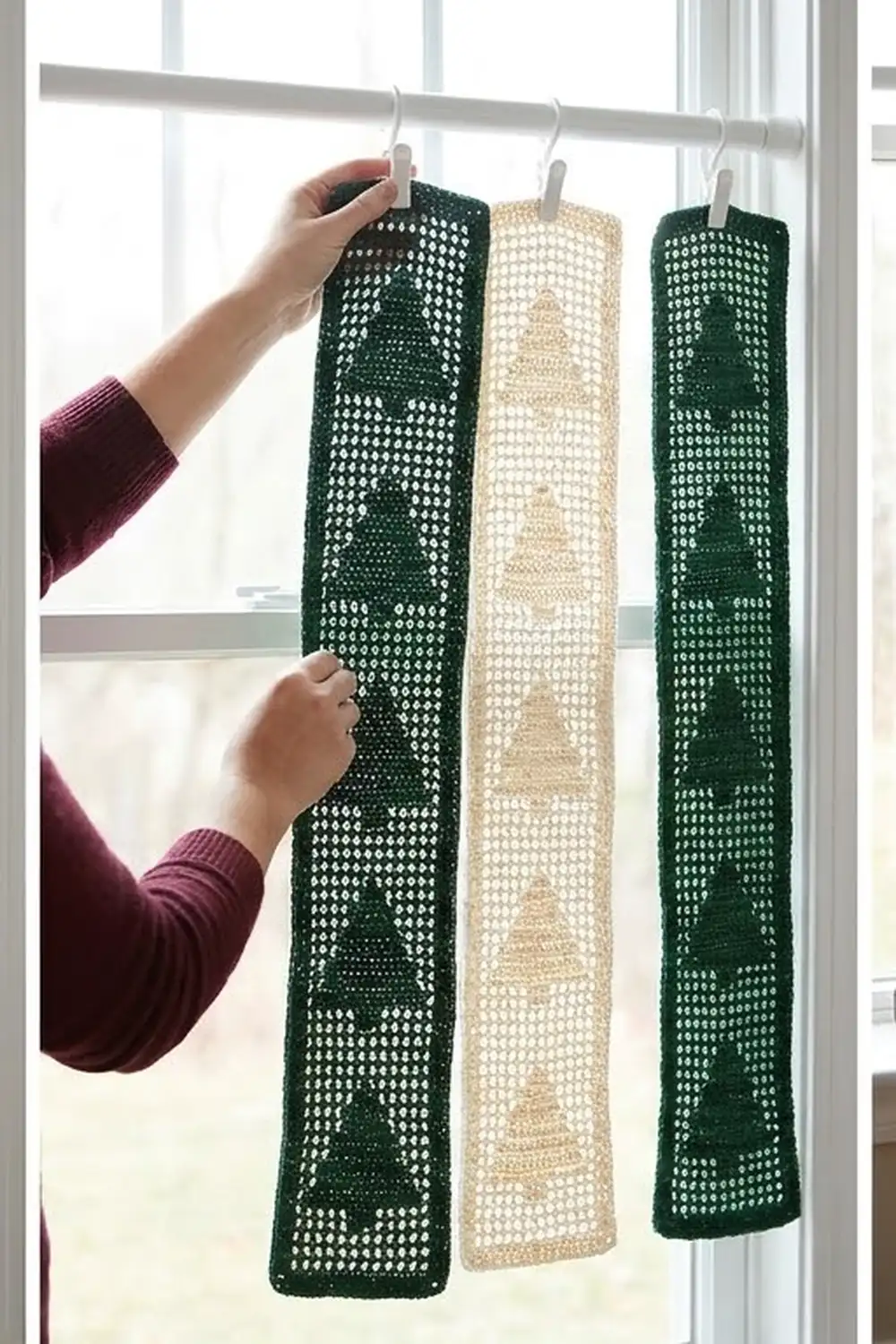
These Evergreen Filet Window Strips are long, narrow panels of open filet mesh. Each one has a column of solid tiered Christmas trees running from top to bottom. They hang side by side from a rail on small clips, filtering daylight like a vertical blind and turning the window into a quiet winter forest.
The set uses two colors, deep forest green and warm cream, and the strips alternate across the window. Each tree has a short trunk and three stepped tiers. A neat solid single crochet edge frames every strip, keeping the long sides straight and giving the clips something firm to grip.
This pattern uses US crochet terms. Each finished strip measures 5.0 in (12.7 cm) wide by 50.5 in (128.3 cm) long. The set shown has 10 strips.
Construction is simple. Each strip is worked flat in rows of filet crochet from the bottom up, with 8 trees per strip. A two-round single crochet border goes around each strip. The strips are never joined to each other; each one hangs on its own.
Finished Size and Construction
- Finished strip size: 5.0 in (12.7 cm) wide x 50.5 in (128.3 cm) long
- Skill level: Easy-intermediate (basic filet, lots of repetition)
- Terminology: US crochet terms
- Yarn weight: Sport weight (#2) cotton
- Hook: 3.0 mm (US C/2 or D/3)
- Number of pieces: 10 separate strips (5 green, 5 cream)
- Layout: 10 strips hung side by side, alternating colors, not joined
- Piece size before border: 4.5 in (11.4 cm) x 50 in (127.0 cm)
- Border depth: 0.25 in (0.6 cm) on every side
- Hanging width of full set: 54.5 in (138.4 cm) with 0.5 in (1.3 cm) gaps
Materials
Choose a smooth sport-weight cotton, either mercerized or combed. Cotton holds a crisp square mesh, stretches very little when hanging, and stands up to sunlight better than most acrylics. Avoid fuzzy or loosely plied yarn, because it blurs the open squares.
- Forest green: 650 g, about 2,015 m (5 strips)
- Cream: 650 g, about 2,015 m (5 strips)
Each strip uses about 120 g (about 372 m). The quantities above include a margin of about 50 g per color for swatching and dye-lot safety. Buy each color in a single dye lot.
Tools:
- 3.0 mm crochet hook, plus 2.75 mm and 3.25 mm for adjustments
- Tapestry needle
- Locking stitch markers
- Rust-proof pins and a long blocking surface (foam mats, or a carpeted floor covered with a towel)
- Spray bottle
- Measuring tape
- 10 blind or curtain clips and a rail or tension rod
Abbreviations (US Terms)
- ch – chain
- sc – single crochet
- dc – double crochet
- sk – skip
- sl st – slip stitch
- st(s) – stitch(es)
- sp – space
- RS – right side
Special stitches (filet squares):
- Open square (O): Ch 2, sk 2 sts (or the ch-2 sp), dc in next dc.
- Block (B): Dc in next 2 sts (or work 2 dc in the ch-2 sp), dc in next dc.
- Start of every row: Ch 3 (counts as first dc), turn. Do not work into the base of the ch-3.
- End of every row: Work the last dc into the top of the turning ch-3.
Every row is 9 squares wide: 1 starting dc + (9 x 3 sts) = 28 sts. When counting, each open square counts as 3 sts (2 ch + 1 dc).
Gauge and Checkpoints
Gauge: 8 filet squares and 8 rows = 4 in (10.2 cm). Each square is 0.5 in (1.3 cm) wide and each row is 0.5 in (1.3 cm) tall.
Gauge swatch: Ch 27. Dc in 4th ch from hook and in each ch across (25 sts). Work 7 rows of open squares (8 O per row). Block the swatch lightly, let it dry, and measure in the center.
Make one complete strip first. Block it and hang it for a day before starting the rest. Cotton relaxes a little when it hangs, so this shows you the true length.
Checkpoints:
- After Row 3: 4.5 in (11.4 cm) wide x 1.5 in (3.8 cm) tall
- After Row 15 (first tree done): 7.5 in (19.1 cm) tall
- After Row 51 (four trees done): 25.5 in (64.8 cm) tall
- After Row 100: 50 in (127.0 cm) tall
- After border: 5.0 in (12.7 cm) x 50.5 in (128.3 cm)
If your work is too big, go down 0.25 mm in hook size. If it is too small, go up 0.25 mm. If only the height is off, change how far you pull up the first loop of each dc instead of changing hooks. Width matters most for the clip fit.
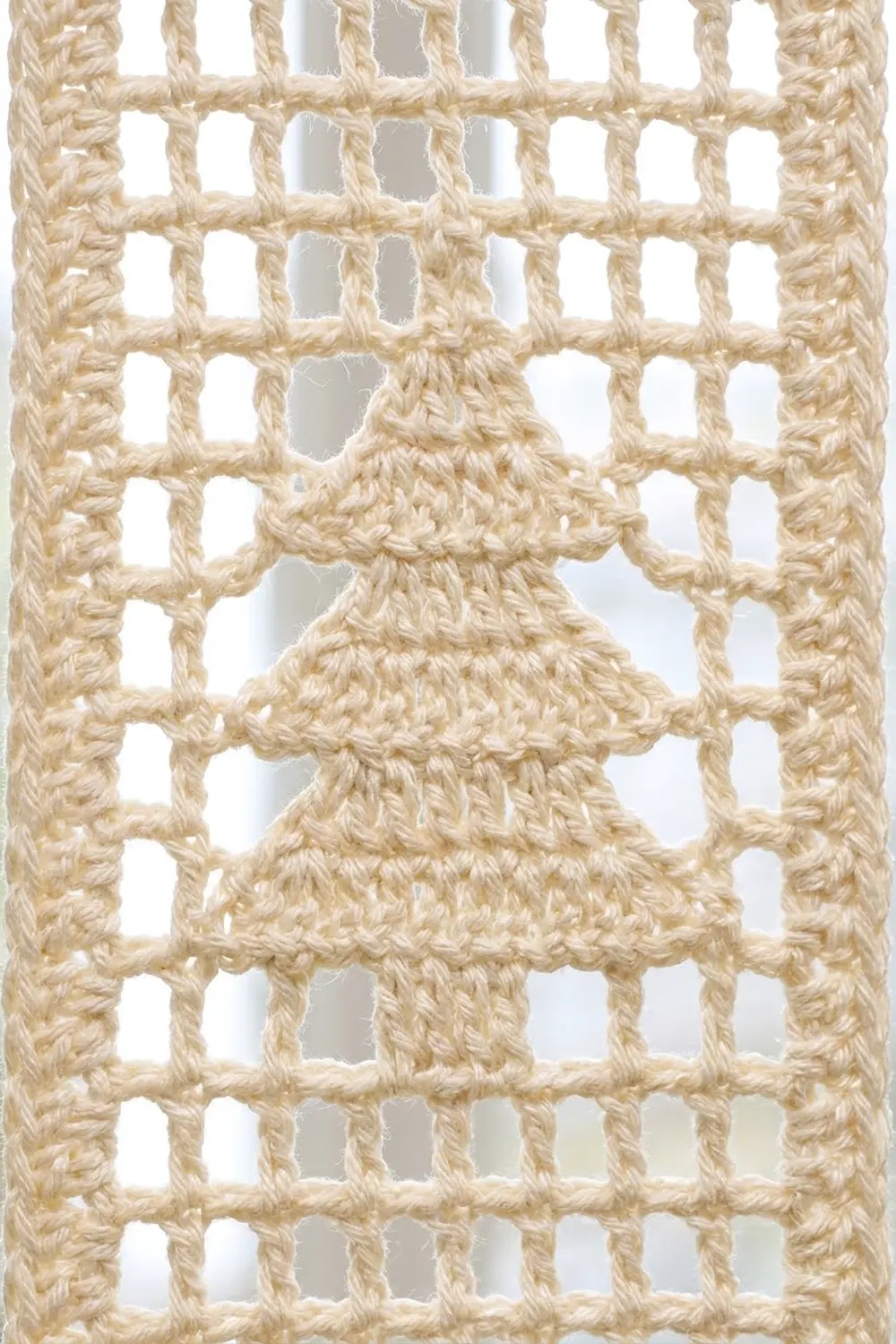
Strip Pattern
Make 5 strips in forest green and 5 in cream. Every strip follows the same instructions.
Foundation: Ch 30.
Row 1 (RS, solid base): Dc in 4th ch from hook (the skipped chs count as the first dc) and in each ch across. (28 sts: 9 B)
Row 2: Ch 3, turn. *Ch 2, sk 2, dc in next dc; repeat from * across, ending with dc in top of turning ch. (28 sts: 9 O)
Row 3: Repeat Row 2. (28 sts: 9 O)
Tree Repeat (12 rows)
Each tree takes 10 chart rows, followed by 2 open spacer rows. Every row has 28 sts. The design is symmetrical, so you read every row the same way in either direction.
Text chart (B = block, O = open), read from the bottom up:
T12  O O O O O O O O O
T11  O O O O O O O O O
T10  O O O O B O O O O   tip
T9   O O O B B B O O O   tier 3
T8   O O O O B O O O O
T7   O O O B B B O O O
T6   O O B B B B B O O   tier 2
T5   O O O B B B O O O
T4   O O B B B B B O O
T3   O B B B B B B B O   tier 1
T2   O O O O B O O O O   trunk
T1   O O O O B O O O O   trunk
- T1: Ch 3, turn. 4 O, 1 B, 4 O. (28 sts: 1 B)
- T2: Ch 3, turn. 4 O, 1 B, 4 O. (28 sts: 1 B)
- T3: Ch 3, turn. 1 O, 7 B, 1 O. (28 sts: 7 B)
- T4: Ch 3, turn. 2 O, 5 B, 2 O. (28 sts: 5 B)
- T5: Ch 3, turn. 3 O, 3 B, 3 O. (28 sts: 3 B)
- T6: Ch 3, turn. 2 O, 5 B, 2 O. (28 sts: 5 B)
- T7: Ch 3, turn. 3 O, 3 B, 3 O. (28 sts: 3 B)
- T8: Ch 3, turn. 4 O, 1 B, 4 O. (28 sts: 1 B)
- T9: Ch 3, turn. 3 O, 3 B, 3 O. (28 sts: 3 B)
- T10: Ch 3, turn. 4 O, 1 B, 4 O. (28 sts: 1 B)
- T11: Ch 3, turn. 9 O. (28 sts)
- T12: Ch 3, turn. 9 O. (28 sts)
The tiers come from the step-outs at T6 and T9. Each new tier starts wider than the row below it, so the tree reads as three stacked triangles instead of one long wedge.
Rows 4–99: Work the Tree Repeat (T1–T12) 8 times. Tree 1 is Rows 4–15, Tree 2 is Rows 16–27, and so on; Tree 8 ends at Row 99. Place a marker at the end of each tree so you can count repeats at a glance.
Row 100 (solid top): Ch 3, turn. Dc in each dc and 2 dc in each ch-2 sp across, ending with dc in top of turning ch. (28 sts: 9 B)
Do not fasten off. Continue straight into the border.
At this stage the strip measures 4.5 in (11.4 cm) x 50 in (127.0 cm). It has 100 rows: 1 solid, 2 open, 96 tree-repeat rows, and 1 solid.
Make All Pieces
- Forest green: 5 strips
- Cream: 5 strips
- Total: 10 strips
Layout across the window, left to right:
| G | C | G | C | G | C | G | C | G | C |
  1   2   3   4   5   6   7   8   9   10
G = forest green, C = cream. Pin a small numbered tag to the back of each strip so the order stays right.
Joining: Not Required (Hanging the Strips)
The strips are not sewn or crocheted together. Each one hangs from its own clip, so the strips can turn slightly and let light through between them.
- Clip each strip at the center of its top edge. The clip should grip both border rounds and the solid Row 100 for strength.
- Space the clips 5.5 in (14.0 cm) apart, center to center. This leaves a 0.5 in (1.3 cm) gap between strips.
- Size checkpoint: 10 strips x 5.0 in (12.7 cm) + 9 gaps x 0.5 in (1.3 cm) = 54.5 in (138.4 cm) total width.
Keep the tension of the solid rows the same as the mesh. A tight top row pulls the upper corners in, and the clip will pucker the fabric.
Border
Border gauge: 6 sc = 1 in (2.5 cm), with the same 3.0 mm hook.
Each corner is 3 sc worked into one st. The middle sc of that group is the corner st. The per-side counts below include both corner sts of that side.
Round 1: With RS facing, ch 1. Work 3 sc in the last dc of Row 100 (corner). Work down the long side with 3 sc around each row-end post, 100 times (300 sc). Work 3 sc in the first free loop of the foundation chain (corner). Sc in each of the next 26 free loops. Work 3 sc in the last free loop (corner). Work up the second long side with 3 sc around each row-end post (300 sc). Work 3 sc in the top of the turning ch of Row 100 (corner). Sc in each of the next 26 sts. Join with sl st to first sc.
- Top and bottom: 30 sc each (1 corner + 28 + 1 corner)
- Long sides: 304 sc each (1 corner + 302 + 1 corner)
- Round total: 4 corners + (2 x 28) + (2 x 302) = 664 sc
Round 2: Ch 1. Sc in each st around, with 3 sc in each corner st. Join with sl st to first sc. Fasten off.
- Top and bottom: 32 sc each (1 corner + 30 + 1 corner)
- Long sides: 306 sc each (1 corner + 304 + 1 corner)
- Round total: 664 + 8 = 672 sc
Why the math works: The top edge has 28 sts over 4.5 in (11.4 cm), about 6.2 sts per inch. That matches the border gauge of 6 sc per inch, so 1 sc per st lies flat. Each row is 0.5 in (1.3 cm) tall, so 3 sc per row-end also works out to 6 sc per inch, and the long sides neither ruffle nor cup. Two rounds of sc add 0.25 in (0.6 cm) per side. That gives 4.5 + 0.5 = 5.0 in (12.7 cm) wide and 50 + 0.5 = 50.5 in (128.3 cm) long.
Weave in all ends along the border, never across open squares, where they would show against the light.
Final Blocking
- Soak the strip in cool water with a drop of mild soap. Squeeze it out gently; do not wring.
- Roll it in a towel to remove excess water.
- Lay it flat on the blocking surface, RS up.
- Pin the four corners first, at 5.0 in (12.7 cm) x 50.5 in (128.3 cm).
- Pin along each long side every 4 in (10.2 cm), using a measuring tape laid alongside to keep the edges straight.
- Use a fingertip to ease each open square into a true square, one tree at a time.
- Let it dry completely, ideally for 24 hours.
- Unpin it, hang it for a day, and measure again before blocking the rest of the set.
Final Quality-Control Checklist
- Every row has 28 sts and 9 squares.
- Each strip has exactly 8 trees, each with a trunk, three tiers, and a tip.
- Rows 1 and 100 are solid. Rows 2–3 and the last two rows of Tree 8 are open.
- Border Round 2 has 672 sc, with 3 sc at each corner.
- Every strip measures 5.0 in (12.7 cm) x 50.5 in (128.3 cm), within 0.5 in (1.3 cm) in length.
- The trees line up at the same height across all 10 strips when hung.
- No yarn ends show inside the mesh.
Troubleshooting
- Strip leans or slants: You are probably missing the last dc into the turning ch on some rows. Recount to 28 sts.
- Squares look like tall rectangles: Your dc is too tall. Pull up the first loop less.
- Tree looks lopsided: Check that each tree row has the same number of open squares on both sides, for example 2 O, 5 B, 2 O.
- Long sides ruffle after the border: Work 2 sc instead of 3 in every fourth row-end, or switch to a 2.75 mm hook for the border.
- Long sides pull in: Switch to a 3.25 mm hook for the border only.
- Strips hang at different lengths: Block all strips the same way and hang them for a day. A second blocking usually evens out small differences.
Care
Hand wash in cool water, or machine wash on a delicate cycle in a mesh bag, then lay flat and pin to shape while damp. Do not tumble dry, because heat can shrink cotton and distort the mesh.
Final Notes
The measurement chain is short. 8 squares = 4 in (10.2 cm), so a 9-square strip is 4.5 in (11.4 cm) wide, and 100 rows reach 50 in (127.0 cm). The two-round border adds 0.25 in (0.6 cm) per side, for a finished strip of 5.0 in (12.7 cm) x 50.5 in (128.3 cm). Ten strips with 0.5 in (1.3 cm) gaps cover 54.5 in (138.4 cm) of window. Check your gauge and finish one strip completely; the other nine follow the same numbers.
Happy crocheting!