

The Evergreen Leaf Table Runner is made of lacy leaf motifs set in three columns. Each leaf has a raised center spine with solid “vein” stitches fanning out from it. Around that sits a ring of open spaces held by spoke stitches, and a smooth single-crochet outline finishes the edge. Joined together, the leaves form a long, airy lattice with diamond-shaped gaps that let the tablecloth show through.
The sample uses one color, a soft sage green cotton, which looks calm and seasonal next to candles, pine and silver ornaments. Thick wrapped tassels at each short end give the runner some weight and a neat finish.
This pattern uses US crochet terms. The finished runner measures 12 in (30.5 cm) wide by 60 in (152.4 cm) long, not counting tassels. With a 4 in (10.2 cm) tassel at each end, it is about 68 in (172.7 cm) overall.
Each motif is worked in 3 rounds around a foundation chain, so the chain becomes the leaf’s spine. Motifs are joined as you go in Round 3, at the tips and at the widest point of each side. Tassels are added last.
Finished Size and Construction
- Finished runner: 12 in (30.5 cm) wide x 60 in (152.4 cm) long, plus tassels
- Overall length with tassels: about 68 in (172.7 cm)
- Skill level: Intermediate
- Terminology: US crochet terms
- Yarn weight: #4 worsted cotton
- Hook: 4.5 mm (US 7)
- Number of pieces: 30 leaf motifs, plus 6 tassels
- Layout: 3 columns x 10 rows
- Motif size: 4 in (10.2 cm) wide x 6 in (15.2 cm) long, measured from the top point to the end of the bottom loop
- Size before border: 12 in x 60 in (30.5 cm x 152.4 cm)
- Border depth: no separate border. The Round 3 single-crochet outline is the finished edge, about 0.25 in (0.6 cm) deep.
Materials
Choose a smooth, tightly plied worsted cotton or cotton blend. Cotton holds the pointed tips and open spaces crisply after blocking. Avoid fuzzy or very soft yarns, which blur the spokes.
- Sage green, worsted cotton: about 200 g / 340 m (372 yd)
- Motifs: about 7.2 m (7.9 yd) each, 216 m (236 yd) total
- Tassels: about 7.5 m (8.2 yd) each, 45 m (49 yd) total
- Tools:
- 4.5 mm (US 7) crochet hook
- Tapestry needle
- Scissors
- Stiff card cut to 4.5 in (11.4 cm) tall, for the tassels
- Rust-proof pins
- Blocking mats long enough for 60 in (152.4 cm), or a towel-covered floor
- Spray bottle
The quantities include about a 30% margin for your gauge test, weaving in ends and normal differences between yarns.
Abbreviations (US Terms)
- ch: chain
- sl st: slip stitch
- sc: single crochet
- hdc: half double crochet
- dc: double crochet
- tr: treble crochet (yarn over twice)
- sk: skip
- sp: space
- st(s): stitch(es)
- RS: right side
Special stitches
- Side join: Work 1 sc. Remove the hook from the loop, insert it from front to back through the matching sc on the neighboring motif, pick up the dropped loop and pull it through. Continue with the next sc. The join is not counted as a stitch.
- Tip join: Ch 1, sl st around the ch-6 loop of the motif above, ch 1. This replaces the ch-2 of the top point.
Gauge and Checkpoints
Swatch gauge: 16 sc and 17 rows = 4 in (10.2 cm) in sc worked flat.
Before starting the runner, make one complete motif without joining it and block it lightly. All final measurements depend on this motif.
Checkpoints:
- After Round 1: 4.75 in (12.1 cm) from tip to tip and 2 in (5.1 cm) across the tallest tr.
- After Round 2: 5.25 in (13.3 cm) long and 3.5 in (8.9 cm) wide.
- After Round 3: 4 in (10.2 cm) wide and 6 in (15.2 cm) long, including the bottom loop.
If the motif is too big: go down to a 4 mm (US G-6) hook. Also check that your foundation chain is not loose, because a long spine stretches the whole leaf.
If the motif is too small: go up to a 5 mm (US H-8) hook. Tight tr stitches are the usual cause, so pull each loop up to full height.
Every 0.25 in (0.6 cm) of extra motif width adds 0.75 in (1.9 cm) to the runner’s width. Every 0.25 in (0.6 cm) of extra length adds 2.5 in (6.4 cm) to its length.
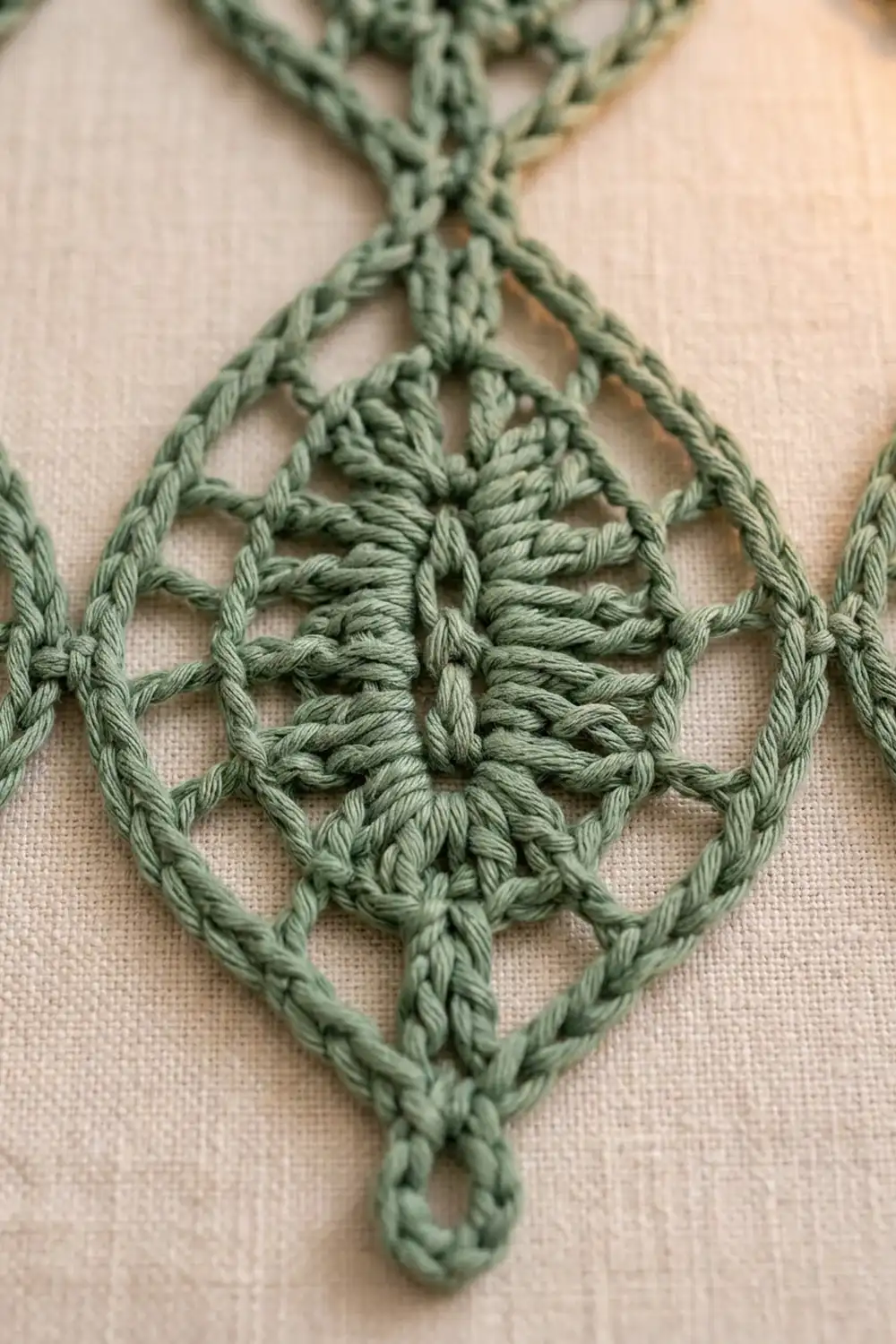
Leaf Motif
Make 30 motifs. Work with the RS facing and do not turn.
Foundation
Ch 18. This chain becomes the spine of the leaf.
Round 1: Spine and Veins
The stitches are worked into both sides of the chain. Because they stand straight out from it, they look like veins.
Side A:
- Sc in 2nd ch from hook and in the next ch.
- Hdc in next 2 ch.
- Dc in next 3 ch.
- Tr in next 4 ch.
- Dc in next 3 ch.
- Hdc in next 2 ch.
- Sc in last ch.
That is 17 sts.
Bottom tip: Ch 2.
Side B: Rotate the work and work into the free loops on the other side of the foundation chain.
- Sc in the same ch as the last sc.
- Hdc in next 2 ch.
- Dc in next 3 ch.
- Tr in next 4 ch.
- Dc in next 3 ch.
- Hdc in next 2 ch.
- Sc in last 2 ch.
That is 17 sts.
Top tip: Ch 2, then sl st to the first sc.
Round 1 total: 34 sts (17 per side) plus 2 ch-2 tip sps.
The stitch heights match across the spine: sc at both ends, rising to 4 tr in the middle. This gives the solid center its leaf shape.
Round 2: Spoke Ring
Sl st into the top ch-2 sp. Ch 1, then work (sc, ch 3, sc) in the same sp.
Side A:
- Ch 2, sk 1 st, hdc in next st.
- Ch 2, sk 1 st, dc in next st.
- Ch 3, sk 1 st, tr in next st. Repeat this step 3 more times.
- Ch 3, sk 1 st, dc in next st.
- Ch 2, sk 1 st, hdc in next st.
- Ch 2, sk the last st.
Bottom tip: Work (sc, ch 3, sc) in the ch-2 tip sp.
Side B: Repeat the Side A sequence, ending with ch 2, sk the last st. Sl st to the first sc.
Each side now has 8 spokes (hdc, dc, 4 tr, dc, hdc) and 9 spaces in this order: ch-2, ch-2, ch-3, ch-3, ch-3, ch-3, ch-3, ch-2, ch-2.
Round 2 total: 16 spokes, 4 sc and 2 ch-3 tip loops. That makes 20 sts, plus 18 side spaces and 2 tip loops.
The spokes are tallest at the widest part of the leaf and shortest near the tips, so the ring widens in the middle and tapers to a point.
Round 3: Cord Outline
This round makes the firm outline and holds all of the joins. For your first test motif, ignore the joins.
Sl st into the top ch-3 loop. Ch 1, then work (2 sc, ch 2, 2 sc) in the loop.
Side A:
- 2 sc in each ch-2 sp
- 3 sc in each ch-3 sp
- 1 sc in the top of each spoke
That is 31 sc in this order: 2, 1, 2, 1, 3, 1, 3, 1, 3, 1, 3, 1, 3, 1, 2, 1, 2.
Bottom tip: Sk the sc, then work (2 sc, ch 6, 2 sc) in the bottom ch-3 loop.
Side B: Work the same 31 sc. Sk the last sc, then sl st to the first sc. Fasten off.
Round 3 total: 70 sc. That is 31 sc per side plus 4 sc at each tip (2 on each side of the point). It also has a ch-2 top point and a ch-6 bottom loop.
Definition: in this pattern, “per side” means the 31 sc between the tips. The 2 sc at each end of a tip are not included in that count.
The joining sc is the 16th of the 31 sc on a side, the exact middle. It is the center sc of the middle ch-3 sp, between the 2nd and 3rd tr spokes. This is the widest point of the leaf.
Weave in the ends along the spine, where they stay hidden in the solid stitches.
Make All Pieces
All 30 motifs are sage green. Work motifs 1 to 3 in Row 1 as described below, then join every later motif to its neighbors as you finish its Round 3.
Layout grid (columns A, B and C; T = tassel):
Row 1:   A1 - B1 - C1      (tassels tied to top points)
Row 2:   A2 - B2 - C2
Row 3:   A3 - B3 - C3
Row 4:   A4 - B4 - C4
Row 5:   A5 - B5 - C5
Row 6:   A6 - B6 - C6
Row 7:   A7 - B7 - C7
Row 8:   A8 - B8 - C8
Row 9:   A9 - B9 - C9
Row 10:  A10 - B10 - C10
         T     T     T     (tassels tied to bottom loops)
“-” marks a side join at the widest point. Every motif in rows 2 to 10 also tip-joins to the motif directly above it.
Joining
All joins happen in Round 3, using the join-as-you-go method.
Row 1:
- Make A1 complete.
- Make B1. On the Side A edge facing A1, work the 16th sc as a side join into A1’s 16th sc.
- Make C1 the same way, joining it to B1.
Rows 2 to 10:
- At the top tip, work (2 sc, tip join, 2 sc). The ch-1, sl st, ch-1 replaces the ch-2 point and links the motif to the ch-6 bottom loop of the motif above.
- Work a side join at the 16th sc on each edge that faces an already-finished neighbor. Column A motifs join on one side only, column B motifs on one side, and column C motifs on one side, always to the motif before them in the row. B motifs therefore end up linked to both A and C.
Stitch logic: each join connects a single sc to a single sc, or a tip to a loop. No stitches are added or removed, so every motif keeps 70 sc. Joins are only at the middle of the sides and at the tips, so the shaped edges curve apart between joins and leave the diamond-shaped gaps.
Tension: keep each join snug but not tight. A tight side join pinches the leaves inward, and a tight tip join shortens the column. Before you pull the loop through, the two motifs should lie flat side by side with no gap and no overlap.
Size checkpoints:
- After Row 1: 12 in (30.5 cm) wide (3 x 4 in, or 3 x 10.2 cm).
- After Row 5: 30 in (76.2 cm) long.
- After Row 10: 60 in (152.4 cm) long.
Border
This runner has no separate border round. The Round 3 sc outline of the motifs is the finished edge, giving the scalloped silhouette shown in the photo. This section covers edge gauge and the end finish.
Edge gauge: 31 sc along each 6 in (15.2 cm) motif side, including its curve.
Long sides: each long edge of the runner is made of 10 outer motif sides (column A on one edge, column C on the other). That gives 10 x 31 = 310 sc per long edge. The only breaks are the 9 tip junctions, which add no stitches.
Short ends: each end has 3 motif tips, one per column. The top end uses the ch-2 points of A1, B1 and C1. The bottom end uses the ch-6 loops of A10, B10 and C10.
Why the math works: joins only link existing stitches, so every motif side keeps exactly 31 sc. Nothing is gathered or stretched, and the outline stays even from end to end.
Tassels (make 6)
- Wrap yarn 30 times around the 4.5 in (11.4 cm) card.
- Slide a 12 in (30.5 cm) strand under the wraps at the top edge and tie it tightly. Leave the ends long for attaching.
- Cut through the wraps along the bottom edge.
- With a 20 in (50.8 cm) strand, wrap the neck tightly 8 times, 0.75 in (1.9 cm) below the top. Tie it off and bury the ends inside the tassel.
- Trim the tassel to 4 in (10.2 cm) long.
- Tie the tassel to the end of the runner. At the bottom end, thread the tie through a ch-6 loop. At the top end, thread it through a ch-2 point. Knot it securely and hide the ends inside the tassel.
Final Blocking
- Weave in any remaining ends before blocking.
- Soak the runner in cool water for 15 minutes, then press out the water. Do not wring it.
- Lay it flat and pat it to 12 in x 60 in (30.5 cm x 152.4 cm).
- Pin the top point and bottom loop of every motif on the center line of its column.
- Pin each side join, then pin the curve of each leaf between joins so the diamond gaps open evenly.
- Pin one point on the open edge of every space in the Round 2 ring so the spokes radiate cleanly.
- Let it dry completely, at least 24 hours.
- Steam the tassels lightly and comb them straight. Trim them evenly to 4 in (10.2 cm) if needed.
Final Quality-Control Checklist
- [ ] There are 30 motifs, each with 70 sc in Round 3
- [ ] Each motif side has 31 sc, and the side joins are at the 16th sc
- [ ] All 27 tip joins sit centered in the ch-6 loops
- [ ] All 30 side joins are present: 2 per row x 3 columns… see the note below
- [ ] The runner measures 12 in (30.5 cm) x 60 in (152.4 cm)
- [ ] There are 6 tassels, each 4 in (10.2 cm), firmly tied
- [ ] All ends are woven into the solid spines
Side join count: each row has 2 side joins (A to B and B to C), so 10 rows make 20 side joins. Tip joins: 9 per column x 3 columns = 27.
Troubleshooting
The leaf cups or curls. The Round 2 chains are too tight for the tr spokes. Loosen your chains, or add 1 ch to the ch-3 sps if the problem continues.
The edges ruffle. The Round 3 sc is too loose, or the chains are too long. Go down half a hook size for Round 3 only.
The tips are blunt. Make sure you skip the sc beside each tip loop in Round 3, and pin the points firmly when blocking.
The columns drift apart. A side join may be on the wrong sc. Count to the 16th sc again, so the join is the center of the middle ch-3 sp.
The runner comes out short. The tip joins are too tight. Work the ch-1s on either side of the sl st loosely.
The spine twists. The foundation chain was twisted. Keep the “V”s facing you as you work Side A.
Care
Hand wash in cool water with mild soap and lay flat to dry, reshaping the tips as it dries. Do not tumble dry, and keep the runner away from open candle flames on the table.
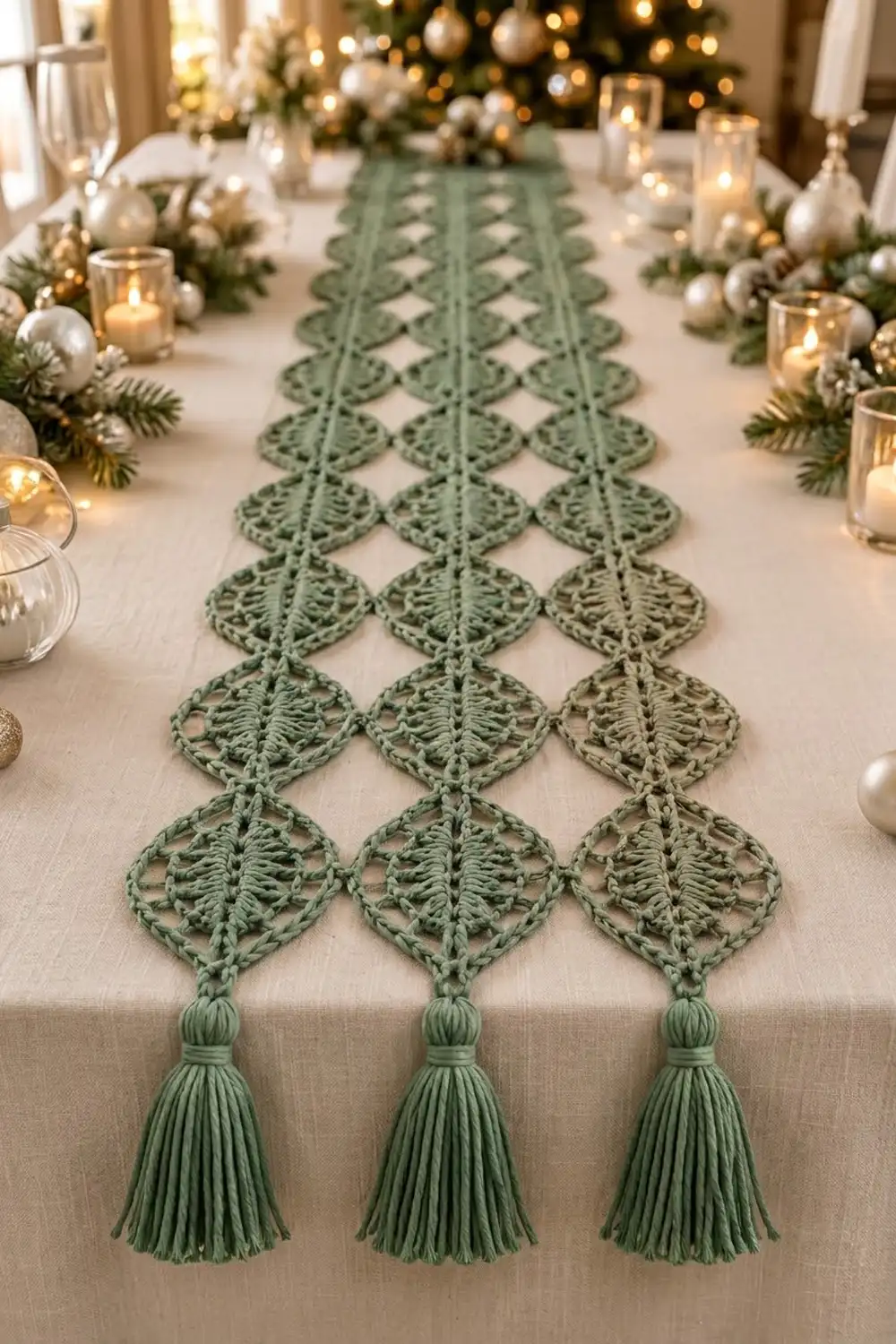
Final Notes
The measurements build on each other. A swatch gauge of 16 sc = 4 in (10.2 cm) produces a Round 1 leaf of 4.75 in (12.1 cm). Round 2 takes it to 5.25 in x 3.5 in (13.3 cm x 8.9 cm). Round 3 finishes the motif at 4 in x 6 in (10.2 cm x 15.2 cm) with 31 sc per side.
Three columns make the runner 12 in (30.5 cm) wide, and ten rows make it 60 in (152.4 cm) long, with 310 outline sc along each long edge. Tassels bring the finished piece to about 68 in (172.7 cm).
Check your first motif carefully, and the rest of the runner will fall into place, one leaf at a time.
Happy crocheting!