

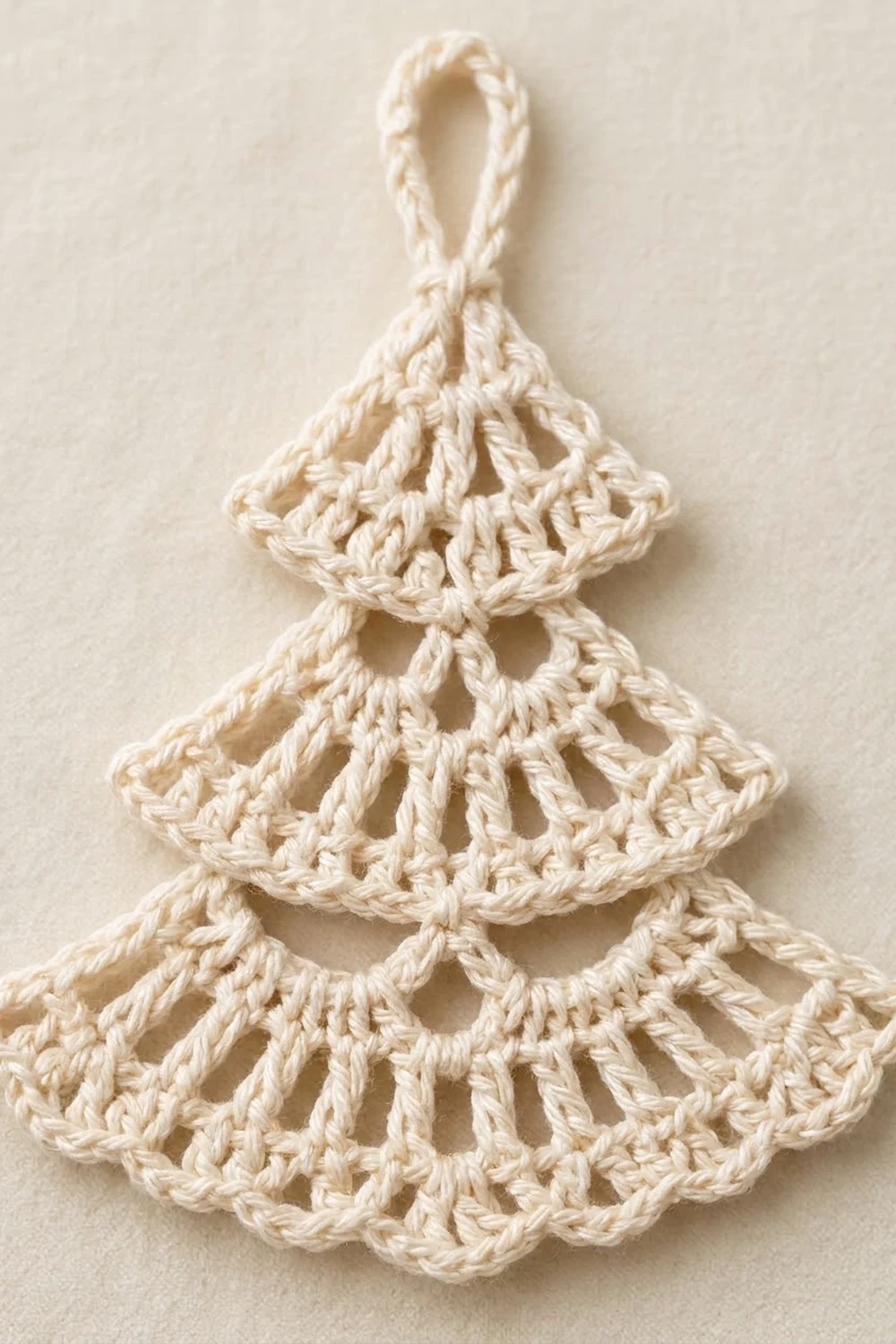
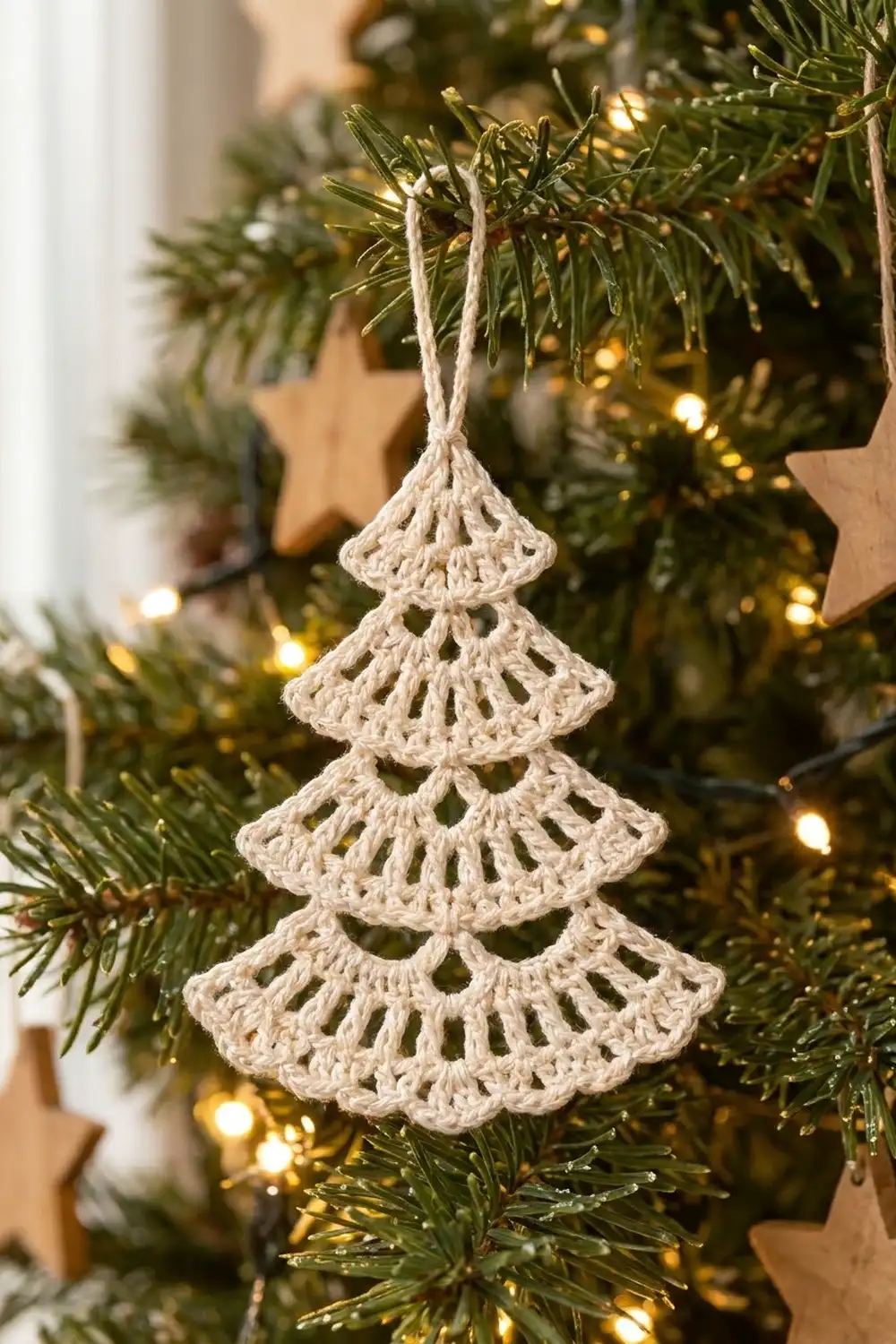
The Frosted Lace Tier Tree is a small lace Christmas tree ornament worked in cream cotton thread. It has four fan-shaped tiers stacked one above the other. Each tier is made of tall spokes that spread downward with open chain spaces between them, then a narrow solid band, then a hem of rounded scallops. Each hem overlaps the top of the tier below, so the tree looks layered, like snowy branches.
The tree uses only one color, ivory or cream, so the texture carries the design. The style is soft vintage lace. It looks good on a tree, tied to a gift, or hung in a window. The pattern uses US crochet terms throughout.
The finished ornament is 4 in (10.2 cm) tall from the tip to the bottom scallops and 3.25 in (8.3 cm) wide at the bottom tier. The hanging loop adds 0.75 in (1.9 cm), for an overall height of 4.75 in (12.1 cm).
The whole tree is one piece, worked from the top down in turned rows, starting from a small ring at the tip. Each tier is four rows long. You work the scallops into the front loops only of a single crochet row, then work the next tier into the back loops left free behind them. That is how the layers overlap with no sewing. A hanging loop finishes the tip.
Finished Size and Construction
- Finished size: 4 in (10.2 cm) tall x 3.25 in (8.3 cm) wide, plus a 0.75 in (1.9 cm) hanging loop
- Skill level: Intermediate (front-loop layering, careful counting)
- Terminology: US crochet terms
- Yarn weight: Size 3 mercerized cotton crochet thread (Super Fine #1 range)
- Hook: 2.25 mm (US B-1)
- Number of pieces: 1
- Layout: Four stacked tiers in one continuous piece, 16 rows total
- Piece size: 4 in (10.2 cm) x 3.25 in (8.3 cm)
- Size before border: The same as the finished size. The scalloped hems are built into the rows, so only the hanging loop is added afterward.
- Border depth: Each scalloped hem is about 0.25 in (0.6 cm) deep.
Materials
Choose a smooth, tightly twisted, mercerized cotton thread. It shows every stitch clearly, holds its shape after blocking, and takes starch well. Avoid fuzzy or very soft cottons, because they blur the chain spaces and make the scallops look limp.
- Cream / ivory: 8 g, about 22 m (24 yd)
The ornament itself uses roughly 4 g. The amount above includes a generous margin for a test tier and the hanging loop. If you plan to make a set, one 50 g ball makes several trees.
Tools
- 2.25 mm (US B-1) crochet hook
- Tapestry needle with a small eye
- Scissors
- Stitch marker
- Blocking mat or folded towel
- Rust-proof pins
- Spray bottle with water
- Optional: spray starch or diluted fabric stiffener
Abbreviations (US Terms)
- ch – chain
- sl st – slip stitch
- sc – single crochet
- hdc – half double crochet
- dc – double crochet
- tr – treble crochet
- st(s) – stitch(es)
- sp(s) – space(s)
- sk – skip
- FLO – front loop only
- RS – right side
- rep – repeat
Special stitch – Scallop: Work (hdc, 2 dc) in the FLO of the next st, then (2 dc, hdc) in the FLO of the following st. One scallop uses 2 sts and makes 6 sts.
Free loops: After a FLO row, the back loops of the row below are left unworked. These are the free loops you use to start each new tier.
Right side: The RS is the side facing you on the scallop rows (Rows 4, 8, 12 and 16). All the scallops sit on this side.
Turning chains: Ch 6 counts as tr + ch 2, and ch 5 counts as dc + ch 2. At the end of each sc band row, work the last sc into the 3rd ch of the beginning ch-5.
Gauge and Checkpoints
Gauge: 8 sc = 1 in (2.5 cm), in sc rows with a 2.25 mm hook.
The tree is one piece, so Tier 1 is your test piece. Work Rows 1–4 and measure before you go on.
Checkpoints (laid flat and lightly pressed, before blocking):
- After Tier 1 (Row 4): 1.25 in (3.2 cm) tall; Tier 1 about 1.125 in (2.9 cm) wide
- After Tier 2 (Row 8): 2.2 in (5.6 cm) tall; Tier 2 about 1.75 in (4.4 cm) wide
- After Tier 3 (Row 12): 3.1 in (7.9 cm) tall; Tier 3 about 2.5 in (6.4 cm) wide
- After Tier 4 (Row 16): 4 in (10.2 cm) tall; Tier 4 about 3.25 in (8.3 cm) wide
If Tier 1 is too big: Switch to a 2 mm hook. Also check that your tr are not loose and loopy at the top.
If Tier 1 is too small: Switch to a 2.5 mm hook. Tight chain spaces are the usual cause, so loosen your chains in particular.
A difference of 0.125 in (0.3 cm) in Tier 1 grows to about 0.5 in (1.3 cm) by Tier 4, so fix it early.
Pattern
Every tier has the same four-row structure:
- Spoke row in tr, with ch-2 spaces
- Second spoke row in dc, with ch-2 spaces
- Solid band in sc: 1 sc in each dc and 2 sc in each ch-2 sp
- Scallop hem worked in FLO
If a tier has k spokes, its sc band has 3k – 2 sts. That number always fits exactly k – 1 scallops, with 1 sc between each pair.
Tier 1 (top)
Ring: Ch 4, sl st in the first ch to form a ring.
Row 1: Ch 6 (counts as tr + ch 2), (tr, ch 2) twice in the ring, tr in the ring, turn. (4 tr, 3 ch-2 sps)
The tr spread downward from the ring. The top half of the ring stays bare. The hanging loop goes there later.
Row 2: Ch 5 (counts as dc + ch 2), (dc in next tr, ch 2) twice, dc in 4th ch of beginning ch-6, turn. (4 dc, 3 ch-2 sps)
Row 3: Ch 1, sc in first dc, (2 sc in next ch-2 sp, sc in next dc) 3 times, turn. (10 sc)
Row 4 (RS, scallop hem): Ch 1, sc in FLO of first st, (Scallop, sc in FLO of next st) 3 times, turn. (3 scallops, 4 sc)
Check: 1 + (3 x 3) = 10 sts used.
Tier 2
Row 5: Fold the scallops away from you. Sl st into the free loop of the last st of Row 3, directly behind the sc you just made. Ch 6 (counts as tr + ch 2), tr in the same free loop, (ch 2, sk 2 free loops, tr in next free loop) 3 times, ch 2, tr in the same free loop, turn. (6 tr, 5 ch-2 sps)
The tr land on free loops 1, 4, 7 and 10 of the 10 available. The extra tr at each end forms a V-shaped corner, which makes the tier flare out past the tier above.
Row 6: Ch 5 (counts as dc + ch 2), (dc in next tr, ch 2) 4 times, dc in 4th ch of beginning ch-6, turn. (6 dc, 5 ch-2 sps)
Row 7: Ch 1, sc in first dc, (2 sc in next ch-2 sp, sc in next dc) 5 times, turn. (16 sc)
Row 8 (RS): Ch 1, sc in FLO of first st, (Scallop, sc in FLO of next st) 5 times, turn. (5 scallops, 6 sc)
Check: 1 + (5 x 3) = 16.
Tier 3
Row 9: Sl st into the free loop of the last st of Row 7. Ch 6, tr in the same free loop, (ch 2, sk 2, tr in next free loop) 5 times, ch 2, tr in the same free loop, turn. (8 tr, 7 ch-2 sps)
Row 10: Ch 5, (dc in next tr, ch 2) 6 times, dc in 4th ch of beginning ch-6, turn. (8 dc, 7 ch-2 sps)
Row 11: Ch 1, sc in first dc, (2 sc in next ch-2 sp, sc in next dc) 7 times, turn. (22 sc)
Row 12 (RS): Ch 1, sc in FLO of first st, (Scallop, sc in FLO of next st) 7 times, turn. (7 scallops, 8 sc)
Check: 1 + (7 x 3) = 22.
Tier 4 (bottom)
Row 13: Sl st into the free loop of the last st of Row 11. Ch 6, tr in the same free loop, (ch 2, sk 2, tr in next free loop) 7 times, ch 2, tr in the same free loop, turn. (10 tr, 9 ch-2 sps)
Row 14: Ch 5, (dc in next tr, ch 2) 8 times, dc in 4th ch of beginning ch-6, turn. (10 dc, 9 ch-2 sps)
Row 15: Ch 1, sc in first dc, (2 sc in next ch-2 sp, sc in next dc) 9 times, turn. (28 sc)
Row 16 (RS): Ch 1, sc in FLO of first st, (Scallop, sc in FLO of next st) 9 times. (9 scallops, 10 sc) Fasten off.
Check: 1 + (9 x 3) = 28.
Summary: 4 → 6 → 8 → 10 spokes; 10 → 16 → 22 → 28 sc; 3 → 5 → 7 → 9 scallops.
Border: Scalloped Hems and Hanging Loop
This ornament has no separate border round. The scalloped hems are the edging. The slanted sides stay as plain row ends, which keeps the stepped tree outline crisp. This section explains the hem math and adds the hanging loop.
Border gauge: One scallop repeat (Scallop + 1 sc) uses 3 sts, about 0.375 in (1.0 cm) along the sc band. Each scallop stands about 0.25 in (0.6 cm) deep.
Hem counts per tier:
- Tier 1: 10 sts = 4 sc + 3 scallops, about 1.25 in (3.2 cm) along the curve
- Tier 2: 16 sts = 6 sc + 5 scallops, about 2 in (5.1 cm) along the curve
- Tier 3: 22 sts = 8 sc + 7 scallops, about 2.75 in (7.0 cm) along the curve
- Tier 4: 28 sts = 10 sc + 9 scallops, about 3.5 in (8.9 cm) along the curve
These are lengths measured along the curve. Each hem is curved, so its straight-across width is shorter, which matches the widths in the checkpoints.
Why the math works: A tier with k spokes has k – 1 spaces, so its sc band has k + 2(k – 1) = 3k – 2 sts. A scallop hem needs 1 + 3n sts, so it holds exactly n = k – 1 scallops with nothing left over. The next tier works into the same 3k – 2 free loops. A tr in every 3rd loop gives k spokes, and the 2 extra end tr make k + 2. So each tier gains exactly 2 spokes, 6 band sts and 2 scallops.
Each slanted side of each tier shows 3 row ends (tr, dc and sc) plus the end sc of the scallop row. Do not add stitches there.
Hanging loop: With the RS facing, join the thread with a sl st in the center of the bare top of the ring. Ch 14, sl st in the same place. Ch 1, work 20 sc over the chain loop, then sl st at the base. Fasten off. The loop should stand 0.75 in (1.9 cm) tall.
Weave in all ends along the row ends or inside the sc bands. Never weave them through the scallops.
Final Blocking
- Wet the ornament, or mist it until it is damp all the way through.
- Roll it in a towel to press out the water. Do not wring it.
- Lay it RS up on the mat with the tip at the top.
- Pin the tip and the base of the hanging loop first.
- Pin the two outer corners of Tier 4 so the tree is 3.25 in (8.3 cm) wide and 4 in (10.2 cm) tall.
- Pin the outer corners of Tiers 3, 2 and 1 at 2.5 in (6.4 cm), 1.75 in (4.4 cm) and 1.125 in (2.9 cm) wide, centered under the tip.
- Pin each scallop tip outward so the hems curve smoothly.
- Lift each scallop hem slightly so it lies over the tier below instead of tucking under.
- Spray with starch if you want a crisp ornament. Let it dry fully before you unpin it.
Final Quality-Control Checklist
- Spokes: 4, 6, 8 and 10 tr
- Sc bands: 10, 16, 22 and 28 sts
- Scallops: 3, 5, 7 and 9, all on the RS
- Each tier starts in the free loops behind the scallops above it
- Both sides of the tree slope evenly
- The blocked tree measures 4 in (10.2 cm) x 3.25 in (8.3 cm)
- The hanging loop is centered and 0.75 in (1.9 cm) tall
- All ends are woven in and hidden from the RS
Troubleshooting
Scallops are on different sides. You missed or added a row. Each tier must be exactly 4 rows, with every scallop row worked RS facing.
The new tier is hard to start. Fold the scallops all the way away from you. The free loops are the horizontal bars left along the top of the sc band.
A tier cups or ruffles. Make sure you worked 2 sc, not 3, in each ch-2 sp, and that each scallop spans 2 sts.
The tree is lopsided. Count the ch-2 sps. If one end is missing its V, the whole tier shifts to one side.
The sides look ragged. Keep the turning chains snug. A loose ch-6 at the start of a tr row is the most common cause.
The loop twists. Work the sc over the chain evenly, and pin the loop flat while blocking.
Care
Hand wash in cool water with mild soap, press out the water in a towel, and dry flat, reshaping the scallops as it dries. Starch again if needed.
Final Notes
The measurement chain is short. A gauge of 8 sc = 1 in (2.5 cm) gives a Tier 1 that is 1.25 in (3.2 cm) tall. Each tier after that adds about 0.9 in (2.3 cm) of height and 2 spokes of width. The result is a tree 4 in (10.2 cm) tall and 3.25 in (8.3 cm) wide, with a 0.75 in (1.9 cm) loop, for 4.75 in (12.1 cm) overall. Check Tier 1, count every band, and the rest takes care of itself.
Happy crocheting!