

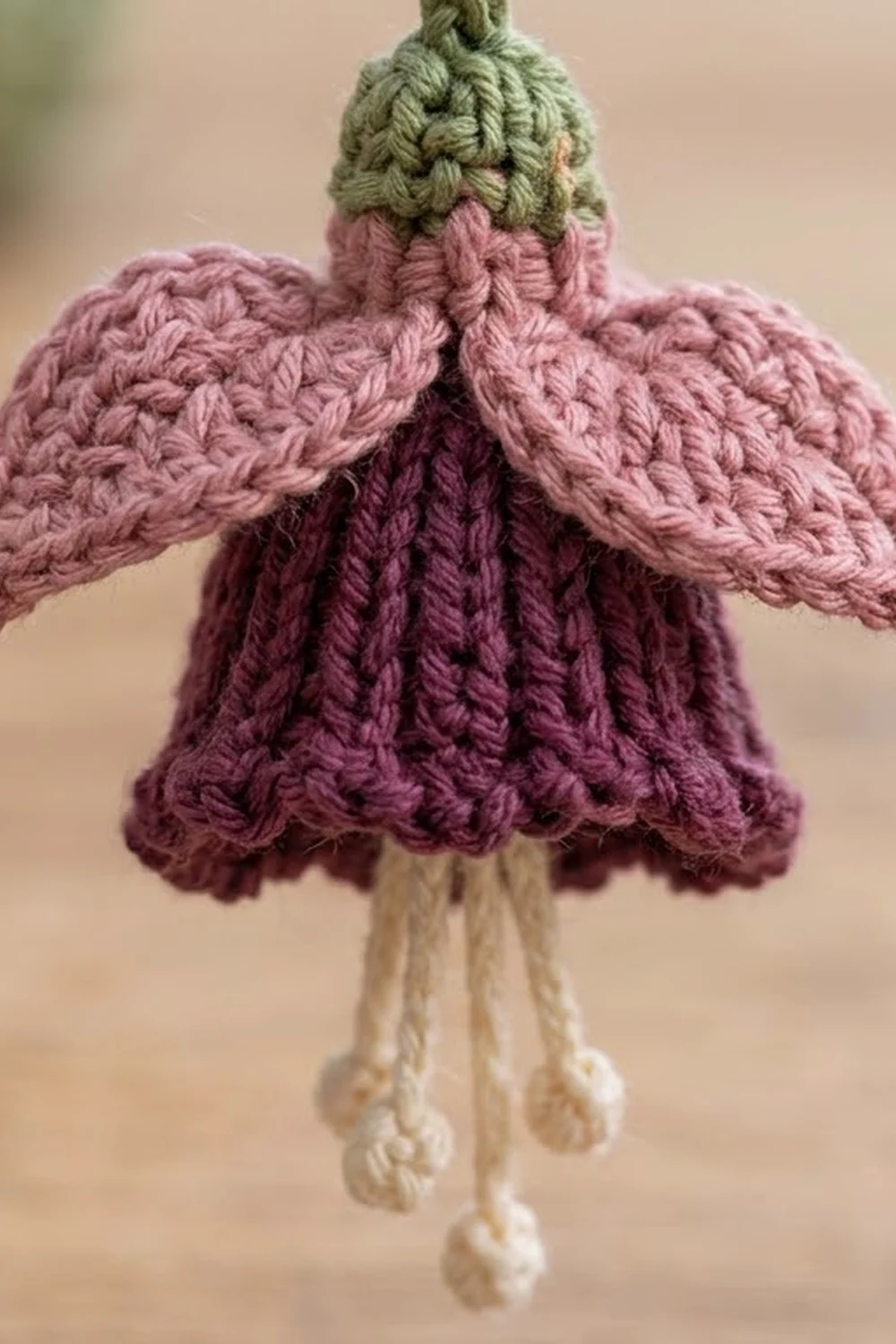
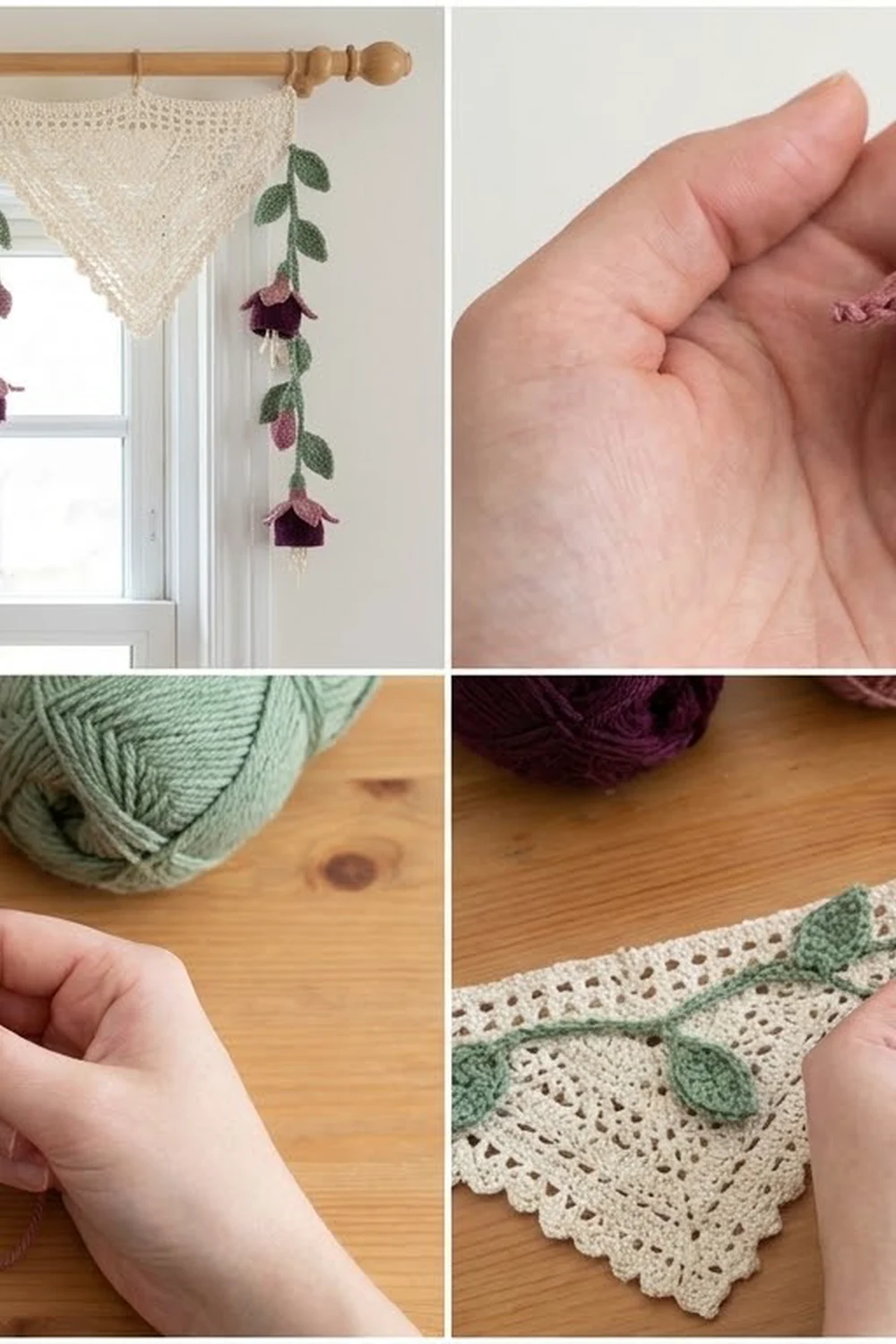
This valance pairs a cream lace header with trailing fuchsia vines. The lace band ends in eight pointed scallops with a picot trim, and seven tab loops hold it on a curtain rod. A leafy vine hangs from each scallop tip, and each vine ends in a fuchsia flower.
The colors are cream for the lace and stamens, sage green for the vines, leaves and caps, dusty rose for the sepals and deep plum for the bells. It’s a cottage-garden look that suits a kitchen or sunroom window.
The pattern uses US terms. Including points and border, the band measures 32.5 in × 5.3 in (82.6 cm × 13.5 cm). The six short vines drop 12.5 in (31.8 cm) below their tips, and the two long outer vines drop 20.5 in (52.1 cm).
You’ll work the band in rows, add the scallops one at a time, then work a two-round border and the tabs. The flowers and vines are made separately and sewn on.
Finished Size and Construction
- Finished size: band 32.5 in × 5.3 in (82.6 cm × 13.5 cm); vines 12.5 in (31.8 cm) and 20.5 in (52.1 cm)
- Skill level: Intermediate
- Terminology: US
- Yarn weight: DK / light (#3) cotton
- Hooks: 4.0 mm (G-6) for the band, 3.5 mm (E-4) for the flowers and vines
- Number of pieces: 1 band, 8 vines, 10 bells, 10 sepal stars, 10 caps
- Layout: 8 points in a row, with 1 vine per tip and 7 tabs over the valleys
- Piece size: each point is 4 in (10.2 cm) wide and 2 in (5.1 cm) tall
- Size before border: 32 in × 4.8 in (81.3 cm × 12.2 cm)
- Border depth: about 0.25 in (0.6 cm) per edge
Materials
Choose a smooth combed or mercerized DK cotton. It gives crisp lace and firm bells. Fuzzy yarns blur the ribbed texture.
- Cream: 100 g, about 230 m (band, border, tabs, stamens)
- Sage green: 60 g, about 138 m (vines, leaves, caps)
- Plum: 50 g, about 115 m (bells)
- Dusty rose: 30 g, about 69 m (sepals)
These quantities include a margin of about 15 percent.
Tools: 4.0 mm (G-6) and 3.5 mm (E-4) hooks, tapestry needle, stitch markers, scissors, rust-proof pins, blocking mat, spray bottle, a little fiberfill, and a curtain rod up to 1 in (2.5 cm) in diameter.
Abbreviations (US Terms)
- ch – chain
- sl st – slip stitch
- sc – single crochet
- hdc – half double crochet
- dc – double crochet
- tr – treble crochet
- sk – skip
- sp – space
- st(s) – stitch(es)
- MR – magic ring
- RS / WS – right side / wrong side
- sc2tog – single crochet 2 together
- dc2tog / dc3tog / dc4tog – dc in each of the next 2, 3 or 4 sts, leaving the last loop of each on the hook, then yo and draw through all loops
Special stitches
- V-st: (dc, ch 1, dc) in the same st.
- Waistcoat stitch (ksc): an sc worked by inserting the hook through the center of the “V” of the st below. This creates the knit-look ribs on the bells.
- Picot: ch 3, sl st in the 3rd ch from hook.
- 3-dc bobble: 3 dc in the same st, leaving the last loop of each on the hook, then yo and draw through all 4 loops.
Gauge and Checkpoints
Make one test point first. Ch 23, work band Rows 1–3 over 21 sts, then work the five point rows.
- Band gauge (4.0 mm): 20 dc and 10 rows = 4 in (10.2 cm). One dc row is 0.4 in (1.0 cm) tall.
- Vine gauge (3.5 mm): 5 ch = 1 in (2.5 cm).
Checkpoints:
- Band Row 1: 161 dc = 32 in (81.3 cm).
- Band Row 7: 2.8 in (7.1 cm) deep.
- Each point: 4 in (10.2 cm) wide × 2 in (5.1 cm) tall.
- Bell: Rnd 3 is a disc 1.25 in (3.2 cm) across. The finished bell is 1.75 in (4.4 cm) tall, and the hem spreads to about 2 in (5.1 cm).
- Sepal star: 3.5 in (8.9 cm) from tip to tip.
- Leaf: 1.25 in (3.2 cm) long.
If your swatch is too big, go down half a hook size. If it’s too small, go up half a size. Never change the stitch counts, because every edge count depends on the 20-st repeat.
Lace Band
With cream and the 4.0 mm hook, ch 163.
Row 1 (RS): Dc in 4th ch from hook (the skipped ch count as 1 dc) and in each ch across. Turn. (161 dc)
Row 2: Ch 4 (counts as dc + ch 1), sk next st, dc in next st, ch 1, sk 1, dc in next st across. Turn. (81 dc + 80 ch-1 sps = 161 sts)
Row 3: Ch 3 (counts as dc), dc in each ch-1 sp and each dc across. Turn. (161 dc)
Row 4: Ch 3, sk 1, V-st in next st, sk 1, dc in next st 40 times. Turn. (40 V-sts + 41 dc = 161 sts)
Row 5: Ch 3, dc in next dc, dc in ch-1 sp, dc in next dc, dc in next single dc 40 times. Turn. (161 dc)
Row 6: Repeat Row 2. (161 sts)
Row 7: Repeat Row 3. Fasten off. (161 dc)
Checkpoint: the band measures 32 in × 2.8 in (81.3 cm × 7.1 cm).
Pointed Scallops
The 161 sts form 8 points. Point k is worked over sts 20(k−1)+1 through 20k+1, which is 21 sts. Neighboring points share their valley st (sts 21, 41, 61, 81, 101, 121 and 141), so you work into each of those sts twice.
With the WS facing, join cream in the first st of the point.
Row 1: Ch 2, dc2tog over next 2 sts (counts as beg dc3tog), dc in next 15 sts, dc3tog over last 3 sts. Turn. (17 sts)
Row 2: Ch 2, dc2tog, ch 1, sk 1, dc in next st 5 times, ch 1, sk 1, dc3tog. Turn. (13 sts)
Row 3: Ch 2, dc2tog, dc in each of next 7 sts and ch-1 sps, dc3tog. Turn. (9 sts)
Row 4: Ch 2, dc2tog, ch 1, sk 1, dc in next st, ch 1, sk 1, dc3tog. Turn. (5 sts)
Row 5: Ch 2, dc4tog over next 4 sts. Fasten off. (1 st, the tip)
Repeat for all 8 points. Before the border, the piece measures 32 in × 4.8 in (81.3 cm × 12.2 cm).
Make All Pieces
Use the 3.5 mm hook for all flower parts and vines.
| Piece | Color | Quantity |
|---|---|---|
| Bell + stamens | Plum + cream | 10 |
| Sepal star | Dusty rose | 10 |
| Cap | Sage green | 10 |
| Short vine | Sage green | 6 |
| Long vine | Sage green | 2 |
Bell (plum). Work in a spiral and mark the first st of each round.
- Rnd 1: 6 sc in MR. (6)
- Rnd 2: 2 sc in each st. (12)
- Rnd 3: Sc in next st, 2 sc in next st 6 times. (18)
- Rnds 4–8: Ksc in each st. (18)
- Rnd 9: Ksc in next 2 sts, 2 ksc in next st 6 times. (24)
- Rnd 10: Ksc in each st. (24)
- Rnd 11 (ruffle trim): 2 hdc in each st, sl st to the first hdc. (24 worked 1-per-st + 24 extra = 48 hdc) Fasten off.
Stamens (cream). Turn the bell inside out and join cream with a sl st through the center of Rnd 1.
- Short stamens (make 2): ch 14, 3-dc bobble in 4th ch from hook, sl st in remaining 10 ch.
- Long stamens (make 2): ch 18, bobble in 4th ch from hook, sl st in remaining 14 ch.
- Pistil (make 1): ch 22, bobble in 4th ch from hook, sl st in remaining 18 ch.
Fasten off and turn the bell right side out.
Sepal star (dusty rose).
- Rnd 1: 8 sc in MR, sl st to the first sc. (8)
- Rnd 2: Ch 10, sl st in 2nd ch from hook, sc in next ch, hdc in next ch, dc in next 2 ch, tr in next 2 ch, dc in next ch, hdc in next ch, sk next sc, sl st in next sc 4 times. (4 sepals of 9 sts)
- Rnd 3: Around each sepal, work 9 sc in the free chain loops, (sc, ch 2, sc) in the tip ch and 9 sc in the st tops, then sl st in the joining sl st. (20 sc per sepal = 80 sc + 4 ch-2 tips) Fasten off.
Cap (sage green).
- Rnd 1: 6 sc in MR. (6)
- Rnd 2: Sc in next st, 2 sc in next st 3 times. (9)
- Rnd 3: Sc in each st. (9)
- Rnd 4: Sc in next st, sc2tog 3 times. (6)
Stuff lightly and leave a 10 in (25.4 cm) tail. The cap is about 0.5 in (1.3 cm) tall.
Leaf (worked off the vine). Ch 8, sl st in 2nd ch from hook, then work sc, hdc, dc, dc, hdc and sc across the next 6 ch (7 sts). Work into the free loops on the other side: sc, hdc, dc, dc, hdc, sc and sl st (7 sts). Sl st in the tip ch, then sl st back to the vine through the center of the 7 foundation ch to form the vein. A leaf pair is two leaves worked from the same vine ch.
Short vine. Leave a 10 in (25.4 cm) tail. Ch 5, ch 10, leaf pair 3 times, ch 10. That’s 45 vine ch, or 9 in (22.9 cm). Sl st in the back bump of the 2nd ch from hook and of each vine ch back to the top, skipping over the leaves (44 sl st).
Long vine. Leave a 10 in (25.4 cm) tail. Ch 5, ch 10, leaf pair 3 times, ch 10. For the side branch, ch 10, then sl st back along those 10 ch. Then ch 10, leaf pair 3 times, ch 10. That’s 85 vine ch, or 17 in (43.2 cm). Sl st back up the vine as for the short vine (84 sl st).
Layout grid:
Points:   P1    P2    P3    P4    P5    P6    P7    P8
Tabs:        T1    T2    T3    T4    T5    T6    T7
Vine:     Long  Short Short Short Short Short Short Long
Flowers:   2     1     1     1     1     1     1     2
Joining
Flowers: Stack the bell, then the sepal star RS up and centered on bell Rnd 1, then the cap. Use the cap tail to sew down through all three layers in a small circle, then back up. Bend the sepals down over the bell.
Vines to flowers: Sew the bottom end of each vine into the top of a cap. On a long vine, the side branch and the bottom end each get a flower.
Vines to valance: After the border, wrap each top tail around its point’s tip picot and stitch through the picot base three times. Keep the tension firm but don’t distort the picot.
Size check: The short vines should drop 12.5 in (31.8 cm) and the long vines 20.5 in (52.1 cm) below their tips.
Border
Border gauge: 5 sc = 1 in (2.5 cm) along the top, and 2 sc per dc row-end on the sides and slopes.
Round 1 (RS): With cream, join in the first foundation ch at the top right corner.
- Top: sc in each foundation ch. (161 sc)
- Corner: ch 1.
- Side: 2 sc in each of the 7 row-ends. (14 sc)
- Each point: 10 sc up the slope, (sc, ch 3, sc) in the tip, 10 sc down the slope. (22 sc + ch-3 tip)
- Other side: 14 sc.
- Corner: ch 1, then sl st to the first sc.
Total: 161 + 14 + 176 + 14 = 365 sc, plus 2 corner ch-1 sps and 8 ch-3 tips.
Row 2 (picot edging, sides and bottom only): Sl st into the corner ch-1 sp you just made.
- Side: sc in each of the 14 sc.
- Each point: sc in the next 11 sc (10 slope sc + tip sc), with a picot after the 3rd, 6th and 9th sc. Work (2 sc, picot, 2 sc) in the ch-3 tip. Sc in the next 11 sc, with a picot after the 2nd, 5th and 8th sc. (26 sc + 7 picots)
- Other side: sc in each of the 14 sc, then sl st in the corner ch-1 sp. Fasten off.
Total: 14 + 208 + 14 = 236 sc, plus 56 picots.
Tabs: With the RS facing, join cream in top sc 18. Ch 1, sc in the same st and the next 6 sts (7 sc). Work 27 more rows of 7 sc. The 28 rows measure about 5 in (12.7 cm). Fold the tab to the WS and whipstitch it to the back of band Row 1 to make a 2.5 in (6.4 cm) loop. Repeat over sc 38–44, 58–64, 78–84, 98–104, 118–124 and 138–144. Each tab is 1.4 in (3.6 cm) wide.
Why the math works:
- The 161 top sc are one per foundation ch, so the top stays exactly 32 in (81.3 cm).
- An sc is half as tall as a dc, so 2 sc per row-end lies flat.
- Every point has the same 22-sc base, so the picots mirror on both slopes.
- Each tab is centered on a valley st, with 17 free sc at each end.
Final Blocking
- Weave in all ends except the vine tails.
- Pin the band to 32.5 in × 5.3 in (82.6 cm × 13.5 cm).
- Pin out each point tip and open each picot.
- Spray until damp and let dry fully.
- Steam the sepals into a downward curve and the leaves flat.
- Attach the vines.
Final Quality-Control Checklist
- 161 sc across the top
- 8 identical points
- 7 evenly spaced tabs
- 10 flowers, each with 5 stamens and 4 sepals
- Vines measure 12.5 in (31.8 cm) and 20.5 in (52.1 cm)
- All joins are secure and no knots show
Troubleshooting
- Band ruffles: the foundation chain is too loose. Chain with a smaller hook.
- Points lean: a shared valley st was skipped. Recount to 21 base sts.
- Bell won’t flare: check that Rnd 11 has 48 hdc.
- Sepals flop: re-steam them, or work Rnd 3 tighter.
- Vine twists: work the return sl sts into back bumps only.
Care
Hand wash in cool water, roll in a towel and dry flat. Reshape the sepals while they’re damp.
Final Notes
The measurements build on each other:
- The 20 dc gauge gives a 32 in (81.3 cm) band.
- Eight 4 in (10.2 cm) points and the border bring it to 32.5 in × 5.3 in (82.6 cm × 13.5 cm).
- The 5-ch vine gauge sets the 12.5 in (31.8 cm) and 20.5 in (52.1 cm) drops.
If you check each stage, the valance will hang evenly.
Happy crocheting!