

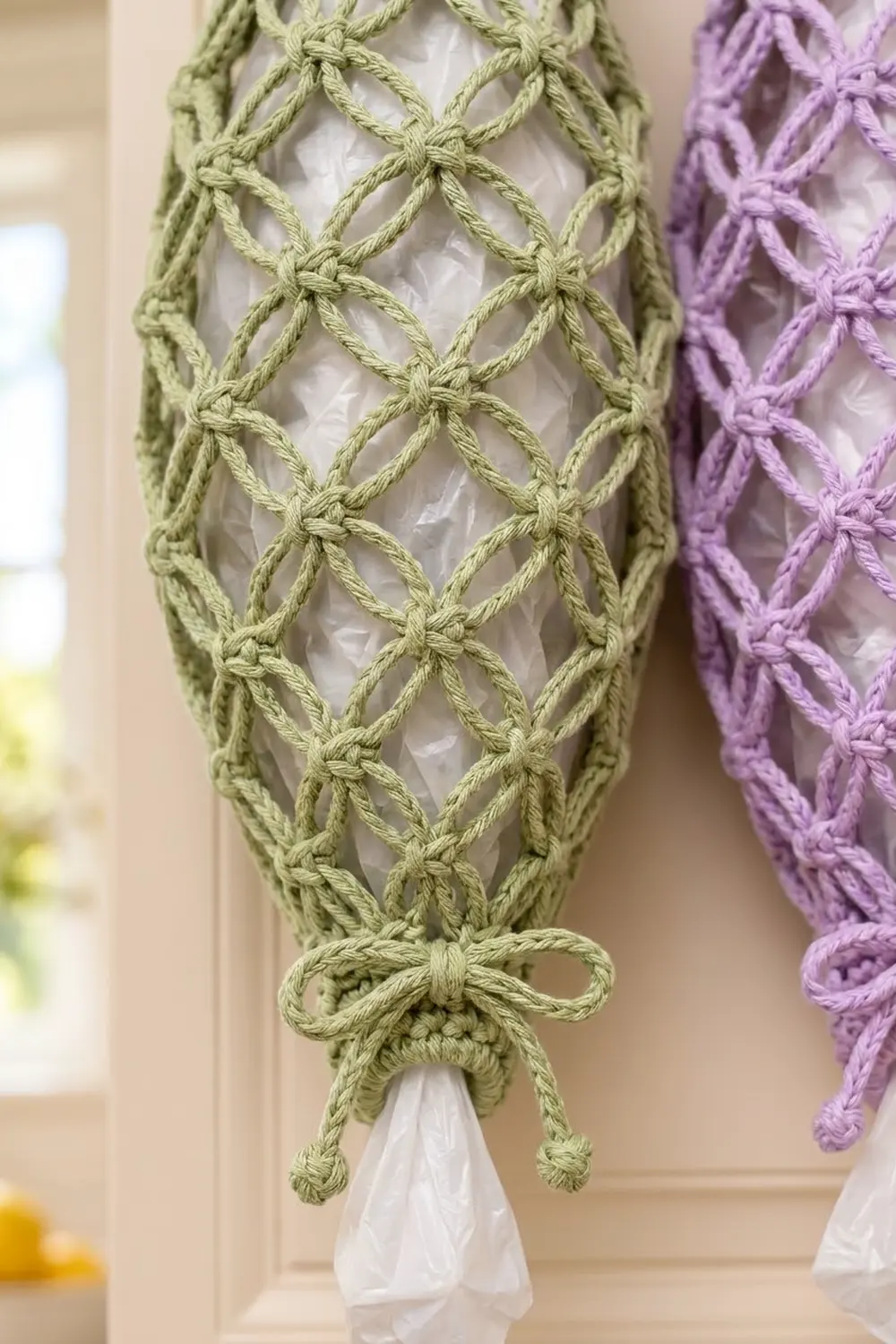
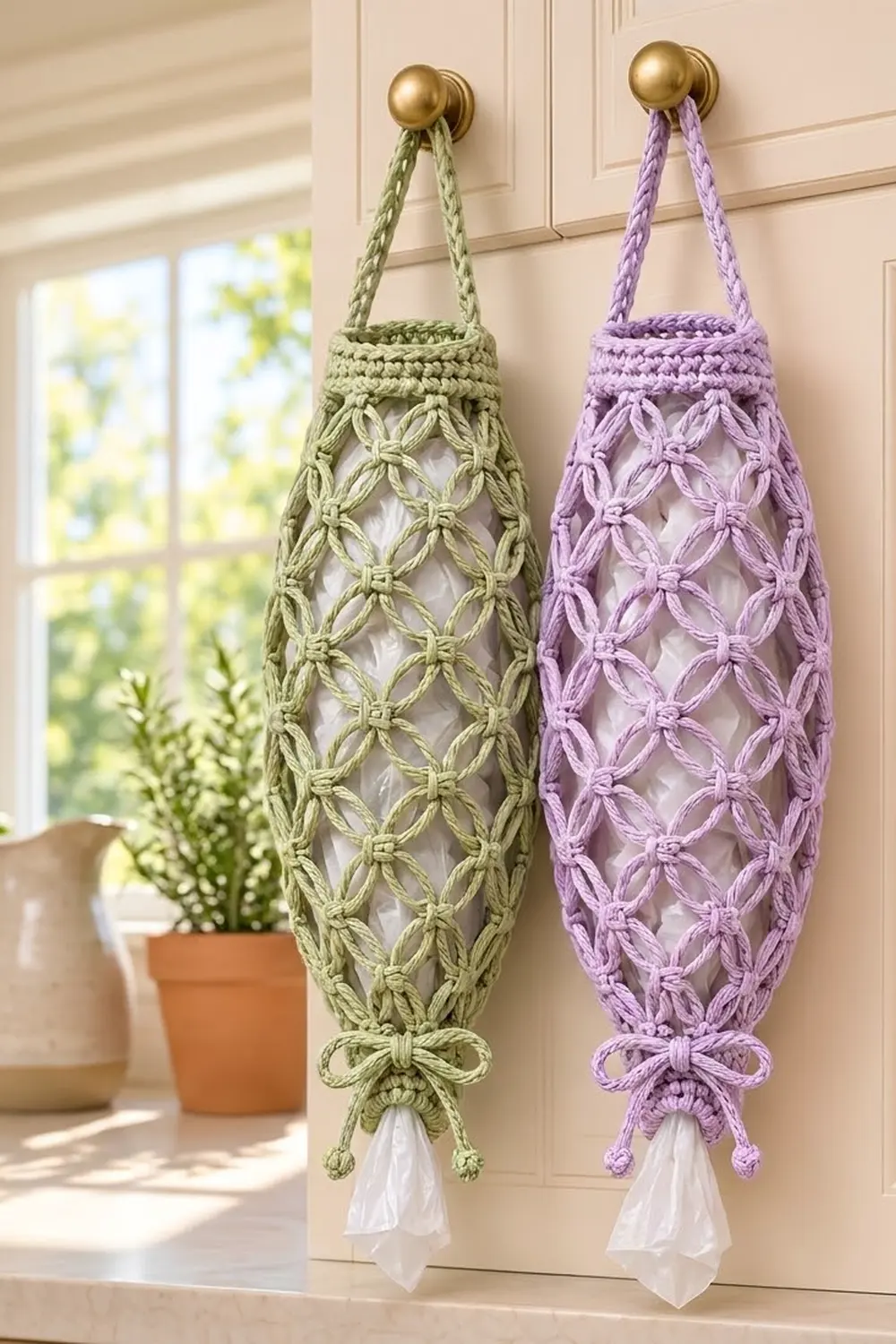
This bag holder tidies up loose plastic bags. Its long cocoon shape is made of open chain loops, and small knots join the loops where they meet, so the mesh looks like rows of overlapping circles. You push bags in through the top and pull them out one at a time through the small ring at the bottom.
The sample is in soft sage green cotton, a calm color that suits a kitchen. A lilac version looks just as good, and the pattern works in any smooth, firm yarn. The style is light and airy, with a solid band at the top, a narrow hanging strap, and a drawstring bow near the bottom.
All instructions use US crochet terms. The finished holder is about 16.75 in (42.5 cm) long without the strap and about 7 in (17.8 cm) wide at its widest when laid flat. With the hanging loop it measures about 21.75 in (55.2 cm).
The holder is worked in one piece from the bottom up. You start with a small sc ring, change to a mesh of knotted chain loops, and make the loops longer and then shorter again to shape the cocoon. You finish with a solid sc band, then add the strap and the drawstring.
Finished Size and Construction
- Finished size: 16.75 in (42.5 cm) long, plus a 5 in (12.7 cm) hanging loop
- Widest flat width: about 7 in (17.8 cm), which is about 14 in (35.6 cm) around
- Skill level: Easy to Intermediate
- Terminology: US
- Yarn weight: Worsted (#4), cotton or a cotton blend
- Hook: 5.0 mm (H-8)
- Number of pieces: 1 body, plus 1 drawstring cord
- Layout: one tube, worked in joined rounds from the bottom up
- Bottom ring: 24 sc around, 6 in (15.2 cm) around, about 1.9 in (4.8 cm) across
- Size before the top band: 15.25 in (38.7 cm) long
- Top band depth: 1.5 in (3.8 cm), 48 sc around, 12 in (30.5 cm) around
Materials
Use a smooth, tightly plied cotton. It shows the knots clearly and holds the loops’ shape, and it won’t stretch out under the weight of the bags. Avoid fuzzy or very soft acrylics, because the mesh will sag.
- Sage green (main color): 150 g, about 300 m (328 yd)
- Optional second holder in lilac: another 150 g, about 300 m (328 yd)
The drawstring and strap are included in the main color amount. All quantities include a margin of about 15%.
Tools:
– 5.0 mm (H-8) crochet hook
– Tapestry needle
– 2 stitch markers
– Scissors
– Measuring tape
– Spray bottle and a rolled towel for blocking
Abbreviations (US Terms)
- ch: chain
- sc: single crochet
- sl st: slip stitch
- st(s): stitch(es)
- sp: space
- Rnd: round
- mk: mesh knot (special stitch)
Special stitch: mesh knot (mk). Work (sc, ch 2, sc) around the center of the chain loop indicated, so the stitches wrap the chain itself. This makes a small, firm bump. The ch-2 sp in the middle of each mk is where the top band attaches later.
Moving to the next loop. At the start of each mesh round, sl st along the previous round until your hook is at the center of the first loop. Each round tells you exactly how many sl sts to make.
Gauge and Checkpoints
Gauge: 16 sc and 16 rnds = 4 in (10.2 cm) in sc worked in rounds.
Mesh gauge, with the holder hanging lightly:
– One round of ch-5 or ch-6 loops is about 0.75 in (1.9 cm) tall.
– One round of ch-7 or ch-8 loops is about 0.875 in (2.2 cm) tall.
– One round of ch-9 loops is about 1 in (2.5 cm) tall.
Test the gauge on the piece itself instead of a separate swatch: work Rnds 1–3 and measure. The ring should be 6 in (15.2 cm) around and 0.75 in (1.9 cm) tall.
- Ring too big: change to a 4.5 mm hook and start again.
- Ring too small: change to a 5.5 mm hook.
Checkpoints, measured hanging:
– After Rnd 3: 0.75 in (1.9 cm)
– After Rnd 7: 4 in (10.2 cm)
– After Rnd 15: 12 in (30.5 cm)
– After Rnd 19: 15.25 in (38.7 cm)
– After Rnd 25: 16.75 in (42.5 cm)
If the mesh comes out long but your sc gauge is correct, you’re pulling your chains loose. Make every loop 1 ch shorter, and keep the knots firm.
Bottom Ring
Ch 24 and join with a sl st into the first ch to form a ring. Make sure the chain isn’t twisted.
Rnd 1: Ch 1, sc in each ch around, then sl st to the first sc to join. (24 sc)
Rnds 2–3: Ch 1, sc in each st around, then join. (24 sc)
The ring should feel firm and curl inward slightly. It forms the round bottom opening that the bags come out of.
Mesh Body
Rnd 4 (conversion round, solid to mesh): Ch 1, sc in the first st. Ch 5, skip 1 st, sc in the next st. Repeat from * 10 more times. Ch 5, skip the last st, and sl st to the first sc to join.
(12 sc + 12 ch-5 loops)
The drawstring goes through these 12 loops at the end. You started with 24 sc: 12 of them now each hold one sc, and the 12 skipped sts sit under the loops.
Rnd 5: Sl st in the next 3 ch to reach the center of the first loop. Ch 1, mk around the same loop. Ch 6, mk around the next loop. Repeat from * 10 more times. Ch 6 and sl st to the first sc to join.
(12 mk + 12 ch-6 loops)
Rnd 6: Sl st in the ch-2 sp, in the next sc, and in the next 3 ch. Ch 1, mk around the same loop. Ch 7, mk around the next loop. Repeat from * 10 more times. Ch 7 and join.
(12 mk + 12 ch-7 loops)
Rnd 7: Sl st in the ch-2 sp, in the next sc, and in the next 3 ch. Ch 1, mk around the same loop. Ch 8, mk around the next loop. Repeat from * 10 more times. Ch 8 and join.
(12 mk + 12 ch-8 loops)
Checkpoint: about 4 in (10.2 cm) long.
Rnd 8: Sl st in the ch-2 sp, in the next sc, and in the next 4 ch. Ch 1, mk around the same loop. Ch 9, mk around the next loop. Repeat from * 10 more times. Ch 9 and join.
(12 mk + 12 ch-9 loops)
Rnds 9–15: Sl st in the ch-2 sp, in the next sc, and in the next 4 ch. Ch 1, mk around the same loop. Ch 9, mk around the next loop. Repeat from * 10 more times. Ch 9 and join.
(12 mk + 12 ch-9 loops in each round)
These 8 rounds of ch-9 loops make the wide middle of the cocoon.
Checkpoint: about 12 in (30.5 cm) long and 7 in (17.8 cm) wide when flat.
Rnd 16: Sl st in the ch-2 sp, in the next sc, and in the next 4 ch. Ch 1, mk around the same loop. Ch 8, mk around the next loop. Repeat from * 10 more times. Ch 8 and join.
(12 mk + 12 ch-8 loops)
Rnd 17: Sl st in the ch-2 sp, in the next sc, and in the next 4 ch. Ch 1, mk around the same loop. Ch 7, mk around the next loop. Repeat from * 10 more times. Ch 7 and join.
(12 mk + 12 ch-7 loops)
Rnd 18: Sl st in the ch-2 sp, in the next sc, and in the next 3 ch. Ch 1, mk around the same loop. Ch 6, mk around the next loop. Repeat from * 10 more times. Ch 6 and join.
(12 mk + 12 ch-6 loops)
Rnd 19: Sl st in the ch-2 sp, in the next sc, and in the next 3 ch. Ch 1, mk around the same loop. Ch 5, mk around the next loop. Repeat from * 10 more times. Ch 5 and join.
(12 mk + 12 ch-5 loops)
Checkpoint: about 15.25 in (38.7 cm) long.
Every knot sits at the center of a loop from the round below, so each round shifts half a loop sideways. This stagger makes the overlapping-circle look. The rounds will spiral slightly, which is normal.
Top Band (Border)
The top band works as this holder’s border. It turns the open mesh back into solid fabric so the rim stays round and stable.
Border gauge: 16 sc = 4 in (10.2 cm), the same as the bottom ring.
Rnd 20 (conversion round, mesh to solid): Sl st in the ch-2 sp of the first mk. Ch 1, sc in the same ch-2 sp, then 3 sc around the next ch-5 loop. Sc in the next ch-2 sp, 3 sc around the next ch-5 loop. Repeat from * 10 more times. Join.
(12 sc worked 1 per knot + 36 sc worked 3 per loop = 48 sc)
Rnds 21–25: Ch 1, sc in each st around, then join. (48 sc in each round)
At the end of Rnd 25, don’t fasten off.
Counts per side: Laid flat, the band has 24 sc across the front and 24 sc across the back, which makes 48 in total. A tube has no corner sts, so nothing is counted twice.
Why the math works:
– Each of the 12 mesh repeats gives exactly 4 sc: 1 in the knot and 3 in the loop.
– So 12 × 4 = 48 sc. At 16 sc per 4 in, that’s 12 in (30.5 cm) around, or 6 in (15.2 cm) across when flat.
– The band is 6 rounds deep (Rnds 20–25). At 16 rounds per 4 in, that’s 1.5 in (3.8 cm).
Hanging Strap
Mark the 4 sts that will be centered at the back of the holder.
Row 1: Ch 1, sc in the next 4 sts, turn. (4 sc)
Rows 2–40: Ch 1, sc in each st across, turn. (4 sc in each row)
The strip should measure 10 in (25.4 cm) long and 1 in (2.5 cm) wide. Fasten off, leaving a 12 in (30.5 cm) tail.
Fold the strip up into a loop. Use the tail to sew the last row to the inside of the band, directly behind Row 1. This makes a 5 in (12.7 cm) hanging loop that rises from one point of the rim.
Drawstring
Ch 100, which is about 25 in (63.5 cm). Sl st in the back bump of the 2nd ch from the hook and in each ch across, for 99 sl sts. Fasten off.
Weave the cord in and out through the 12 ch-5 loops of Rnd 4, starting and ending at the center front. Pull the cord gently so the bottom ring sits neatly, then tie a bow. Tie an overhand knot about 0.5 in (1.3 cm) from each end and trim the tails close.
Final Blocking
- Weave in all ends along the sc rounds, not through the chain loops.
- Spray the whole holder lightly with water until it’s damp but not dripping.
- Roll a bath towel into a cylinder about 14 in (35.6 cm) around and slide it inside the holder.
- Pat the mesh into even diamonds and center each knot between the two loops it holds.
- Make sure the top band is round and measures 12 in (30.5 cm) around.
- Lay the holder flat, or hang it from the strap with the towel still inside, and let it dry completely.
- Remove the towel and retie the bow neatly.
Final Quality-Control Checklist
- [ ] Bottom ring: 24 sc, 6 in (15.2 cm) around
- [ ] Every mesh round has 12 knots and 12 loops
- [ ] Loop lengths run 5, 6, 7, 8, nine rounds of 9, then 8, 7, 6, 5
- [ ] Length before the top band: 15.25 in (38.7 cm)
- [ ] Top band: 48 sc, 6 rounds, 1.5 in (3.8 cm) deep
- [ ] Strap: 4 sc wide, 40 rows, sewn securely to the inside of the band
- [ ] Drawstring goes through all 12 loops of Rnd 4 and the bow has knotted ends
- [ ] Finished length: 16.75 in (42.5 cm), plus a 5 in (12.7 cm) loop
Troubleshooting
The knots slide along the chains. Work each mk around the loop, not into a single chain, and pull both sc firmly.
The mesh twists into a strong spiral. Check that every round starts at the center of the first loop and uses the sl st counts given.
The holder is too short or too wide. Your chains are tight or loose compared with your sc. Adjust the mesh rounds only: go up or down 1 ch per loop.
The top band ruffles. You probably put more than 3 sc in some loops. Recount Rnd 20; it must be exactly 48 sc.
The top band pulls in. Use 2 sc per loop plus 2 sc per knot instead. That still gives 48 sc.
Bags fall straight through the bottom. Pull the drawstring a little tighter before you tie the bow.
The strap stretches. Sew both edges of the strap to the band, not just the last row.
Care
Hand wash in cool water and lay flat to dry, shaping it over a rolled towel. Cotton can be machine washed on a gentle cycle in a mesh bag, but don’t tumble dry it.
Final Notes
The measurements build on each other in this order:
- The bottom ring is 24 sc, which is 6 in (15.2 cm) around and 0.75 in (1.9 cm) tall.
- Rnd 4 turns that into 12 loops.
- Sixteen mesh rounds with loops of 5 to 9 chains grow the tube to 15.25 in (38.7 cm), about 7 in (17.8 cm) wide at the middle.
- Rnd 20 turns the 12 repeats into 48 sc, a 12 in (30.5 cm) rim.
- Six band rounds bring the holder to 16.75 in (42.5 cm).
- The 10 in (25.4 cm) strap folds into a 5 in (12.7 cm) hanging loop.
If you check your measurements at each stage, the finished holder will come out the right size. Happy crocheting!