

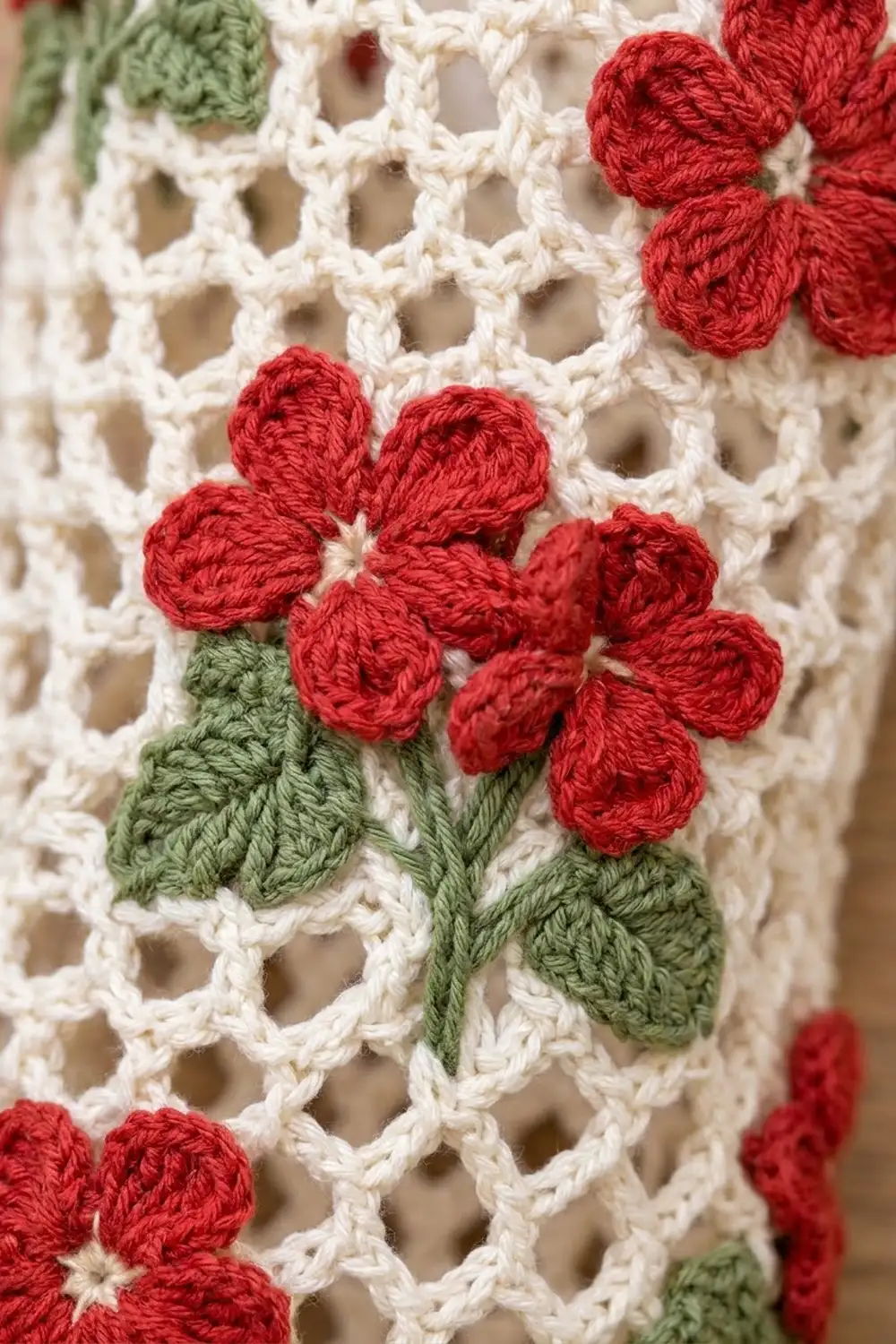
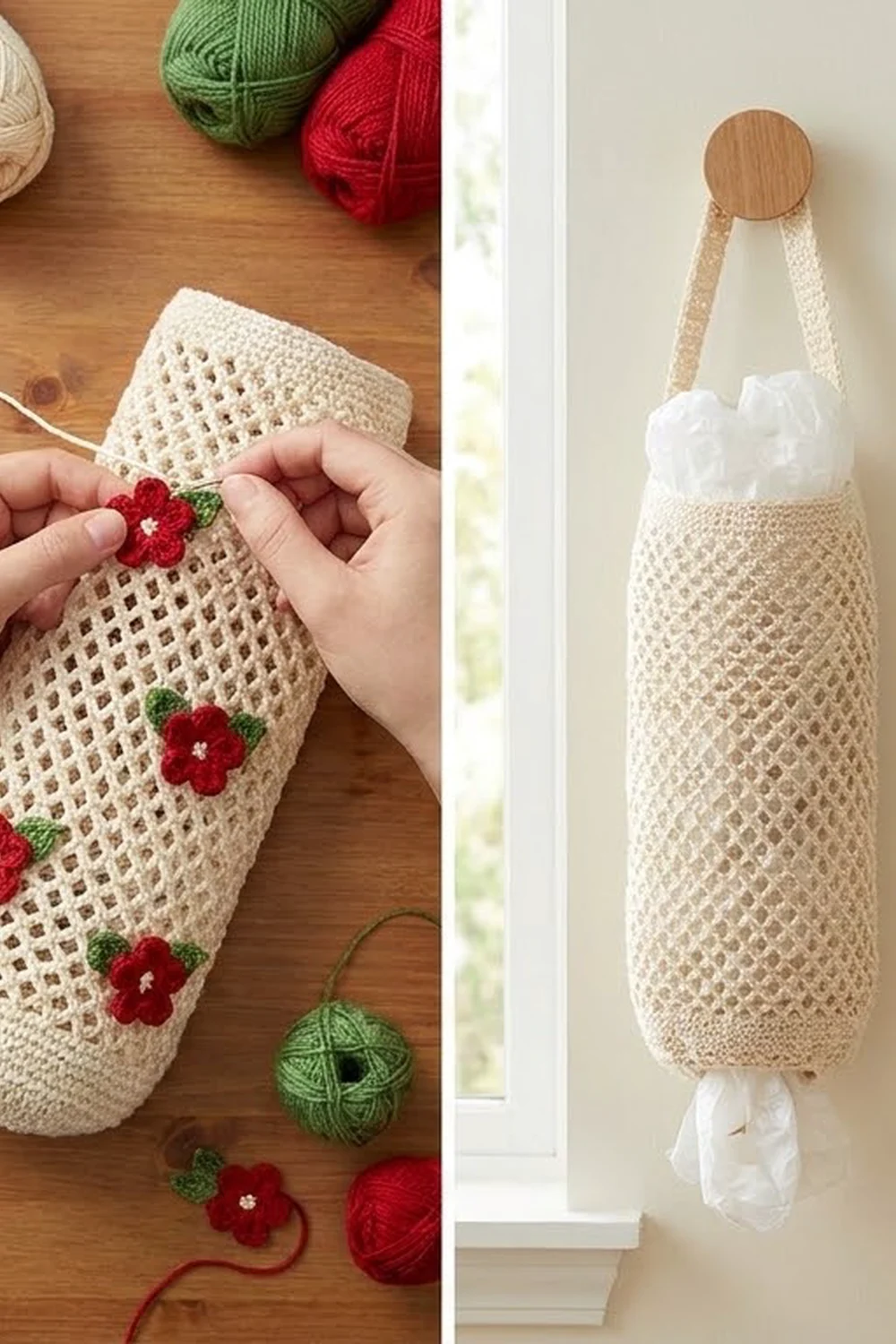
Plastic bags pile up fast. This tall mesh tube keeps them tidy: you push bags in at the top and pull them out one at a time from the bottom. The Geranium Lattice version adds a garden feel, with clusters of small red five-petal flowers and green leaves sewn over an open cream fishnet.
The palette is simple. The body is cream, the flowers are a clear red, and the leaves and stems are a soft sage green. The style is cottage kitchen: bright and fresh without looking busy.
The pattern uses US crochet terms. The finished holder is 16 in (40.6 cm) tall and 8 in (20.3 cm) wide when laid flat. That makes a tube 16 in (40.6 cm) around and about 5 in (12.7 cm) across. The hanging strap rises about 3.5 in (8.9 cm) above the top rim.
The holder is worked from the bottom up with no seams. You chain a ring, work a solid single crochet rim, then switch to a chain-5 fishnet mesh for the body. A matching solid rim closes the top, and a single crochet strap arches across the opening. Last, you make small flowers, leaves, and stems and sew them on in clusters.
Finished Size and Construction
- Finished size: 16 in (40.6 cm) tall x 8 in (20.3 cm) wide, laid flat
- Circumference: 16 in (40.6 cm); diameter about 5 in (12.7 cm)
- Skill level: Easy intermediate
- Terminology: US crochet terms
- Yarn weight: Worsted (#4) cotton
- Hook: 5.0 mm (H-8)
- Number of pieces: 1 main body (a tube with the strap attached), plus 30 flowers, 20 leaves, and 10 stems sewn on as appliqués
- Layout: 10 flower clusters in 4 vertical columns around the tube
- Size before the top rim: 14.9 in (37.8 cm) tall
- Top rim (border) depth: 1.1 in (2.8 cm)
Materials
Use a smooth worsted-weight cotton or cotton blend with about 85 m per 50 g. Cotton holds its shape when bags are stuffed inside and won’t stretch out over time. Avoid fuzzy yarns, because both the mesh and the flowers need crisp stitches.
- Cream (body, strap, flower centers): 100 g, about 170 m
- Red (flowers): 35 g, about 60 m
- Green (leaves and stems): 20 g, about 34 m
All quantities include a safety margin of about 15 percent.
Tools:
– 5.0 mm (H-8) crochet hook
– Tapestry needle
– 4 stitch markers
– Scissors
– Measuring tape
– Pins with large heads
– Spray bottle for blocking
– A piece of flat cardboard about 7 in (17.8 cm) wide
Abbreviations (US Terms)
- ch – chain
- sl st – slip stitch
- sc – single crochet
- hdc – half double crochet
- dc – double crochet
- st(s) – stitch(es)
- sk – skip
- rep – repeat
- RS – right side
- Rnd – round
Special stitch: Mesh closing loop. At the end of each mesh round, ch 2, then dc in the first sc of the round. The ch-2 plus the dc is the same height as a ch-5 loop. It also leaves your hook at the top center of that loop, ready for the next round.
Gauge and Checkpoints
Single crochet gauge: 16 sts and 18 rows = 4 in (10.2 cm).
Mesh gauge: 4 ch-5 loops = 4 in (10.2 cm) wide, and 5 mesh rounds = 3 in (7.6 cm) tall. Each mesh round adds about 0.6 in (1.5 cm).
Test first. Make one flower and one leaf before you start the body. The flower should measure about 1.75 in (4.4 cm) across. The leaf should be about 1.5 in (3.8 cm) long and 0.75 in (1.9 cm) wide. Then work Rnds 1–5 of the body and use them as your real gauge swatch.
Checkpoints:
– After Rnd 5: the tube lies flat at 8 in (20.3 cm) wide and is 1.1 in (2.8 cm) tall.
– After Rnd 15: total height is 7.1 in (18.0 cm).
– After Rnd 28: total height is 14.9 in (37.8 cm).
– After Rnd 33: total height is 16 in (40.6 cm).
If your piece is too big: go down 0.5 mm in hook size. If it’s too small: go up 0.5 mm. Being off by 0.25 in (0.6 cm) at a checkpoint is fine. A bigger difference will add up over 33 rounds.
Body
Bottom Rim
With cream, ch 64. Join with a sl st to the first ch, taking care not to twist the chain.
Rnd 1: Ch 1, sc in each ch around, sl st to first sc. (64 sc)
Rnds 2–5: Ch 1, sc in each sc around, sl st to first sc. (64 sc)
Place a marker in the first st of Rnd 5. When the tube is laid flat, you’ll have 32 sts across the front and 32 across the back.
Mesh Body
Rnd 6 (mesh setup): Ch 1, sc in first st, *ch 5, sk 3 sts, sc in next st; rep from * 14 more times, ch 2, sk last 3 sts, dc in first sc. (16 sc and 16 loops: 15 ch-5 loops plus 1 closing loop)
Check the math: the sc anchors land on sts 1, 5, 9, and so on up to st 61. That gives 16 anchors, and sts 62–64 are skipped under the closing loop.
Rnds 7–27: Ch 1, sc in the closing loop just made, *ch 5, sc in next ch-5 loop; rep from * 14 more times, ch 2, dc in first sc. (16 sc, 16 loops)
Each round shifts half a loop over from the round below, which makes the diamond fishnet. Don’t try to straighten it. If you lose a loop, the round will look visibly uneven, so count the loops after every few rounds.
Rnd 28 (final mesh round): Ch 1, sc in the closing loop, *ch 5, sc in next ch-5 loop; rep from * 14 more times, ch 5, sl st to first sc. (16 sc, 16 ch-5 loops)
This last round closes with a full ch-5 so the top rim starts level. The body is now 14.9 in (37.8 cm) tall.
Flowers, Leaves, and Stems
Flower (make 30)
With red, make a magic ring.
Rnd 1: Ch 1, 10 sc in ring, sl st to first sc. Pull the ring closed. (10 sc)
Rnd 2: *(Ch 2, 3 dc, ch 2, sl st) in next sc, sl st in next sc; rep from * 4 more times. (5 petals)
Fasten off, leaving a 10 in (25.4 cm) tail for sewing. With cream, work one French knot in the center, wrapping the yarn twice.
Leaf (make 20)
With green, ch 7.
Sl st in 2nd ch from hook, sc in next ch, hdc in next ch, dc in next ch, hdc in next ch, sc in last ch. Ch 1 for the tip. Working along the other side of the foundation chain: sc in first ch, hdc in next ch, dc in next ch, hdc in next ch, sc in next ch, sl st in last ch. (12 sts plus the tip ch)
Fasten off, leaving a 10 in (25.4 cm) tail.
Stem (make 10)
With green, ch 7. Fasten off, leaving an 8 in (20.3 cm) tail. The stem is about 1.25 in (3.2 cm) long.
Border: Top Rim and Strap
The top rim mirrors the bottom rim. It turns the 16 mesh loops back into a solid band of 64 sts.
Border gauge: same as the body, 16 sc and 18 rounds = 4 in (10.2 cm).
Rnd 29 (conversion): Ch 1, sc in same sc as join, 3 sc in next ch-5 loop, *sc in next sc, 3 sc in next ch-5 loop; rep from * 14 more times, sl st to first sc. (16 sc worked 1 per existing sc + 48 sc worked into 16 loops = 64 sc)
Rnds 30–33: Ch 1, sc in each sc around, sl st to first sc. (64 sc)
Laid flat, the rim has 32 sts across the front and 32 across the back. A tube has no corners, so you don’t add any corner stitches. Fasten off.
Why the math works: in Rnd 6, each mesh repeat used up 4 sts of the bottom rim (1 anchor sc plus 3 skipped sts). In Rnd 29, each repeat gives back 4 sts (1 sc on the anchor plus 3 sc in the loop). That’s 16 x 4 = 64, the same as the bottom rim. Both openings measure 8 in (20.3 cm) flat, so the tube doesn’t flare out or pull in.
Hanging Strap
Lay the tube flat with the Rnd 33 join at one folded edge. Mark st 1 and st 33, which sits directly opposite.
Row 1: With RS facing, join cream in st 1, ch 1, sc in sts 1–5. (5 sc)
Rows 2–45: Ch 1, turn, sc in each sc across. (5 sc)
The strap is 1.25 in (3.2 cm) wide and 10 in (25.4 cm) long. Without twisting it, bring the free end across the opening and whipstitch Row 45 to sts 33–37. The arch rises about 3.5 in (8.9 cm) above the rim.
Assembling the Flower Clusters
Each cluster uses 3 flowers, 2 leaves, and 1 stem, and measures about 3 in (7.6 cm) wide and 3.5 in (8.9 cm) tall.
Column placement: Number the ch-5 loops of Rnd 28 from 1 to 16, starting under the strap. Put markers on loops 1, 5, 9, and 13. They are 4 in (10.2 cm) apart and mark 4 columns running straight down the tube.
- Front column (loop 5): clusters centered on Rnds 9, 17, and 25.
- Back column (loop 13): clusters centered on Rnds 9, 17, and 25.
- Side columns (loops 1 and 9): clusters centered on Rnds 13 and 21.
Clusters in the front and back columns are 4.8 in (12.2 cm) apart. The side clusters fall halfway between them, so no two clusters touch.
Layering order, from the bottom layer up:
1. Sew the stem on vertically, with its top end at the cluster center.
2. Sew one leaf on each side of the top of the stem, angled down and outward.
3. Sew the lower flower centered over the bases of the leaves.
4. Sew two upper flowers side by side above it. They overlap each other by 0.5 in (1.3 cm) and overlap the lower flower by 0.25 in (0.6 cm).
Slide the cardboard inside the tube while you sew so you never catch the back wall. Tack down each petal tip and the flower center through the mesh strands. Weave in the ends on the inside.
Final Blocking
- Mist the whole holder with water until it is damp but not soaked.
- Slide a rolled towel or a bottle about 5 in (12.7 cm) wide into the tube.
- Ease the mesh until the diamonds look even all the way around.
- Flatten each rim and check that it measures 8 in (20.3 cm) flat.
- Pin the strap straight along its full length.
- Press each petal and leaf flat with your fingers.
- Let it dry completely, 12–24 hours, before removing the form.
Final Quality-Control Checklist
- The bottom and top rims each have 64 sts.
- Every mesh round has 16 loops.
- The height is 16 in (40.6 cm), not counting the strap.
- Both rims lie flat at 8 in (20.3 cm).
- The strap is untwisted and centered across the opening.
- All 10 clusters are in place: 3 front, 3 back, and 2 on each side.
- Each flower has 5 even petals and a cream center.
- No appliqué stitch goes through both walls of the tube.
- All ends are woven in on the inside.
Troubleshooting
The top rim flares out: you probably added extra sts in Rnd 29. Recount to 64.
The top rim pulls in: 3 sc per loop may be too tight. Work Rnd 29 only with a hook 0.5 mm larger.
The mesh looks slanted: this is normal for fishnet worked in the round. Blocking over a form evens it out.
You lose count of loops: place a marker in the first sc of each mesh round.
The petals are floppy: use a hook 0.5 mm smaller for the flowers.
Bags slide out on their own: weave a 12 in (30.5 cm) cream chain through Rnd 1 and cinch it slightly, leaving room to pull bags through.
The strap stretches: work a row of surface sl sts along each long edge of the strap.
Care
Hand wash in cool water with mild soap. Lay flat to dry, reshaping it over a towel roll. Don’t use the dryer, which can shrink cotton and distort the flowers.
Final Notes
Here’s how the measurements build on each other. The bottom rim sets the width at 64 sts, or 8 in (20.3 cm) flat. The mesh turns those 64 sts into 16 loops and adds 0.6 in (1.5 cm) of height per round, reaching 14.9 in (37.8 cm). The top rim turns the 16 loops back into 64 sts and adds 1.1 in (2.8 cm), for a finished height of 16 in (40.6 cm). The 10 in (25.4 cm) strap arches 3.5 in (8.9 cm) above the rim. If you hit each checkpoint, the flower clusters will line up as planned.
Happy crocheting!